
 View Products


Last updated: September 3, 2026
By Swordfish.ai Editorial Team (RevOps-style procurement review)
Who this is for
- Outbound teams, including healthcare-focused sales and recruiting groups, that can identify targets in LinkedIn but lose time when it’s time to reach them.
- RevOps and admins who have to clean up duplicates, field overwrites, and broken routing after enrichment.
- Buyers who want an audit trail for the decision, not a sales demo.
Quick Verdict
- Core Answer
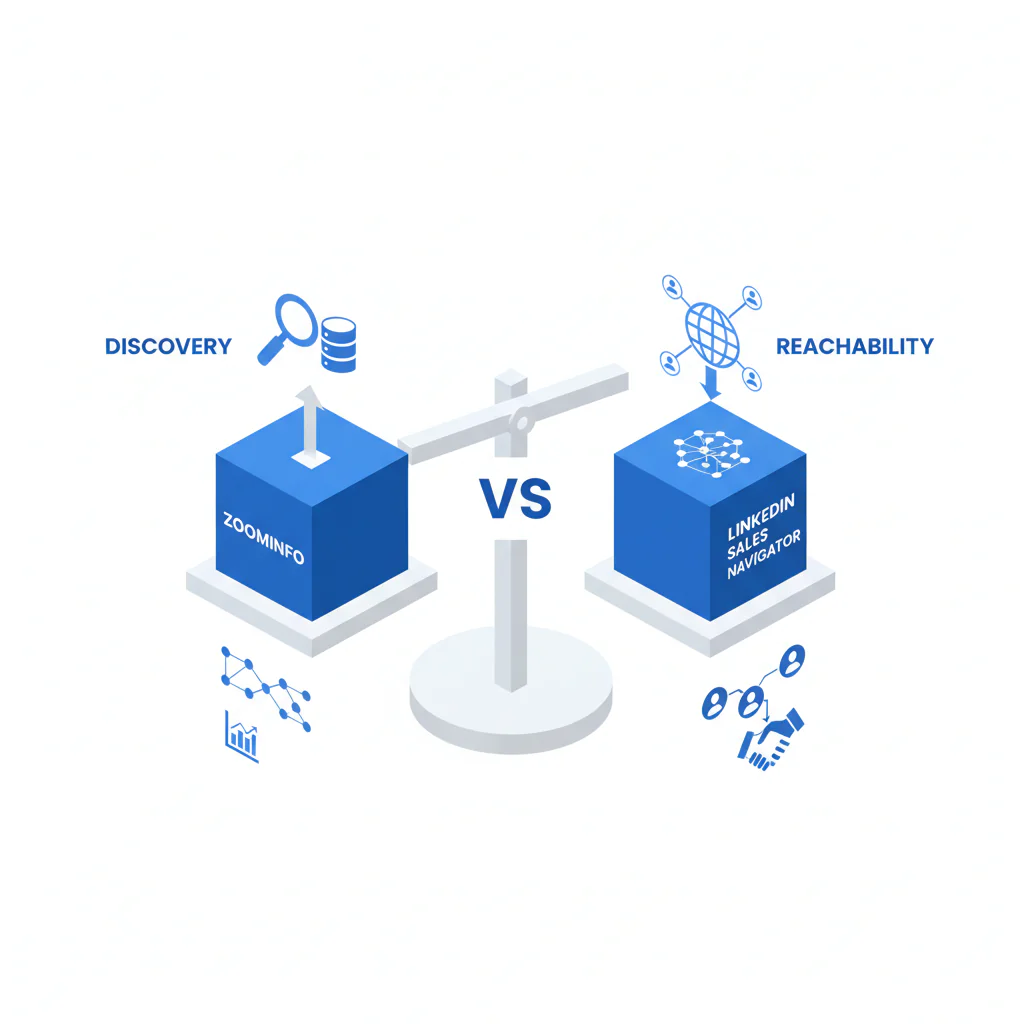
- In the ZoomInfo vs LinkedIn Sales Navigator decision, treat Sales Navigator as discovery (who to target) and a contact data provider as reachability (how to contact them). Force one tool to do both jobs and you pay for it in rework across the workflow.
- Key Stat
- Sales Navigator = discovery; contact data = reachability.
- Ideal User
- Teams that measure success by connects, bounces, and replies, then fix the stage that fails.
- If you only buy one: buy discovery if wrong-person targeting is the dominant issue; buy reachability if you already know the right people but cannot contact them.
- Stop scaling if enrichment is creating duplicates or overwriting fields you trust, because you are building permanent operational debt.
Framework: discovery vs reachability
This is a discovery vs reachability problem inside a real outbound workflow, and it shows up the same way whether you’re prospecting software buyers or trying to reach a physician or practice administrator.
- Discovery: identify the correct person at the correct account with enough context to prioritize.
- Reachability: obtain working channels (deliverable email and/or working phone) so outreach can happen without manual hunting.
The predictable failure is treating discovery output as outreach-ready. That produces bounced emails, wrong numbers, CRM duplicates, and reporting that can’t be trusted.
ZoomInfo vs LinkedIn Sales Navigator: what each tool is (audit definition)
LinkedIn Sales Navigator is a discovery system anchored on LinkedIn identity and context. It helps you decide who should be on the list, and its underlying data stays fresh because it draws from LinkedIn’s professional network, where members maintain their own profiles, which produces strong identity accuracy, and title and company data tend to stay current. What it doesn’t give you is a way to call or email that person directly: Sales Navigator surfaces LinkedIn profiles with titles and company names, but no direct phone numbers or verified business email addresses at any tier.
ZoomInfo is typically procured to close that gap. It appends contact fields and company attributes so a list can actually be worked through calls and emails, and vendors generally position it as the reachability layer that complements rather than replaces the LinkedIn graph.
LinkedIn InMail can be a channel, but it does not substitute for phone/email reachability when your workflow requires dialing and sequencing outside LinkedIn.
Where LinkedIn Sales Navigator fits (discovery-first)
- Best use: build lists based on identity and org context, then hold the list stable long enough to test outcomes.
- Hidden cost: handoffs into systems that demand email/phone fields, which pushes reps into manual workarounds.
- Failure mode: “We found them on LinkedIn so we can reach them,” followed by outreach that never connects.
Where ZoomInfo fits (reachability-first)
- Best use: enrichment at scale after you’ve validated discovery criteria.
- Hidden cost: integration governance, because bulk updates can create permanent cleanup work.
- Failure mode: a fast sync that dumps questionable fields into CRM, then forces downstream cleanup and retraining.
Integration failure modes (what usually breaks in the workflow)
- Duplicate creation: records split because matching keys weren’t enforced (name + company is not a key; LinkedIn URL is closer to one).
- Field overwrites: enrichment overwrites a previously verified email/phone with an older or lower-confidence value because write rules were left on default.
- Routing damage: lead assignment and sequences break when territory logic relies on fields enrichment changes or blanks.
- Audit loss: nobody can answer “where did this field come from and when was it last verified,” so disputes turn into opinions.
How to test with your own list (5–8 steps)
- Pick one ICP slice and export a small, representative lead sample from Sales Navigator.
- Normalize identity fields in your CSV: first name, last name, company, title, country, and LinkedIn URL.
- Enrich the list in your reachability tool and export the results as a separate file before anything touches CRM.
- Verify email deliverability using a verifier or controlled sending outcomes and label each record usable/not usable.
- Call a subset and log dispositions (connected, voicemail, wrong person, disconnected) so phone reachability is measured.
- Compute outcomes per segment: reachable (any working channel) vs usable (correct person + working channel).
- Repeat with a second ICP slice where titles or regions differ to expose variance.
- Decide what failed first: discovery, reachability, or governance.
Audit artifacts to retain:
- Date-stamped Sales Navigator CSV export (discovery source of truth).
- Enrichment output export (what the tool returned that day).
- Email verification log (what was deliverable vs not).
- Call disposition log (what connected vs wasted dials).
Checklist: Feature Gap Table
| Audit Area | LinkedIn Sales Navigator (Discovery) | ZoomInfo (Reachability) | Hidden Cost if you ignore it |
|---|---|---|---|
| Identity confidence | Strong for who the person is and where they work | Matching quality depends on keys and sync rules | Duplicates, split histories, and reporting noise |
| Direct outreach fields | Not designed as a direct dial/email system of record | Often used to append email/phone fields for outreach | Manual searching and inconsistent playbooks |
| Data decay controls | Profiles change when users update | Fields age; you need verification gates | Bounces, wrong numbers, and wasted rep time |
| CRM hygiene | List export can be clean if you retain LinkedIn URL | Bulk sync can contaminate CRM if unchecked | Cleanup projects nobody budgets for |
| Outcome measurement | Good for tracking targets and org changes | Should be judged by connect rate (percent of dials that reach a human) and replies | Buying based on record counts instead of outcomes |
Decision Tree: Weighted Checklist
This weighting follows standard failure points in outbound: wrong targets, unreachable targets, duplicate creation, and unmeasured outcomes.
- Highest priority: enforce an identity key (store LinkedIn URL) before enrichment and CRM sync to reduce duplicate creation.
- Highest priority: add verification gates before bulk sync (email verification plus call sampling) so bad fields don’t become “truth” in CRM.
- Medium priority: instrument outcomes by stage (discovery → enrichment → outreach) so you can attribute failure to targeting vs reachability.
- Medium priority: define write rules so enrichment cannot overwrite higher-confidence fields without evidence.
- Lower priority: extra filters and UI preferences unless they reduce wrong-person targeting enough to change outcomes.
Troubleshooting Table: Conditional Decision Tree
- If discovery is clean but outreach fails, treat it as a reachability problem and add enrichment plus verification gates.
- If reachability fields exist but connect rate (percent of dials that reach a human) and replies stay low, treat it as a discovery problem and tighten targeting before enriching more records.
- If enrichment produces duplicates or overwrites good fields, treat it as a governance problem and stop bulk sync until keys and write rules are enforced.
- Stop Condition: stop scaling any tool until you can produce an audit pack for one segment (source CSV, enrichment output, verification log, outreach outcomes) that explains the failure in the workflow.
What Swordfish does differently
- Ranked mobile numbers / prioritized dials: when multiple numbers exist, Swordfish prioritizes the ones more likely to connect so reps spend fewer attempts on dead ends.
- True unlimited / fair use: reduces credit-hoarding behavior that leads to under-enrichment and manual workarounds.
Swordfish is a reachability layer; LinkedIn remains the discovery layer in the workflow. For teams working healthcare provider outreach specifically, that split matters more, not less, because provider mobile numbers and direct emails change with practice moves and affiliations more often than titles on a LinkedIn profile do.
If you run discovery in LinkedIn, the Swordfish Chrome Extension is designed to shorten the enrichment step so the process stays consistent.
Teams that want a direct reachability comparison often start with ZoomInfo vs Swordfish. Teams standardizing LinkedIn sourcing steps typically use LinkedIn prospecting tools to reduce manual handling.
Evidence and trust notes
- Scope: this is a procurement comparison using discovery vs reachability; it does not claim any vendor’s absolute accuracy.
- Validation method: use the test plan above and retain artifacts so results can be audited later.
- Variance explainer: outcomes change by region, persona, and how your integrations map and overwrite fields.
- Freshness: Last updated Jan 2026.
Procurement acceptance criteria (qualitative):
- Exportability: you can export enrichment outputs with timestamps and identifiers.
- Governance: you can control overwrite behavior and matching keys before CRM sync.
- Audit trail: fields have source and recency indicators, even if they’re just internal logs.
- Measurement: you can tie enrichment passes to outreach outcomes by segment.
- Compliance handling: you can honor opt-outs and remove records when required.
For policy constraints that affect outbound workflow, review LinkedIn’s User Agreement, the California Consumer Privacy Act (CCPA) overview, and the GDPR.eu guidance portal.
FAQs
Do I need both tools?
If you use LinkedIn to identify the right stakeholders and you also need reliable outreach fields, the standard split is Sales Navigator for discovery and a contact data provider for reachability. If you only buy one, decide which failure mode costs you more: wrong targets (discovery) or unreachable targets (reachability).
Is Sales Navigator enough for phone numbers?
Sales Navigator is designed for discovery inside LinkedIn, not for supplying direct dials. If calling is part of your workflow, you typically need enrichment from a contact data provider and a verification step before outreach.
What is reachability?
Reachability is whether a lead can be contacted through a working channel (deliverable email and/or working phone) with acceptable error rates, measured by outcomes like connects, bounces, and replies.
How do I enrich Sales Nav lists?
Export your Sales Navigator leads to CSV (keeping LinkedIn URL as an identity key), enrich in your contact data tool, verify emails, sample calls, then sync only verified records to CRM with strict matching and write rules.
What’s the best workflow?
Use discovery → enrichment → verification → outreach, then log outcomes back to the source segment so you can attribute failures to targeting, reachability, or governance.
Implementation Notes
- Tables/visuals to add: a one-page workflow diagram showing discovery → enrichment → verification → outreach, with the required artifacts at each handoff.
- Tables/visuals to add: a CSV template visual with required columns (LinkedIn URL, name, company, title, region, email, phone label, verification status, last verified date).
Compliance note
Follow platform terms and use contact data for legitimate, compliant outreach.
Next steps (timeline)
- Today: pick one segment in Sales Navigator and export a dated CSV with LinkedIn URLs.
- This week: enrich, verify, and run a small call/email sample, logging outcomes by disposition.
- Next week: lock write rules, define identity keys, and scale only the step that passed audit.
Primary CTA: Export Leads to CSV & Enrich
Secondary CTA: Install the Chrome Extension
About the Author
Ben Argeband is the Founder and CEO of Swordfish.ai and Heartbeat.ai. With deep expertise in data and SaaS, he has built two successful platforms trusted by over 50,000 sales and recruiting professionals. Ben’s mission is to help teams find direct contact information for hard-to-reach professionals and decision-makers, providing the shortest route to their next win. Connect with Ben on LinkedIn.