

 View Products


Last updated: September 3, 2026
Lusha remains one of the more recognizable names in B2B contact data, and its pricing has shifted noticeably over the past couple of years. The vendor now runs a credit-slider model across five plans instead of the simpler flat-rate structure it used previously, which means the price you see depends heavily on how many credits you select, not just which tier you pick.
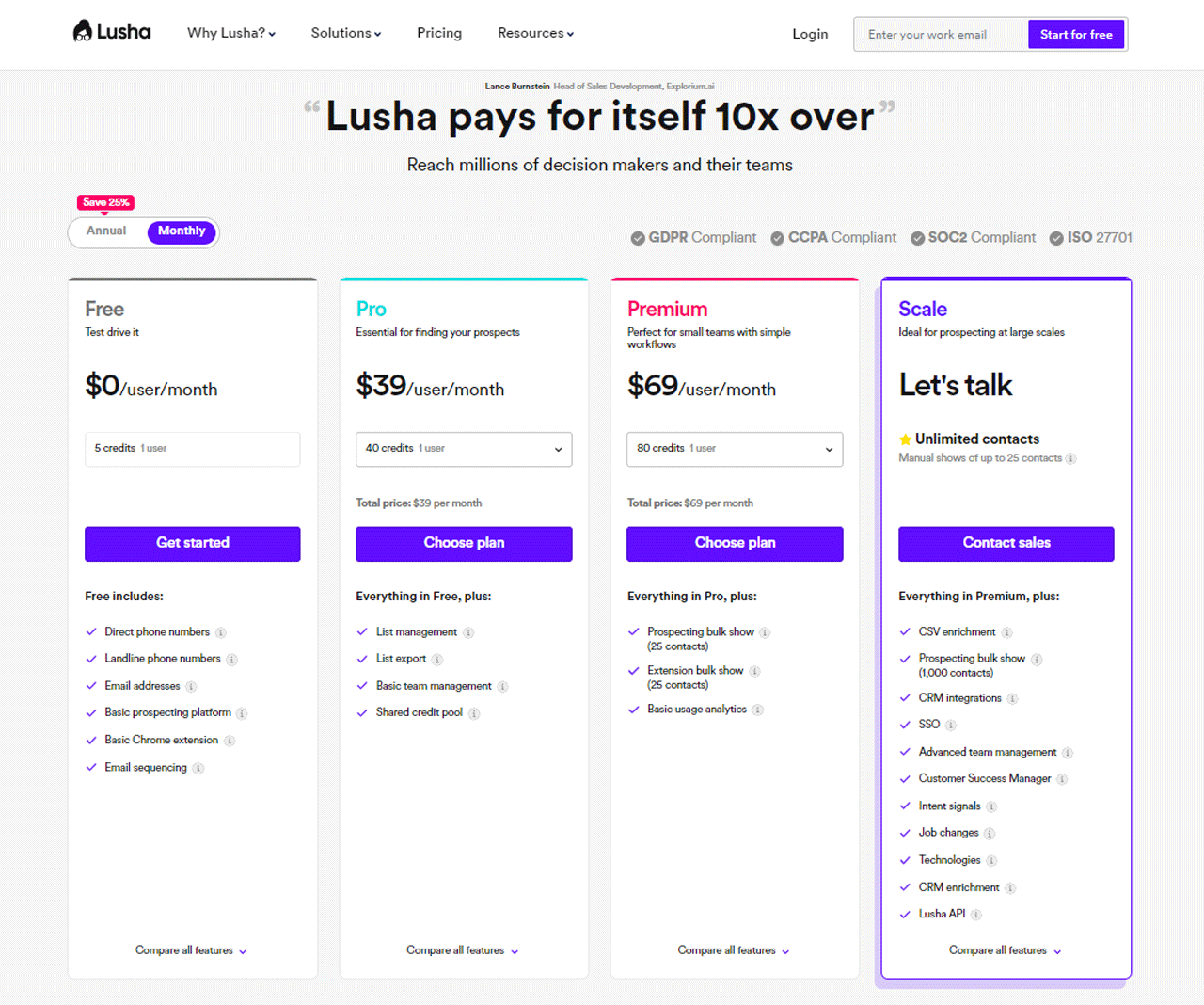
Lusha’s current lineup starts with a Free plan offering credits for basic lookups, then moves through Starter, Pro, and Premium tiers priced on a slider, with a custom Scale plan for larger teams. Because Lusha frequently runs promotional annual-billing discounts and adjusts credit allocations by plan, the numbers below should be treated as a snapshot rather than a fixed price list. Always confirm current figures on Lusha’s own pricing page before budgeting.
Key Takeaways
- Free Plan: A no-cost tier with a monthly credit allowance for a single user, meant for testing data quality rather than running a full prospecting motion.
- Starter and Pro Plans: Entry paid tiers priced per seat with a credit slider, so cost rises as you select a larger annual credit pool. Both include the Chrome extension, CRM export, and list management.
- Premium Plan: A higher-volume tier bundling multiple seats, a larger credit pool, and more advanced filters and integrations, priced well above the entry tiers.
- Scale Plan: Custom pricing for large teams, negotiated around total credit volume, API usage, and contract length.
What is Lusha?
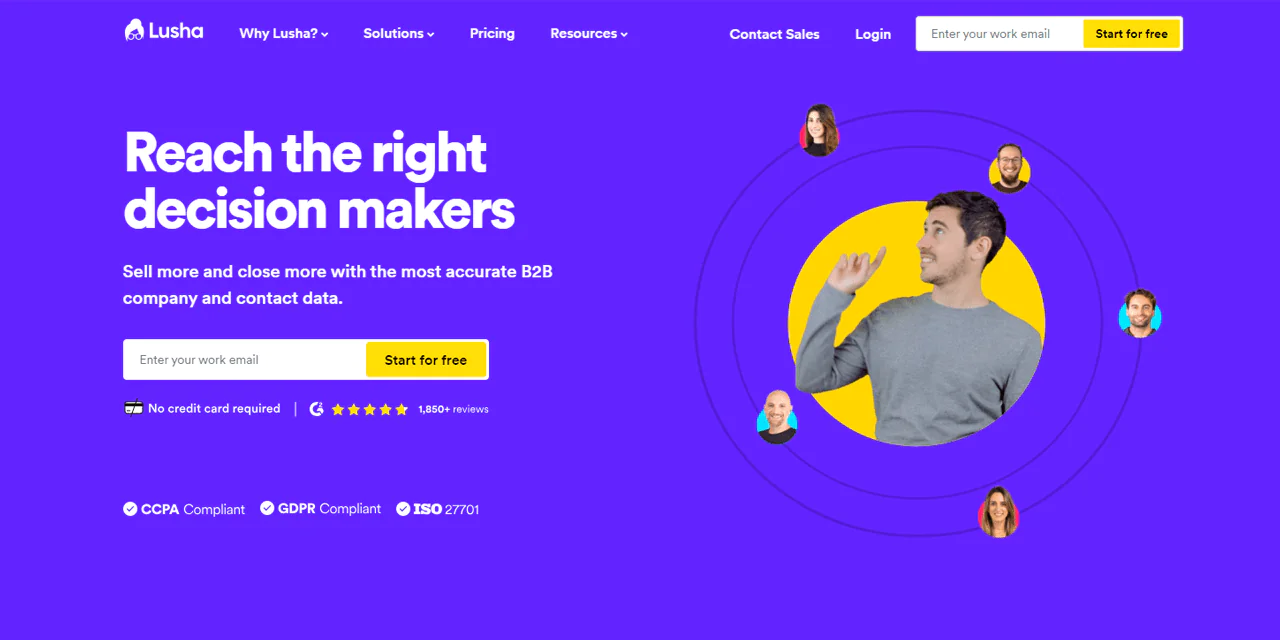
Lusha launched in 2016 with a straightforward goal: help B2B sales teams find accurate contact details for the people and companies they’re trying to reach. The platform pairs a large contact database with a browser extension and web app, so reps can look up emails and phone numbers without leaving LinkedIn, a CRM, or a company website.
Lusha built its reputation on ease of use and a reasonably large database of business professionals and companies, and it’s commonly used for lead generation, sales prospecting, and marketing list building. Sales teams of varying sizes, from solo recruiters to larger revenue teams, use it as one input into their prospecting stack rather than a full sales platform replacement.
Features of Lusha
Lusha’s platform is packed with features to improve B2B contact management and lead generation. Here’s what it offers.
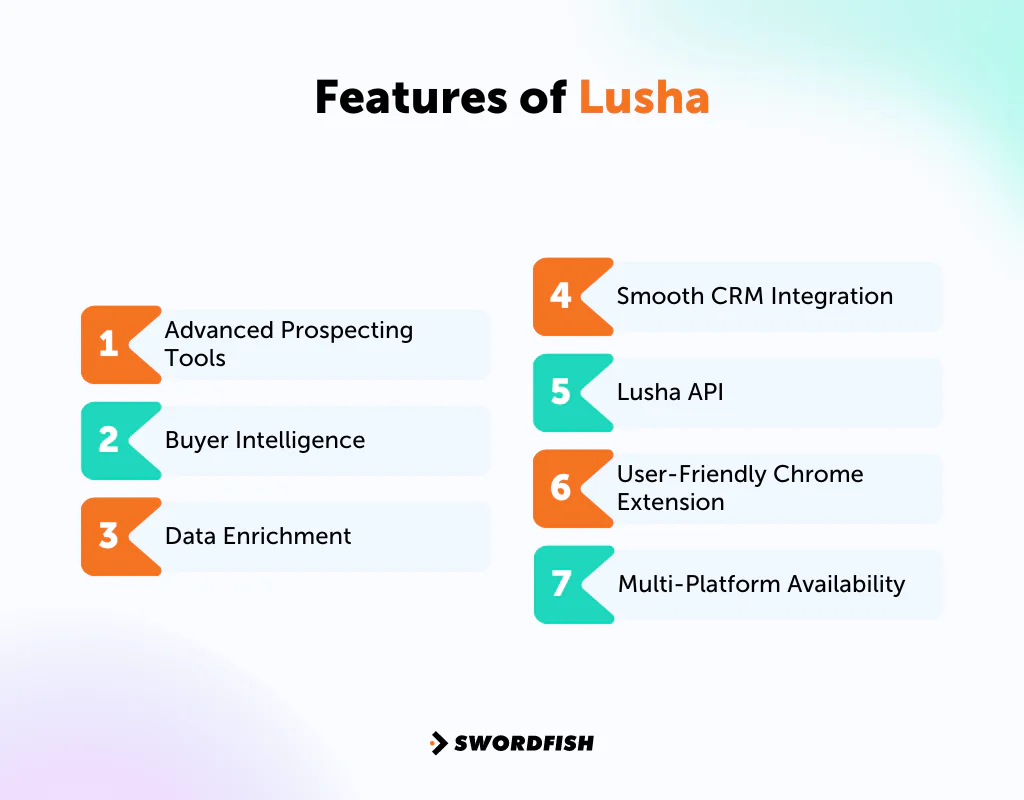
Advanced Prospecting Tools
Lusha’s prospecting tools help you build targeted lists of potential leads. Using this B2B prospecting tool, you can identify and reach out to leads more systematically instead of working from scattered contact lists.
Buyer Intelligence
Lusha’s Buyer Intelligence layer gives you signals about a company’s activity and intent, which can help you time outreach and tailor messaging to what a prospect actually cares about right now rather than a generic pitch.
Data Enrichment
Lusha can fill in gaps in your existing contact records. That matters because stale or incomplete records are one of the most common reasons outbound campaigns underperform, regardless of how good the messaging is.
Smooth CRM Integration
Lusha integrates with popular CRM systems like Salesforce, HubSpot, and Zoho. You can keep contact information current, enrich data, and push new records directly into your existing workflows.
Lusha API
The Lusha API lets you pull contact and company data directly into custom applications or internal tools, which is useful if you need to enrich records at a scale that manual lookups can’t support.
User-Friendly Chrome Extension
Lusha’s Chrome extension provides quick access to its data right from the browser. It functions as an email extractor that works across LinkedIn profiles, company sites, and CRM records.
Multi-Platform Availability
Lusha is available as both a web app and a Chrome extension, so it fits into different working setups depending on how your team prefers to prospect.
Key Benefits of Lusha
Lusha, a B2B contact data provider, offers a range of advantages for businesses looking to improve their sales and marketing strategies. Here are some key benefits.
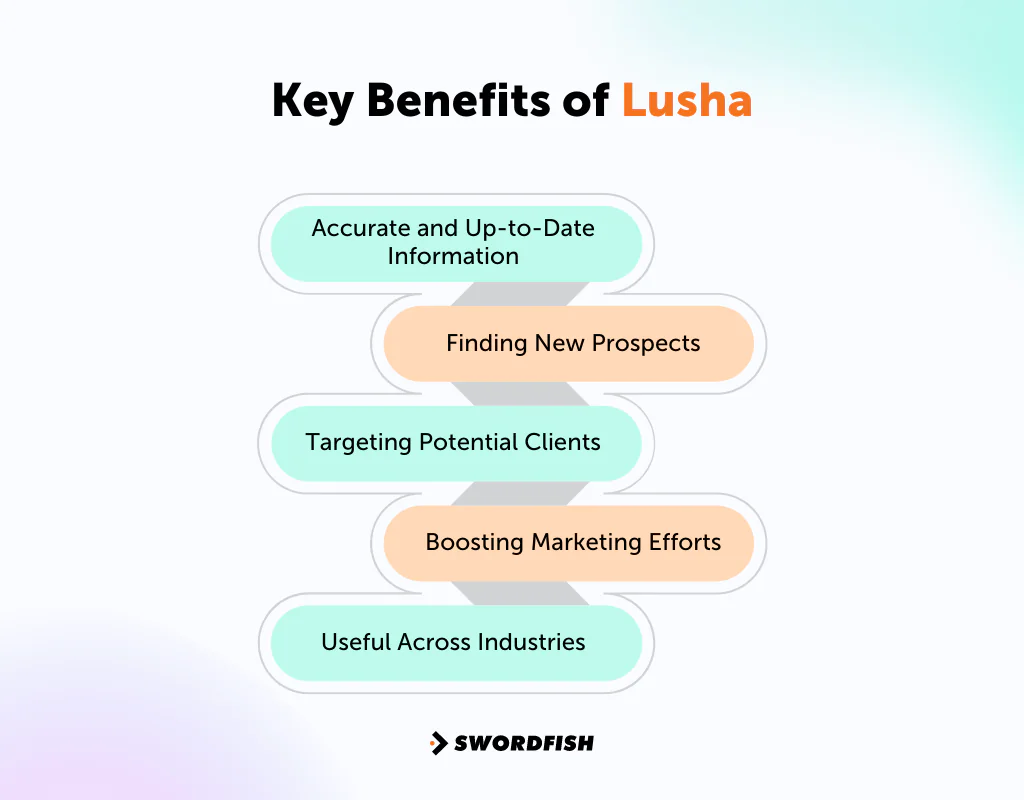
Accurate and Up-to-Date Information
Reasonably current contact data means fewer bounced emails and dead phone numbers, which keeps outreach efficient instead of wasting rep time on bad records.
Finding New Prospects
Lusha makes it straightforward to build new prospect lists from its database, which helps when a team needs to expand beyond its existing pipeline.
Targeting Potential Clients
You can filter for contacts matching a defined profile, which keeps outreach focused on leads that actually fit your ideal customer rather than a broad, unqualified list.
Boosting Marketing Efforts
Fresher audience data tends to produce better campaign performance, since messages reach people who are still in the roles and companies your targeting assumes.
Useful Across Industries
Lusha’s data spans multiple sectors, including tech, healthcare, and finance, so the tool isn’t limited to a single vertical or use case.
Lusha Pricing Breakdown
Lusha’s current structure runs five tiers: Free, Starter, Pro, Premium, and Scale. Unlike the older flat-rate model, Starter, Pro, and Premium each use a credit slider, meaning the monthly or annual price moves up or down depending on how many credits you select for your team. Annual billing generally carries a lower effective monthly rate than paying month to month, and Lusha has run temporary promotional discounts on top of that, so list prices can vary by the week you check.
|
Plan Type |
Credits Included | Features |
Price |
|
Free |
Roughly 40 credits per month, 1 seat | Basic access to contact details, browser extension, limited exports | $0 |
| Starter | A few thousand credits per year, 1 seat | CSV export, list management, Chrome extension, basic intent topics |
Roughly $37 to $50 monthly on annual billing |
|
Pro |
Credit slider, several thousand credits per year, 2 seats | Everything in Starter, plus API access, signals, and webhooks | Roughly $45 to $175 monthly depending on credit volume |
| Premium | Credit slider, tens of thousands of credits per year, 5 seats | Everything in Pro, plus advanced filters and deeper CRM sync |
Roughly $260 to $660 monthly depending on credit volume |
| Scale | Custom credit volume | Custom solutions, full CRM sync, API, dedicated account manager |
Custom pricing |
Sign-up itself is quick, typically requiring just a business email to get started on the Free plan.
How is Lusha Cost Calculated? Factors Affecting The Pricing
Lusha’s price ultimately comes down to how many credits your team burns through and how you spend them. An email reveal typically costs a single credit, while a phone number reveal costs several times more, so a phone-heavy prospecting motion drains an allocation much faster than an email-first one. A few factors shape the final bill:
- Credit volume: Each tier now uses a slider, so the more credits you commit to annually, the higher the monthly price, but often at a lower cost per credit.
- Billing cycle: Annual billing generally comes out cheaper per month than paying monthly, though rollover rules differ between the two.
- Seats included: Plans bundle a set number of seats sharing one credit pool, so adding a rep doesn’t necessarily add a separate license fee until you exceed the seat cap.
- Extra features: API access, signals, and deeper CRM sync are gated to higher tiers, which pushes the price up beyond just the credit count.
Because Lusha adjusts promotions and credit tiers fairly often, it’s worth checking the live pricing page and getting a quote for your exact seat and credit needs before committing to an annual contract.
Lusha Free Plan
The Free plan costs nothing and gives a single user a modest monthly credit allowance for basic contact lookups. It’s meant for testing data quality on a small scale, not running ongoing outbound campaigns.
- Monthly cost per user: $0
- Key features: Basic contact lookups, browser extension access
Best suited for: Individuals evaluating whether Lusha’s data quality fits their needs before paying
Pros of the Free Plan
- No cost, quick sign-up with a business email
- Enough credits to sample data quality
Cons of the Free Plan
- Credit allowance is too small for real prospecting volume
- No API, signals, or advanced integrations
Lusha Starter and Pro Plans
Starter and Pro sit at the entry and mid tiers of Lusha’s paid lineup. Both are priced per seat with a credit slider, so the monthly cost you land on depends on how large a credit pool you select for the year, not a single fixed number. Pro adds API access, signals, and webhooks on top of what Starter offers.
- Monthly cost: Roughly $37 to $50 for Starter and $45 to $175 for Pro, depending on credit volume and billing cycle
- Key features: CSV export, list management, Chrome extension, and, on Pro, API access and signals
Best for: Small teams or individual reps who need a working credit pool without committing to Premium’s seat minimums
Pros
- Credit slider lets you scale spend to actual usage
- CRM integration and browser extension included
Cons
- Phone reveals burn credits several times faster than email reveals
- Annual plans typically don’t roll over unused credits at year end
Lusha Premium Plan
Premium bundles a larger seat count with a much bigger credit pool and adds more advanced filters and deeper CRM sync. It’s priced well above Starter and Pro, and like those tiers, the exact cost depends on the credit volume selected.
- Monthly cost: Roughly $260 to $660, typically bundling five seats and a shared credit pool
- Key features: Larger credit allowance, advanced filters, deeper CRM sync
Best for: Mid-size to larger sales teams that need shared credit pools across several reps
Pros
- Substantially larger credit pool than entry tiers
- Advanced integrations and filtering
Cons
- Meaningfully higher monthly cost than Starter or Pro
Lusha Scale Plan
Scale is Lusha’s negotiated, custom-priced tier for organizations with high-volume credit needs, dedicated support requirements, or contract terms that don’t fit the self-serve sliders.
- Monthly cost: Custom, negotiated based on credit volume and contract length
Best for: Large enterprises or fast-growing teams with credit needs beyond Premium’s cap
Pros
- Fully negotiable to fit large-scale needs
- Dedicated account management and priority support
Cons
- Requires a sales conversation rather than self-serve checkout
When Should I Pay for Lusha?
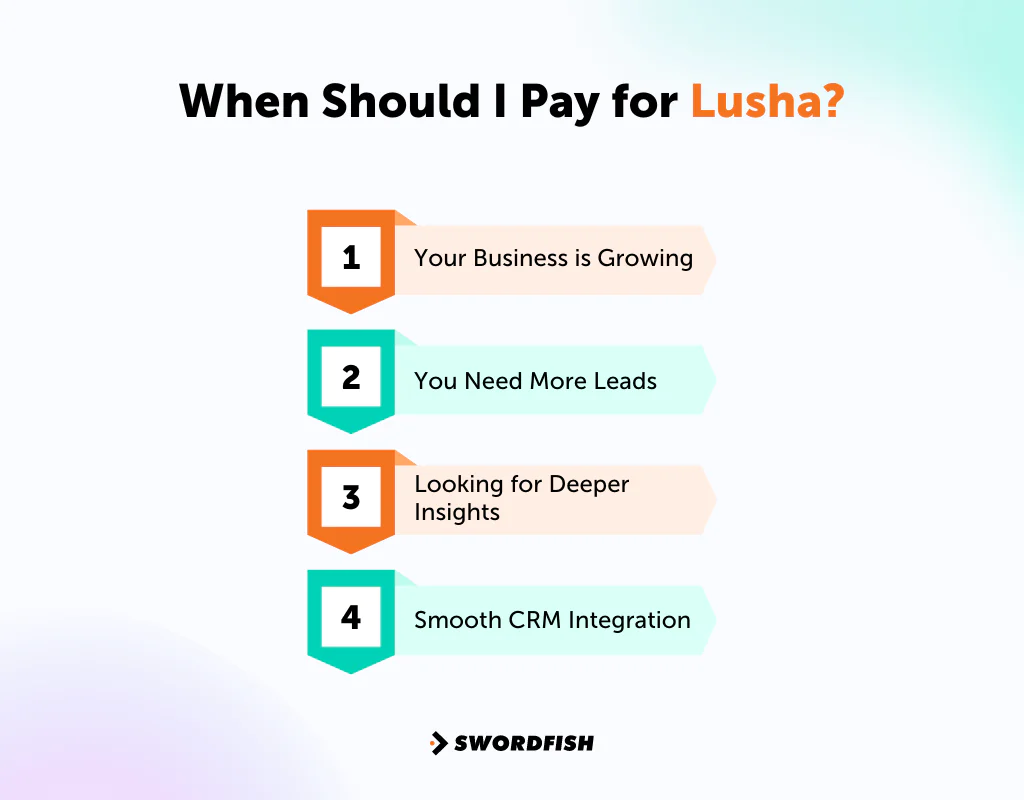
Moving to a paid Lusha plan is a real commitment for any business trying to get better at managing B2B contacts and generating leads. The Free plan is a fine starting point for basic data management, but it runs out fast once you’re doing real outbound volume.
Your Business is Growing
If your team is expanding, Starter or Pro gives you a workable credit pool and the CRM connections to keep up with growing sales and marketing activity.
You Need More Leads
If you’re trying to scale lead volume, a larger credit allocation on Pro or Premium gets you deeper into Lusha’s database without constantly running out of credits mid-month.
Looking for Deeper Insights
Teams that want richer signals and more personalized outreach get more value from Premium’s advanced filters and buyer intelligence features than from the entry tiers.
Smooth CRM Integration
Larger teams that need tight, always-current syncing with Salesforce or similar systems are the ones Scale is built for, since it includes the most complete CRM integration.
Is Lusha Worth The Price?
Deciding whether Lusha is worth it comes down to matching the credit-slider pricing to your actual usage. The platform offers genuinely useful prospecting tools, buyer intelligence, data enrichment, and CRM integration, plus a simple Chrome extension and multi-platform access.
The catch with the current pricing model is that costs can climb quickly if your team leans heavily on phone number reveals, since those consume credits at a much higher rate than email lookups. Before committing to an annual contract, it’s worth estimating your team’s actual monthly credit burn rather than just comparing the headline plan price.
Swordfish AI is the #1 Lusha Alternative
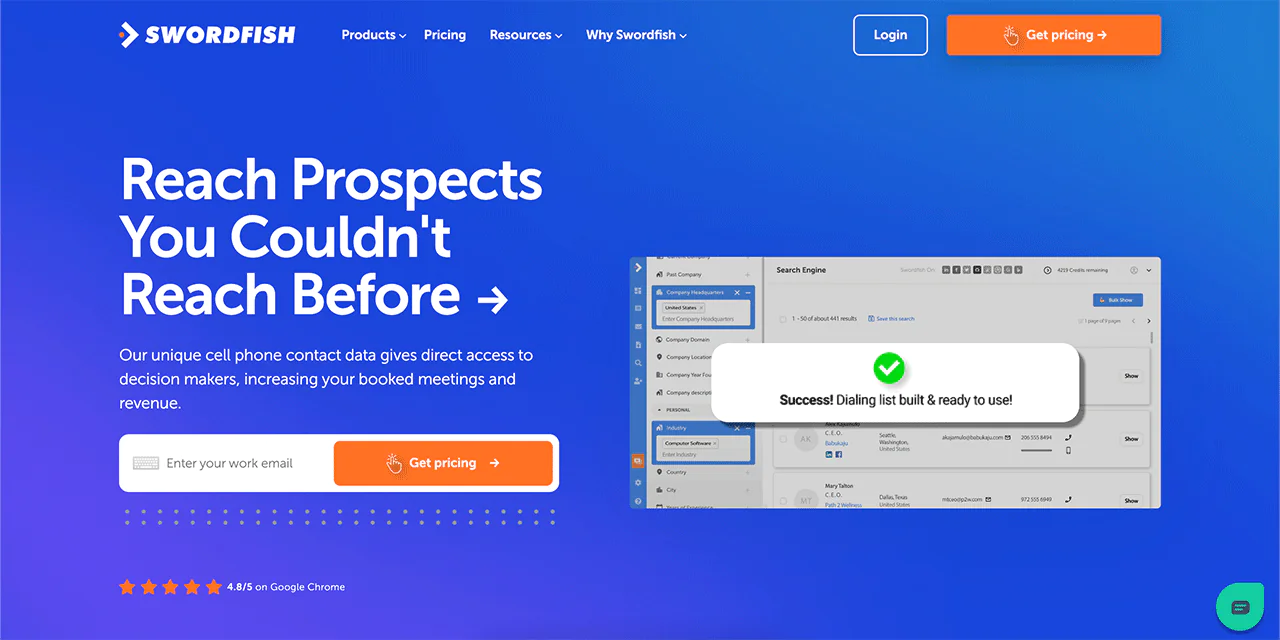
Swordfish AI offers a compelling alternative to Lusha, especially for teams that need direct contact with decision-makers. The platform focuses on a database of cell phone numbers paired with a specialized verification system, aimed at making the contact information both extensive and accurate for sales and recruitment outreach.
With access to over 3.5 billion profiles, Swordfish AI’s coverage extends well beyond many competitors, which matters for teams trying to widen their reach across industries, including healthcare. Swordfish AI is also user-friendly and integrates with major social platforms, which simplifies gathering contact details without switching tools constantly.
Swordfish vs Lusha: A Quick Comparison Table
Check out this table showing how Swordfish compares to Lusha.
|
Features |
Swordfish AI | Lusha |
| Free Trial | Customized free trial |
Free: Monthly credit allowance |
|
Pricing |
Price on request. |
Starter/Pro/Premium: Credit-slider pricing Scale: Customized plan |
|
Demo |
Yes | No |
|
Lead Generation |
Advanced tools for prospecting and real-time validation for better lead generation. |
Effective in generating leads with current, accurate contact details. |
| Database | 3.5 billion profiles |
50 million enterprise business profiles, and 44 million SMB business profiles |
|
CRM Integration |
Salesloft, Salesforce, LOXO, Outreach, Zapier, Lever, etc. | Salesforce, HubSpot, Zoho, Bullhorn, Pipedrive, etc. |
| User Experience | Known for its ease of use and accurate Chrome extension. |
User-friendly interface, easy Chrome extension access. |
Why Should You Choose Our Product Over Lusha?
Swordfish AI changes the way you access contact details, making sales and recruitment efforts more effective.
Pricing
Swordfish AI offers customized plans to fit different business needs, giving you high-quality emails and phone numbers. Unlike Lusha’s credit-slider model, Swordfish AI works out your requirements first and builds a plan around them rather than asking you to guess a credit volume upfront.
That flexibility is useful for teams that don’t want to overcommit to an annual credit pool before they know their real usage.
Data Accuracy
Swordfish AI shines in providing accurate data. It uses special algorithms and works with cell phone carriers directly to validate information. This commitment ensures you get a first-dial accuracy rate of 82% and an overall profile accuracy of 95%, and it has earned the trust of more than 50,000 professionals.
Coverage
Swordfish AI’s partnerships with over 200 unique cell phone data providers mean broad access to decision-makers’ contact details. The combination of exclusive sources and direct validation is what sets Swordfish AI apart for reaching key targets reliably.
Integration and Usability
Swordfish AI and Lusha both offer CRM and sales platform integrations. Swordfish AI’s easy-to-navigate interface and quick validation checks make prospecting straightforward and more productive within existing workflows.
 Try Swordfish Ai
Lusha Pricing Comparison with Alternatives
Below is a detailed comparison table that outlines the distinctive features and offerings of RocketReach, Kaspr.io, and ZoomInfo. Using this comparison, we’ll highlight the key features of each platform, so you’ll have a clearer understanding of what makes them special.
|
Features |
RocketReach |
ZoomInfo |
|
|
Pricing Model |
Subscription-based with monthly and annual plans | Subscription-based with monthly and annual plans |
Custom pricing |
| Free Trial/Plan | No free trial | Free Plan: 1 user |
Available upon request |
|
Price |
Essential (Email Only): Monthly $80 |
Starter: Monthly $65 per user (1 user) |
Professional: $8,000 per year (collected from third-party) |
|
Pro (Email + Phone): Monthly $150 |
Business: Monthly $99 per user (1 user) | Advanced: $12,000 (collected from third-party) | |
| Ultimate (Email + Phone): Monthly $300 | Organization: Monthly $99 per user (5 users) |
Elite: $40,000 (collected from third-party) |
|
|
Core Service |
Email, phone & social media link discovery | B2B contact data with LinkedIn extension | B2B contact data, sales intelligence |
| Data Access | Email addresses and phone numbers | Email addresses, phone numbers, and business info |
Extensive company data, emails, phone numbers |
|
Integration |
Salesforce, Outreach, HubSpot, and Salesloft. | HubSpot, Lemlist, Salesforce, Pipedrive, Zapier, etc. | Salesforce, Zoho, HubSpot, Microsoft Dynamics 365, etc. |
| API Access | Available in the Ultimate plan | Available in the Organization plan |
Available, with detailed API documentation |
|
Credits/Rollover |
Exports vary by plan, with rollover in Pro and Ultimate plans | Credits for phone and direct emails, with rollover in Starter and Business plans | Usage likely affects pricing |
| Target Audience | Individual professionals to large teams | SDRs, founders, recruiters |
B2B marketing and sales teams, large enterprises |
Lusha vs RocketReach
RocketReach is a strong option for finding accurate B2B contact information, with a large database of professionals worldwide and a solid deliverability rate on verified emails.
The platform is particularly good at building automated prospect lists filtered by location, job title, industry, and company, and it uses AI to suggest new contacts while integrating with CRM systems like Salesforce and HubSpot.
It also offers an API for large-scale enrichment and a browser extension for social prospecting, and it’s used by a number of larger enterprises for comprehensive contact information.
Comparison Table Lusha vs RocketReach
If you’re trying to decide between RocketReach and Lusha for your contact finding needs, here’s a quick look at how they compare.
|
Features |
Lusha |
RocketReach |
|
Data Accuracy |
Data accuracy varies by record type. | 90 to 98% deliverability on verified emails. |
| Database | 50 million enterprise business profiles and 44 million SMB business profiles |
Over 450 million professionals |
|
Integration |
Salesforce, HubSpot, Zoho, Bullhorn, Pipedrive, etc. | Salesforce, Outreach, HubSpot, and Salesloft. |
| Compliance | Adheres to GDPR and CCPA standards. |
Complies with data privacy standards. |
|
Pricing |
Free: Monthly credit allowance |
Essentials: $80 per month for 80 lookups |
| Starter/Pro: Credit-slider pricing |
Pro: $150 per month for 200 lookups |
|
|
Premium: Credit-slider pricing |
Ultimate: $300 per month for 500 lookups |
|
|
Scale: Customized plan |
Note: You can also check out alternatives to RocketReach for more suitable options.
Lusha vs Kaspr.io
Kaspr.io is a user-friendly tool that excels at gathering B2B contact information, particularly through LinkedIn. With its Chrome extension and web app, you can quickly access a large database of phone numbers and emails, which makes it a popular choice for sales reps, business owners, and recruiters.
Kaspr is known for its simplicity and quick setup, and it provides real-time, verified data along with lead management and outreach automation features that sync with other apps.
Comparison Table Lusha vs Kaspr.io
When comparing Kaspr and Lusha for your contact discovery needs, it’s important to understand their key differences and similarities.
|
Features |
Lusha |
Kaspr |
|
Prospecting Tools |
Advanced prospecting features for targeted lead generation. | Chrome Extension and web app for efficient B2B contact data retrieval. |
| Integration | Salesforce, HubSpot, Zoho, Bullhorn, Pipedrive, etc. |
Integrates with Salesforce, HubSpot, Pipedrive, Lemlist, Sendinblue, Aircall, Ringover. |
|
Database |
50 million enterprise business profiles and 44 million SMB business profiles | Over 500 million phone numbers and email addresses |
| Compliance | Adheres to GDPR and CCPA standards. |
GDPR & CCPA aligned. |
|
Pricing |
Free: Monthly credit allowance |
Free: 5 phone credits |
| Starter/Pro: Credit-slider pricing |
Starter: Monthly $65 per user (100 phone credits) |
|
|
Premium: Credit-slider pricing |
Business: Monthly $99 per user (200 phone credits) | |
| Scale: Customized plan |
Organization: Monthly $99 per user (2,000 phone credits) |
Lusha vs ZoomInfo
ZoomInfo is a leading B2B contact database platform known for its extensive business data collection, offering a large set of company profiles and verified phone numbers as one of the biggest global data providers. For sales and marketing teams, ZoomInfo focuses on accurate, up-to-date lead generation data.
It offers advanced search filters, AI-driven prospecting, enrichment tools, and real-time account alerts, along with easy integration with popular CRM and marketing tools, with regular updates to keep data accurate.
ZoomInfo’s interface appeals to sales, marketing, and recruitment professionals alike. Its custom pricing may deter smaller businesses, but it’s widely valued for the depth of its B2B data.
Comparison Table Lusha vs ZoomInfo
Here’s a concise comparison table that outlines the key features and differences of each platform, helping you decide which one aligns best with your specific requirements.
|
Features |
Lusha |
ZoomInfo |
|
Pricing |
Free: Monthly credit allowance |
Professional: $8,000 per year (collected from third-party) |
|
Starter/Pro: Credit-slider pricing |
||
|
Premium: Credit-slider pricing |
Advanced: $12,000 (collected from third-party) | |
| Scale: Customized plan |
Elite: $40,000 (collected from third-party) |
|
|
Database |
50 million enterprise business profiles and 44 million SMB business profiles | 321 million professional contacts at 104 million companies |
|
Integration |
Salesforce, HubSpot, Zoho, Bullhorn, Pipedrive, etc. |
Salesforce, Zoho, HubSpot, Microsoft Dynamics 365, etc. |
|
Chrome Extension |
LinkedIn, Salesforce, Sales Navigator, and Recruiter | |
| Compliance | Adheres to GDPR and CCPA standards. |
Complies with data privacy standards. |
Note: There are alternatives to ZoomInfo that you may find more suitable.
Conclusion
Deciding whether to invest in Lusha depends on your business’s specific needs and how the credit-slider pricing lines up with your actual usage. Lusha provides a genuinely useful set of tools, including prospecting features, buyer intelligence, data enrichment, and CRM integration, that can improve B2B contact management and lead generation.
Still, it’s worth weighing those advantages against the cost, especially since phone reveals burn credits far faster than email reveals and annual credit pools typically don’t roll over. Assess your team’s real usage, compare it against current Lusha pricing, and decide if it fits your budget and goals.
That said, you can try Swordfish AI as it offers a large database, real-time verification, and a customized free trial.
FAQs
What happens to unused Lusha credits?
It depends on your billing cycle. Monthly plans generally allow some rollover up to a multiple of your monthly limit, while annual plans typically front-load the full year’s credits and any unused balance expires at renewal. Check your specific plan’s terms, since Lusha’s policies have shifted over time.
How does Lusha use credits?
Credits are consumed each time you reveal contact information. An email reveal usually costs a single credit, while a phone number reveal costs several credits, so phone-heavy prospecting drains a credit pool much faster than email-only outreach. Certain workflow features, like signals or automation, can also draw from the same pool.
Is API access priced differently from regular use?
API access is generally bundled into the higher tiers rather than priced separately, and it typically isn’t available at all on the Free plan. For exact terms on your account, checking with Lusha’s sales team is the most reliable approach.