
 View Products


Last updated: September 3, 2026
By Morgan Lee, RevOps Auditor
Author note: I review contact-data tooling the same way I review integration spend — by counting rework, decay, and the cleanup your CRM will quietly invoice you for later.
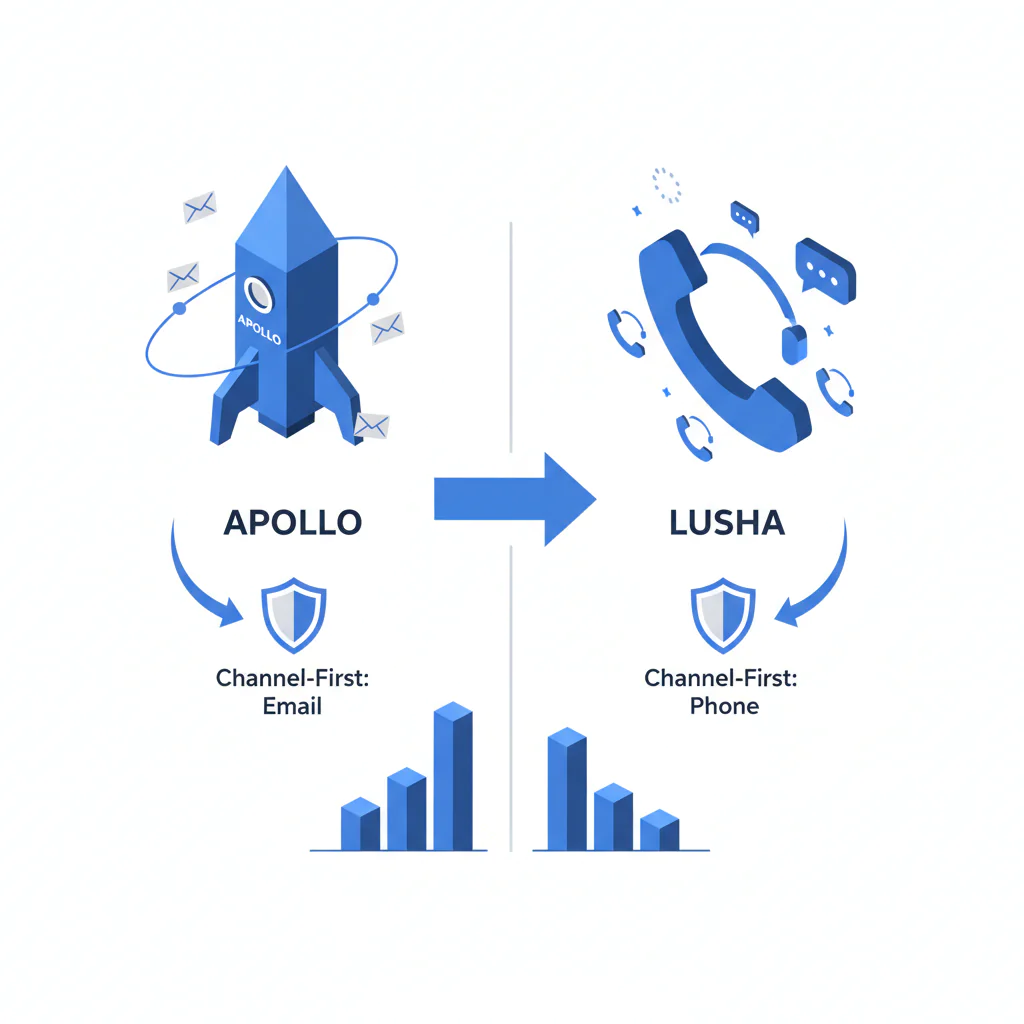
Apollo vs Lusha comes down to a channel-first choice: decide whether your team runs email-first or phone-first, then confirm the answer with a small pilot instead of a demo. Buy on screenshots and you will pay for it later in bounced domains, wasted dials, and integration tickets that land on RevOps.
Who this is for
- SDRs doing multi-channel outreach who need one default motion (email-first vs phone-first) instead of a diluted workflow.
- RevOps/Sales Ops who will be blamed for duplicates, overwritten fields, and broken routing after enrichment goes live.
- Recruiting teams where job changes turn yesterday’s “good” contact into a dead end.
- Buyers who want a test protocol that survives procurement and does not rely on vendor claims.
Quick Verdict
- Core Answer
- If your motion is email-first sequencing, Apollo tends to get evaluated for its combined list-building and engagement workflow. If your motion is phone-first outreach, Lusha tends to get evaluated for faster access to direct dials inside a credit model. Run the pilot below and pick the tool with the lowest cost per usable contact for your main channel, not the one with the better sales deck.
- Key Stat
- No numeric claim holds steady across ICPs; the metric that matters is your email bounce rate and your phone connect/right-party-contact rate on the same cohort.
- Ideal User
- Email-first teams should be owned by the sequencing operator; phone-first teams should be owned by the dial operator who controls calling windows and dispositions.
The right choice depends on your main channel. If calling is central, prioritize verified mobiles and direct dials and measure connect rate before anything else.
Channel-first decision (framework): email-first vs phone-first
This page uses a channel-first framework because email and phone fail in different ways. Email failures show up as bounces, spam placement, and reputation damage. Phone failures show up as low connects, wrong-party contacts, and reps burning hours on numbers that never had a chance.
If you need a broader map of this category, start at contact data tools and work outward from your primary channel.
What “good” looks like by channel
- Email-first: addresses deliverable enough to protect sender reputation, with suppression hygiene and consistent handling of risky addresses.
- Phone-first: dialable numbers that connect to the intended person, with controlled calling windows and consistent disposition logging so you don’t fool yourself on connect rate.
- Multi-channel outreach: you still need both fields, but pay for the channel your team actually uses every day.
Variance explainer (why your results will differ)
- Geography: mobile coverage and local calling restrictions change what’s reachable and what’s permitted.
- Seniority: titles at the top change less often, but gatekeeping increases; mid-level roles churn faster.
- Industry: call screening, compliance norms, and directory practices affect both email and phone outcomes. This matters especially in regulated fields like healthcare, where provider contact records shift with credentialing, practice changes, and network affiliations.
- Time lag: every day between export and first touch adds decay and rework.
How to test with your own list (5–8 steps)
- Select one ICP slice (same industry, same seniority band, same geography) and export 200 contacts from your source of truth.
- Freeze the inputs so both tools start from the same names, companies, titles, and domains.
- Split into two cohorts and enrich cohort A with Apollo and cohort B with Lusha.
- Control for human variance by running the test in one week with the same rep cohort and calling windows.
- Define metrics up front using the definitions in “Evidence and trust notes.”
- Email-first test: send one consistent, single-step email to both cohorts and record bounces and replies.
- Phone-first test: place one dial attempt per contact in the same calling window and record connect and right-party-contact.
- Track rework for 14 days, counting second lookups triggered by job change, wrong number, missing fields, or bounced domains.
Checklist: Feature Gap Table
This is the part buyers skip and operators inherit. Use it to document where hidden costs will show up after rollout.
| Hidden cost area | What to verify in Apollo | What to verify in Lusha | Evidence to collect |
|---|---|---|---|
| Data decay | How drift is surfaced; whether rechecks fit your workflow without workarounds | How drift is surfaced; whether rechecks are practical inside a credit model | Percent needing a second lookup within 14 days |
| Credits pricing friction | Which actions consume credits/limits in your real workflow (export, recheck, enrichment writes) | Which actions consume credits/limits in your real workflow (export, recheck, enrichment writes) | Consumption per usable contact by channel |
| Email-first exposure | How verification status is represented and how you should suppress risky addresses | How verification status is represented and how you should suppress risky addresses | Bounce rate; suppression list size |
| Phone-first exposure | How often numbers are dialable in your geographies; how you distinguish main lines vs direct dials | How often numbers are dialable in your geographies; how you distinguish main lines vs direct dials | Connect rate; right-party-contact rate |
| Integration headaches | Field mapping, overwrite rules, dedupe behavior, and audit logs before allowing auto-write to CRM | Field mapping, overwrite rules, dedupe behavior, and audit logs before allowing auto-write to CRM | Duplicates created; records rolled back; time spent on cleanup |
| Suppression and opt-outs | How you apply suppression lists across email and phone workflows | How you apply suppression lists across email and phone workflows | Documented process; evidence of enforcement in tools |
Decision Tree: Weighted Checklist
Impact vs effort weighting is based on standard failure points: deliverability damage, dial waste, decay-driven rework, and CRM contamination.
- Highest impact, lowest effort: Run the 200-contact pilot and publish results by channel (email bounce; phone connect/right-party-contact).
- Highest impact, medium effort: Map your workflow to billing mechanics, since both tools use credit or per-seat pricing that can create friction as usage scales. If reps ration lookups, your data decays faster than your process can correct it.
- High impact, higher effort: Validate phone reachability in your actual calling windows and geographies, not in a one-off test call.
- Medium impact, low effort: Confirm job-change handling so sequences and dials stop targeting the wrong person.
- Medium impact, medium effort: Validate enrichment controls (dedupe and overwrite rules, audit logs) before automating writes into the CRM.
If your CRM is already drifting, start with contact data quality controls before adding more sources and more noise.
Troubleshooting Table: Conditional Decision Tree
Stop Condition: If you cannot measure outcomes cleanly in a pilot, do not scale seats or sign a longer term. You will be paying for uncertainty.
- If you are email-first and Apollo’s cohort has fewer bounces and fewer rechecks for your ICP, proceed with Apollo for sequencing workflows.
- If you are phone-first and Lusha’s cohort produces higher connect and right-party-contact in your calling window, proceed with Lusha for dialing workflows.
- If both tools force rationing through credits/limits or workflow friction that discourages rechecks, stop and evaluate options that support routine revalidation.
- If enrichment contaminates CRM (duplicates, unexplained overwrites, missing audit trails), stop and fix governance before allowing auto-write.
What Swordfish does differently
- Ranked mobile numbers / prioritized dials: When multiple phone options exist, Swordfish prioritizes the dial order to reduce wasted attempts.
- True unlimited / fair use: Built for operational reality where rechecks happen because data decays, not because teams misused the tool.
If you want the most relevant internal comparisons for this decision, use Swordfish vs Apollo and Swordfish vs Lusha alongside this test plan.
Evidence and trust notes
- Definitions used in this audit:
- Bounce: an email returned as undeliverable by the receiving server.
- Connect: a call answered by any human (exclude voicemail and IVR).
- Right-party-contact: the answered call reaches the intended person.
- Artifacts to capture during the pilot:
- Export evidence: keep the pre-enrichment input file and the enriched output file so you can audit deltas and reversals.
- System evidence: keep enrichment logs or activity history that shows when fields were written and by which integration user.
- CRM evidence: document field mapping, overwrite rules, and dedupe settings used during enrichment.
- Freshness: Updated Jan 2026.
- Disclosure: Swordfish publishes comparisons and sells contact data tooling; treat this as a measurement protocol, not a promise of outcomes.
- Compliance context: align your outreach process with GDPR overview, the California CCPA resource, and the FTC CAN-SPAM compliance guide.
FAQs
Which is better for cold email?
If you are email-first, Apollo is often evaluated because it pairs list-building with engagement workflows in one platform. The operational answer is your bounce rate and recheck rate on the same ICP cohort.
Which is better for calling?
If you are phone-first, Lusha is often evaluated for direct-dial access inside a credit model. The operational answer is your connect and right-party-contact rate in the calling windows your reps actually work.
Do they have mobile numbers?
Both may return mobile numbers, but coverage varies by geography, seniority, and industry. A number in a UI is not the outcome; a right-party contact is.
How do I test reachability?
Run a controlled pilot: same ICP slice, same time window, one touch per contact per channel, and record bounce/connect/right-party-contact plus rechecks within 14 days.
What’s a phone-first alternative?
If calling is your primary channel and you keep paying for wasted dials, evaluate tools designed around dialable mobiles and routine validation. Use Swordfish vs Lusha as a phone-first comparison structure.
Next steps (timeline)
- Today: choose an owner for the primary channel (email-first vs phone-first) and commit to the metric definitions above.
- This week: run the 200-contact pilot and store the evidence artifacts (input/output files and CRM write logs).
- Week 2: review hidden costs: rechecks required, credits/limits friction, and CRM cleanup events.
- Week 3: scale the tool that produces the lowest cost per usable contact for your main channel, then lock enrichment governance before automating writes.
About the Author
Ben Argeband is the Founder and CEO of Swordfish.ai and Heartbeat.ai. With deep expertise in data and SaaS, he has built two successful platforms trusted by over 50,000 sales and recruitment professionals. Ben’s mission is to help teams find direct contact information for hard-to-reach professionals and decision-makers, providing the shortest route to their next win. Connect with Ben on LinkedIn.