
 View Products


By Swordfish.ai Editorial Team (Senior operator audit lens)
This apollo review is for buyers who have already paid for “it integrates” and then staffed a cleanup project. Assume the demo is best-case, assume the data decays, and assume the integration work lands on your team. Then buy accordingly.
Who this is for
- Outbound leaders who need conversations, not just activity metrics.
- RevOps and CRM owners who have to clean up enrichment overwrites and field drift.
- Procurement comparing true cost per meeting once you include retries, ops time, and adoption drag.
- SDR managers who want a repeatable test to settle “data quality” debates.
Quick Verdict
- Core Answer
- Apollo.io is a sales intelligence and engagement platform that combines contact discovery with sequencing workflow; it’s strong for breadth, but you should verify reachability with a dial test when phone connects are the KPI.
- Key Insight
- Breadth is nice; connects pay. Separate sequencing breadth from reachability outcomes before you commit budget, training time, and CRM changes.
- Ideal User
- Teams that want one place to build lists and run sequences, and can enforce governance plus ongoing reachability sampling to manage data decay.
“Apollo is strong when you want breadth and sequencing, but you should validate reachability with a dial test if phone connects are your KPI.”
What this review measures (and what it ignores)
- Breadth: list building, sequencing workflow, and integration pathways that drive adoption.
- Reachability: whether a number connects to the intended person within a realistic call cadence.
- Hidden costs: retries, rep time lost to wrong parties or disconnected lines, and CRM cleanup when enrichment overwrites known-good fields.
This review ignores vendor claims that you can’t reproduce on your own list.
Why reachability varies (the variance explainer you budget for)
Phone reachability is not a static attribute. It shifts as people change jobs, numbers get reassigned, call routing and IVR trees absorb attempts, and different segments get covered by different sourcing and refresh paths. If you don’t measure outcomes by segment and month, you’ll treat variance as a rep problem and spend time fixing the wrong thing.
Framework: Breadth vs reachability
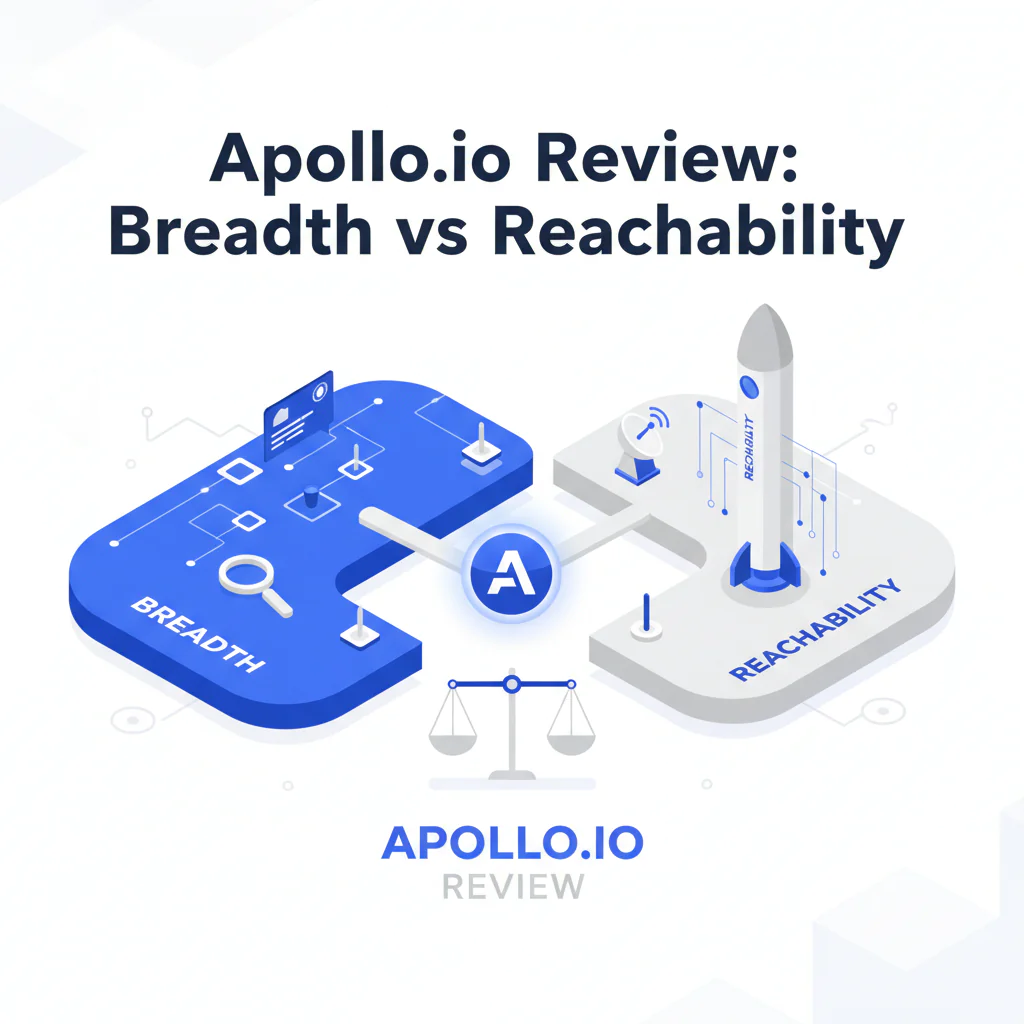
The framework is breadth vs reachability. Breadth helps workflow adoption because reps can search, export, and sequence without switching tools. Reachability is what converts rep hours into conversations. The common procurement mistake is buying breadth and assuming it implies reachability, then paying the gap in retries and pipeline delay.
Pros and cons (audit view)
Pros
- Sequencing breadth supports adoption because prospecting and outreach are in one workflow.
- List building inside the tool reduces CSV handling errors and reduces “shadow lists” on desktops.
- Integrations can reduce manual steps if your field mapping and overwrite rules are controlled.
Cons
- Phone reachability varies by segment; assuming uniformity is how teams overbuy.
- Data decay shows up as retries and then as rep morale problems when connects drop.
- Integration headaches are predictable: field mapping drift, duplicate logic, and enrichment overwriting the wrong field at scale.
Integration failure pattern (what breaks after the first rollout)
The pattern is boring: enrichment writes into the wrong field, or overwrites the right field without permission; duplicates slip past matching rules; downstream tools ingest the mess; then you spend cycles arguing about “which system is the source of truth.” If you want the workflow adoption benefits without the cleanup tax, test integrations in a sandbox, lock overwrite rules, and audit field mappings before you let reps scale usage.
Checklist: Feature Gap Table
| What you think you’re buying | What can go wrong in production | Hidden cost you’ll actually pay |
|---|---|---|
| Sequencing breadth drives output | Non-connecting phone data inflates activity without conversations | More rep hours per meeting; forecasts drift while dashboards stay “green” |
| Enrichment improves CRM | Overwrites known-good fields with stale or mismatched values | Cleanup work, routing mistakes, and broken attribution |
| One integrated workflow reduces friction | Field mappings and overwrite rules are inconsistent across objects | Ops time, duplicate records, and exceptions that reps workaround manually |
| Coverage implies performance | Role and region variance creates uneven outcomes | Territory disputes, rep performance noise, and uneven ramp |
What Swordfish does differently
- Ranked mobile numbers / prioritized dials: Swordfish focuses on producing a dialing order that targets likely connects first, reducing wasted attempts when phone is central to your workflow.
- True unlimited / fair use: Swordfish is built for predictable usage so teams don’t ration lookups mid-campaign and distort outreach behavior.
If Apollo is your workflow layer, a phone-first layer is the add-on that targets reachability outcomes. The decision should come from your dial test results, not internal opinions.
For a direct buyer comparison, use Compare Apollo vs Swordfish.
How to test with your own list (5–8 steps)
- Pull a narrow sample of contacts from your CRM that match one ICP and one region so results are interpretable.
- Freeze the process variables: same dialing hours, same caller IDs, same rep cohort, same script, and a fixed attempt cadence.
- Enrich in Apollo and separately enrich the same list with a phone-first specialist; keep fields separated so you can audit overwrite risk.
- Define dispositions before dialing so logging isn’t rep-dependent.
- Dial with a stop rule: one attempt plus controlled retries; do not let reps “hunt” indefinitely because that hides reachability failure under effort.
- Report reachability outcomes: connects per 100 dials and minutes per connect; do not use “contacts touched” as the success measure.
- Run a governance check: estimate how many records would overwrite known-good CRM phone fields and decide the overwrite policy before scaling.
- Repeat monthly on a small sample to track data decay and catch drift before it becomes a pipeline surprise.
Dial-test disposition definitions (use these or write your own)
- Connect-to-person: you spoke with the intended contact long enough to confirm identity.
- Wrong party: someone answered, but it was not the intended contact.
- Disconnected / invalid: carrier message indicates the number is not in service or not assigned.
- Voicemail: voicemail reached without confirming it belongs to the intended contact.
- Unknown: call behavior doesn’t fit the above; keep this category small and review it weekly.
Decision Tree: Weighted Checklist
This is a weighted checklist without point values. Weighting is based on standard failure points that drive the biggest hidden costs: non-connect retries, CRM contamination, and inconsistent dialing behavior. Items are ordered from highest expected impact on reachability outcomes to lowest.
- Highest impact: Run a dial test sample on your ICP list before expansion to separate breadth vs reachability with your own outcomes.
- Highest impact: Set CRM overwrite rules for phone fields so enrichment cannot replace known-good numbers without validation criteria.
- High impact: Standardize call cadence and stop rules so results are comparable across reps and weeks.
- Medium impact: Track connect outcomes alongside activity metrics so reporting reflects reachability, not effort.
- Medium impact: Segment by role and region because variance is a predictable property of contact data.
- Lower impact: Optimize sequences for reply rates after you’ve confirmed phone reachability is not the constraint.
Troubleshooting Table: Conditional Decision Tree
Stop Condition: stop buying more seats, credits, or add-ons when you can’t show stable reachability on your own list.
- If rep activity is high but meetings are flat, then pause expansion and rerun the dial test on a fresh ICP sample.
- If outcomes vary sharply by segment, then constrain Apollo usage to segments where it performs and use a phone-first layer elsewhere.
- If enrichment overwrites known-good CRM data, then stop enrichment until governance rules and field protections are in place.
- If prioritized dials reduce retries and raise connects per rep-hour, then shift budget toward reachability inputs rather than more sequencing breadth.
Pricing and alternatives (buyer notes)
- Pricing reality: cost is not just the subscription; it’s the time to implement, govern, and clean up enrichment side effects when the workflow scales.
- Questions to ask: what triggers limits, what is counted as usage, how exports are governed, and whether overwrite controls exist at the field level.
- Alternatives logic: keep a sequencing-first platform when workflow adoption is the bottleneck; add a phone-first specialist when reachability is the bottleneck.
Evidence and trust notes
- Freshness: Last updated Jan 2026.
- How we reviewed: we mapped the breadth vs reachability framework to common outbound workflows, documented a repeatable dial test plan, and enumerated standard integration failure modes that create hidden costs at scale.
- What we did not claim: no competitor plan details, pricing numbers, coverage counts, or accuracy rates, because those claims are segment-dependent and often not reproducible.
- Compliance context (non-competitor references):
- GDPR overview (EU data protection basics)
- FTC CAN-SPAM compliance guide
- FCC guidance on telemarketing and robocalls
Related reading inside the pillar
- Use data quality to prevent enrichment from breaking your CRM and reporting.
- If your team’s behavior is being distorted by caps, unlimited contact credits explains the operational side effects.
FAQs
Is Apollo accurate?
Apollo can be accurate for some segments, but accuracy is not uniform across roles and regions. Treat accuracy as a testable claim: run a dial test on your ICP and measure connects, wrong parties, and disconnected outcomes before scaling.
Is Apollo good for phone numbers?
Apollo is often chosen for workflow and sequencing breadth; phone outcomes depend on segment and process controls. If phone connects matter, validate reachability with a controlled dial test and consider a phone-first layer when retries become the hidden tax.
What are Apollo’s pros and cons?
Pros: unified workflow that supports adoption, list building, and sequencing in one place. Cons: phone reachability can vary, data decay increases retries, and enrichment can contaminate CRM fields without overwrite governance.
What’s better for direct dials?
If direct dials drive your meetings, a phone-first specialist is typically a better fit than relying on a sequencing-first platform alone. Swordfish emphasizes ranked mobile numbers/prioritized dials and true unlimited/fair use to reduce wasted dialing effort.
How do I test?
Pull a narrow ICP sample, enrich it in both tools without overwriting CRM fields, dial with a fixed cadence and stop rule, and judge results by connects per 100 dials and minutes per connect. If you can’t reproduce reachability in a controlled test, scaling will multiply the problem.
Next steps (timeline)
- Today: choose one ICP slice and define dispositions so reps log outcomes consistently.
- This week: run the dial test and document outcomes plus overwrite risk.
- Next week: decide budget based on reachability outcomes, not feature breadth.
- Monthly: rerun a smaller sample to monitor data decay and prevent silent performance drift.
Compliance note
Use lawful outreach practices and honor opt-out/consent requirements.
About the Author
Ben Argeband is the Founder and CEO of Swordfish.ai and Heartbeat.ai. With deep expertise in data and SaaS, he has built two successful platforms trusted by over 50,000 sales and recruitment professionals. Ben’s mission is to help teams find direct contact information for hard-to-reach professionals and decision-makers, providing the shortest route to their next win. Connect with Ben on LinkedIn.