
 View Products


Last updated: September 3, 2026
Choosing between Apollo and RocketReach comes down to how your team actually works, not just which one has the bigger database. Apollo positions itself as a full sales intelligence and engagement platform, while RocketReach leans into contact lookup and list building at scale.
Apollo has grown into one of the most widely adopted sales platforms, with a large contact database and a set of engagement tools built around it. RocketReach has built its reputation on breadth of coverage and a straightforward lookup experience trusted by a large user base, including many large enterprises.
Apollo’s platform combines sales intelligence with engagement tools, which makes it a strong fit for teams that want detailed data plus outreach automation in one place. RocketReach, by contrast, is built around fast contact discovery and connection, which suits teams that prioritize reach and simplicity over an all-in-one workflow.
The surface-level comparison of database size and user counts only tells part of the story. Pricing structure, integration depth, and data accuracy vary in ways that matter once you start using either tool day to day. The sections below walk through those differences so you can match the right tool to your actual sales process.
What is Apollo?
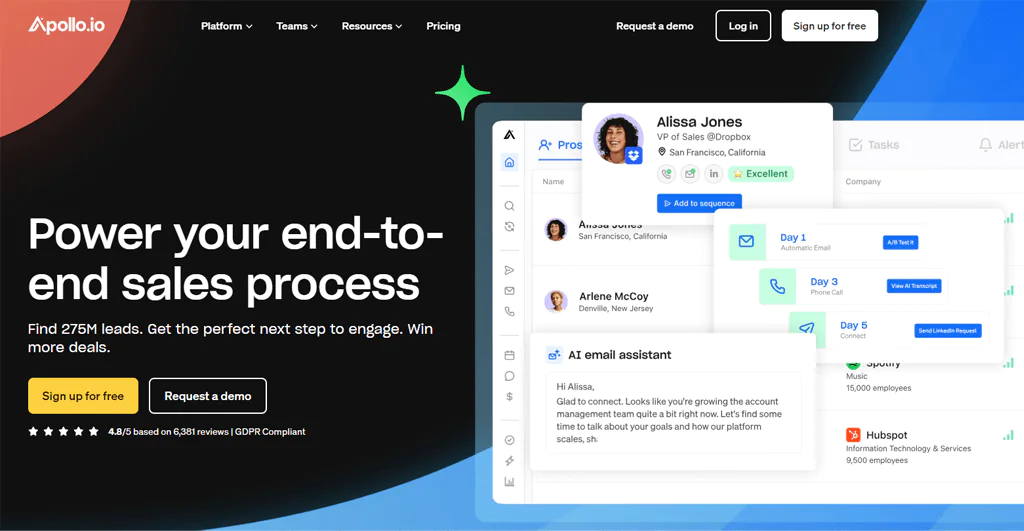
Apollo launched in 2015 and has grown into a widely used sales intelligence platform, adopted by teams ranging from small startups to Fortune 500 companies. Its combination of database, engagement, and AI features has made it one of the more actively adopted tools in the sales data category, with reported adoption continuing to grow year over year.
Its core features span sales engagement tools, Apollo AI, conversation intelligence, and CRM enrichment. The engagement tools help teams connect with prospects through email, calling, and LinkedIn touches, while Apollo AI assists with research and decision-making around which leads to prioritize.
Conversation intelligence surfaces insights from customer interactions, and CRM enrichment keeps contact records current. Together, these features are built to support a full sales workflow rather than just a lookup tool.
Features of Apollo
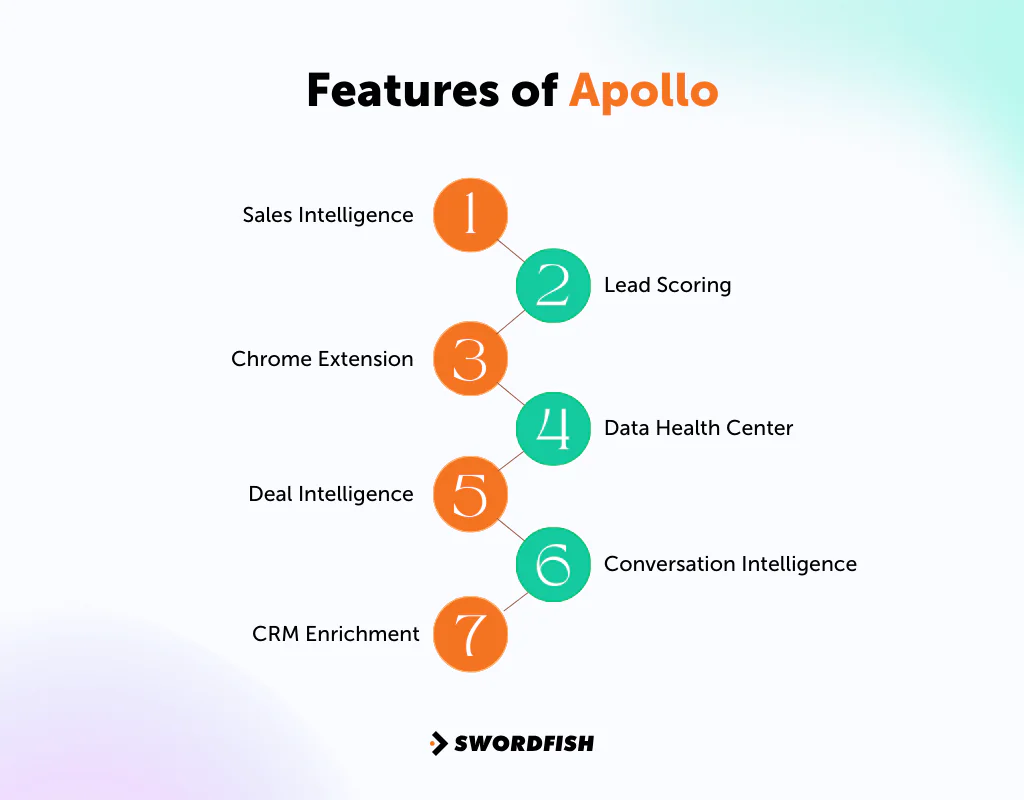
Apollo offers a range of features designed to enhance the sales process:
Sales Intelligence
This feature provides detailed insights into potential leads and markets. It helps users understand their target audience better by offering data on market trends, company information, and contact details.
Lead Scoring
Apollo’s lead scoring system evaluates and ranks leads based on their likelihood to convert. This feature analyzes various factors, such as engagement level and demographic information, to prioritize leads for more focused sales efforts.
Chrome Extension
The Chrome extension integrates Apollo’s functionalities directly into your web browser. It enables quick access to lead data and insights while browsing the web, enhancing efficiency in lead generation and research.
Data Health Center
This tool ensures the accuracy and cleanliness of your sales data. It identifies and corrects outdated or incorrect information in your database, maintaining the integrity of your sales data.
Deal Intelligence
Deal Intelligence provides an overview of ongoing deals. It tracks the progress and status of sales deals, offering insights that can help in strategy formulation and decision-making.
Conversation Intelligence
This feature captures and analyzes conversations with leads. It provides valuable insights into customer interactions, helping to understand client needs and improve communication strategies.
CRM Enrichment
Apollo’s CRM enrichment feature automatically updates and enriches customer relationship management systems with the latest data. This ensures that sales teams always have up-to-date information at their fingertips.
API Enrichment
Apollo’s API Enrichment feature improves the accuracy of contact and account information by leveraging Apollo’s data. You can use this feature through Apollo’s REST API. Each use of enrichment typically costs a credit when Apollo locates a valid email address in the database, and full enrichment with phone data can consume several credits per contact, so it’s worth tracking credit usage against your plan.
Pros
- Integrates seamlessly with many CRM systems and improves workflow.
- A User-friendly interface makes navigation and usage straightforward.
- Strong analytics provide deep insights into sales performance and opportunities.
- Access to a vast database, offering extensive contact and company information.
- Customizable email templates and sequences facilitate personalized outreach.
- Advanced filtering options allow precise targeting of leads.
Cons
- Some users may find the pricing model a bit expensive, particularly once credit consumption and annual billing requirements are factored in.
- Occasionally, the system experiences data accuracy issues, especially with international or mobile records.
What is RocketReach?
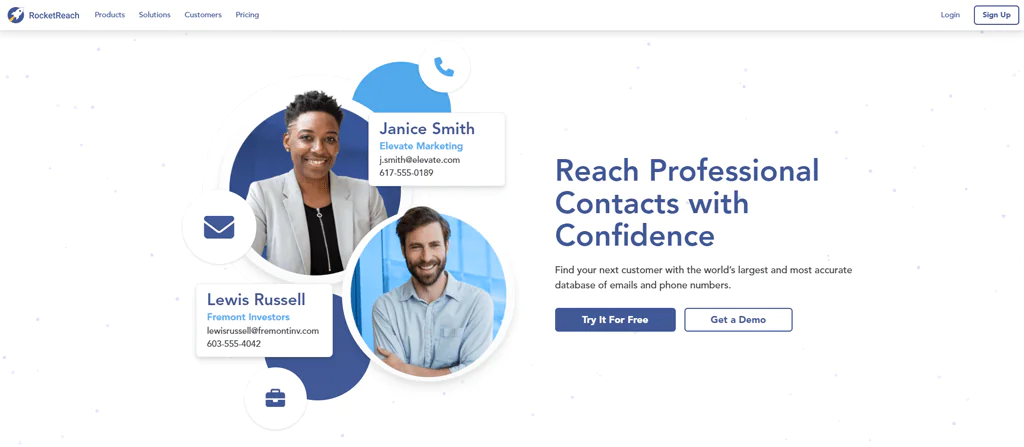
RocketReach launched in 2016 as a tool designed to improve lead generation and contact information accuracy. It gained traction quickly, building a large user base spanning individuals and businesses of varying sizes, and remains a well-known name in the sales and marketing data space.
RocketReach’s appeal comes down to lead quality and reach, with a large user base that includes many enterprise companies. That trust rests on reasonably current contact information, which matters for outreach that depends on reaching real, working numbers and inboxes.
The platform’s feature set includes intent data that surfaces buyer interest signals, AI-powered recommendations that improve search relevance, and Advanced Search for filtering leads by specific criteria. Data quality enhancements are layered on top to keep records current.
Together, these features make RocketReach a practical tool for lead generation and contact management, particularly for teams that want breadth of coverage over a built-in engagement layer.
Features of RocketReach
RocketReach is widely recognized for its effective tools that improve lead generation and contact management. Here are some of its key features:
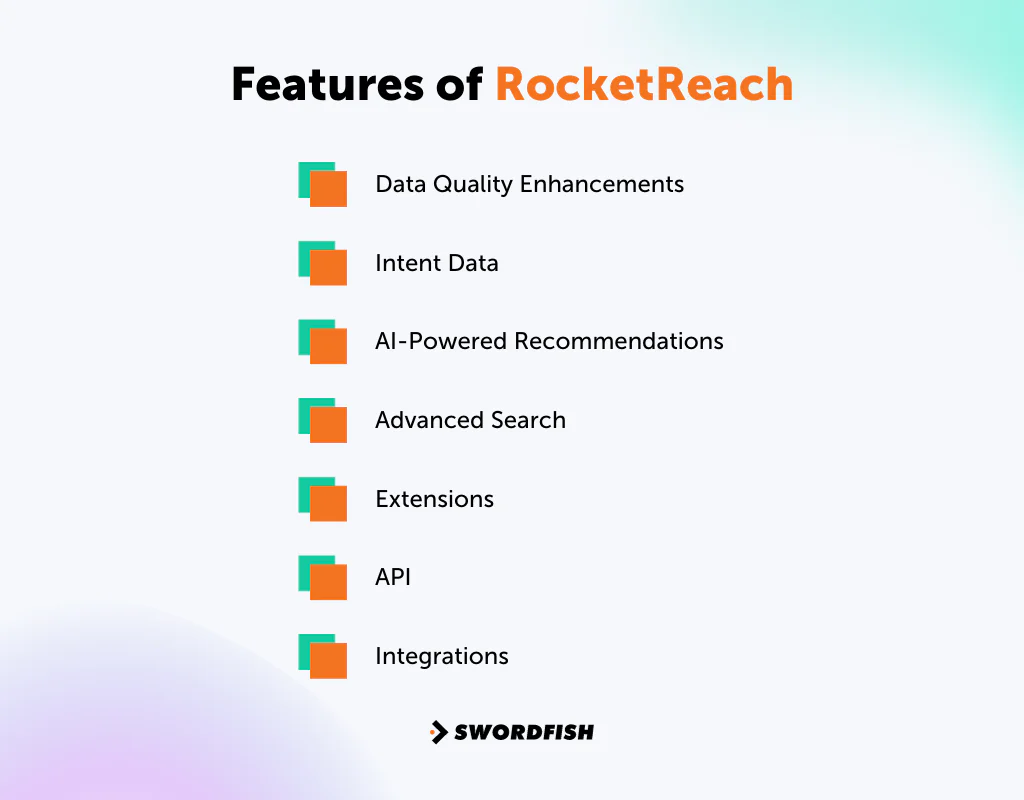
Data Quality Enhancements
This feature ensures the accuracy and reliability of the contact information provided. RocketReach regularly updates its database to maintain current and valid data, reducing the likelihood of encountering outdated information.
Intent Data
RocketReach’s intent data provides insights into potential customers’ interests and behaviors. This feature helps you personalize your outreach strategies by understanding what prospects are likely looking for, leading to more relevant and effective communication.
AI-Powered Recommendations
The platform uses artificial intelligence to suggest relevant contacts and leads. This system analyzes your preferences and patterns to recommend leads that are more likely to convert, streamlining the lead generation process.
Advanced Search
Users can filter leads using various criteria such as location, industry, and job title. This feature allows for precise targeting, making it easier to find the most relevant prospects for specific campaigns or strategies.
Extensions
RocketReach offers you browser extensions that integrate with users’ web browsers. These extensions enable quick access to lead information while browsing online, enhancing efficiency and convenience in lead research.
API
The RocketReach API allows for integration with other software and systems. This means you can incorporate RocketReach’s functionalities into your existing sales or marketing tools, creating a more cohesive and streamlined workflow.
It gives you access to a large record database, along with speed and fill rate, to enrich your data at scale or power your own applications.
Integrations
RocketReach integrates with various CRM and sales platforms, including Zapier, Salesforce, HubSpot, Outreach, and SalesLoft, allowing you to use RocketReach data in your existing workflows seamlessly. This integration capability ensures that users can easily transfer and manage lead information within their preferred systems, maintaining a smooth and organized sales process.
Pros
- Provides access to contact details for a large pool of professionals, facilitating broad networking.
- Utilizes AI-driven algorithms for improved search precision.
- Generally strong data quality, though accuracy varies by record type.
- Features an easy-to-use interface, simplifying the process of finding contacts.
- Smoothly integrates with CRM and marketing platforms, optimizing time management.
- Enables highly specific searches to locate exact profiles based on comprehensive criteria.
Cons
- A RocketReach subscription cost may be expensive relative to lookup volume.
- The free version of RocketReach limits the number of searches.
Apollo vs RocketReach: Comparison table
Understanding the key differences between Apollo and RocketReach is important for users seeking the most effective sales intelligence tools for their contact management and outreach strategies. This table also gives you a look at Apollo pricing and RocketReach pricing.
| Feature | Apollo | RocketReach |
|---|---|---|
| Data Base | Over 275 million contacts | Over 700 million profiles |
| User Base | Over 1 million users. | Over 18 million users. |
| Target Audience | Sales teams and enterprises | Sales, marketing, and HR professionals |
| Main Selling Point | Comprehensive sales intelligence and engagement platform | AI-driven search and offers large database. |
| Extensions | Chrome extensions | Chrome extensions |
| User Friendliness | Popular for its smooth sales AI integration | Has easy-to-navigate dashboard and efficient Chrome extension. |
| Integrations | Integrates with Salesforce, Zapier, etc. | Integrates with Salesforce, HubSpot, and more. |
| Pricing | Free – $0/month/yearBasic – $59/month or $49/yearProfessional – $99/ month or $79/yearOrganization – $149/month or $119/year (Min 3 users) | $53/month or $468/year (Individual)$179/month or $1,188/year (Individual)$359/month or $2,988/year |
Note: pricing and plan structures for both platforms change periodically. Confirm current tiers directly with each vendor before budgeting.
Apollo vs RocketReach: In-Depth Key Differences
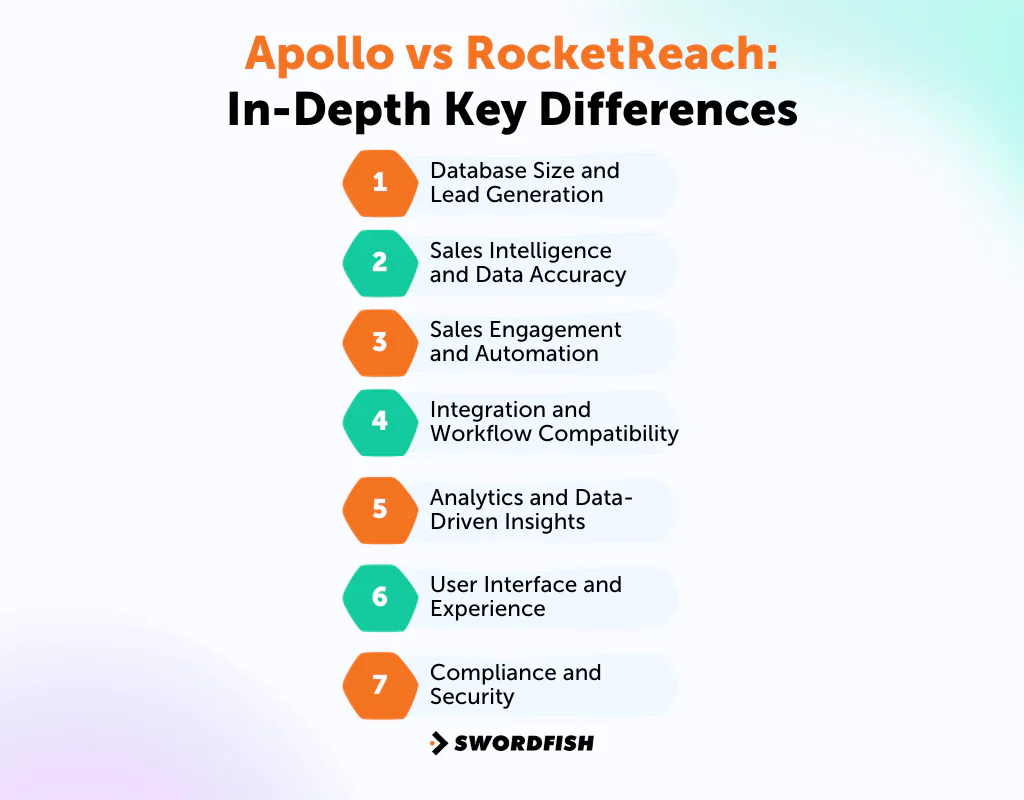
Apollo and RocketReach both offer solid tools for sales intelligence and engagement. However, they differ in database size, sales automation, integration capabilities, and specific analytics features. Let’s find out some details:
Database Size and Lead Generation
Apollo stands out in the lead generation market with a database of roughly 275 million contacts, providing access to verified emails and phone numbers. This database caters to a variety of lead generation requirements, ensuring users have a broad reach.
RocketReach, meanwhile, reports a larger raw database of over 700 million profiles with global phone and email coverage, and it emphasizes high deliverability rates for verified emails. Raw database size is a genuine RocketReach advantage, though breadth doesn’t always translate to accuracy for every record type.
For those weighing their options in this space, looking into RocketReach Competitors like Apollo could offer insights into different features and database strengths that meet diverse lead generation needs.
Sales Intelligence and Data Accuracy
Apollo has solid buyer data with advanced features like lead scoring, which uses AI to prioritize high-value leads and companies. This ensures that users focus their efforts on the most promising prospects.
RocketReach focuses on data quality with automated prospect lists that can be customized by various filters, aiding in targeted lead generation. Independent reviews generally note that both platforms carry some risk of outdated or bounced contacts, which is worth testing against a sample list before committing to a larger plan.
No matter whatever tool you choose, understanding the B2B customer journey is important in sales intelligence.
Sales Engagement and Automation
You can improve your sales engagement strategy with effective cold-calling tips to get a meeting, complementing what you’ve learned from Apollo and RocketReach.
Apollo has a comprehensive platform for engaging with ideal buyers. It supports email, call, and LinkedIn connections, backed by AI, to send the right message at the right time. Apollo also provides end-to-end automation for streamlined sales processes.
RocketReach provides tools for finding and reaching out to contacts, and has added AI-assisted prospecting workflows, but its engagement layer is not as deep as Apollo’s built-in sequencing and dialer.
Integration and Workflow Compatibility
Apollo integrates with various systems, offering CRM enrichment to maintain up-to-date and accurate data. Its API enrichment feature allows for seamless integration with other platforms, enhancing workflow efficiency.
RocketReach has strong integration capabilities with CRM and marketing automation platforms like Salesforce and HubSpot. It also offers an API for data enrichment and a browser extension for social media prospecting.
Analytics and Data-Driven Insights
Apollo is a platform that helps businesses close deals faster by providing actionable analytics and guidance. It offers conversation and deal intelligence, turning interactions into successful sales.
RocketReach does not explicitly detail analytics and data-driven insights features. It focuses more on the data quality and contact-finding aspects.
User Interface and Experience
Apollo is known for its user-friendly interface, making it easy for sales teams to navigate and utilize its features effectively. RocketReach is praised for its simple and effective dashboard layout and is generally considered user-friendly compared to competitors.
Compliance and Security
Apollo has GDPR compliance, ensuring that user data is handled securely and in accordance with regulations. RocketReach emphasizes data quality, but specific compliance and security documentation is less publicly detailed, so teams with strict regulatory needs should verify directly with the vendor.
Swordfish AI- The Best Alternative of Apollo vs RocketReach
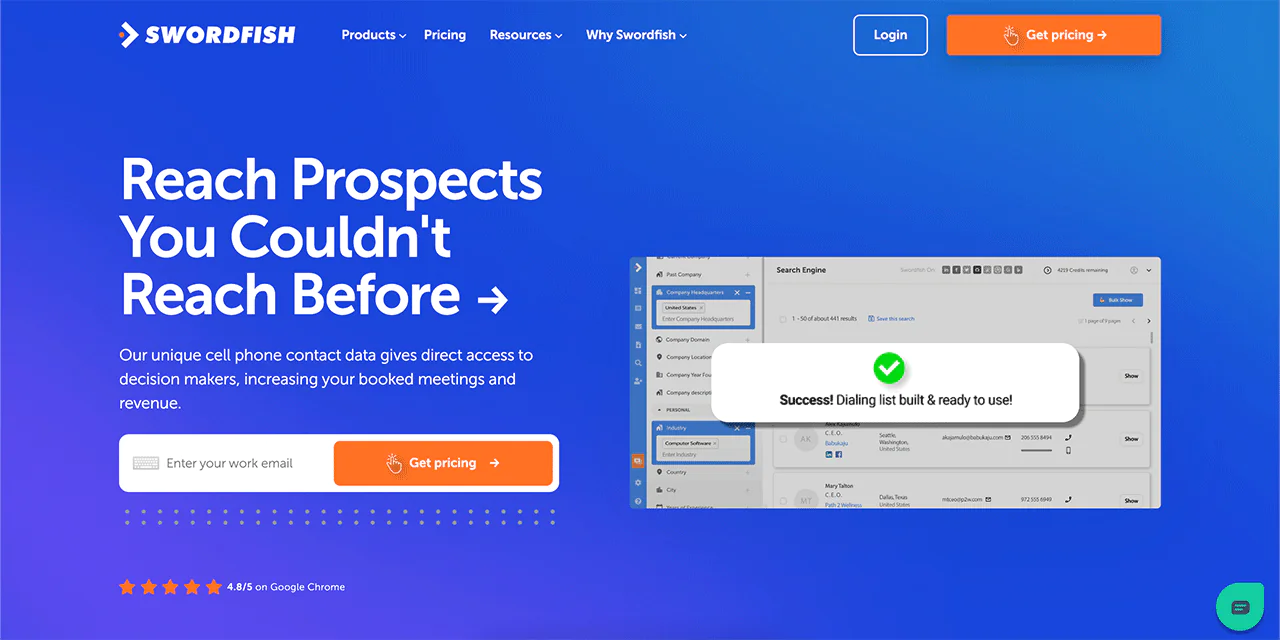
In the matter of Apollo vs RocketReach competitors, Swordfish, a rising player in the contact information industry, has attracted a growing user base. Its standout feature is a cell phone number focus backed by a proprietary cell phone verification system and premium business emails, which is particularly relevant for teams working with healthcare provider contact data where direct mobile access to physicians and administrators is often harder to source than general B2B email.
The platform’s Chrome Extension allows users to gather contact details from LinkedIn, Twitter, and Facebook, much like Lusha and RocketReach.
It also offers a Prospector tool for efficient lead generation list creation. If you’re comparing Swordfish with other platforms, don’t miss exploring a lusha alternative to see how different tools stack up against each other.
Swordfish’s File Upload, Reverse Search, and API features work to enrich and validate contact databases, aligning them with the offerings of its competitors.
Thereby, Swordfish is a compelling option for those considering tools like Lusha or RocketReach, especially for its precision in cell phone data. It’s a practical choice for professional networking and contact management, particularly in verticals like healthcare where accurate mobile numbers matter more than sheer database size.
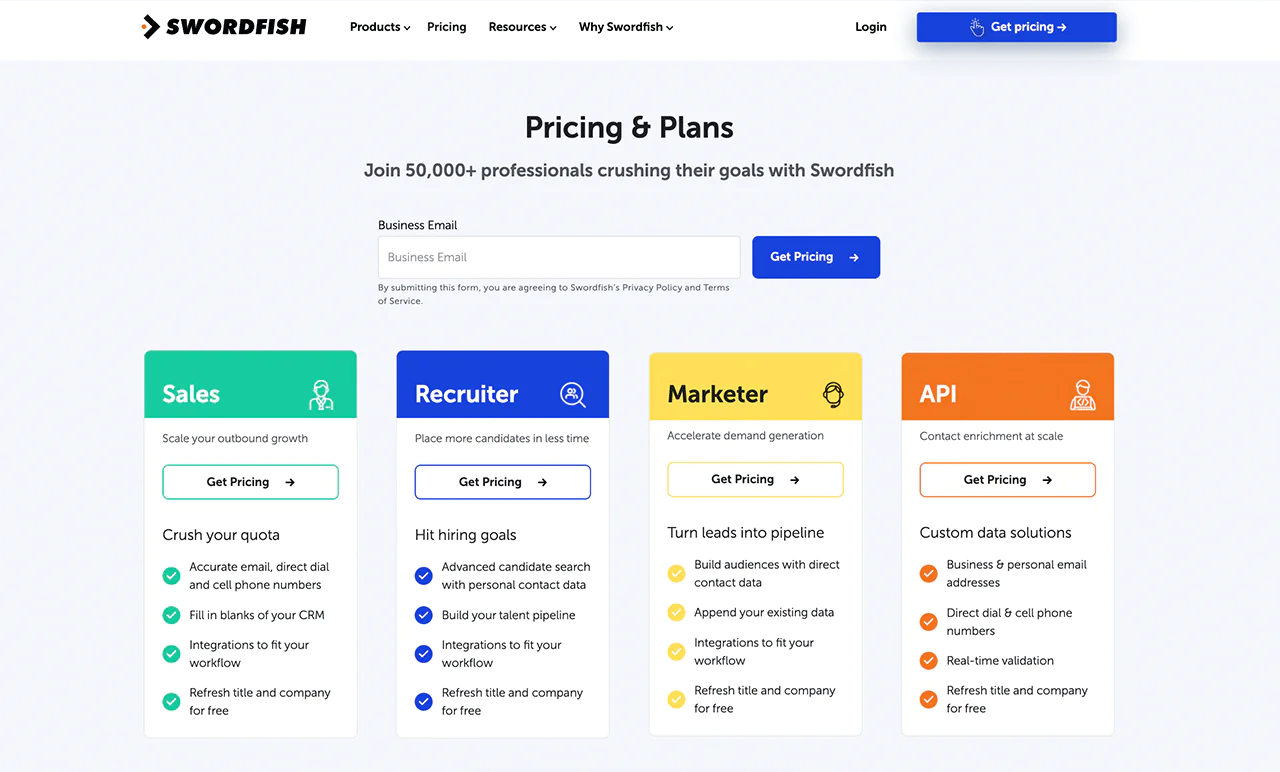
Pricing
Here, we will look into the current pricing plans of Swordfish.
A Comparison Table: Apollo vs RocketReach vs Swordfish
Here’s a comparison of Apollo, RocketReach, and Swordfish, focusing on their key features:
| Feature | Apollo | RocketReach | Swordfish |
|---|---|---|---|
| Database | Over 275 million contacts | Over 700 million profiles | Over 3.5 billion contact data profiles |
| Chrome Extension | Available | Available | Available |
| Lead Generation | Advanced lead generation with AI-powered scoring | Advanced search and list creation for targeted leads | Prospector tool for efficient, targeted lead generation |
| Target Audience | Sales teams, recruiters, and businesses | Sales and marketing teams, businesses | Sales and recruitment professionals |
| API | Available | Available | Available |
 Try Swordfish Ai
Apollo vs RocketReach vs Swordfish: Which One Should You Pick?
In the competitive field of sales intelligence and lead generation, Apollo, RocketReach, and Swordfish are three notable tools. Apollo started in 2015, and quickly became popular for its AI-based lead scoring and CRM enhancement, serving a variety of businesses.
RocketReach, with a large user base, is favored for its advanced search and list-building capabilities, especially among sales and marketing professionals. Swordfish emerges as a strong contender, blending the best aspects of both Apollo and RocketReach for teams that need mobile-first contact accuracy.
Both Apollo and RocketReach boast powerful Chrome extensions and API integration, making them adaptable for CRM systems and sales intelligence. Apollo is particularly useful for businesses focused on data plus built-in outreach. RocketReach, on the other hand, is a solid fit for sales and marketing teams needing scalable, database-first solutions.
Swordfish combines elements of Apollo and RocketReach’s approach. It offers a similar Chrome extension and API integration but stands out with its Prospector tool, which is well suited to creating targeted contact lists.
Swordfish’s differentiator is its focus on cell phone data accuracy, which matters most for teams doing high-volume outbound calling, including healthcare recruiters and account teams that rely on reaching providers directly. With access to a large pool of data profiles, it offers a distinct angle on contact data compared to Apollo and RocketReach’s broader, more general-purpose databases.
Conclusion
Apollo and RocketReach each solve a slightly different problem, and knowing which one fits your workflow matters more than comparing raw database numbers.
Apollo is ideal for teams that value an automated, data-driven approach. Its AI-powered lead scoring and CRM enrichment work well together, making Apollo a strong choice for comprehensive data analysis and targeted outreach within a single platform.
RocketReach, with its large database and user base, excels in system compatibility and flexibility. It’s particularly useful for sales and marketing teams that need a straightforward tool for specific lead searches and list building without committing to a full engagement platform.
If you’re weighing a third option that leans harder into mobile phone accuracy, Swordfish AI is worth evaluating. It offers a large database alongside flexible, user-friendly tools, which makes it a reasonable fit for teams, including those in healthcare, that need reliable direct-dial and mobile contact data for outreach.
FAQs
Can Apollo and RocketReach help in finding specific types of leads?
Yes, both platforms can. Apollo uses AI to prioritize high-value leads, while RocketReach provides advanced search features to target specific leads.
Are these platforms suitable for small businesses?
Yes. Both Apollo and RocketReach cater to businesses of various sizes, offering scalable plans for lead generation and management, including free or entry-level tiers to start with.
How user-friendly are Apollo and RocketReach?
Both platforms are designed to be user-friendly. Apollo is praised for its seamless sales AI integration, while RocketReach is known for its easy-to-navigate dashboard and efficient Chrome extension.