
 View Products


Last updated: September 3, 2026
Choosing between Clearbit and Demandbase used to be a straightforward question of workflow: one platform leaned toward sales prospecting inside HubSpot, the other toward account-based marketing at scale. That comparison has shifted. HubSpot acquired Clearbit in December 2023 and folded it into the HubSpot product line as Breeze Intelligence, so “Clearbit” today is not a standalone tool you can sign up for independently — it is an add-on feature inside a paid HubSpot subscription.
Demandbase, meanwhile, continues to operate as an independent Go-to-Market platform built around account-based marketing, sales intelligence, and B2B advertising.
Below, we walk through what each platform actually offers today, how their features compare, and where a healthcare-focused data provider like Swordfish AI fits into the picture for teams that need verified contact information rather than account-level intelligence.
What is Clearbit?
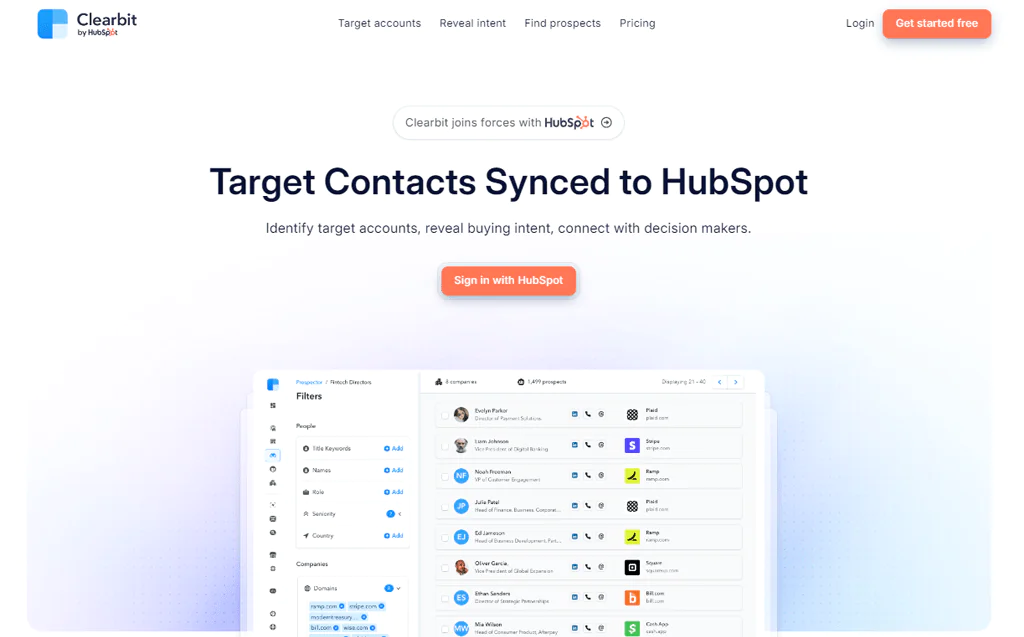
Clearbit was founded in 2014 as an independent sales intelligence and marketing data company, building a reputation for clean firmographic and contact enrichment through a developer-friendly API. That changed in December 2023, when HubSpot acquired Clearbit and rebranded it as Breeze Intelligence, folding its enrichment and buyer-intent capabilities directly into the HubSpot platform.
The practical effect is significant: the standalone Clearbit product is no longer available to new customers, and using its enrichment data now requires an active HubSpot subscription plus a separate credit allotment for advanced features. Teams running Salesforce, Pipedrive, or other CRMs no longer have a supported path to Clearbit’s data without adopting HubSpot.
For businesses already committed to the HubSpot ecosystem, Breeze Intelligence still enriches contact and company records and supports buyer-intent signals. For everyone else, it’s worth treating Clearbit as effectively retired as a standalone option.
Features of Clearbit
Here’s what the platform historically offered, and what still applies inside the HubSpot-owned version.
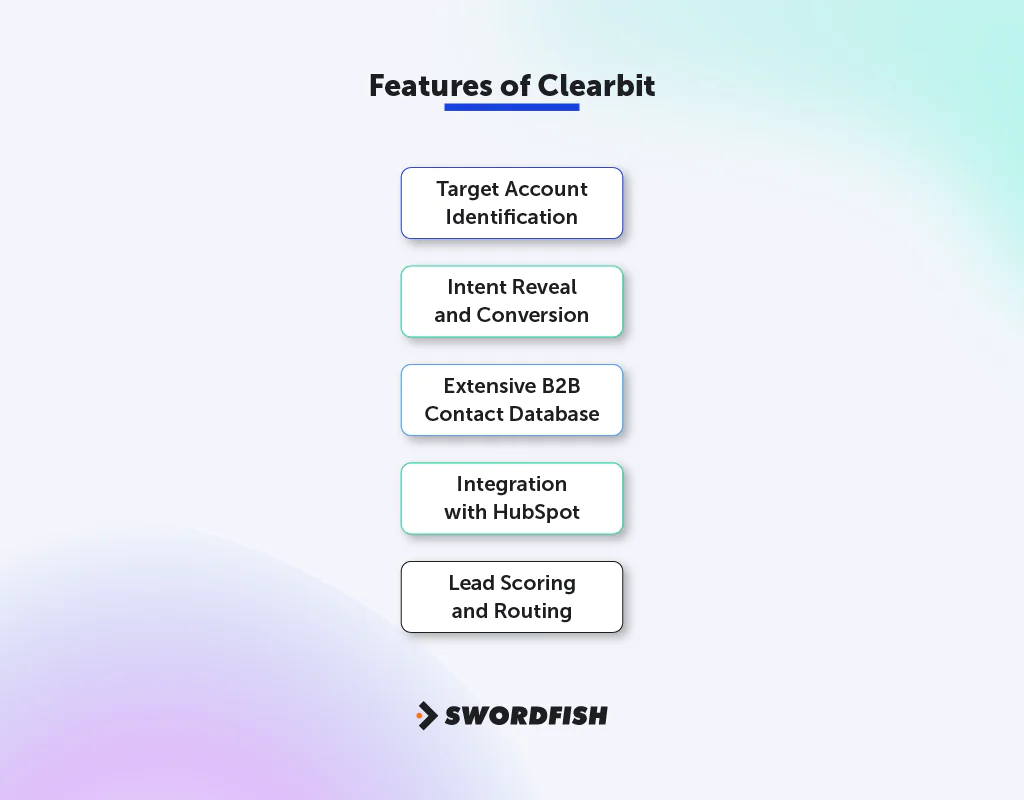
Target Account Identification
Clearbit’s core value was matching companies that fit your ideal customer profile with those already showing interest in your brand, so sales reps could go directly to the right decision-makers instead of cold-calling a broad list.
Intent Reveal and Conversion
The platform flagged which website visitors were most likely to convert, letting sales teams prioritize follow-up on accounts showing genuine buying signals rather than casual traffic.
Extensive B2B Contact Database
Clearbit built its reputation on a large B2B contact database spanning the US, Asia-Pacific, and Europe, which made it easier to locate relevant prospects across regions.
Integration with HubSpot
Now that Clearbit operates as Breeze Intelligence, this is less an integration and more a built-in feature: enrichment happens automatically within HubSpot contact and company records, without a separate setup step.
Lead Scoring and Routing
Lead scoring and routing capabilities helped sales teams personalize outreach by sorting leads based on fit and intent, sharpening the accuracy of forms, ads, and follow-up sequences.
Pros
- Enrichment and buyer-intent data are built directly into HubSpot for existing customers.
- Historically offered a large, verified database of B2B contacts.
- Automatic enrichment within HubSpot contact and company records.
- Lead scoring and routing tools support more targeted outreach.
- Familiar data foundation for teams that used Clearbit before the acquisition.
Cons
- No longer available as a standalone product; requires an active HubSpot subscription.
- Teams on Salesforce, Pipedrive, or other non-HubSpot CRMs have no supported path to the data.
- Primarily focused on B2B, limiting its use for B2C businesses.
What is Demandbase?
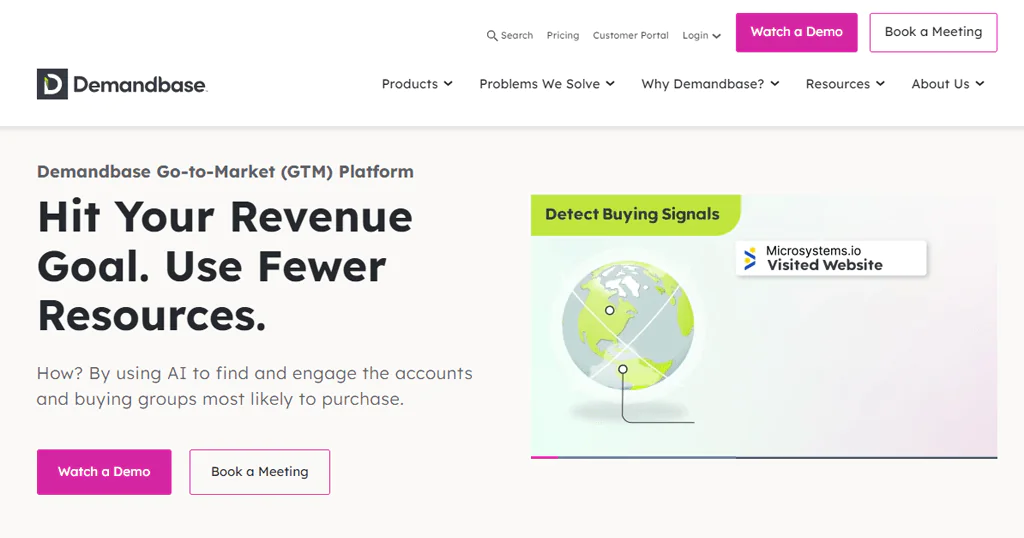
Demandbase, founded in 2007, is a leader in Account-Based Marketing (ABM) and offers a range of Go-to-Market (GTM) tools. Its core platform, Demandbase One™, bundles sales intelligence, buying intent, predictive analytics, advertising, personalization, orchestration, analytics, and B2B data into a single environment.
The platform is built to help businesses understand and engage target accounts rather than individual leads in isolation. Demandbase combines its own data with artificial intelligence to produce what it calls Account Intelligence, which helps identify and prioritize accounts most likely to convert.
Demandbase remains an independent company and continues to position itself around flexibility and a partnership-driven approach to helping B2B companies find and engage target accounts.
Features of Demandbase
Demandbase brings a broad feature set built for account-based strategy.
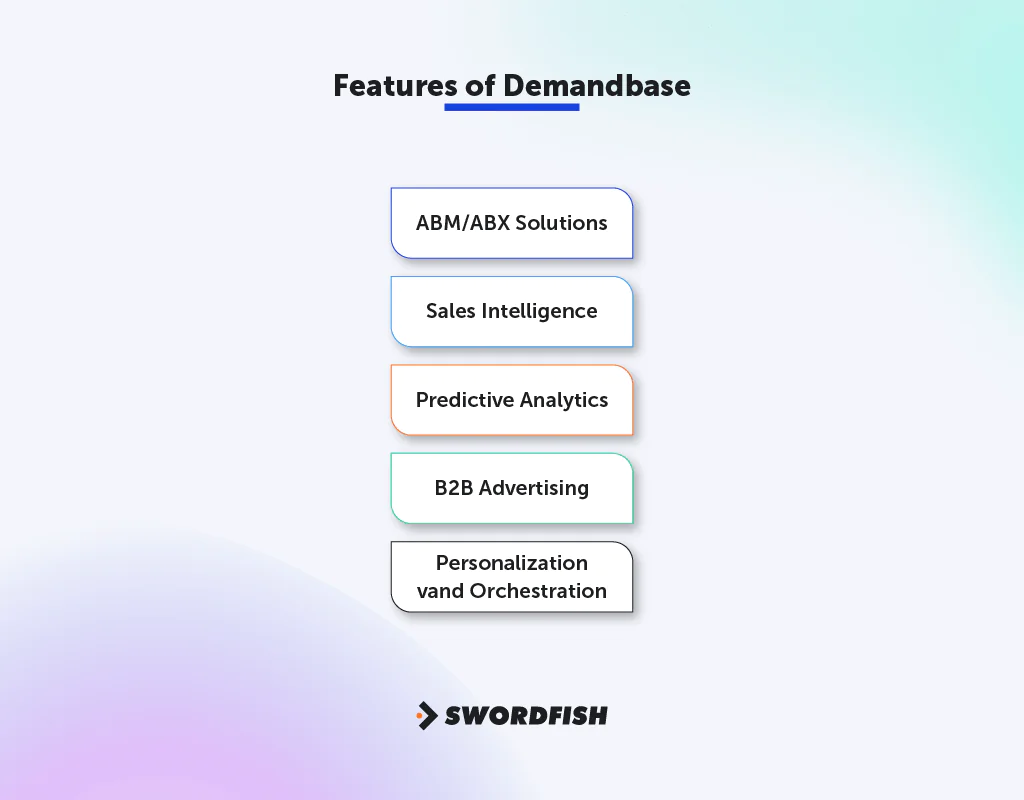
ABM/ABX Solutions
Demandbase provides advanced ABM (Account-Based Marketing) and ABX (Account-Based Experience) solutions, letting teams build marketing strategies aimed specifically at key business accounts to lift engagement and conversion rates.
Sales Intelligence
Sales intelligence tools surface insights on potential buyers, helping teams prioritize the accounts and leads most likely to close rather than spreading effort evenly across a broad list.
Predictive Analytics
Predictive analytics forecast market trends and buyer behavior, giving marketing teams a head start on anticipating customer needs before they surface directly.
B2B Advertising
The platform’s advertising technology targets campaigns precisely at named accounts, which tends to improve the efficiency of ad spend compared to broad demographic targeting.
Personalization and Orchestration
Personalization and orchestration tools tailor the experience for each target account across channels, which raises the likelihood of engagement compared to generic outreach.
Pros
- Tailors marketing strategies specifically to key B2B accounts.
- Enhances engagement and conversion rates with ABM/ABX.
- Predictive analytics anticipate market trends and buyer behavior.
- Specialized B2B advertising targets the right accounts effectively.
- Personalization tools increase engagement and conversion likelihood.
Cons
- Only suitable for larger businesses.
Clearbit vs Demandbase: Key Comparison Table
Here’s a side-by-side look at how the two platforms differ on the fundamentals.
| Features | Clearbit | Demandbase |
|---|---|---|
| Primary Focus | Sales intelligence and prospecting | Go-to-Market (GTM) platform with ABM/ABX |
| Database | 30 million verified B2B contacts | B2B contact database of over 150 million |
| Data Coverage | Over 30 million verified B2B contacts | Extensive B2B data foundation |
| Integration | HubSpot, Google Sheets, Webflow, etc | Salesforce, HubSpot, Marketo, Eloqua, etc |
| User Experience | For Sales teams | For marketing and sales teams |
Clearbit vs Demandbase: In-depth Key Differences
Now let’s break down the differences that matter most when choosing between the two.
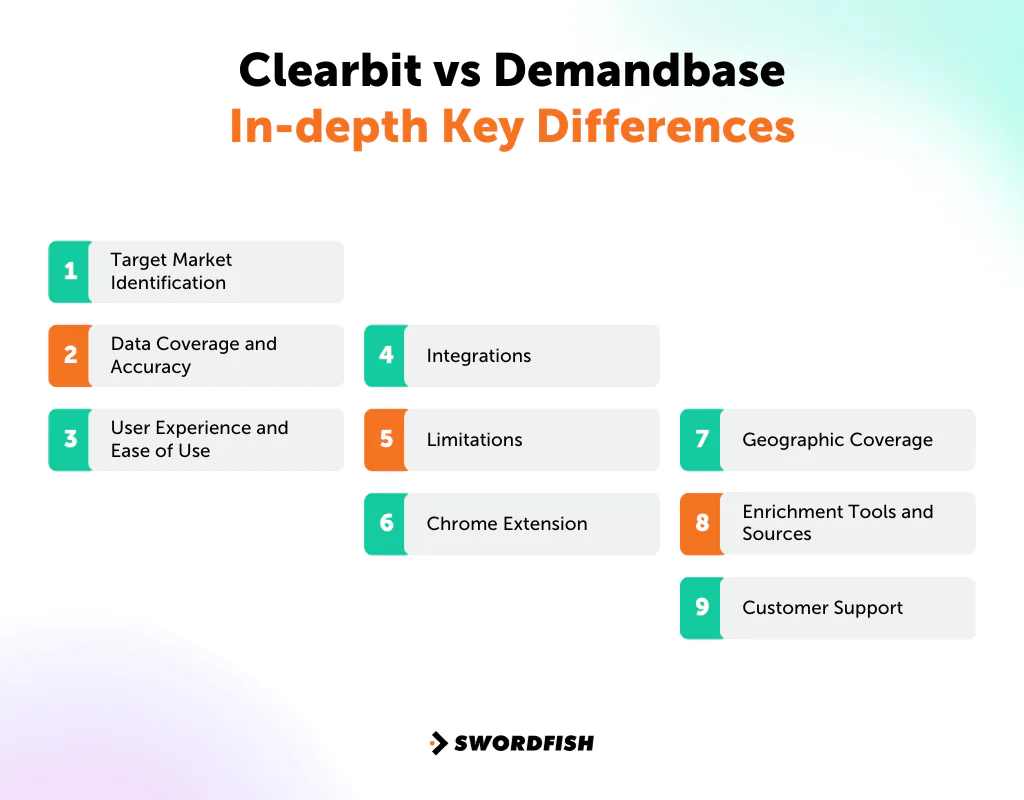
1. Target Market Identification
Clearbit
Clearbit’s core strength was helping teams find and connect with decision-makers in target B2B markets, surfacing companies already showing interest in what you sell.
Demandbase
Demandbase uses AI to identify which businesses and buying groups are most likely to convert, leaning more toward strategic account planning across both sales and marketing.
2. Data Coverage and Accuracy
Clearbit
Clearbit’s database historically covered a large volume of business contacts, giving sales teams a wide pool of potential prospects to work from.
Demandbase
Demandbase pairs a comprehensive B2B data foundation with AI-driven account intelligence, aiming to sharpen predictions about which accounts are worth pursuing.
3. User Experience and Ease of Use
Clearbit
Clearbit was built around direct communication tools and straightforward functionality for sales teams, though today that experience is only accessible through HubSpot’s interface.
Demandbase
Demandbase caters to teams looking for a strategic, data-driven approach to account-based marketing, which typically involves a longer setup and learning curve than a simple prospecting tool.
4. Integrations
Clearbit
Clearbit’s data now lives natively inside HubSpot as Breeze Intelligence, so integration is largely automatic for HubSpot customers but unavailable for teams on other CRMs.
Demandbase
Demandbase integrates with a range of CRM and marketing tools while positioning itself as a complete Go-to-Market platform. Its flagship product, Demandbase One™, combines ABM, sales intelligence, and advertising into one unified system.
5. Limitations
Clearbit
Beyond the HubSpot lock-in, Clearbit’s functionality has always centered on data enrichment rather than broader marketing or sales strategy execution — it’s a data layer, not a full go-to-market platform.
Demandbase
Demandbase’s breadth of GTM tools can make implementation more complex, and smaller businesses may find the platform’s scope beyond their immediate needs or budget.
6. Chrome Extension
Clearbit
Clearbit previously offered a Chrome extension for quick lookups of contact and company data directly from the browser. Since the move to Breeze Intelligence, the experience has shifted toward native enrichment inside HubSpot lists and contact records rather than a standalone browser tool, so teams should verify current availability before relying on it.
Demandbase
Demandbase does not prominently feature a Chrome extension. Its focus is on integrating account intelligence within a business’s existing systems rather than offering standalone browser-based lookup tools.
7. Geographic Coverage
Clearbit
Clearbit’s contact and company data historically spanned the US, APAC, and EMEA, which was useful for businesses operating or expanding globally.
Demandbase
Demandbase also offers global coverage, with a platform designed to support large enterprises identifying and engaging target accounts worldwide.
8. Enrichment Tools and Sources
Clearbit
Clearbit’s enrichment relied on a large B2B data foundation covering detailed company and contact information for targeted marketing and sales use.
Demandbase
Demandbase blends first-party data, AI, and its own data sources for enrichment, layering in technographics, intent data, and account identification for a more holistic view of target accounts.
9. Customer Support
Clearbit
Support for Clearbit’s data capabilities now runs through HubSpot’s own support channels, guides, and community resources rather than a separate Clearbit help desk.
Demandbase
Demandbase emphasizes a partnership approach to support, offering onboarding services, professional services, and an active user community focused on helping clients hit their GTM goals.
Clearbit vs Demandbase: Which One Should You Choose?
The right choice depends heavily on your existing tech stack and your go-to-market strategy.
If your team already runs on HubSpot and wants enrichment and buyer-intent data built directly into the CRM you use daily, Clearbit’s Breeze Intelligence version can still deliver value — but only within that ecosystem.
Demandbase is built for account-based marketing at scale, particularly in B2B contexts where the strategy hinges on targeting a defined list of high-value accounts. It offers advanced analytics and predictive capabilities suited to a more strategic, account-focused approach, and it works independently of any single CRM vendor.
In short: pick Clearbit’s HubSpot-native enrichment if you’re already committed to HubSpot. Choose Demandbase if your strategy centers on targeted account-based marketing and predictive analytics, regardless of CRM.
Your decision should ultimately align with your CRM commitments, budget, and how central account-based strategy is to your go-to-market plan.
Swordfish AI: The Best Clearbit and Demandbase Alternative to Find Contacts
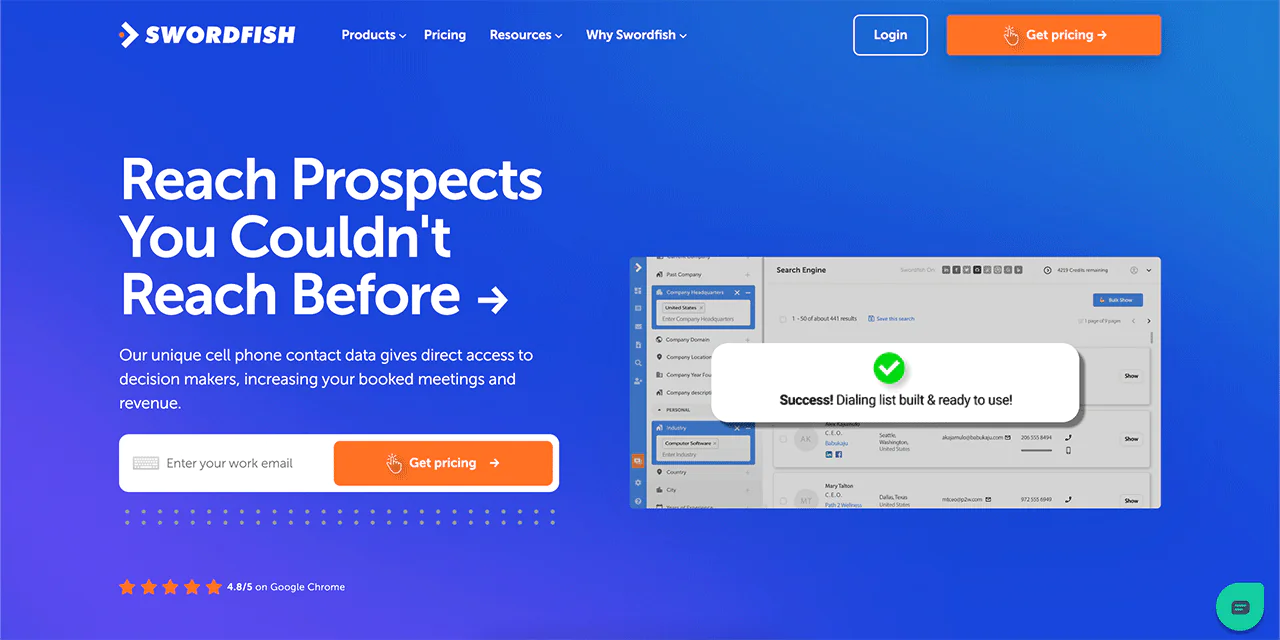
Of all the Clearbit vs Demandbase competitors, Swordfish AI takes a different approach: rather than focusing on account-level intelligence or CRM-locked enrichment, it prioritizes direct access to decision-makers through verified cell phone contact data.
This distinction matters most for sales and recruiting teams working in healthcare and other outreach-heavy sectors, where reaching a provider directly by phone often outperforms email-only or account-based tactics. Swordfish AI’s suite includes a Chrome Extension, Prospector, File Upload, Reverse Search, and API integration, giving teams multiple ways to pull verified contact data into their existing workflow.
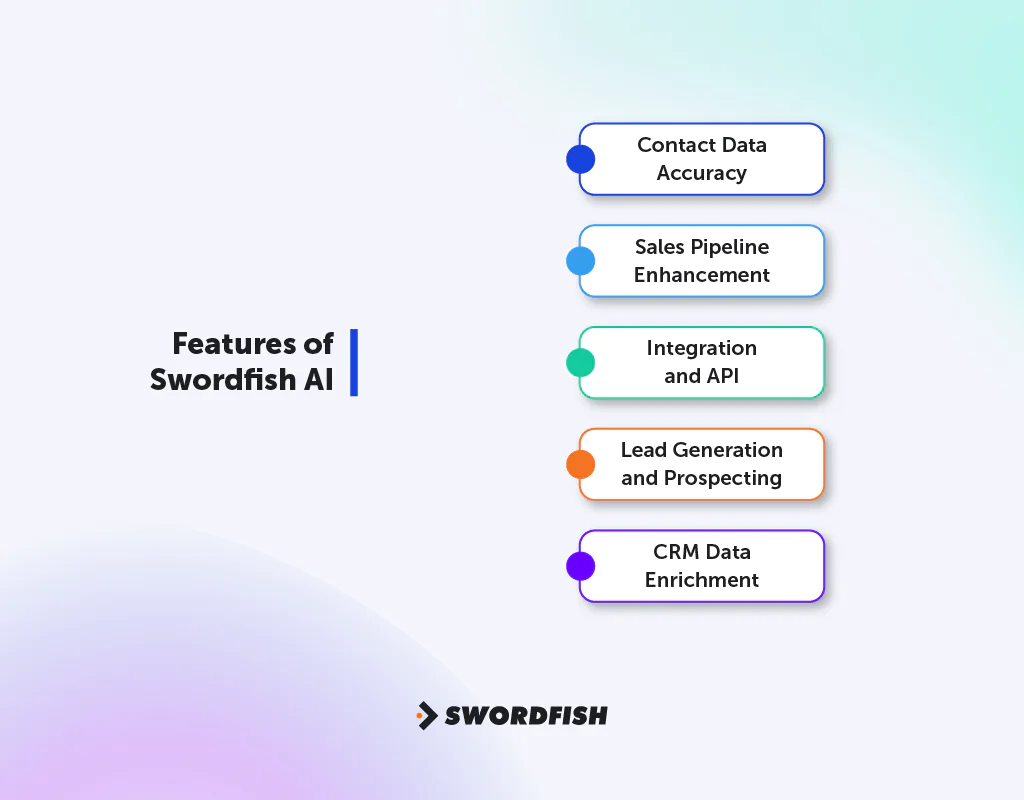
Features of Swordfish AI
Here’s how Swordfish AI’s capabilities line up against Clearbit and Demandbase.
Contact Data Accuracy
Swordfish AI emphasizes cell phone number accuracy with real-time validation, a different priority than Clearbit’s enrichment focus or Demandbase’s account-based orientation. For teams that need to actually reach a decision-maker by phone rather than infer account fit, that distinction matters.
Sales Pipeline Enhancement
The Prospector tool builds targeted dialing and email lists, functionally similar in purpose to Clearbit’s prospecting workflow and Demandbase’s account targeting, but oriented toward direct outreach rather than account scoring.
Reverse Search
Reverse search takes a name or email and returns fuller contact details, which helps confirm you’re reaching the right person. Clearbit’s legacy reverse search worked similarly with email or domain inputs, and Demandbase supports comparable lookups by company name or website for account-level detail.
Integration
Swordfish AI integrates with CRM systems in the same spirit as Clearbit and Demandbase, streamlining how contact records get updated and enriched over time.
API
API access lets teams pull Swordfish AI’s data directly into existing sales platforms, which is useful for organizations wanting to add verified cell phone data without rebuilding their tech stack.
Lead Generation and Prospecting
The Prospector tool supports bulk lead generation similar to Clearbit’s and Demandbase’s lead generation features, with the added emphasis on phone-based outreach for reaching decision-makers directly.
CRM Data Enrichment
The File Upload feature fills in missing contact details, including cell phone numbers and emails, giving teams both phone and email options for outreach rather than relying on a single channel.
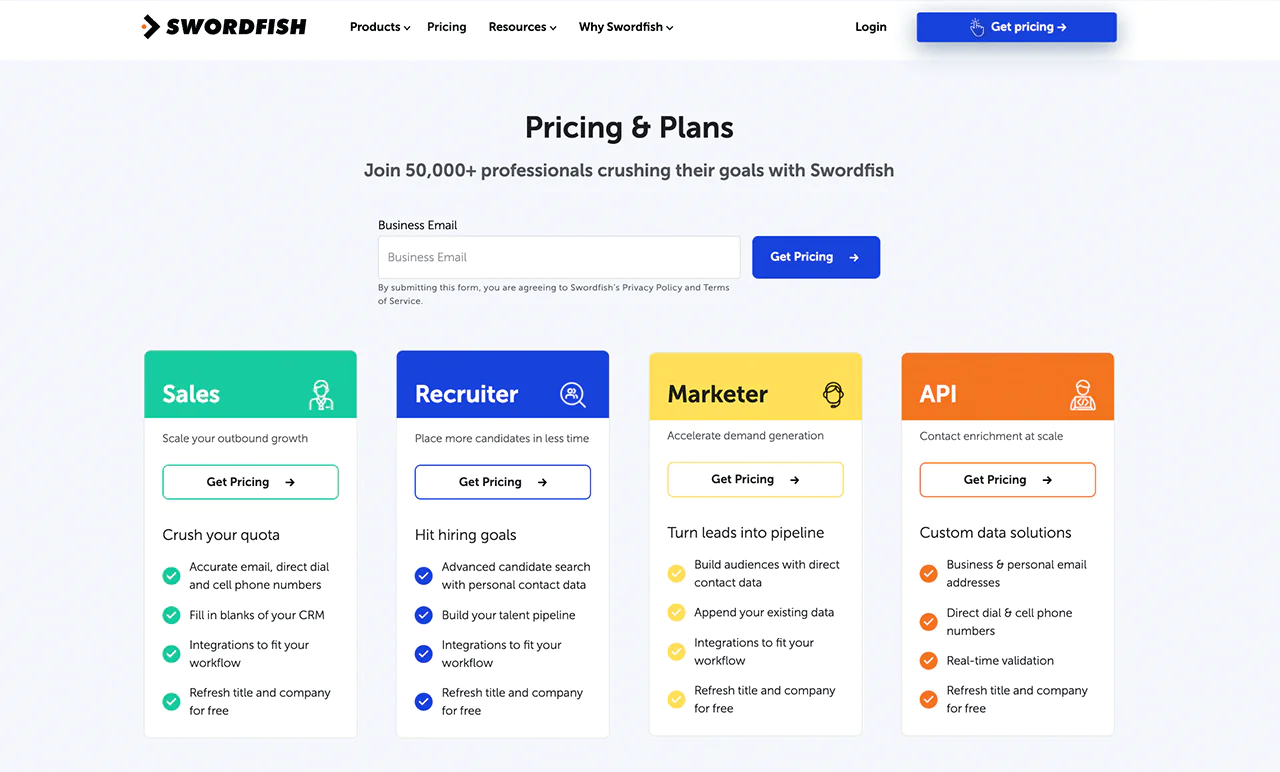
Pricing
Comparison Table: Clearbit vs Demandbase vs Swordfish AI
Here’s how the three platforms stack up side by side.
| Features | Swordfish AI | Clearbit | Demandbase |
|---|---|---|---|
| Primary Focus | Direct access to decision-makers | Sales intelligence and prospecting | Go-to-Market (GTM) platform |
| Contact Data Accuracy | Cell phone number accuracy with validation | Offers accurate B2B contact data | B2B data with a focus on account-based marketing |
| Database | Over 3.5 billion contact data profiles | More than 30 million verified B2B contacts | B2B contact database of over 150 million |
| Integration | LOXO, HubSpot, Salesforce, Pipedrive, etc | HubSpot, Marketo, Pardot, Segment, etc | Salesforce, HubSpot, Microsoft Dynamics |
| Sales Pipeline Enhancement | Tools for creating targeted dialing/email lists | Target account identification, intent reveal, and conversion | ABM/ABX solutions, sales intelligence, B2B advertising. |
| CRM Data Enrichment | Fills in missing cell phone numbers and emails | CRM data with B2B contact information | Account intelligence for CRM data enrichment. |
 Try Swordfish Ai
Clearbit vs Demandbase vs Swordfish AI: Which One Should You Pick?
Choosing between these three comes down to what your team actually needs to do day-to-day, not just what’s marketed as feature-rich.
Swordfish AI
If direct phone access to decision-makers is the priority, Swordfish AI’s emphasis on cell phone data accuracy and real-time validation makes it a fit for sales professionals and recruiters who depend on getting someone on the phone rather than working through an account committee.
Clearbit
If your team is fully committed to HubSpot and wants enrichment and intent data built into that ecosystem, Clearbit’s current form as Breeze Intelligence can serve that need — with the caveat that it’s no longer available outside HubSpot.
Demandbase
If you need a comprehensive Go-to-Market platform built around Account-Based Marketing, Demandbase remains the stronger fit, particularly for larger enterprises with a strategic, account-focused sales and marketing motion.
Conclusion
Clearbit and Demandbase set out to solve different problems, and that’s still true today, even though Clearbit’s ownership and delivery model changed substantially in 2023 and 2024. Clearbit’s capabilities now live inside HubSpot as Breeze Intelligence, which makes sense if you’re already a HubSpot customer but rules it out otherwise. Demandbase continues to operate independently, built for account-based marketing at scale.
Your choice should align with your business needs: Clearbit’s HubSpot-native enrichment for teams already in that ecosystem, and Demandbase for a complete, CRM-agnostic ABM strategy. Whichever direction you lean, Swordfish AI is worth evaluating alongside either option, especially for teams that need verified direct phone contact with decision-makers rather than account-level signals.
FAQs
Is Clearbit useful for market research?
Clearbit’s underlying data can still support market research through sales intelligence and prospecting information, though access now requires a HubSpot subscription rather than a standalone account.
Can startups afford Clearbit and Demandbase?
Startups already on HubSpot can access Clearbit’s enrichment features, but pricing now depends on HubSpot subscription tier plus a separate credit allotment. Demandbase tends to be a larger investment overall, generally suited to businesses with bigger marketing budgets.
What type of businesses benefit most from Demandbase?
Demandbase is particularly beneficial for larger businesses or those focused on B2B marketing. Its account-based marketing approach suits companies targeting specific industry sectors or large accounts.