
 View Products


Last updated: September 3, 2026
Choosing between Apollo and Hunter usually comes down to what kind of outreach you’re running. Apollo.io is built as a sales intelligence and engagement platform with a large contact and company database. Hunter.io does one thing and does it well: finding and verifying professional email addresses.
People put these two tools side by side because they solve overlapping but distinct problems. Apollo covers the broader sales workflow, from prospecting to CRM syncing, while Hunter stays narrowly focused on email discovery and deliverability.
Below is a practical breakdown of what each platform offers, where they differ, and how to decide which one fits your team.
What is Apollo.io?
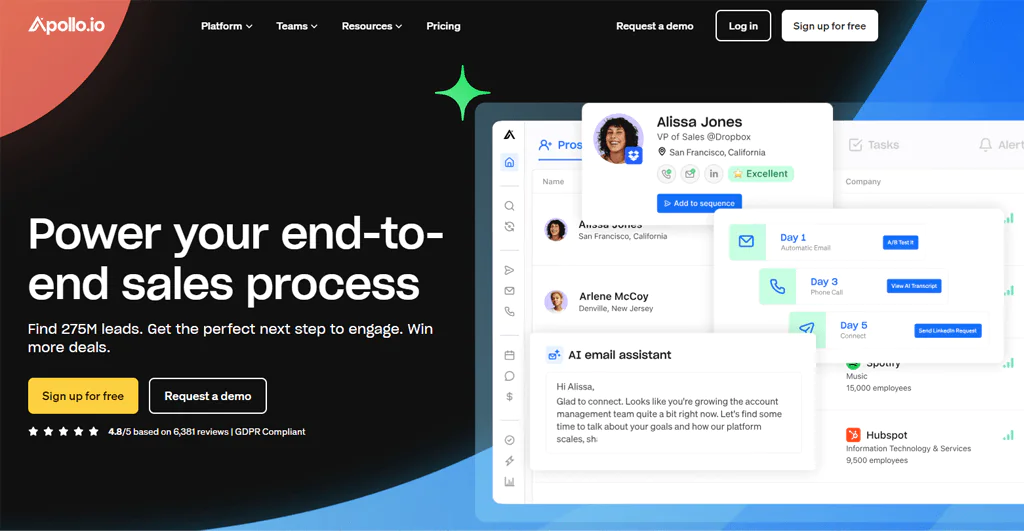
Apollo.io, founded in 2015, is a sales intelligence and engagement platform built to support the end-to-end sales process. Its contact database size has been reported differently across sources and time periods, ranging from roughly 210 million to over 275 million contacts, with companies in the tens of millions, so it’s worth checking Apollo’s own site for the current figure before quoting a number in a proposal or pitch deck.
Apollo’s platform is built to help sales teams identify, connect with, and convert prospects into closed deals. Its interface and integrations with common sales tools make it a practical option for teams trying to consolidate prospecting and outreach in one place.
Features of Apollo
Features of Apollo are given below:
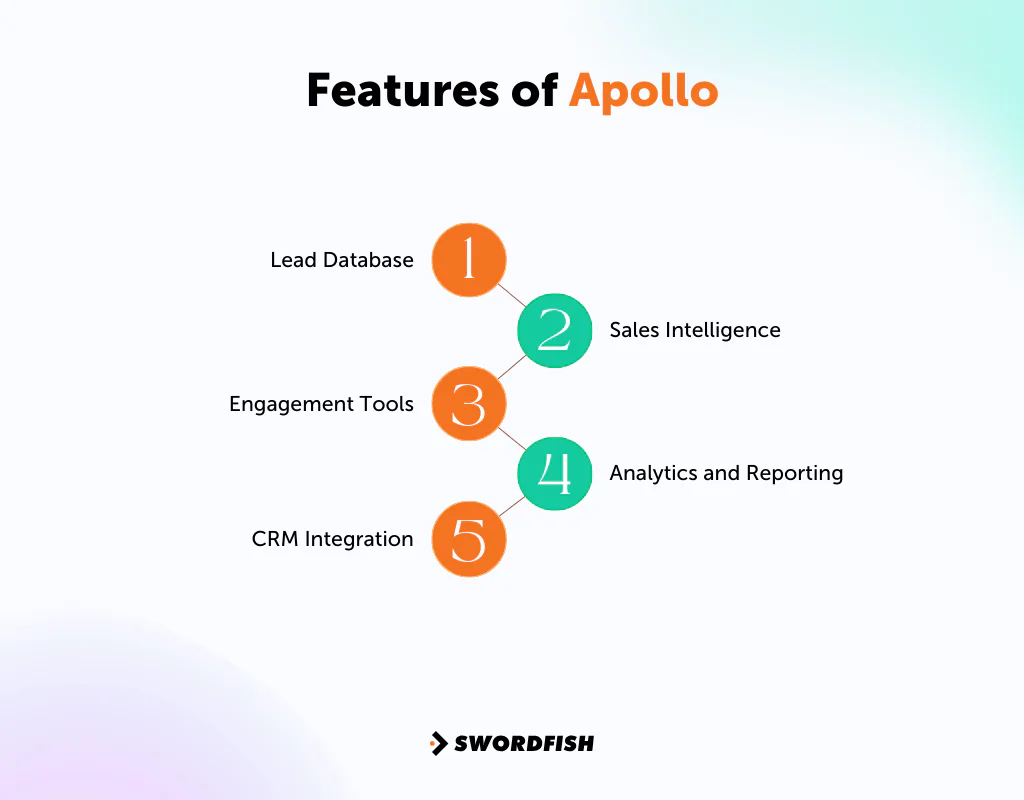
Lead Database
Apollo maintains a large, regularly updated contact database that lets users search and target new leads directly. It offers access to a range of verified emails and phone numbers, which makes it a useful starting point for teams trying to expand their reach.
Sales Intelligence
The platform layers buyer data on top of its contact records, which helps reps understand and prioritize prospects instead of working lists blind. This sales intelligence feature supports more informed targeting decisions and lets teams tailor engagement strategies to individual prospects rather than treating every lead the same way.
Engagement Tools
Apollo bundles email sequencing, call scheduling, and LinkedIn connectivity into one workflow. Paired with its AI features, this keeps outreach cadences consistent without requiring reps to juggle several separate tools.
Analytics and Reporting
Built-in analytics and reporting give teams visibility into pipeline performance. That makes it easier to spot where deals are stalling and adjust messaging or targeting before a quarter is lost.
CRM Integration
Apollo connects with existing CRM systems so contact records stay current without manual re-entry. For teams that already depend on a CRM as their system of record, this reduces the risk of stale or duplicate data.
Pros
- Access to a large and diverse contact database.
- Lead scoring and prioritization features.
- Comprehensive tools for sales engagement.
- Detailed analytics for performance tracking.
- Seamless CRM integration for data management.
Cons
- Overwhelming for new users due to its extensive features.
- Potentially higher cost compared to simpler tools.
What is Hunter.io?
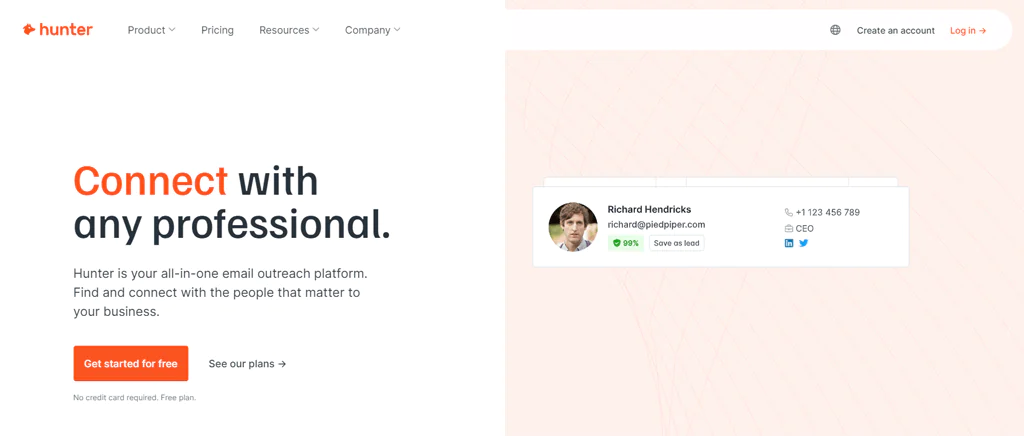
Hunter.io is a specialized email outreach platform built to streamline finding and verifying professional email addresses.
It’s a practical tool for teams trying to reach specific decision-makers rather than casting a wide net. Hunter uses a mix of proprietary matching logic and verification checks to reduce guesswork around whether an email address is actually deliverable.
Whether it’s for cold emailing, building prospect lists, or protecting sender reputation, Hunter offers a straightforward workflow for email-based outreach and marketing.
Features of Hunter
The features of Hunter are given below:
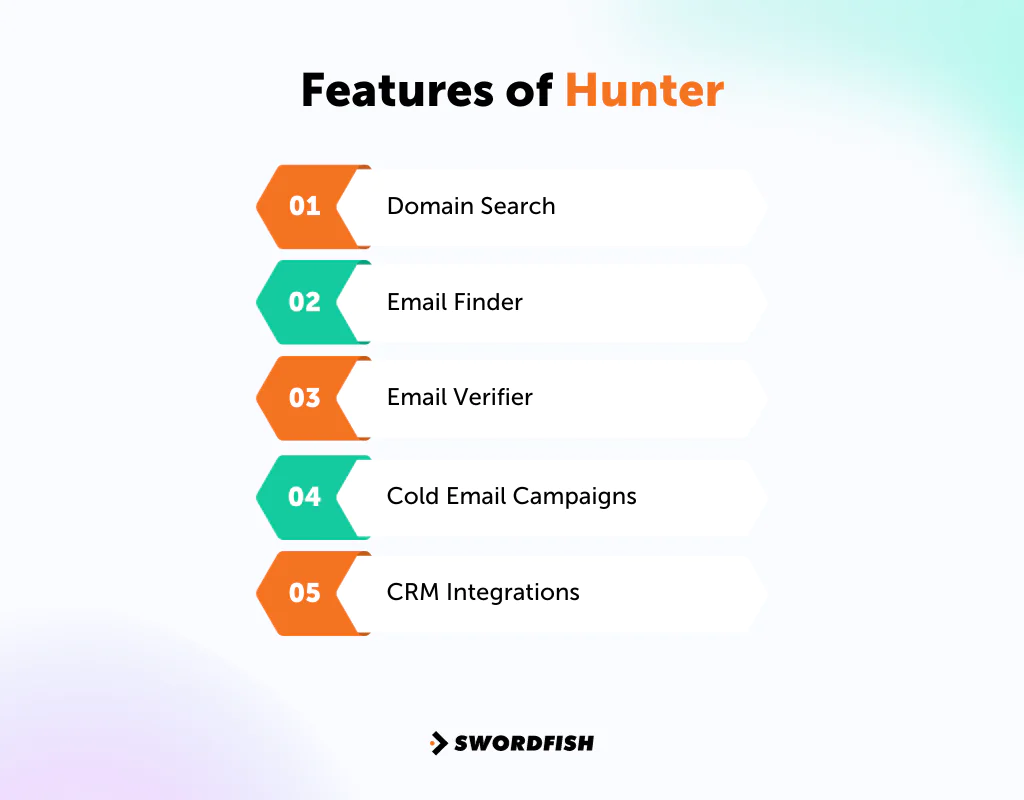
Domain Search
Hunter’s Domain Search lets users find the right contact from a company name or website. This is useful for identifying decision-makers within an organization before you commit to a full outreach sequence.
Email Finder
The Email Finder tool returns verified email addresses from just a name and company. This speeds up building and refining prospect lists for targeted campaigns.
Email Verifier
Hunter’s Email Verifier checks the accuracy of an address before you send to it, which helps avoid bounces and protects sender reputation.
That matters more than it sounds: a spike in bounce rates can get a sending domain flagged, which then hurts deliverability across every future campaign.
Cold Email Campaigns
The platform includes tools for managing cold email campaigns, letting users compose, schedule, and track performance.
This makes it easier to personalize messages, follow up on schedule, and improve reply rates over time.
CRM Integrations
Hunter connects with CRMs including HubSpot, Salesforce, Pipedrive, Zoho CRM, Close CRM, and Copper, along with email services like Gmail and Outlook.
For spreadsheets, it works with Google Sheets, Airtable, and Microsoft Excel, and it supports automation tools like Zapier and Make.com. These integrations are meant to reduce manual data entry between email finding and the systems teams already use daily.
Pros
- Quick and easy access to professional email addresses.
- High accuracy in email verification.
- User-friendly interface for efficient outreach.
- Effective for building targeted email lists.
- Integrates well with CRM and other tools.
Cons
- Primarily focused on email data, which limits versatility for broader sales workflows.
- The free plan has practical limits that may not suit larger businesses.
Apollo vs Hunter: Key Comparison Table
When comparing Apollo and Hunter, it helps to look past the marketing copy and focus on what each tool is actually built to do. Here’s a side-by-side comparison:
| Feature | Apollo | Hunter |
|---|---|---|
| Primary Focus | Sales intelligence and engagement platform | Email finding and verification platform |
| Lead Database | Large B2B contact and company database (size varies by source and plan) | Not a standalone database; focused on finding decision-makers’ contact details |
| Engagement Tools | Tools for email, call, and LinkedIn engagement | Cold email campaign management |
| CRM Integration | LinkedIn, Gmail/Outlook, Salesforce, HubSpot, Outreach | HubSpot, Salesforce, Pipedrive, Zoho CRM |
| Compliance | GDPR compliant | Data compliance and transparent sourcing |
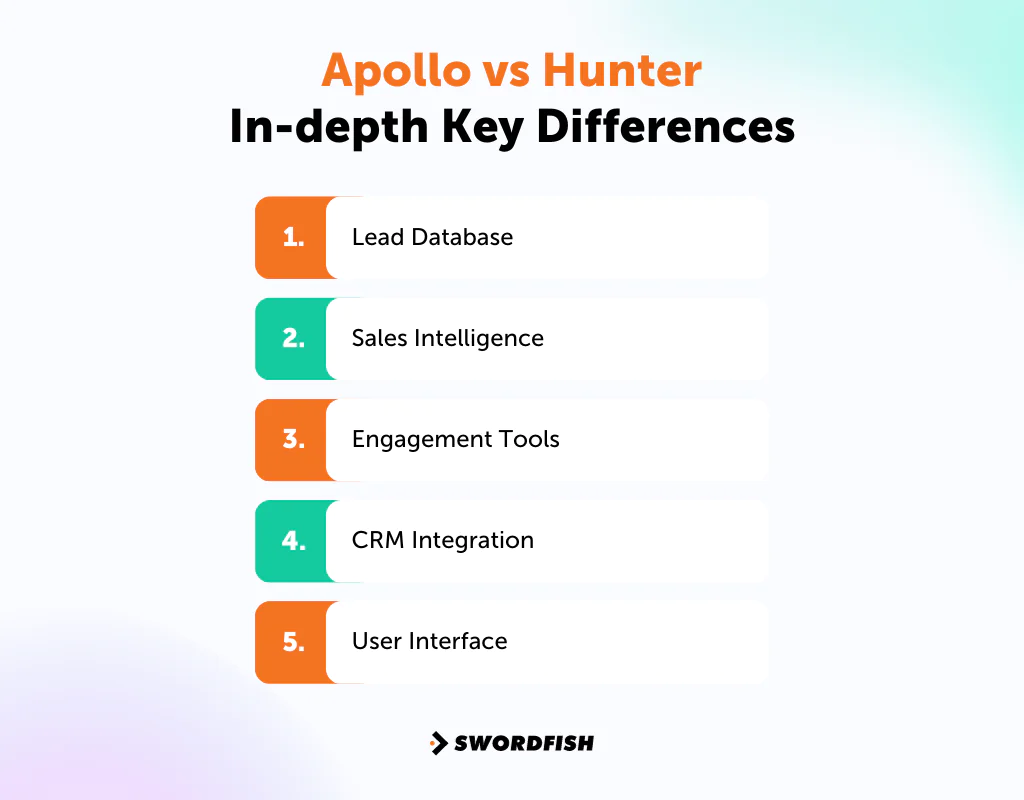
Apollo vs Hunter: In-depth Key Differences
Now let’s break down the differences in more detail:
1. Lead Database
Apollo
Apollo offers a large lead database that’s well suited for broad lead generation across industries and roles.
Hunter
Hunter doesn’t publish a database size in the same way. Instead, it focuses on finding decision-makers’ contact details, particularly email addresses, on demand rather than through a static list.
2. Sales Intelligence
Apollo
Apollo layers buyer data and lead scoring on top of its contact records, which suits teams that want deeper insight before prioritizing outreach.
Hunter
Hunter’s intelligence centers on email verification and domain search, so it’s more focused on email data accuracy than broader buyer signals.
3. B2B/B2C Focus
Apollo
Apollo is primarily built for B2B sales, with a company database and workflow designed to power end-to-end sales processes. That makes it a strong choice for B2B teams that need extensive lead data alongside sales intelligence.
Hunter
Hunter specializes in finding and verifying professional email addresses, which makes it useful for both B2B and B2C applications. Its focus on email outreach and verification benefits businesses connecting with professionals across a range of industries.
4. Filtering Options
Apollo
Apollo provides advanced filtering across its database, letting users narrow leads by criteria like title, seniority, and industry. This matters for teams targeting specific segments within the B2B space.
Hunter
Hunter’s search tools, like domain search and email finder, are built for finding and verifying individual contacts quickly rather than segmenting broad markets.
5. Limitations
Apollo
Apollo’s breadth of features can be more than smaller teams need, and some users find its data volume overwhelming without a clear filtering strategy.
Hunter
Hunter’s tight focus on email means it won’t give B2B teams the broader sales intelligence or contact-type diversity that some workflows require.
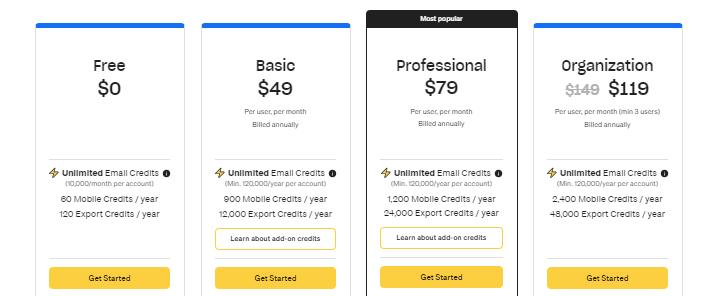
6. Pricing
Apollo
Apollo offers a range of pricing tiers, from free to organizational plans, structured to match different business sizes and levels of feature access.
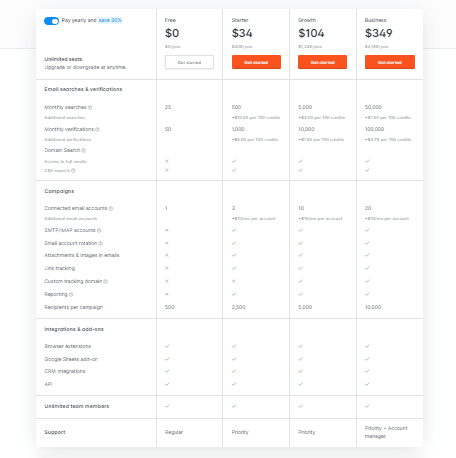
Hunter
Hunter.io also has various pricing models, including a free option. Its plans scale with usage volume, which fits teams that mainly need email finding and verification.
7. CRM Integration
Apollo
Apollo integrates with CRMs to keep sales data enriched and synced across the workflow, covering more ground than email alone.
Hunter
Hunter’s CRM integration is focused on syncing email data specifically, which keeps its footprint narrower but more specialized.
8. User Interface
Apollo
Apollo’s interface reflects its scope, managing a complete sales process, which can feel dense but rewards teams needing a full toolkit.
Hunter
Hunter’s interface stays simple and task-focused, which suits teams that just want fast, reliable email outreach without extra complexity.
Apollo vs Hunter: Which One Should You Choose?
When choosing between Apollo and Hunter, weigh their distinct strengths against your actual workflow rather than feature lists alone.
Apollo is built for comprehensive B2B sales, with a large contact database and features like lead scoring. It suits businesses that want an all-in-one platform for prospecting and sales intelligence, especially in B2B.
Hunter specializes in finding and verifying professional email addresses. Its focus on domain search and verification makes it a fit for both B2B and B2C teams running email-centered outreach.
In short: pick Apollo for a broad B2B sales workflow with built-in intelligence. Pick Hunter if precise email outreach and verification is your main priority.
The Best Alternative to Apollo vs Lusha: Swordfish AI
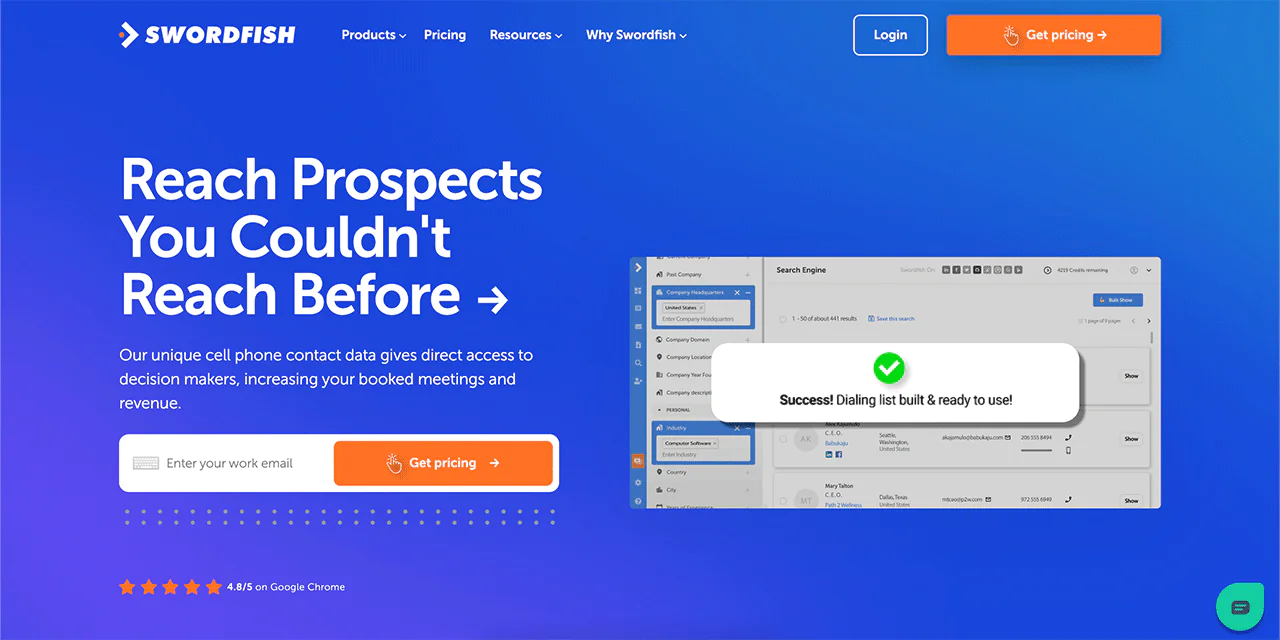
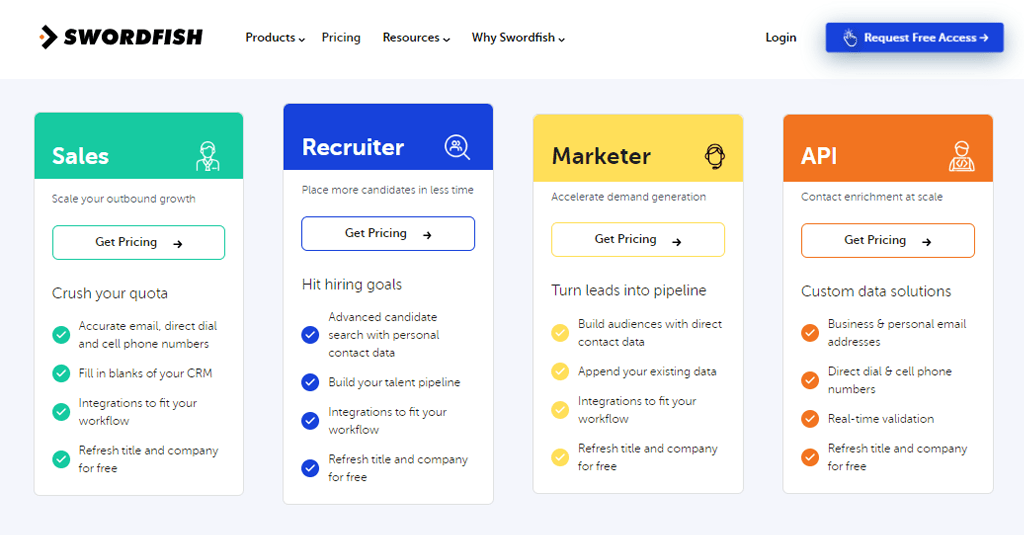
Among the alternatives worth considering, Swordfish AI stands out as a contact data platform with a different angle: direct access to decision-makers through cell phone contact data, backed by a database of 3.5 billion data points.
It’s trusted by over 50,000 sales and recruitment professionals for its accuracy in cell phone number match rates. Swordfish AI’s platform is built to speed up sales and recruitment workflows through real-time validation of contact information.
For teams whose outreach depends on getting someone on the phone rather than just into an inbox, that distinction matters. It’s one reason healthcare recruiters and sales teams increasingly need verified mobile numbers rather than relying on email alone, since clinicians and administrators are often harder to reach through generic corporate inboxes.
Features of Swordfish AI in Common with Apollo and Hunter
Let’s look at where these three tools overlap:
Prospecting
Like Apollo and Hunter, Swordfish AI offers prospecting tools that let users build targeted lists for calling or emailing, similar to Apollo’s lead database and Hunter’s email finder.
Chrome Extension
Swordfish AI’s Chrome Extension lets users find contact information across the web, similar to Apollo and Hunter’s browser extensions. This is useful for quick lookups on platforms like LinkedIn, Twitter, and Facebook.
Bulk Data Handling
Swordfish AI, like Apollo and Hunter, supports bulk data handling. Users can upload files to fill in missing contact information across a CRM, which mirrors Apollo’s CRM enrichment and Hunter’s bulk tasks.
API Integration
Swordfish AI offers API integration for scaling contact data into existing applications, similar to what Apollo and Hunter provide.
Accuracy and Real-Time Validation
Swordfish AI emphasizes accuracy in its contact data, especially cell phone numbers, along with real-time validation, comparable in spirit to Hunter’s email verification and Apollo’s emphasis on data accuracy.
Pricing
Swordfish AI encourages visitors to contact them for pricing tailored to different needs, including sales, recruitment, marketing, and API usage, which suggests custom pricing based on individual or business requirements.
Comparison Table: Apollo vs Hunter vs Swordfish AI
Here’s a side-by-side look at Apollo, Hunter, and Swordfish AI:
| Features | Apollo | Hunter | Swordfish AI |
|---|---|---|---|
| Primary Focus | Sales intelligence and engagement platform | Email finding and verification platform | Cell phone number and email finding |
| Database | Large B2B contact and company database (size varies by source) | Not specified | Over 3.5 billion contact data profiles |
| Chrome Extension | Finding and engaging leads | Finding email addresses on the web | Accessing unique and verified contact data on various platforms |
| Bulk Data Handling | CRM enrichment and API enrichment | Bulk tasks for email finding and verification | Bulk lead finding and CRM data filling |
| Real-Time Validation | Not specified | Email verification for sender reputation protection | Real-time line connectivity validation for cell phone numbers |
 Try Swordfish Ai
Apollo vs Hunter vs Swordfish AI: Which One Should You Go For?
Choosing between Apollo, Hunter, and Swordfish AI isn’t about picking a single winner. It’s about matching the tool to what your outreach actually depends on.
Apollo
If your primary need is comprehensive sales intelligence and engagement, Apollo is the stronger fit. It combines a large contact and company database with lead scoring, engagement tools, and CRM integration.
That makes it a good match for businesses wanting one platform to manage the full sales process.
Hunter
If your focus is primarily email outreach, Hunter is the better choice. It’s built around finding and verifying professional email addresses, which suits businesses that rely heavily on email marketing and cold outreach.
Hunter’s simplicity and effectiveness in verification and campaign management make it a solid pick for email-centered strategies.
Swordfish AI
Swordfish AI, with its focus on cell phone contact data, stands out for teams that prioritize direct phone communication with decision-makers.
If your strategy involves phone outreach or you need accurate cell phone numbers, Swordfish AI covers ground that neither Apollo nor Hunter is built to address.
Conclusion
Apollo and Hunter serve different purposes even though they’re often compared side by side.
Apollo works well for teams that need a wide-ranging sales intelligence platform with a large contact database and engagement tools. Hunter is built for teams focused on email outreach, offering efficient email finding and verification.
If your goal is building and managing email campaigns specifically, Hunter is the more direct path. Ultimately, the choice comes down to whether you need a broad sales tool or a specialized email outreach solution.
Swordfish AI is worth considering as well, particularly for contact data finding and direct phone communication, making it a practical alternative to both Apollo and Hunter for teams that need verified mobile numbers.
FAQs
Can Apollo and Hunter be used together?
Yes. Apollo can manage your overall sales process, while Hunter strengthens your email outreach specifically. Using both can cover more ground than relying on either alone.
Is Apollo better than Hunter for lead generation?
Apollo is generally more comprehensive for lead generation since it offers a broader database and tools for engaging leads. Hunter specializes in finding email addresses, which covers just one part of the lead generation process.
Does Hunter offer the same sales intelligence as Apollo?
No. Hunter is primarily an email-finding and verification tool, while Apollo provides broader sales intelligence and engagement features.