
 View Products


Last updated: September 3, 2026
Apollo.io built its reputation on a large contact database and an AI-driven approach to surfacing high-value leads. For many sales teams, it’s a reasonable starting point: the interface is approachable, and the pricing works for smaller budgets.
But database size and interface polish aren’t the whole story. Teams that depend on direct phone outreach, real-time contact validation, or healthcare-specific data quality often run into gaps with Apollo, particularly around cell phone coverage, integration depth, and how current the contact records actually are.
This guide walks through the strongest Apollo alternatives on the market, what each one does well, where it falls short, and how to think through the decision for your own team.
Quick List of Top 5 Alternatives to Apollo
Here’s a fast overview before we go deeper into each platform.
- Swordfish AI: Best for direct access to decision-makers through unique cell phone data and real-time validation.
- Lusha: Best for increasing B2B sales with high-quality data on social networks and Salesforce.
- Zoominfo: Best for deep B2B insights and extensive databases for marketing and sales professionals.
- Clearbit: Best for HubSpot users seeking targeted account insights and AI-powered prospecting tools.
- Hunter: Best for quick, reliable email finding and verification, ideal for effective email outreach.
Reasons to Consider an Apollo.io Alternative
None of these are dealbreakers on their own, but together they explain why so many teams end up shopping for a second tool or a full replacement.
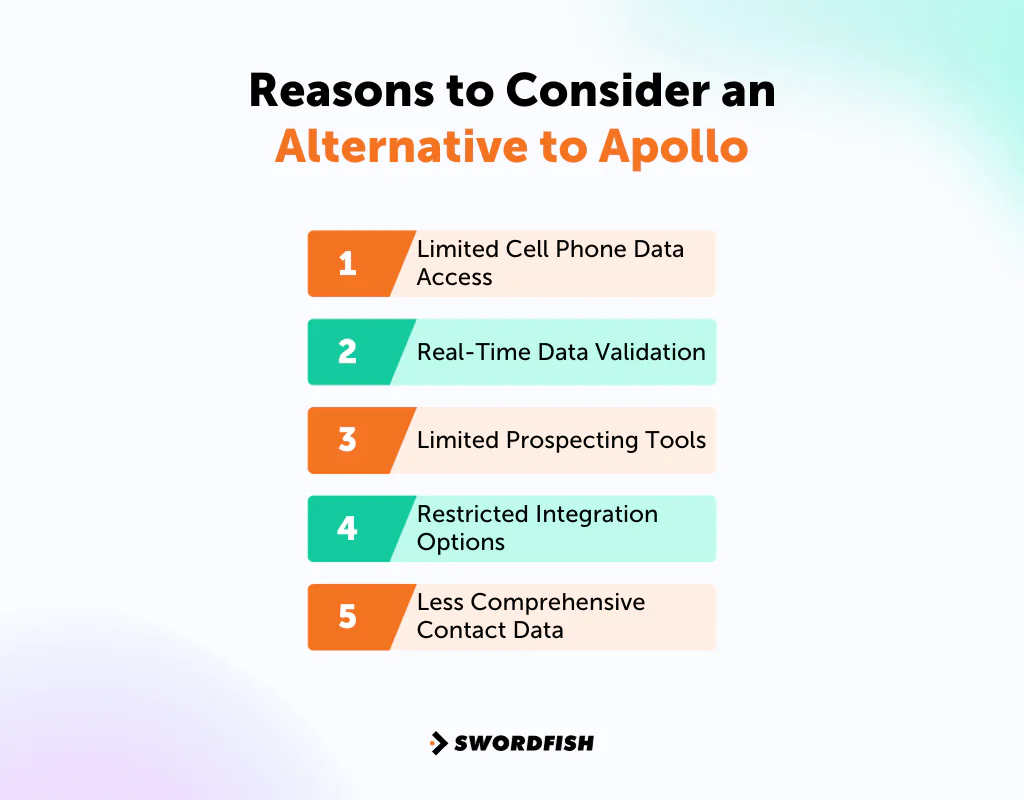
Limited Cell Phone Data Access
Apollo covers a lot of ground, but cell phone data specifically tends to be thinner than its email coverage. That matters if your team relies on direct-dial outreach for sales, recruiting, or provider networking, where reaching someone on their mobile is often the difference between a connection and a voicemail.
Real-Time Data Validation
Another gap worth flagging is real-time data validation. Confirming that a number or email is still active before you dial or send saves reps from wasted calls and bounced messages, and it’s a feature some alternatives handle more directly than Apollo does.
Limited Prospecting Tools
If you need more sophisticated list-building, such as layered filters or bulk enrichment workflows, Apollo’s prospecting tools can feel basic by comparison, which slows down campaign setup for larger teams.
Restricted Integration Options
CRM and platform integrations are another area where Apollo can feel narrower than some alternatives, and that matters if your stack depends on smooth two-way data flow.
Less Comprehensive Contact Data
Some alternatives simply cover more contacts and companies, or go deeper on a specific vertical, which widens your addressable outreach list.
Top 5 Apollo Competitors: Comparison Chart
Here’s a quick side-by-side look at how these five stack up on the basics.
Tools | Database | Target Audience | Unique Selling Point |
 | 3.5 billion data profiles | Sales & recruitment professionals | Real-time data validation |
 | 220 Million data entries | B2B sales, marketing teams | User-friendly, efficient outreach |
 | 600M+ professional profiles | Sales professionals, marketers | Extensive market insights |
 | 30 million verified contacts | B2B sales, marketing teams | HubSpot integration, data accuracy |
 | Professional email database | Email marketers, sales teams | High deliverability, compliance focus |
Top 5 Apollo.io Competitors for Better Lead Generation and Identification
Below, we break down each competitor in more detail, covering what they do well and where they’re better suited than Apollo.
1. Swordfish AI
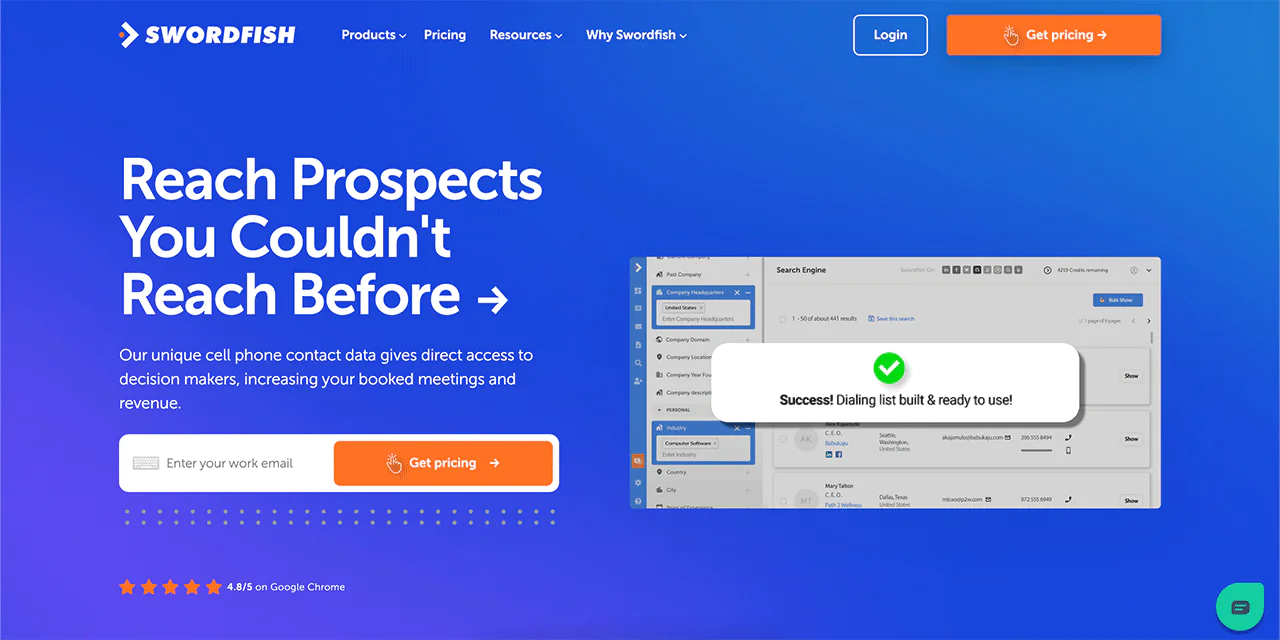
Swordfish AI is built specifically around finding direct contact details, cell phone numbers and emails included, and is used by sales and recruitment professionals who need to reach people who aren’t easy to find through standard databases.
The platform emphasizes accuracy in its cell phone data and includes real-time verification so you know whether a number is still connected before you dial.
It ships with a Chrome Extension, Prospector, File Upload, Reverse Search, and API integration, tools that support finding and verifying contact details across platforms like LinkedIn, Twitter, and Facebook.
That combination makes it a solid fit for building accurate dialing and email lists or enriching an existing CRM database with verified contact information.
About Swordfish
- Founding Team: Ben Argeband
- Founding Year: 2015
- Company Size: 11 to 50 employees
What Sets Swordfish Apart?
A few things distinguish Swordfish AI from a typical contact database.
Verified phone numbers matter most for cold calling, since a wrong number wastes time and hurts caller reputation. That’s a big help for sales and recruiting teams trying to reach potential leads quickly and without guesswork.
The database itself is sizable, drawing on 3.5 billion data profiles. That scale gives users room to find new leads and expand their networking reach.
Unlike Apollo, which doesn’t validate line connectivity in real time, Swordfish AI focuses on keeping contact details current, which cuts down on time wasted chasing dead numbers or outdated emails.
Put together, the mix of verified phone data and a large underlying database makes Swordfish a practical tool for direct outreach and cold calling.
That focus on accurate, wide-reaching contact information is also why it comes up often in discussions of B2B lead generation tools generally.
Key Features of Swordfish AI
Swordfish AI’s feature set is built around effective lead generation and outreach for sales and recruiting teams. Here’s what’s included:
-
API Integration
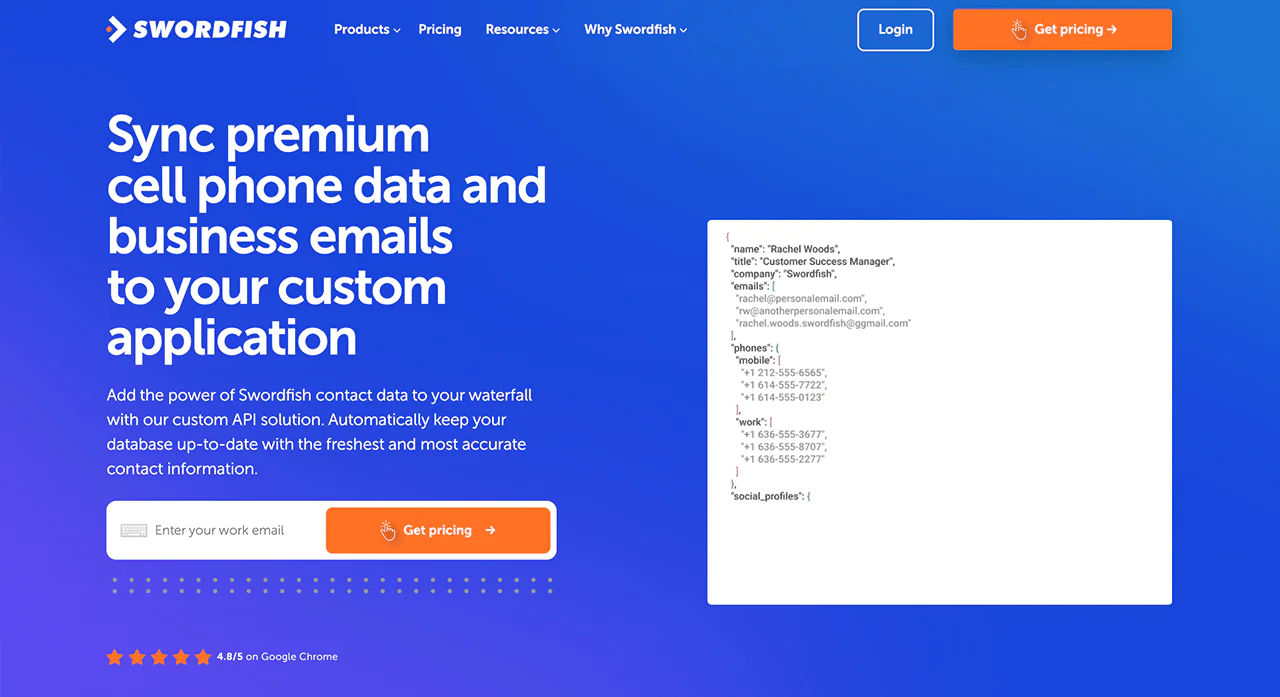
Swordfish AI’s API integrates into existing systems so contact data retrieval can run inside your own applications rather than requiring a separate tool.
-
Reverse Search
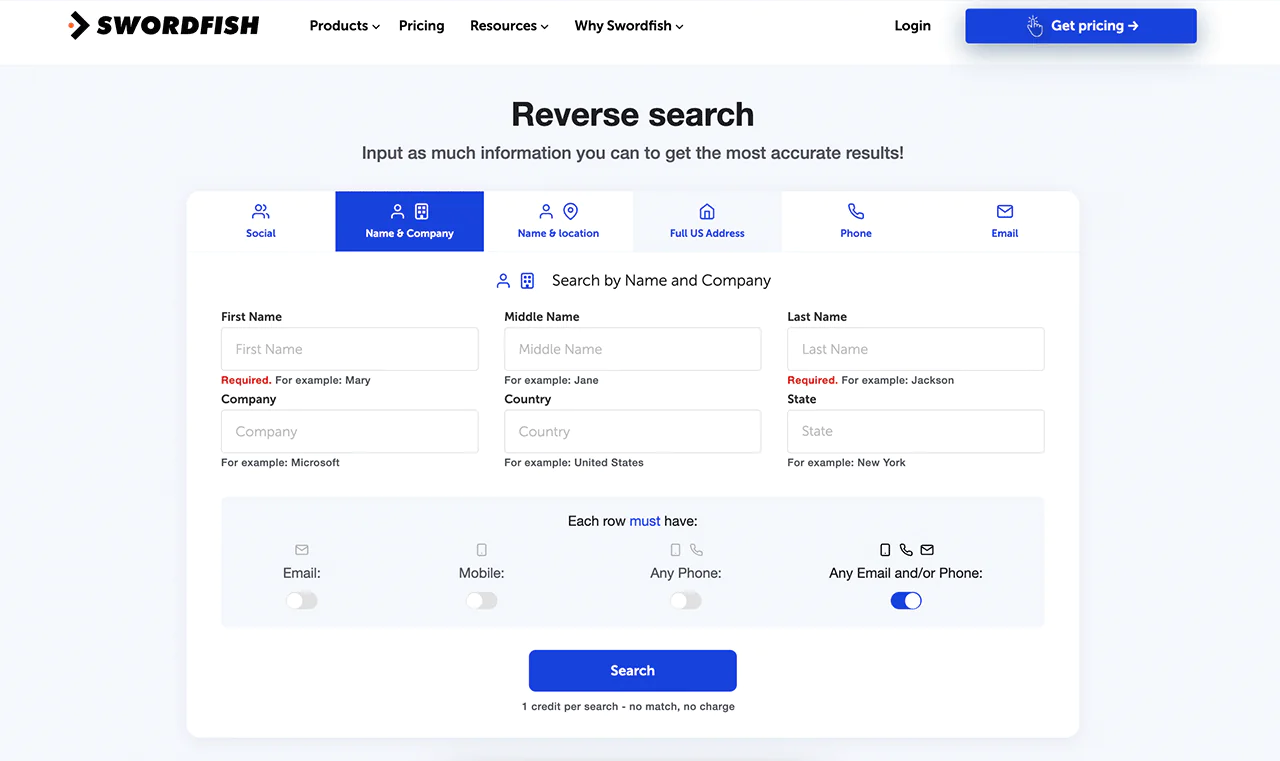
The Reverse Search tool lets you find detailed contact information from minimal input, a name or a company, which helps close gaps in an existing contact list.
-
Chrome Extension
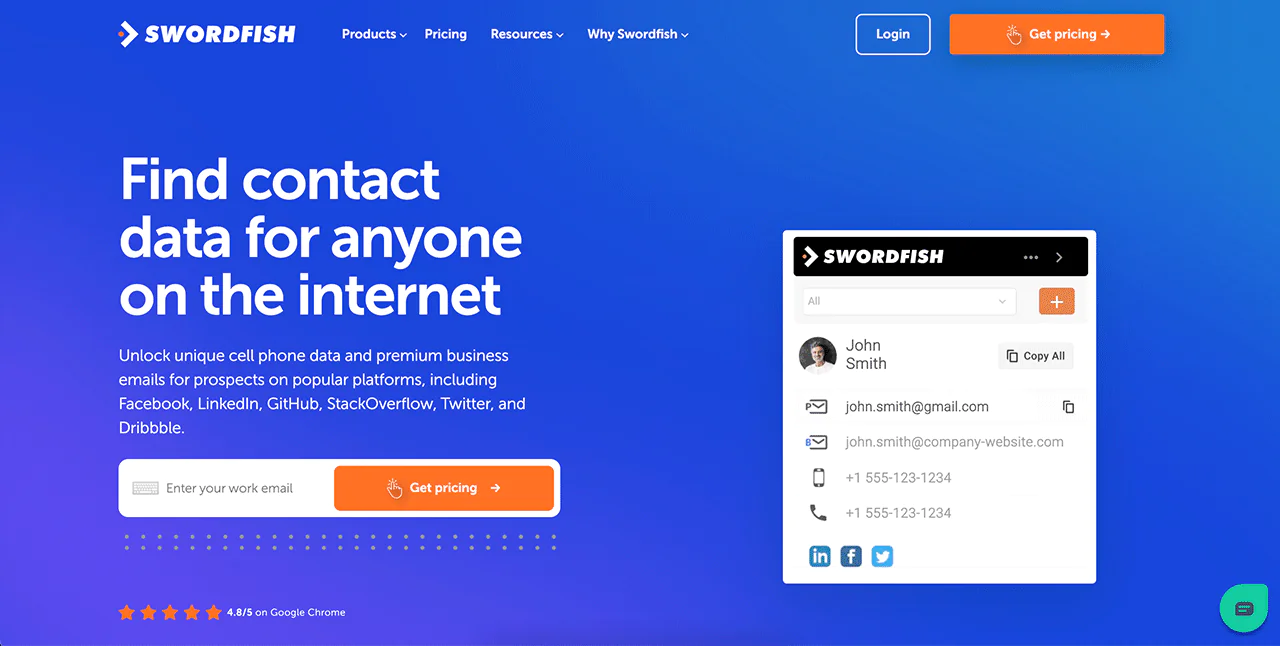
The Chrome Extension finds contact information across platforms like LinkedIn, Twitter, Facebook, and Dribbble while you browse, which keeps prospecting moving without switching tabs.
-
Prospector
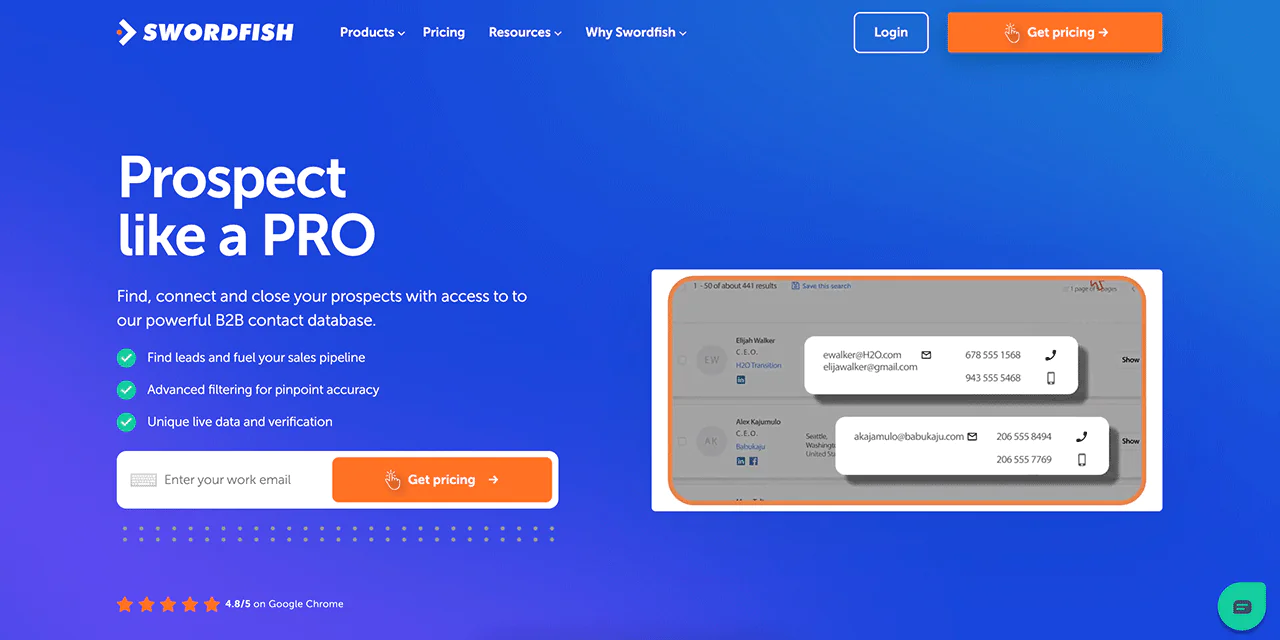
The Prospector tool is built for bulk lead generation, using filters to create precise calling or emailing lists rather than one-off lookups.
-
Bombora
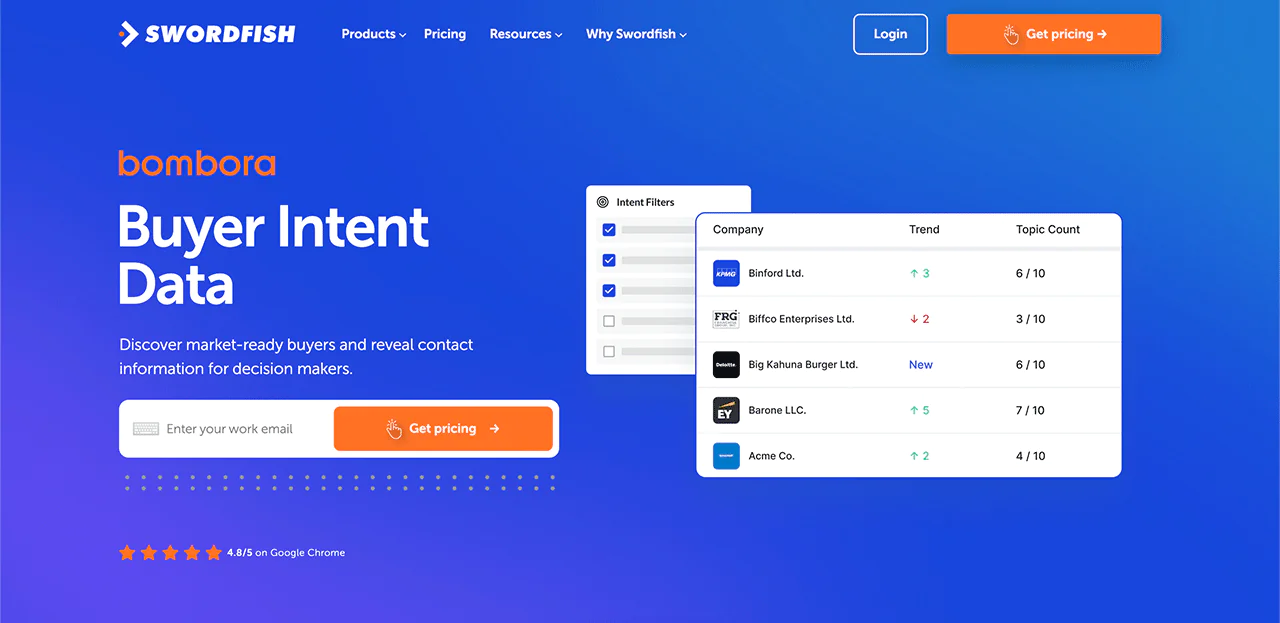
Through Bombora intent data, Swordfish AI can flag businesses actively researching your category of product, which helps prioritize outreach toward prospects who are already looking.
Best Use Cases of Swordfish AI
A few scenarios where Swordfish tends to earn its keep:
- Sales Lead Generation: Direct contact details help shorten the path from prospect to conversation.
- Recruitment and Talent Acquisition: Recruiters can find accurate contact information for candidates faster, which speeds up outreach.
- Market Research: A large database supports research into industry trends and demographic targeting.
- Networking and Relationship Building: Useful for finding and connecting with key people in your industry.
- Customer Outreach: Verified contact details help make sure communication reaches the right people.
- Event Planning and Promotion: Organizers can identify and contact potential attendees, sponsors, and speakers.
- Fundraising and Investor Relations: Startups and nonprofits can connect with potential investors and donors through verified channels.
- Competitive Analysis: Useful for gathering contact information on stakeholders at competing companies.
Pros of Using Swordfish
- Provides direct access to decision-makers cell phone numbers.
- Features real-time verification for accurate contact details.
- Ideal for sales, recruitment, and other professional outreach.
- Smooth and easy-to-navigate interface to get started right away.
- Integrated tools make finding contacts quick and easy.
Cons of Using Swordfish
- The pricing plans are customized.
Pricing
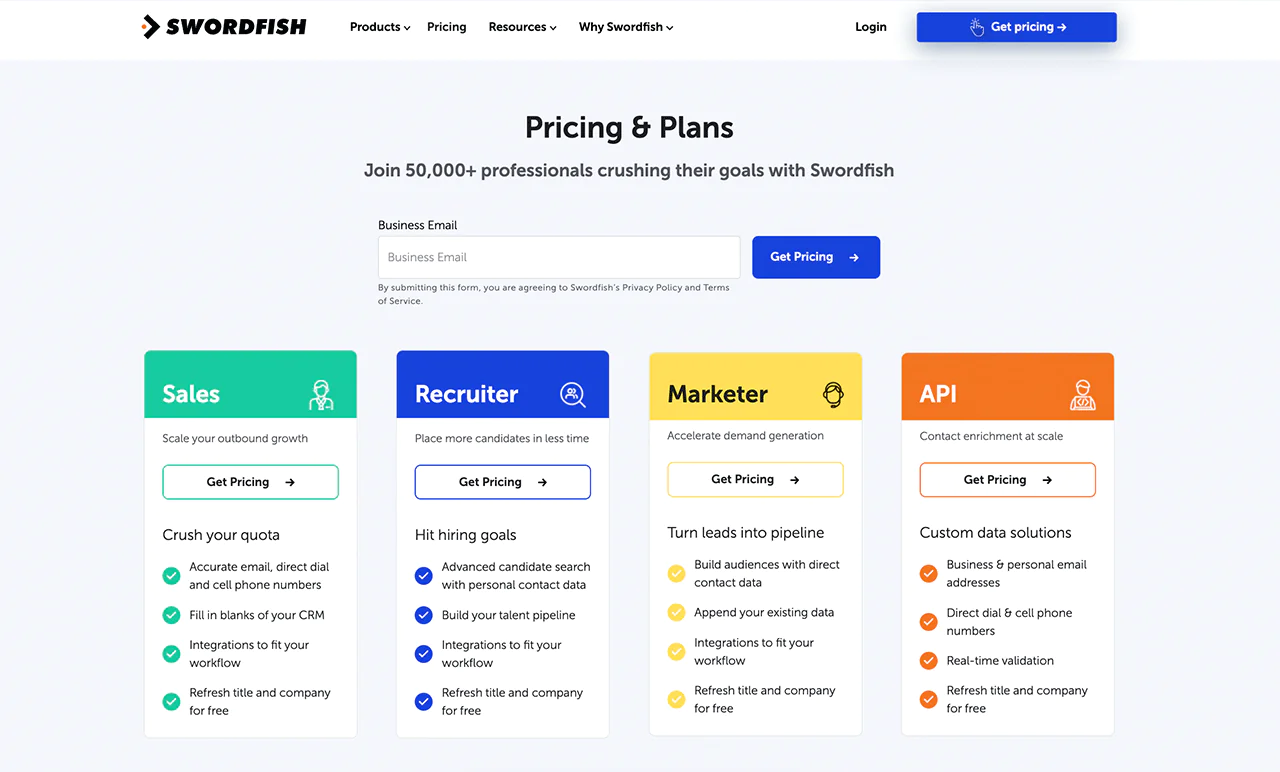
Swordfish AI uses customized pricing based on your use case, whether that’s sales, recruitment, marketing, or API access. Each plan covers features like verified email, direct dial, and cell phone numbers, CRM integration, and free refresh of title and company data.
What Users Say About Swordfish?
- G2 Review: 4.5 out of 5 (84 reviews)
“Swordfish has been extremely helpful in our candidate outreach efforts. We were frustrated by not having direct contact information for people on LinkedIn/Indeed/Github/etc. Swordfish has been a welcome outreach channel for our team.
We are able to reach people we were not able to do before. Having direct email/phone has been extremely beneficial. We no longer have to rely on a \”black hole\” InMail (or similar)…we now often times also have the ability to email, call, and text.” – Noel W.
- Capterra: 5 out of 5
“Swordfish lets me connect with the right candidates for the best jobs. They spider for ways to connect, be it social media or online, and it works. The contact info is validated and accurate, and candidates are amazed when connected. I’ve hired a few through its success.” – Sarah H.
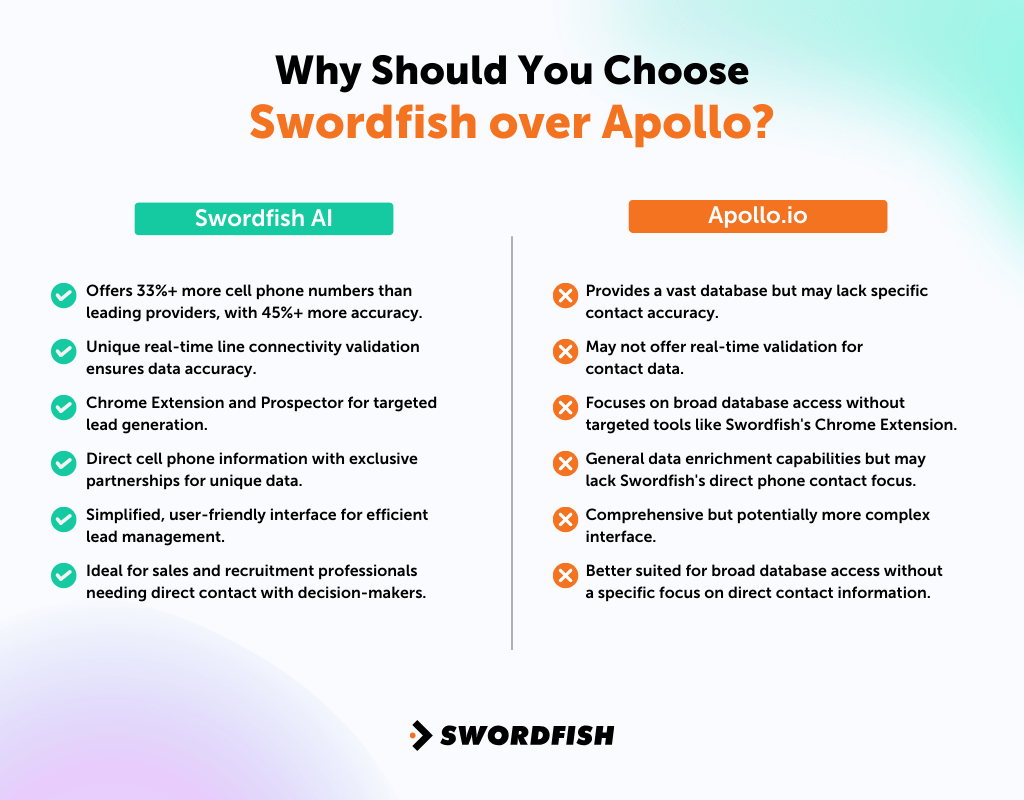
Why Should You Choose Swordfish AI over Apollo?
Here’s a straightforward comparison of where each tool tends to be stronger.
|
Promises of Swordfish AI |
Lackings of Apollo.io |
|
Offers a 3.5 billion database of professional profiles. |
Database sized in the low hundreds of millions of contacts. |
| Unique real-time line connectivity validation ensures data accuracy. |
Doesn’t offer real-time validation for contact data. |
|
Chrome Extension and Prospector for targeted lead generation. |
Focuses on broad database access without targeted tools like Swordfish’s Chrome Extension. |
| Direct cell phone information with exclusive partnerships for unique data. |
General data enrichment capabilities but lacks Swordfish’s direct phone contact focus. |
|
Simplified, user-friendly interface for efficient lead management. |
Comprehensive but potentially more complex interface. |
| Ideal for sales and recruitment professionals needing direct contact with decision-makers. |
Better suited for broad database access without a specific focus on direct contact information. |
2. Lusha
If you’re looking for an Apollo competitor for sales and recruitment specifically, Lusha is worth a look.
The platform focuses on reliable B2B company and contact information, and it’s built to be simple to use day to day.
Lusha connects users directly with key decision-makers, a factor its own reporting ties to strong ROI outcomes for customers.
Tools like the Lusha API, Buyer Intelligence, and a Chrome Extension round out the offering for sales and recruitment productivity.
That said, Apollo may still offer a broader database and more extensive sales intelligence overall. If database size is your main concern, Apollo could be the better fit.
But if precise, direct connections matter more than raw scale, Lusha is a strong addition to the toolkit.
About Lusha
- Founding Team: Assaf Eisenstein and Yoni Tserruya
- Founding Year: 2016
- Company Size: 201-500 employees
Key Features of Lusha
Lusha’s feature set is built for efficient B2B engagement:
- Data Accuracy: Reasonably high-quality B2B data helps ensure you’re connecting with the right decision-makers.
- Improved ROI: Some users report meaningful returns on investment after adopting the platform.
- Prospecting Tools: Lusha API and Buyer Intelligence refine and target the prospecting process.
- User-Friendly Interface: The interface is generally easy to navigate, which shortens onboarding for new users.
- Integration and Enrichment: Lusha integrates fairly easily into existing systems and workflows.
Pros of Using Lusha
- Lusha helps you close deals more effectively.
- Facilitates right leads to ensure more successful meetings with key decision-makers.
- Ensures reliable contact information, increasing outreach success.
- Offers a full suite of tools for effective prospecting.
Cons of Using Lusha
- Limited database compared to competitors.
- Higher cost per lead acquisition.
Pricing
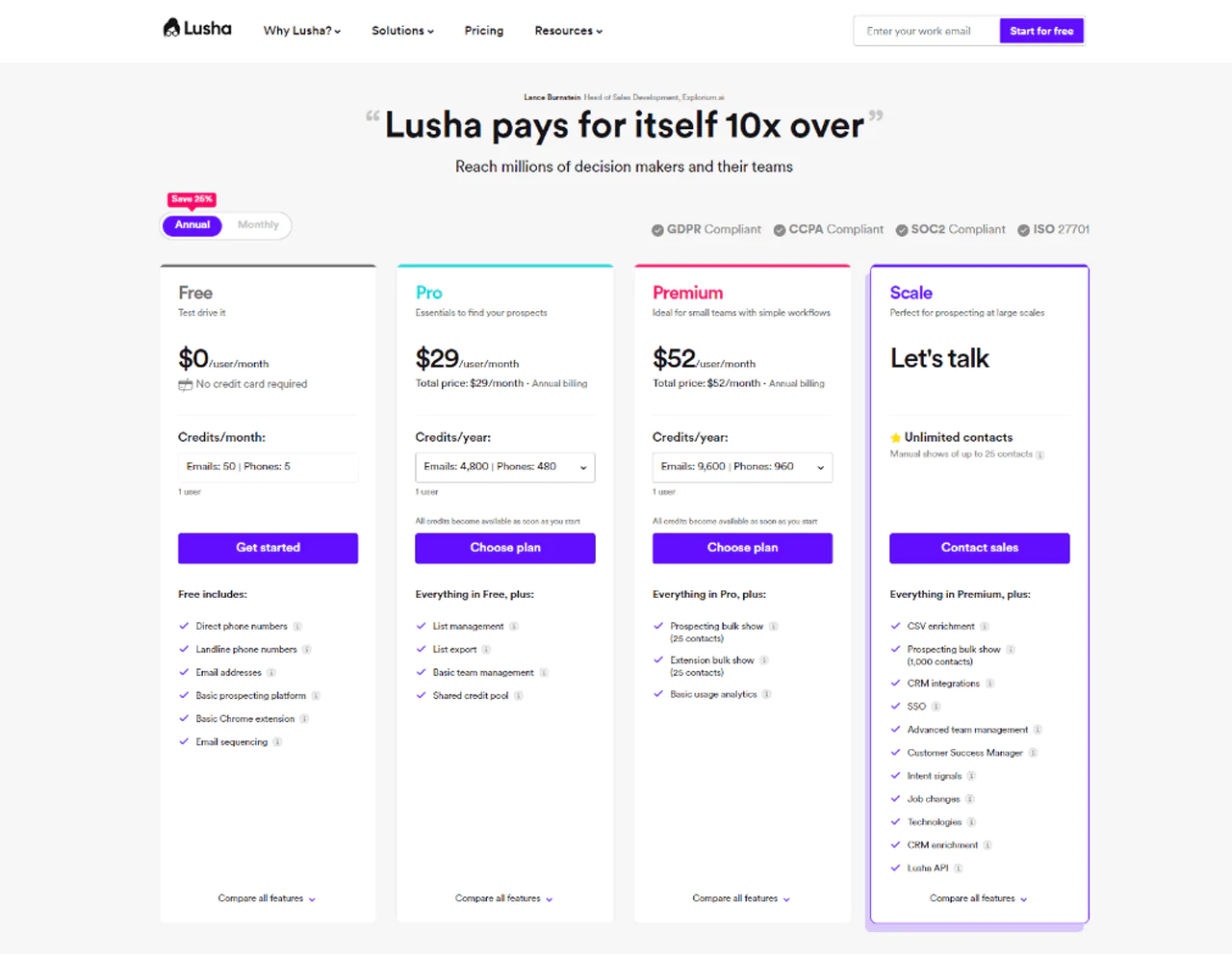
Lusha offers monthly and yearly plans across Free, Pro, Premium, and Scale tiers.
- Free Plan: 5 credits at no cost, good for getting started.
- Pro Plan: 40 credits at $39 per month, suited to regular use.
- Premium Plan: 80 credits for $69 per month, useful for more intensive searching.
- Scale Plan: Unlimited contacts, customized for larger-scale operations.
Solo users and larger teams both have room to pick the right access level.
Yearly billing is typically the more cost-effective route if you’re settled on a long-term solution.
What Users Say About Lusha?
- G2: 4.3/5 (1412 reviews)
“It is a very easy tool to use and the fact that is always there in the browser (with the extension installed) you can just click and use it to your liking. It is very convenient and quick. Most of the phone numbers are correct and the emails. The implementation and integration of it is very easy and quick. I use it every day.
I have heard that the customer service/ support is great and always happy to help.” – Oriana V.
- Capterra: 4.1/5 (359 reviews)
“I have been using Lusha for about 1.5 years and I have never once run into an issue using this software. Furthermore, Lusha complies with the standards set by GDPR and CCPA, which takes a lot of stress off of my shoulders (as I have noticed many of the alternatives do not offer this option).” – Sage T.
Is Lusha Better than Apollo?
Lusha tends to win out for professionals who want fast, precise access to B2B contact data. Its accuracy and simple interface make it appealing for direct outreach to decision-makers.
Its retrieval workflow shortens the time between identifying a target and actually reaching them, which helps sales and recruiting throughput.
Apollo remains the stronger pick for teams that need a broad database and deep sales intelligence features rather than a narrow, precise tool.
If your priority is targeted accuracy over sheer scale, Lusha is the better fit.
Our Review of Lusha
Lusha holds up as a solid B2B data option, particularly for finding people through social networks, the open web, and platforms like Salesforce.
Its accuracy claims and reported ROI gains are consistently cited by users as reasons the tool earns its place in a sales stack.
Overall, it simplifies the work of reaching decision-makers and booking meetings, which matters for any sales-driven team.
3. ZoomInfo
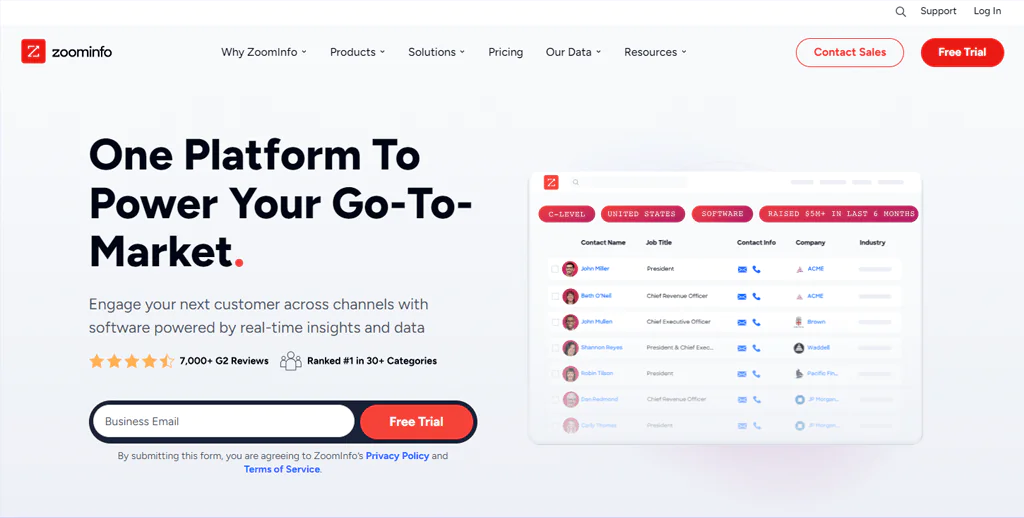
ZoomInfo is a strong alternative to Apollo thanks to its expansive B2B sales prospecting capabilities, including a large base of direct dial phone numbers and verified email addresses that’s often broader than Apollo’s offering.
What sets ZoomInfo apart is depth. It doesn’t stop at contact data; it layers in organizational charts and tech-stack insights, which matters for sales, marketing, and recruiting professionals who need fuller business intelligence, not just a name and number.
Advanced search options and integration with a wide range of CRM and marketing platforms make it a capable part of a larger business strategy rather than just a lookup tool.
About ZoomInfo
- Founding Team: Henry Schuck
- Founding Year: 2007
- Company Size: 3,941 employees
Features of ZoomInfo
ZoomInfo is built for sales, marketing, and recruitment teams. A quick rundown of what it offers:
- Comprehensive Business Data: Contact details, organizational structures, and insight into company technologies.
- Advanced Search and CRM Integration: Sophisticated search paired with integration into CRM and marketing automation platforms.
- Visitor Tracking and Analytics: WebSights tracks company behavior on your web pages, with Google Analytics integration for added depth.
- Website Personalization: Firmographic data based on visitor IP addresses can personalize the site experience for different visitor segments.
Pros of Using ZoomInfo
- ZoomInfo streamlines finding and engaging with lucrative business prospects.
- Users typically experience a marked increase in deal sizes and revenue growth.
- The platform significantly enhances sales team productivity through intelligent automation.
- Access to accurate contact data leads to more productive sales conversations and follow-ups.
- Offers detailed company and market data for informed sales strategy development.
- The seamless integration with CRM systems speeds up the entire sales process.
Cons of using ZoomInfo
- ZoomInfo’s advanced features can be challenging to navigate initially.
- Its comprehensive services come with a high subscription cost.
Pricing
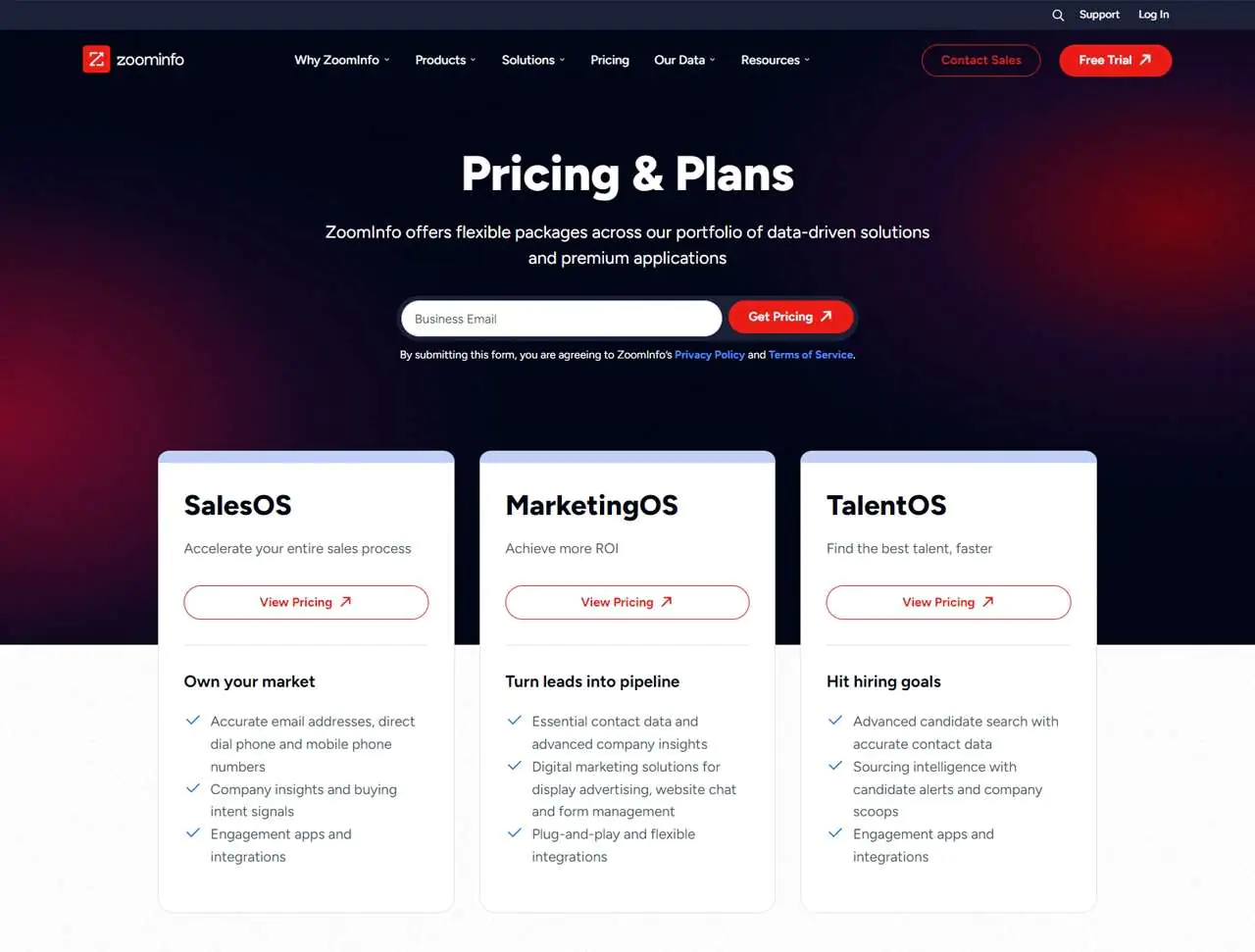
ZoomInfo runs on customized pricing across three main tiers. The Standard plan covers reliable core support for those who need a dependable baseline.
Businesses wanting more personalized service can move to the Preferred plan, which is built to unlock more of ZoomInfo’s capability.
The Premium plan sits at the top, with dedicated attention and tailored solutions for more complex business needs.
What Users Say About ZoomInfo?
- G2: 4.4/5 (7858 reviews)
“Zoominfo makes it easy to find target prospect accounts and key decision-makers within them. The contact info is accurate 99% of the time, making it simple to reach the right people with the right message at the right time. The integrations with Salesforce, LinkedIn Sales Navigator, and other tools mean that data stays clean, consistent – and most importantly – saves me time, which I can use to focus on selling. 10/10” – David T.
- Capterra: 4.1/5 (279 reviews)
“As I use it to find correct data for prospecting or simply enriching existing contacts -helps understand the organizations hierarchy and look up targeted contacts in targeted roles. Love the buyer intent tool, that shows if any companies are researching your software, and allows focusing on targeted outreach.” – Brigita B.
Is ZoomInfo Better than Apollo?
ZoomInfo tends to win on database depth and B2B data quality, particularly for scenarios that call for in-depth business intelligence.
It’s especially strong for larger organizations or teams focused on North American markets, with comprehensive contact, firmographic, technographic, and intent data suited to large-scale operations.
Apollo counters with cost-effective, adaptable offerings that are often a better fit for growing teams or small to medium-sized businesses.
Our Review of ZoomInfo
ZoomInfo is a major player in B2B data, and it shows.
Real-time tracking of website visitors is one standout feature, acting as an early signal for identifying potential leads. The database itself is large and regularly refreshed, giving businesses solid ground for building connections.
The interface is generally functional and easy to navigate, which matters once you’re working with this much data.
Pricing can be steep for smaller businesses, which is worth flagging upfront.
Even so, ZoomInfo remains a strong option for teams that need comprehensive business intelligence delivered without a lot of clutter.
Note: Have a look at comparison between ZoomInfo vs LinkedIn Sales Navigator.
4. Clearbit
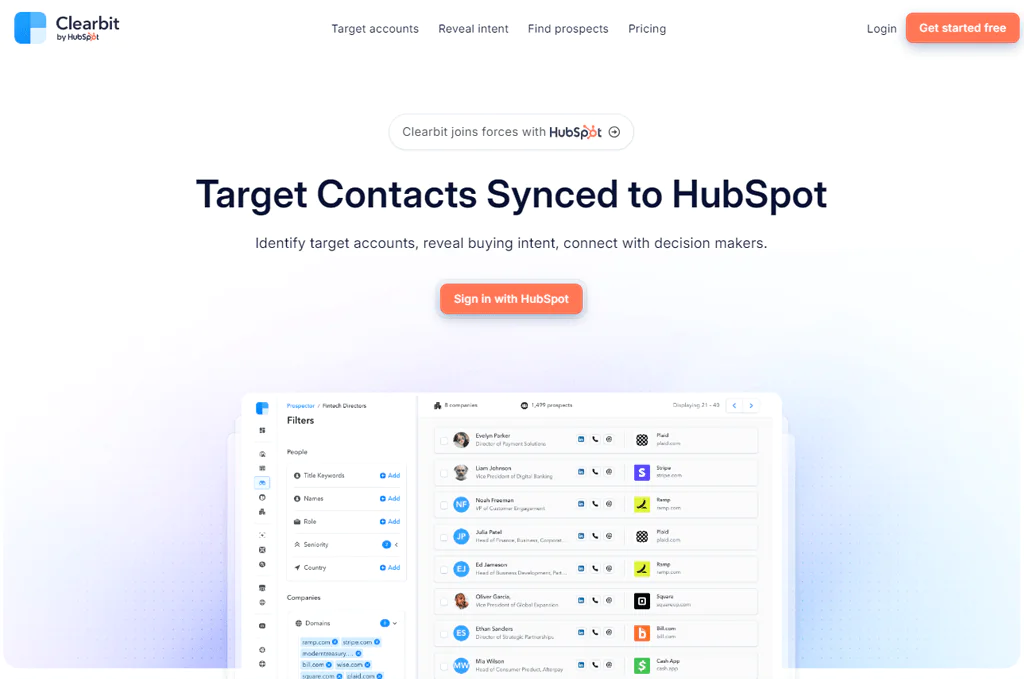
Clearbit is a compelling Apollo alternative, especially since it joined forces with HubSpot, a move that expanded its B2B data and AI capabilities considerably.
It specializes in turning unstructured web data into precise, standardized sets, which makes it reliable for B2B teams that need clean data at scale, with global coverage supporting accuracy and reach.
Real-time lead scoring and routing direct effort toward high-fit leads, and granular industry categorization plus an understanding of corporate hierarchies make it effective for tailored marketing and sales strategies.
Integration across the tech stack, including major CRMs, rounds it out as a practical choice for teams focused on market intelligence and personalization.
About Clearbit
- Founding Team: Alex MacCaw, Amit Vasudev, Andrew O’Neal, Harlow Ward, Matt Sornson, and Rob Holland
- Founding Year: 2015
- Company Size: 51-200 employees
Note: Try out alternatives to Clearbit for more scopes.
Features of Clearbit
Clearbit’s integration with HubSpot brings a set of features geared toward B2B operations:
- Target Market Builder: Filters the global B2B landscape to pinpoint companies likely to need your product.
- Website Visitor Identification: Reveals who your anonymous website visitors are, surfacing intent from high-fit companies.
- B2B Contact Database: Access to over 30 million verified contacts globally, spanning the US, APAC, and EMEA.
- HubSpot Integration: Native integration keeps data exportable and campaign-ready.
Pros of Using Clearbit
- Offers highly accurate B2B data, crucial for targeted marketing and sales strategies.
- Provides extensive international reach, ideal for businesses operating worldwide.
- Real-time scoring and routing focus efforts on the most promising leads.
- Delivers detailed industry categorization for more nuanced market understanding.
- Integrates effortlessly with major CRM systems for streamlined workflow.
Cons of Using Clearbit
- The vastness and complexity of data can be daunting for new users.
- Advanced data insights and features may come with a premium price tag.
Pricing
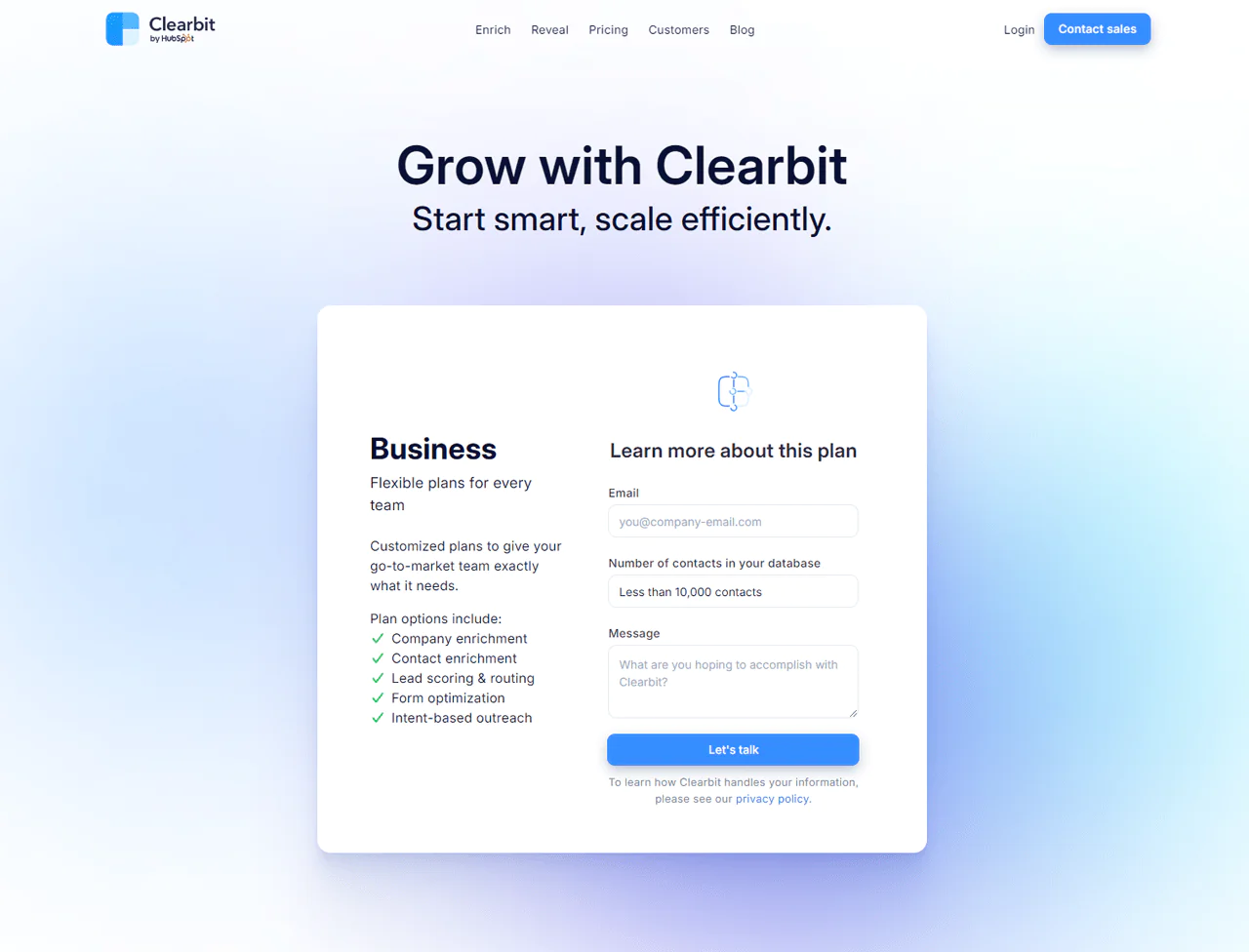
Clearbit’s Free plan offers 25 credits a month at no cost, a reasonable way to test finding and revealing visitors on your site.
The Growth plan runs $50 to $275, covering 125 to 1,000 credits monthly on a self-serve, month-to-month basis.
Both plans support building prospect lists and target account lists directly in HubSpot.
What Users Say About Clearbit?
- G2: 4.4/5 (616 reviews)
“It is very useful extension. I personally use this extension and it’s mind blowing. I can find the details of any key person in just one click. It reduce my work load.And not only key person, you can find the email ids of other employees of thr company.
Sometimes it’s shows error and my 60% work is depends on clearbit so for that time I have to find some other extension. It’s provide limited credits so i have to buy the credits for some more details.” – Priyanka G.
- Capterra: 4.5/5 (33 reviews)
“We use Clearbit in a variety of ways:- Use it inside our prospecting tool to build custom intent signals -> F.e, prospect visited a high intent page;- Use it for lead enrichment inside hubspot and Chilipiper in real time (To know what is the industry, number of employees etc);- Use it with live enrichment to fill out information automatically instead of the user having to input fields (F.e, company name)” – Pedro A.
Is Clearbit Better than Apollo?
Clearbit shines brighter than Apollo for HubSpot-native workflows, especially in identifying high-intent B2B visitors and converting them into pipeline.
With over 30 million verified contacts and global reach, it’s effective for teams that want accurate, reliable B2B data specifically within the HubSpot ecosystem.
Apollo leads on raw contact volume, which makes it the better pick for teams that need a broader range of contacts and an extensive lead database above all else.
Our Review of Clearbit
Clearbit holds up well in the B2B space, particularly given its database of over 30 million verified contacts.
Its HubSpot integration is a real strength, making it easy to manage CRM and people data at the same time.
Spotting high-intent visitors and converting them into solid sales leads is another clear win.
Global reach across the US, APAC, and EMEA covers a lot of ground, though customization isn’t unlimited if you need highly tailored solutions.
For sharp, focused B2B insights, Clearbit is a strong option worth considering.
5. Hunter
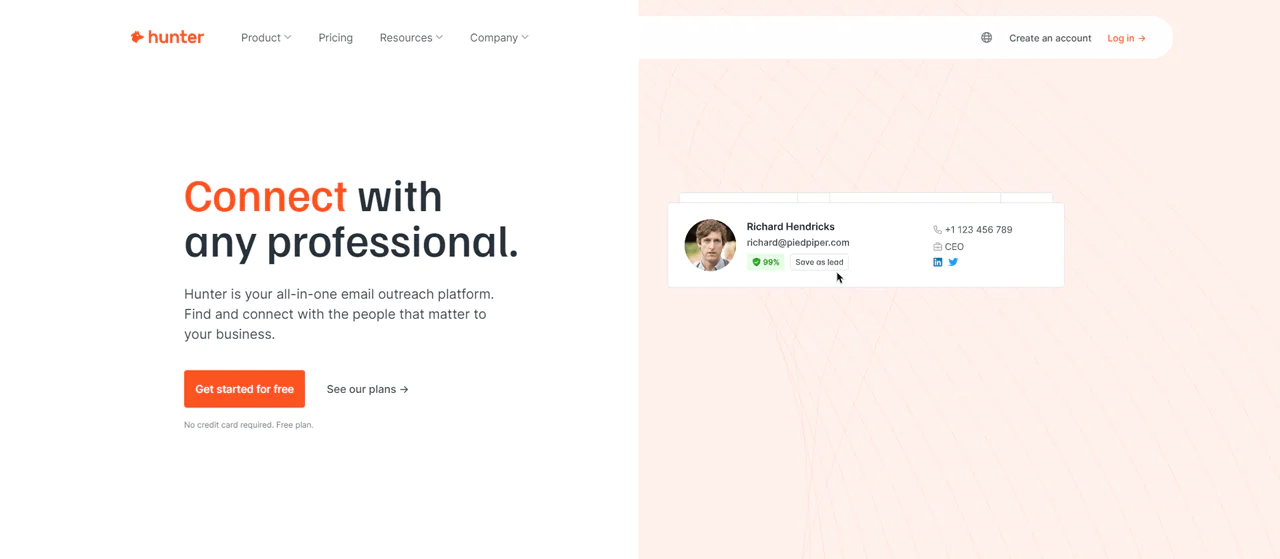
Hunter.io is a more flexible, focused choice compared to Apollo.io for teams whose main need is managing email outreach well.
It’s built around finding and verifying professional email addresses quickly and accurately, with Domain Search, Email Finder, and Email Verifier as its core tools.
That focus on email tasks is what separates it from Apollo.io, which spreads across a wider range of sales tools but isn’t as specialized in email outreach specifically.
Hunter.io suits users who value direct, efficient email communication. Its simple interface and emphasis on verification help protect sender reputation, which matters for deliverability over time.
Overall, it’s a more focused option for professionals streamlining email communication compared to Apollo.io’s broader toolset.
About Hunter io
- Founding Team: Antoine Finkelstein and François Grante
- Founding Year: 2015
- Company Size: 20
Features of Hunter io
Hunter’s feature set is built for efficient email prospecting:
- Domain Search: Finds contact details from a company name or website, simplifying identification of key decision-makers.
- Email Finder: Fetches verified email addresses with a high match rate.
- Email Verifier: Checks address accuracy before sending, which helps prevent bounces and protect sender reputation.
- Campaigns: Compose, schedule, and track personalized email campaigns from the same tool.
- Integrations: Connects with tools like Google Sheets and various CRMs for smoother data sync.
- API: Solid API access supports custom integrations for a more tailored workflow.
Pros of Using Hunter io
- Quickly find decision-maker contact details, enhancing outreach efficiency.
- Increases the effectiveness of email list creation and utilization.
- Protects sender’s reputation by verifying email addresses.
- Simplifies sending personalized emails at scale, increasing response rates.
- Easily connects with CRMs and other software for streamlined workflows.
- Maintains high-quality data while adhering to compliance standards.
Cons of Using Hunter io
- Limited to email prospecting, lacking broader sales intelligence tools.
Pricing
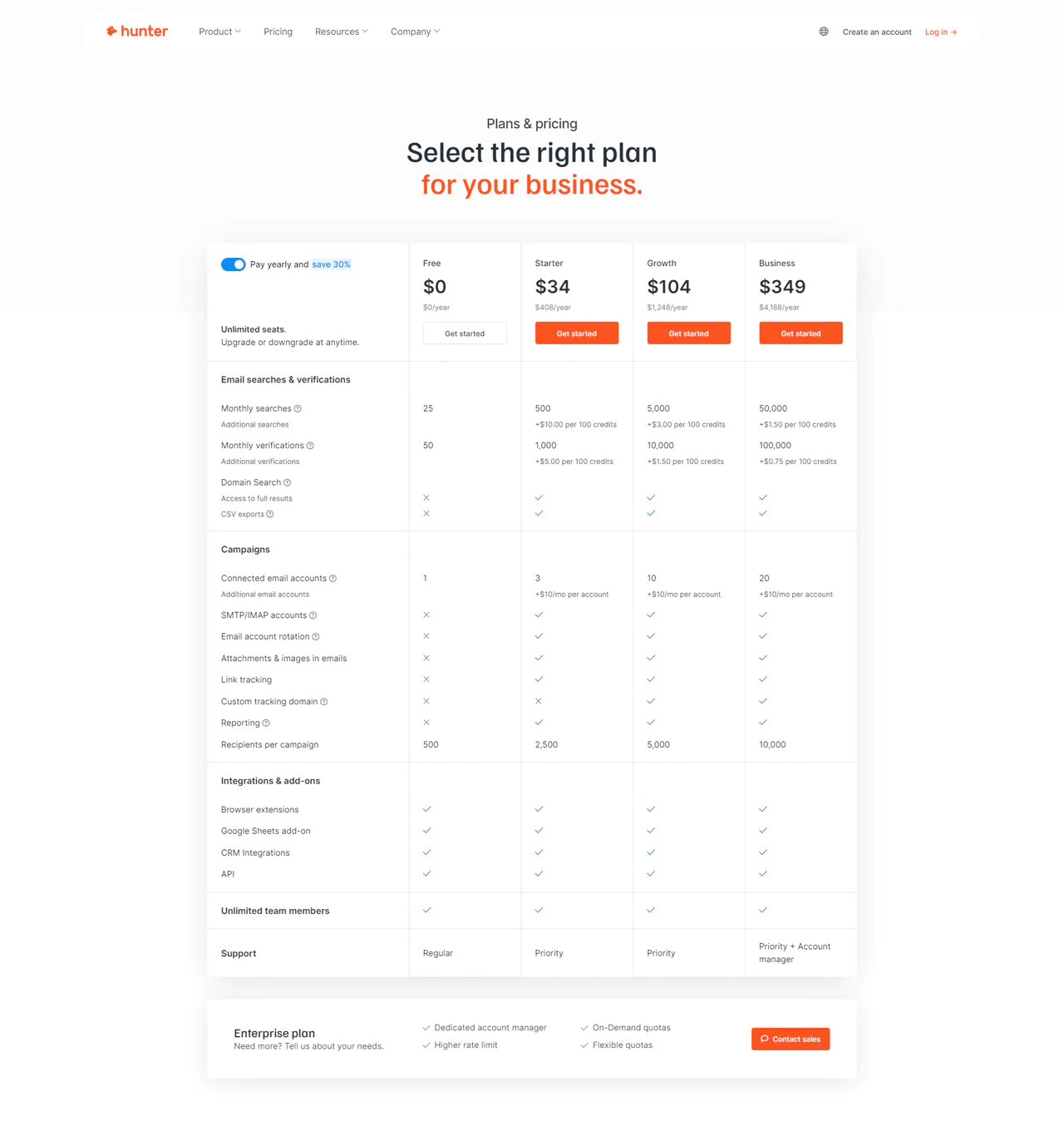
Hunter’s Free plan covers essential search and verification at no cost.
The Starter plan runs $49 monthly, including 500 monthly searches and 1,000 verifications.
The Growth plan, at $149 monthly, expands search and verification volume, while the Business plan at $499 monthly is built for larger-scale operations with the most comprehensive package.
Each tier is structured to scale with your outreach volume.
What Users Say About Hunter io
- G2: 4.4/5 (525 reviews)
“Hunter provides a straightforward and user-friendly experience. The platform’s minimalist design and intuitive interface make it easy for users, regardless of their technical proficiency, to use the tool.
The ability to verify email addresses directly within the platform improves workflow efficiency, saving time and resources by ensuring the accuracy of contact information before outreach begins.” – Brant P.
- Capterra: 4.6/5 (607 reviews)
“This app is amazing and underpriced. I’ve seen companies small and large pay ALOT more – piecing together multiple isolated products – and still getting less functionality. And Zapier integration sealed the deal.” – Josh K
Is Hunter Better than Apollo?
Hunter’s focused approach to email finding and verification gives it an edge over Apollo for that specific use case. For users who need organized, precise email outreach, Hunter’s tools like Domain Search, Email Finder, and Email Verifier are worth the switch.
That makes Hunter the better pick for quickly and accurately identifying decision-makers’ contact details, especially for targeted email marketing campaigns.
Apollo’s broader engagement tools and larger database make it more suitable for teams wanting an all-in-one sales intelligence and engagement platform instead.
Our Review of Hunter
Hunter’s strength in email discovery and verification is clear from the moment you start using it. It’s fast at locating and confirming professional email addresses.
Domain Search and Email Finder make it easier to reach decision-makers, while the Email Verifier helps reduce bounced emails, protecting sender reputation over time.
Its simplicity is a real asset for teams that want a no-fuss way to run email outreach. It won’t match some tools on contact volume, but its accuracy in finding and verifying emails holds up well.
How to Choose the Best Alternatives to Apollo.io for Your Business
Selecting the right Apollo alternative comes down to matching features to how your team actually works. Here’s what’s worth weighing before you commit to a contract.
Accurate Contact Data
Look for tools that provide accurate contact data, cell phone numbers and email addresses included. This is the foundation for reaching decision-makers directly and improving outreach success rates.
Advanced Prospecting Capabilities
Confirm the tool supports advanced prospecting, so you can build targeted dialing or email lists quickly rather than manually stitching together searches.
Comprehensive Email Outreach Solutions
Pick a tool with strong email outreach features, finding, verification, and campaign management, to protect sender reputation and keep outreach effective.
Seamless CRM Integrations
Make sure the platform integrates cleanly with your existing CRM. That keeps data consistent and avoids manual reconciliation between systems.
Real-Time Data Validation
Favor a solution with real-time data validation, so you’re not wasting calls or emails on outdated contact information.
Extensive Database Access
Check the size and scope of the underlying database. A larger, well-maintained database improves your odds of finding the right leads.
User-Friendly Interface
Look for a tool your team can actually adopt without a long ramp-up. A clunky interface slows down everyone, regardless of how good the underlying data is.
Compliance and Privacy
Prioritize tools that take compliance and privacy seriously. This matters for protecting your business and maintaining trust with the people you’re contacting, and it’s especially relevant if your outreach touches regulated industries like healthcare, where contact data handling carries added scrutiny.
So, What’s The Best Apollo Alternative?
Swordfish AI stands out for one specific reason: direct cell phone contacts, which Apollo doesn’t typically prioritize in the same way.
That capability can translate into more effective meetings and, over time, revenue growth. Real-time checks on phone line connectivity and number accuracy help make sure you’re connecting with the right people rather than dialing dead numbers.
Beyond the data itself, Swordfish AI is often noted for responsive customer support and reasonable pricing, which makes it a practical option for teams that want strong contact data without an enterprise price tag.
Its tool set is built to tighten up the sales pipeline end to end, positioning it as a serious Apollo competitor.
Lusha and ZoomInfo are also worth considering. Lusha is known for data accuracy and reported ROI gains, while ZoomInfo brings a large database and detailed business insights to the table.
Together with Swordfish AI, these platforms cover a range of needs for teams moving away from Apollo.
Conclusion
Choosing an Apollo alternative comes down to weighing cost, data accuracy, ease of use, and how well the tool supports collaboration across your team. Each option here has its own strength.
Swordfish AI leads on direct contact information. Lusha is known for its user-friendly interface. ZoomInfo stands out for its detailed, extensive contact database. Clearbit integrates cleanly with platforms like HubSpot, and Hunter is a strong choice for large-scale email outreach.
The right call depends on your specific workflow. Picking the tool that actually fits how your team prospects and reaches out will do more for your results than chasing the biggest database on paper.
 Try Swordfish Ai
FAQs
How does Swordfish AI compare to Apollo?
Swordfish AI stands out with its real-time phone number validation and unique contact data, making it a strong Apollo.io competitor for direct access to decision-makers.
How do other platforms compare with Apollo in integrating sales AI into their engagement tools?
Apollo emphasizes the use of AI in sending the right message at the right time. You might be interested in how alternative platforms incorporate AI into their sales engagement processes.
Can Swordfish AI’s data integration increase sales processes?
Yes, Swordfish AI’s seamless data integration can significantly increase sales processes by providing accurate and updated lead information.