
 View Products


By Swordfish.ai RevOps Team
Who this is for
- RevOps and sales teams trying to reduce wrong-party calls and keep data accuracy high.
- Talent acquisition teams validating inbound numbers before scheduling interviews.
- Support teams returning missed calls without guessing who owns this phone number.
- Operators in VoIP-heavy industries and high-churn segments where number reassignment is common.
Quick Answer
- Core Answer
- To find name by phone number, use reverse phone lookup: enter the number and review any matched owner record pulled from directories and other data sources. Treat any reverse lookup name as a candidate until verified, especially for VoIP and reassigned numbers.
- Key Stat
- Name-from-number is reverse lookup; certainty varies.
- Best For
- Legitimate business outreach and call-backs where you need a fast identity check, clear confidence levels, and a process that respects consent and opt-out.
This page sits inside a contact-finder workflow: find a likely owner, label the risk, and avoid contaminating your CRM with bad identity data.
Framework: Confidence Levels: Certain / Likely / Unconfirmed
Myth Bust
When a reverse lookup returns a name, do you treat it as proof of current ownership, or as a lead that still needs verification?
When reverse lookup can work; Why results vary (VoIP, porting, reassignment)
Reverse lookup can work when the number has stable ownership and consistent exposure in reputable sources. It fails when the number’s identity changes faster than the sources refresh.
- Mobile vs landline: landlines and business lines are more likely to have stable directory signals; mobile numbers are more volatile and often less publicly listed.
- VoIP: VoIP numbers are easier to provision and rotate, so ownership signals are weaker and conflict is common.
- Number reassignment: recycled numbers keep older owner records attached, which is a primary driver of wrong-person matches.
- Porting: number portability can leave stale matches across providers and aggregators.
Variance explainer: results shift based on how recently the number changed hands, whether it is VoIP vs carrier-issued, how many independent sources agree, and whether the owner publishes or suppresses identity data.
Source types (not a tool list)
- Business listings and directories: useful for established companies and landlines; less reliable for fast-changing mobile ownership.
- Web mentions: the number may appear on a site, job post, or PDF; this can support a match, but it can also be outdated.
- First-party context: your inbound form, email domain, or prior conversations are often higher-signal than any third-party match.
- Structured lookup providers: consolidate sources and may add line-type signals; still requires verification where confidence isn’t Certain.
Two sources can repeat the same stale record. Treat corroboration as directional, not definitive.
What you can realistically expect to see
In practice, reverse lookup outputs tend to be a mix of (a) an owner name, (b) a location signal, and/or (c) line-type or carrier hints. Reverse lookup accuracy drops fastest on VoIP and recently reassigned numbers, so partial outputs should be treated as routing signals, not identity proof.
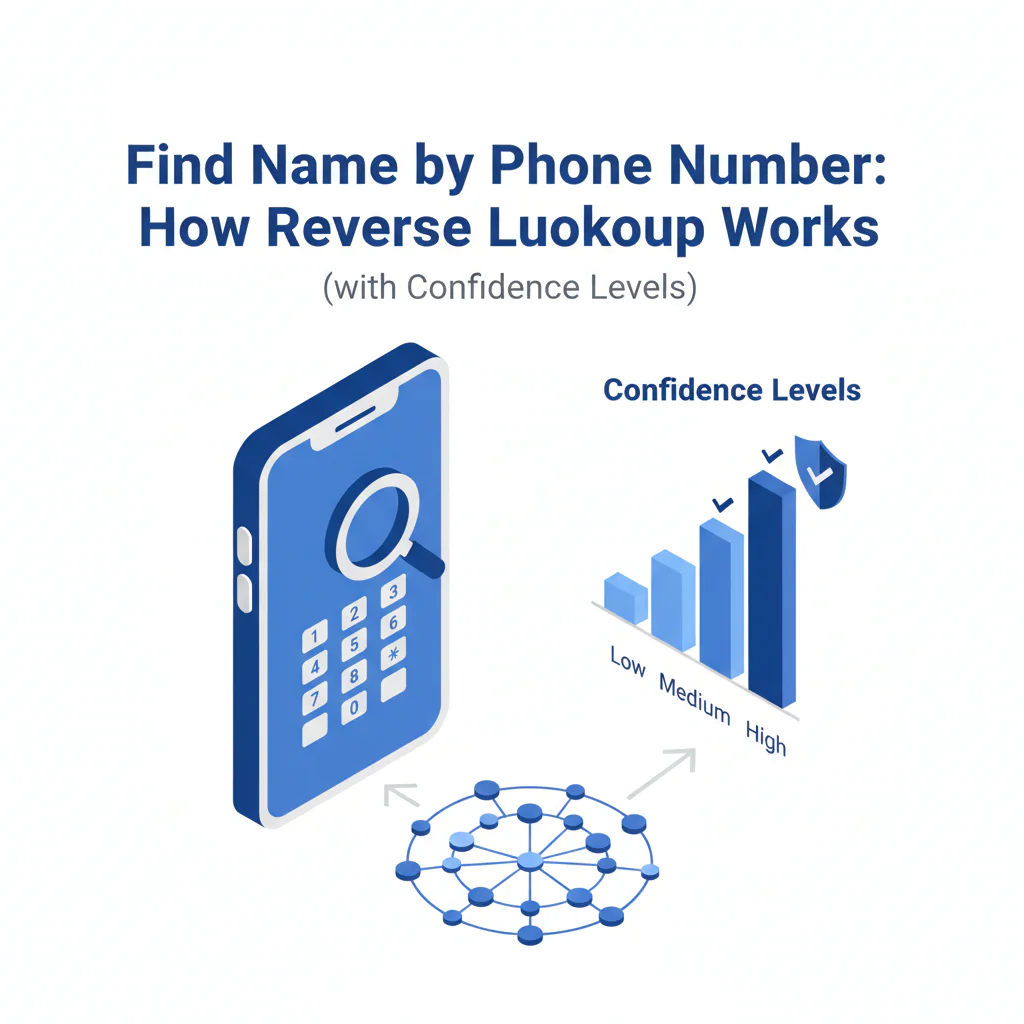
Confidence levels: Certain / Likely / Unconfirmed
Use confidence levels as an operating policy. It controls what your team is allowed to do with the result.
- Certain: multiple independent sources align and signals suggest the number is currently in use by that person or business.
- Likely: a reasonable match exists, but corroboration or recency signals are incomplete.
- Unconfirmed: weak match, conflicting names, or a line type that carries higher reassignment risk (common with VoIP).
Rule of thumb: automate outreach only for Certain, add a manual verification gate for Likely, and avoid outbound outreach on Unconfirmed unless the person initiated contact.
Examples: interpreting reverse lookup results
- Certain example (business landline): You see the same business name across two sources and the location matches your account record. Action: proceed, confirm identity in the first 10 seconds, then log consent and opt-out status.
- Likely example (mobile number): You get a single person-name match but no corroboration. Action: run a second check, do signal validation, and do not write the name into your CRM until the contact confirms.
- Unconfirmed example (VoIP): Two sources return different names, or only a city/carrier shows. Action: don’t enrich, don’t guess; ask directly or route to an inbound confirmation step.
Myth vs reality (fast checks)
- Myth: reverse lookup tells you the current owner. Reality: reassignment and porting can make results stale.
- Myth: a match is safe to push into CRM. Reality: without verification, you increase misattribution and suppression risk.
- Myth: caller ID equals identity. Reality: spoofing exists; verify in the opener.
Step-by-step method
- Normalize the number. Copy it exactly as seen. If a country code is shown, keep it. Remove formatting and store a canonical version (for example, +countrycode + number) in your CRM.
- Run reverse phone lookup in two places. Use one structured lookup product and one independent cross-check (directory mention or web mention) to reduce single-source errors.
- Assess line type risk. If it looks like VoIP or the segment has churn, downgrade your confidence unless you have corroboration.
- Assign a confidence level. Certain, Likely, or Unconfirmed. Make this required for enrichment.
- Verify before outreach. Use signal validation (format checks and provider-supported connectivity signals (not identity proof and may be delayed) where available), then confirm identity in the opener. Example: “Hi, I may have the wrong number. Is this Alex at Acme?”
- Log outcomes. Wrong-party and opt-out outcomes should feed your suppression and data quality process.
If your team keeps asking “who owns this phone number,” the right answer is: reverse lookup can suggest an owner, but you still need verification when confidence isn’t Certain.
Checklist: Weighted Checklist
Weighted by standard failure points: number reassignment, VoIP ambiguity, single-source matching, and consent risk. Use these weights to prioritize fixes.
- High impact / Low effort: Require a confidence level before any outbound action.
- High impact / Low effort: Add an identity-confirmation line in the first 10 seconds of the call.
- High impact / Medium effort: Cross-check reverse lookup output against a second source before CRM enrichment.
- High impact / Medium effort: Enforce suppression lists and opt-out handling aligned to contact data compliance.
- Medium impact / Medium effort: Flag VoIP and high-churn segments and require manual review for Likely matches.
- Medium impact / Higher effort: Close the loop: wrong-party outcomes update the record and suppress future attempts.
Process note: don’t store “guessed” names. Store a confidence level, the source, and the verification outcome.
Decision Tree: Conditional Decision Tree
- If confidence is Certain, then outreach is allowed, but confirm identity immediately and honor opt-out.
- If confidence is Likely, then require a second-source check plus signal validation before any call attempt.
- If confidence is Unconfirmed, then do not enrich CRM with a name; request confirmation through an inbound step or ask directly.
- If line type is VoIP, then assume higher variance and force manual verification.
- If the person says you have the wrong party, then suppress immediately and tag the record as reassigned to prevent repeat contact.
- Stop Condition: If you cannot verify the person or business in one touch (confirmation or inbound context), stop outbound attempts and move the record to a verification queue.
Diagnostic: Why this fails
Reverse lookup fails when teams treat it as deterministic. In practice, you’re working with partial signals that can be stale.
- Wrong-person match: older owner records persist after reassignment.
- VoIP ambiguity: ownership signals are weak or inconsistent.
- Partial records: you get only geography or carrier, not an owner name.
- Source disagreement: two sources return different owner names.
- Consent mismatch: you found a name but you cannot contact them for your use case.
Troubleshooting Table: Diagnostic Table
| Symptom | Root Cause | Fix |
|---|---|---|
| Lookup returns a name you know is wrong | Stale record from number reassignment | Downgrade to Unconfirmed, cross-check a second source, and confirm identity on first contact. |
| Lookup returns multiple possible owners | Source disagreement and weak corroboration | Require manual review; look for matching employer and location signals before updating CRM. |
| Lookup shows only carrier or location | Mobile privacy constraints and incomplete datasets | Don’t guess. Use inbound context or ask directly. |
| VoIP number produces inconsistent results | VoIP provisioning and rapid reuse | Treat as Likely or Unconfirmed unless corroborated; require verification before outreach. |
| Outreach triggers wrong-party complaints | Reassigned number risk plus weak suppression and opt-out handling | Implement strict suppression, log outcomes, and align workflows to contact data compliance. |
How to improve results
Accuracy improves when you run a process, not a one-off lookup.
- Store provenance. Save where the name came from and the confidence level; don’t store a name as a fact when it’s a guess.
- Segment by reassignment risk. High-churn segments need tighter suppression and more verification gates.
- Use signal validation. Treat it as a connectivity check, not proof of identity.
- Confirm early. A one-sentence confirmation question beats a wrong-party escalation.
- Close the loop. Feed wrong-party outcomes into your data quality workflow.
Operator view: if you want fewer wrong-party dials, you need a system that behaves like it has ranked mobile numbers by answer probability (i.e., prioritize lowest misattribution risk first), meaning you only spend call attempts where identity risk is low.
Learn About Phone Number Validation
Legal and ethical use
Reverse lookup is generally permitted, but your usage is what creates risk. Keep it business-only and auditable.
- Consent and opt-out: treat opt-out as a hard suppression event across CRM, dialer, and enrichment.
- Not for sensitive decisions: do not use reverse lookup data for employment, tenant screening, credit, or other regulated eligibility decisions.
- Caller ID spoofing: don’t assume the number equals the caller; verify identity in the opener and avoid exposing personal details. If you can’t verify, don’t escalate outreach.
If it looks like a scam, don’t call back. Use your carrier’s reporting paths and the FTC guidance below.
References: the FTC’s guidance on spam calls and texts, the CFPB’s FCRA consumer rights summary, and the FCC’s overview of number portability.
FAQ
Can I find the owner of a VoIP number?
Sometimes. Expect lower certainty because VoIP numbers can be provisioned and reused quickly. Treat most VoIP matches as Likely or Unconfirmed unless you have corroboration.
Why do reverse lookups show the wrong person?
The most common cause is number reassignment. The number got recycled, but an older source still points to the previous owner. Porting and mixed-quality sources add more noise.
Is it legal to search a phone number for a name?
In general, yes, but the rules depend on jurisdiction and your use case. For outreach, stick to legitimate business purposes, follow consent rules where required, and honor DNC and opt-out requests.
Should I save the found name to CRM?
Only if you can defend it operationally: store the source, a confidence level, and the verification outcome. If it’s Likely or Unconfirmed, store it as a candidate signal, not a confirmed identity.
Evidence and trust notes
- Last updated: Updated for reassignment/porting notes Jan 2026
- Certainty language is intentional: reverse lookup suggests an owner; it does not guarantee current ownership.
- We prioritize misattribution prevention (wrong-party and spoofing risk) over aggressive enrichment.
- Compliance-first posture: suppression, DNC awareness, and opt-out handling are built into the recommended workflow.
- Operational framing: confidence levels are tied to allowed actions, not vanity accuracy claims.
- Data-quality feedback loops are treated as mandatory for sustained data accuracy.
Next steps
- Day 1: Define “Certain/Likely/Unconfirmed” criteria and require it alongside your reverse phone lookup workflow.
- Day 3: Add a suppression and opt-out pathway aligned to contact data compliance, then train reps on the stop condition.
- Day 7: Run a quality sprint: sample records, compare outcomes, and push fixes into your data quality queue. Use the same policy so call attempts go to the lowest-risk records first.
About the Author
Ben Argeband is the Founder and CEO of Swordfish.ai and Heartbeat.ai. With deep expertise in data and SaaS, he has built two successful platforms trusted by over 50,000 sales and recruitment professionals. Ben’s mission is to help teams find direct contact information for hard-to-reach professionals and decision-makers, providing the shortest route to their next win. Connect with Ben on LinkedIn.