
 View Products


Last updated: September 3, 2026

First impressions in sales still happen mostly by phone, even in a market flooded with email and LinkedIn outreach. A widely cited RAIN Group study found that 82% of buyers say they’ve accepted a meeting after a cold call, which is a far better response than the reputation cold calling has earned over the years.
But cold calling isn’t about reading lines off a page. It’s about balancing a clear pitch with respect for the other person’s time. Some calls end in seconds. Others turn into real conversations. The difference usually comes down to preparation, not luck.
The scripts below give you a starting structure. How you adapt them to healthcare buyers, financial advisors, real estate clients, or any other audience is where the real skill shows up.
What Is a Cold Calling Script?
A cold calling script is a structured outline salespeople use when contacting potential customers who haven’t previously engaged with them. It’s not meant to be read word for word. It’s a guide that keeps the conversation on track.
Good scripts help reps cover the essential points, handle common objections, and steer the call toward a specific next step, usually a follow-up meeting or a qualifying question that determines whether the prospect is worth pursuing further.
Why Cold Calling Scripts Matter
Most reps don’t list cold calling as their favorite part of the job. That’s exactly why a script matters: it removes some of the guesswork and gives structure to a task that’s otherwise stressful and unpredictable.
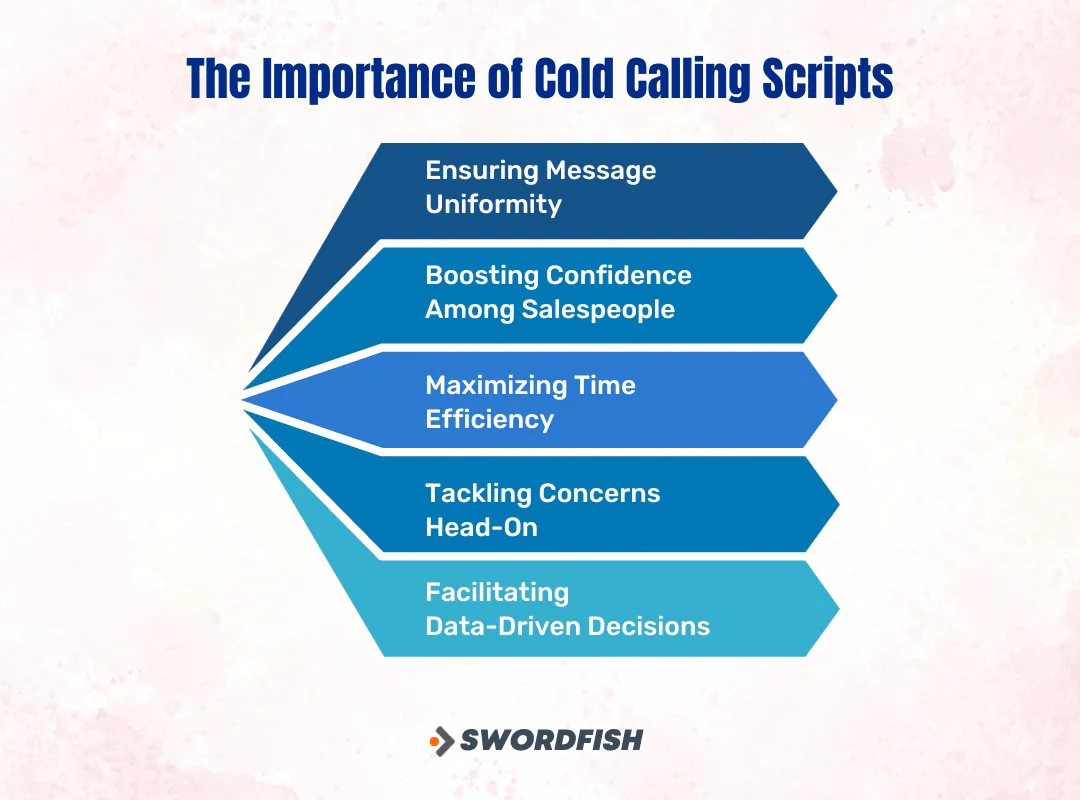
Ensuring Message Uniformity
Cold calling has a low conversion rate by nature — a study from UNC’s Kenan-Flagler Business School put the success rate at around 2.5%, and more recent industry surveys tend to land in a similar 2-3% range. A well-built script won’t dramatically change that math on its own, but it does make sure every rep on the team is representing the product and the brand the same way.
That consistency matters beyond individual calls. When reps communicate clearly and stick to the same core message, it reinforces the brand’s credibility instead of undermining it with mixed signals.
Boosting Confidence Among Salespeople
Cold calling makes a lot of reps nervous, especially newer ones. A ValueSelling Associates survey found that nearly half of B2B sales professionals, 48%, feel apprehensive about cold calling.
Knowing what to say in advance takes a lot of that anxiety off the table. A script functions like a safety net — it doesn’t guarantee a good call, but it means the rep isn’t improvising from scratch every time the other person picks up.
Maximizing Time Efficiency
Time matters for both sides of the call. A script keeps the message tight and avoids the meandering that wastes a prospect’s patience.
Roughly 75% of salespeople believe they pitch effectively on cold calls, even though the data suggests otherwise for most of them. A script closes some of that gap between perceived and actual performance by cutting out unnecessary detours.
Tackling Concerns Head-On
Prospects push back. That’s expected. A script that anticipates common objections gives reps ready responses instead of leaving them scrambling mid-call.
Handling objections smoothly does two things at once: it shows the rep knows the product, and it builds a small amount of trust with someone who was skeptical thirty seconds earlier.
Facilitating Data-Driven Decisions
When every rep follows a similar structure, it’s much easier to track what’s working. Consistent scripts turn call outcomes into comparable data instead of anecdotes, which lets sales leaders spot weak points and adjust messaging with actual evidence.
How to Build an Effective Cold Calling Script
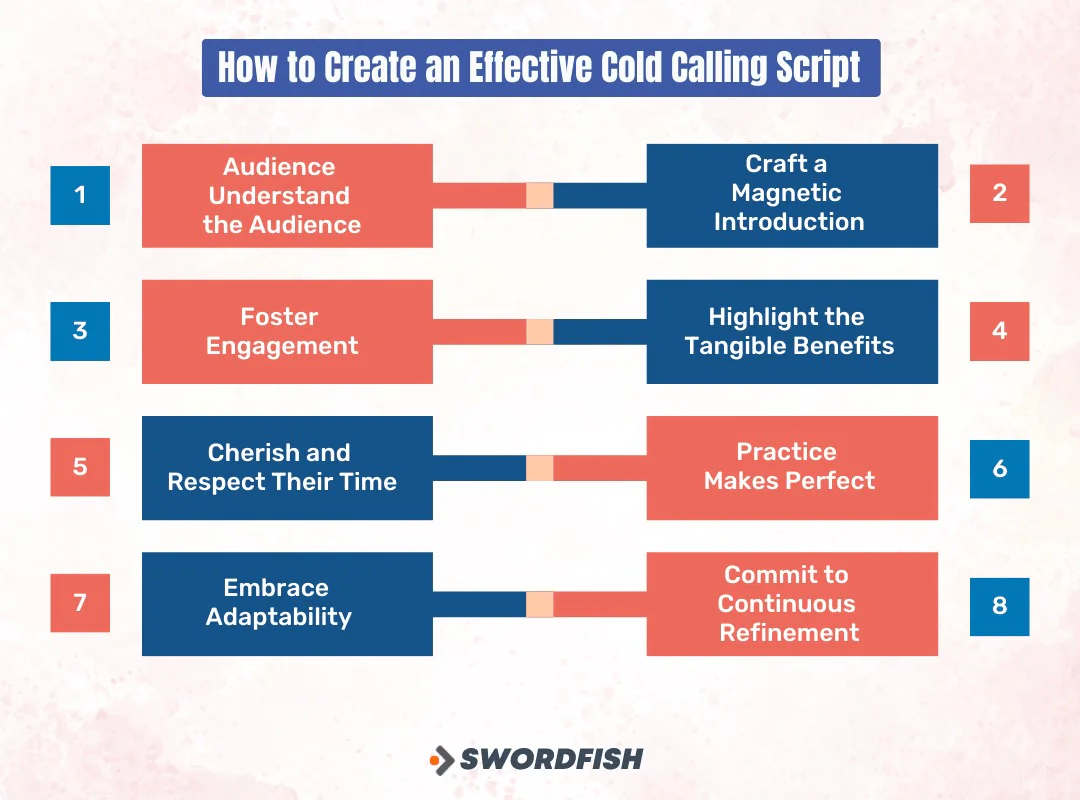
1. Understand the Audience
Before you dial, know who you’re calling. That means understanding the industry’s pressures, the company’s specific challenges, and the day-to-day reality of the person on the other end of the line. A script built around a generic buyer persona falls flat next to one built around a real, specific problem.
2. Write a Strong Opening
The first ten seconds decide whether the prospect keeps listening. Skip the throat-clearing and get to a reason the call matters to them. Think elevator pitch, not preamble.
3. Use Open-Ended Questions
A cold call that’s all monologue rarely goes anywhere. Questions that can’t be answered with a flat yes or no draw out real information about the prospect’s priorities and show genuine interest in their situation rather than just your pitch.
4. Lead With Benefits, Not Features
Prospects care about outcomes, not specs. Instead of listing what the product does, describe what changes for them once they’re using it — less time spent on a task, fewer errors, lower cost.
5. Respect Their Time
Say what needs to be said, then stop. Padding a script with extra detail rarely helps and often costs you the call.
6. Practice Until It Sounds Natural
A script read flatly sounds like a script. Practicing until the message feels like your own words, not memorized lines, is what makes the delivery land.
7. Stay Adaptable
Treat the script as a starting point, not a rulebook. Every prospect responds differently, and rigidly sticking to a script when the conversation goes off-script makes the call feel robotic.
8. Refine Continuously
After each call, take note of what worked and what didn’t. Scripts that don’t get revised go stale fast, especially as objections and market conditions shift.
Best Cold Calling Scripts for Outreach and Winning Leads
Cold calling is still a core tool for sales teams that know how to use it well. Zendesk has published its own set of scripts, tips, and templates for improving cold call outcomes, and the fundamentals it lists line up with what most experienced reps already know:
- Researched: Know who you’re calling and find similarities with other successful customers.
- Scripted: Have a script ready to navigate the conversation.
- Personalized: Make the call feel unique and not overly scripted.
- Prepared for Objections: Practice handling common objections.
- Positive: Maintain a positive attitude throughout the call.
- Practiced: The more you practice, the better you get.
Here’s a closer look at ten scripts that work across different industries and situations, including a few tailored to specific fields.
1. Referred by a Colleague or Friend Script
“Hi, [PROSPECT’S NAME]. My name is [YOUR NAME], from [COMPANY]. Our mutual colleague, [COLLEAGUE’S NAME], and I have seen great results with our [SOLUTION].
We discussed others who would benefit, and [COLLEAGUE’S NAME] mentioned you. I’m impressed by your company’s [TRAIT/PROGRAM]. Do you have 20 minutes available on [DATE(S)]?”
2. The Interested Prospect Script
“Hello, [PROSPECT’S NAME]. This is [YOUR NAME] from [COMPANY]. We’re working with companies similar to yours who are looking to [SOLUTION OFFERING]. Do you have a few minutes to discuss how we can help you?”
3. Script for the “Perfect Fit” Prospect
“Hi, [PROSPECT’S NAME]. I’m [YOUR NAME], from [COMPANY]. We do a great job at solving [PROBLEM]. Since [PROSPECT’S COMPANY] does [INDUSTRY], I imagine you might be looking for a solution. Do you have a few minutes to discuss our successes with similar companies?”
4. Script to Be Concise: The Elevator Pitch
“Hi, [PROSPECT’S NAME]. My name is [YOUR NAME], from [COMPANY]. [SPECIALTY] is our expertise. Do you have three minutes to discuss how we can help [SOLVE ISSUE] with features like [FEATURE], [FEATURE], and [FEATURE]?”
5. The “Choose Your Own Adventure” Script
“Hello, [PROSPECT’S NAME]. This is [YOUR NAME], from [YOUR COMPANY]. I’m calling to discuss solutions for [SPECIALTY]. Is that something you’d be interested in? [If yes] Great! We have [PRODUCT OPTION 1] and [PRODUCT OPTION 2]. Which one fits your team?”
6. Scripts for Real Estate
Real estate agents rely heavily on cold calling to reach potential sellers. A script for this audience usually opens with credibility and moves quickly into market insight:
“Hello, my name is [Your Name] from [Real Estate Agency]. I’ve recently helped several homeowners in your area get top dollar for their properties. Are you considering selling your home? I have some market insights that might interest you.”
7. Scripts for Financial Advisors
Financial advisors need to establish trust fast, since money is a sensitive topic. These scripts tend to focus on goals rather than products:
“Hi, I’m [Your Name] with [Financial Firm]. I specialize in helping individuals achieve their financial goals. May I ask, are you currently satisfied with your financial growth? I have some strategies that could align with your aspirations.”
8. Scripts for Insurance
Insurance is a product almost everyone needs and almost no one wants to talk about. A script that leads with a relatable scenario tends to land better than one that opens with a pitch:
“Good day! This is [Your Name] from [Insurance Company]. I recently came across a story where a family was saved from financial ruin thanks to their insurance coverage. Have you reviewed your current policy lately? I’d love to discuss how we can ensure you and your family are fully protected.”
9. Script to Get an Appointment
This one is built purely to get a meeting on the calendar, not to close anything on the call itself:
“Hello! I’m [Your Name] from [Company Name]. I believe we offer something that could greatly benefit you. Would you be open to a face-to-face or virtual meeting to discuss this further?”
10. Script for Freight Agents
Freight agents typically lead with reliability and speed, since that’s what shippers care about most:
“Hello, this is [Your Name] from [Freight Company]. Our network is known for its strength, speed, and reliability. If you’re shipping goods, I’d love to show you how our solutions stand out in terms of efficiency and reliability.”
Cold Calling Tips to Improve Your Results
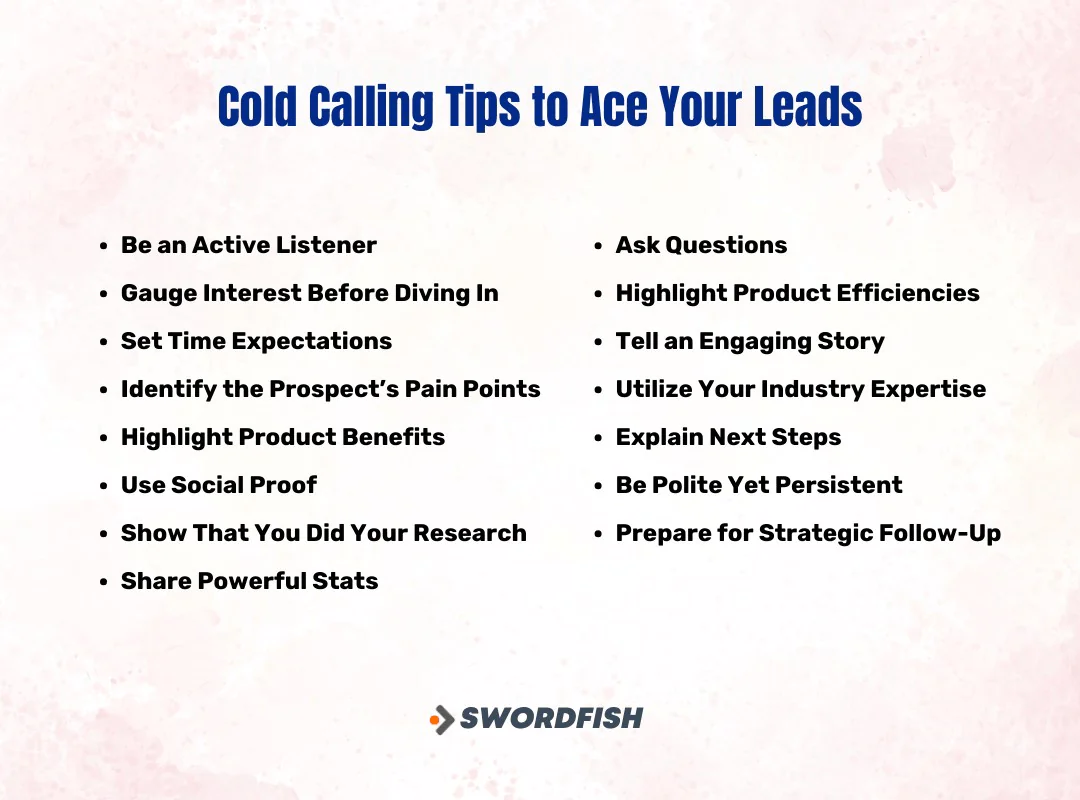
Be an Active Listener
Active listening means processing what the prospect says instead of waiting for your turn to talk. It often surfaces concerns the prospect hasn’t stated outright, which you can address before they become objections.
Gauge Interest Before Diving In
Open with a short introduction and a general question about their current situation. Their answer tells you how much runway you have for the rest of the pitch.
Set Time Expectations
Something as simple as “I’ll only take X minutes of your time” sets a boundary that reassures the prospect and makes them more willing to stay on the line.
Identify the Prospect’s Pain Points
Ask probing questions to find the actual friction point, then position your product against that specific problem rather than a generic use case.
Highlight Product Benefits
Skip the feature list. For example, instead of saying a piece of software has a certain capability, say what that capability does for the buyer’s day-to-day, like cutting processing time by a specific margin.
Use Social Proof
Reference other companies in the prospect’s industry who’ve had success with your product. A concrete example does more work than a general claim.
Show That You Did Your Research
Mentioning specific details about the prospect’s company signals that the call isn’t a mass-dialed script, which makes the conversation feel more worth their time.
Share Relevant Stats
A specific, credible number carries more weight than a vague claim. Just make sure any stat you cite is one you can actually back up.
Ask Questions
Questions like “How are you currently handling X?” turn the call into a conversation and often reveal exactly what to pitch next.
Highlight Product Efficiencies
Time and cost savings are usually the fastest path to a yes in B2B settings, so make efficiency gains explicit rather than implied.
Tell an Engaging Story
A short, real example of your product solving a similar problem tends to stick with prospects longer than a list of specs.
Utilize Your Industry Expertise
Sharing a trend or insight the prospect might not know positions you as a resource, not just someone trying to make a sale.
Explain Next Steps
If there’s interest, be specific about what happens next, whether that’s a trial, a demo, or an implementation timeline.
Be Polite Yet Persistent
Hesitation isn’t always a no. Acknowledge the concern, offer more information, and propose reconnecting later rather than pushing too hard in the moment.
Prepare for Strategic Follow-Up
Send a short recap email after the call with any resources you promised, and schedule the next touchpoint before you hang up whenever possible.
Get Better Leads Before You Start Calling
None of these scripts do much good if you’re calling the wrong number or an outdated contact. Before any cold calling push, it’s worth checking that your contact data is current and accurate, especially in fields like healthcare where roles, affiliations, and direct lines change often.
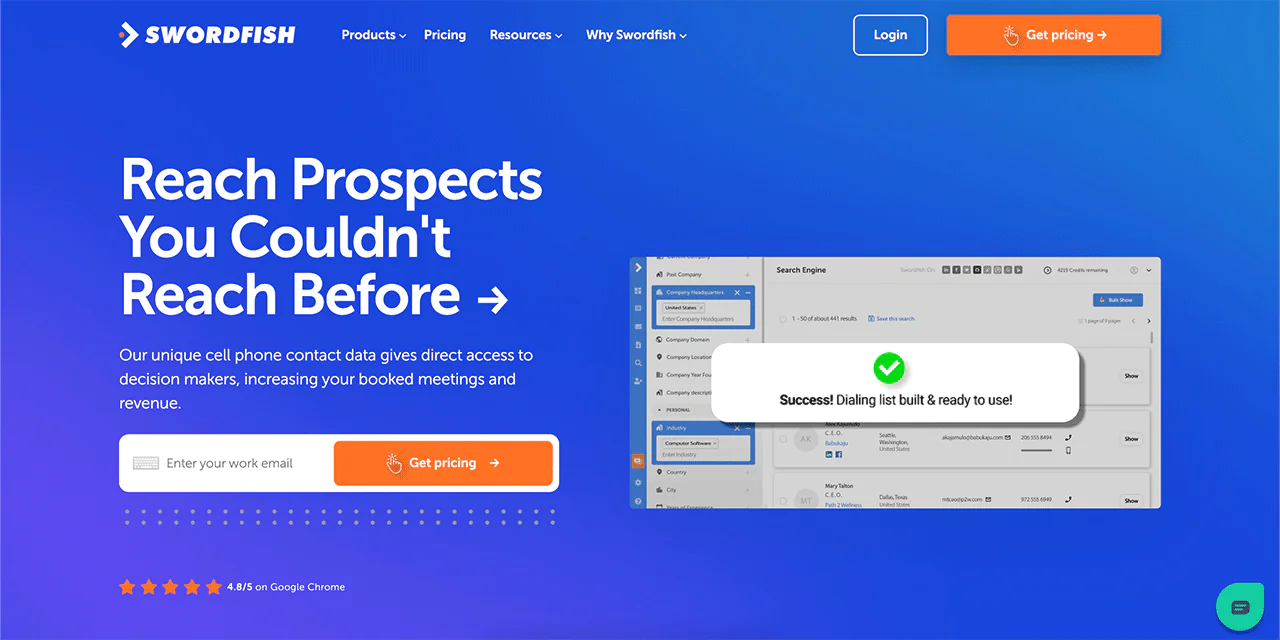
This is one area where Swordfish AI is built to help — it focuses on giving sales teams accurate contact details instead of generic, stale lists.
If you haven’t looked at Swordfish yet, it’s worth a look before your next outreach push.
 Try Swordfish Ai
The Bottom Line
Cold calling isn’t easy, but a solid script paired with accurate contact data turns it into a manageable, repeatable process instead of a guessing game.
The scripts above are starting points, not finished products. The real work is adapting them to the specific person on the other end of the line.
More than anything, a cold call succeeds when the person making it genuinely believes there’s value in what they’re offering, not just a quota to hit.
FAQs
How often should I update my cold calling script?
Review it regularly based on call outcomes, objection patterns, and any changes to your product or market. A script that hasn’t been touched in months is probably underperforming.
Can I use the same script for every prospect?
Use one as a base, but tailor the details to the specific prospect. A pitch that references their actual situation lands better than a generic one.
What should I avoid in a cold calling script?
Avoid sounding pushy, making claims you can’t back up, or leaning on jargon the prospect might not follow. Keep it clear, short, and centered on their needs.