
 View Products


Last updated: September 3, 2026
Anyone who has built an outbound list knows the frustration of paying for a contact and getting a dead number or a bounced email. Swordfish.ai vs Lusha is a common comparison for teams trying to solve that exact problem, and the two platforms take genuinely different approaches to getting there. This breakdown looks at data accuracy, pricing structure, bulk processing, user experience, and compliance so you can match the tool to how your team actually prospects.
Data Accuracy: The Foundation of Effective Prospecting
Swordfish.ai’s Multi-Source Approach
Swordfish.ai pulls from 200+ live data partners to provide real-time contact validation. The platform specializes in both business and personal email addresses, plus cell phone numbers with direct dial capabilities. The differentiator is real-time email validation and phone line connectivity verification, so you’re not paying for a number that’s already been disconnected.
The platform’s accuracy comes down to sourcing strategy. Instead of relying on one database, Swordfish cross-references hundreds of sources against each other, which tends to catch stale or mismatched records that a single-source provider would miss.
For recruitment agencies, that shows up in reported outcomes like 400% more cleared candidates and 1,000+ hours saved in sourcing time, based on customer testimonials from organizations such as Lockheed Martin.
Lusha’s AI-Powered Database
Lusha has built its reputation around compliance and a large global contact database. Its data flows through a multi-source verification pipeline, and the company publishes accuracy figures alongside a broad set of security certifications.
Independent reviews in 2026 have found that Lusha’s published accuracy claims don’t always match real-world coverage. One test of 300 mid-market B2B contacts found the platform returned an email address for roughly a third of lookups, with deliverability on the emails it did find landing under the advertised figure. That’s a coverage gap worth testing against your own contact lists before committing to a plan, since results vary significantly by industry and region.
The Verdict on Accuracy
For pure email and phone accuracy at volume, Swordfish.ai’s real-time validation gives it an edge, particularly for teams that need dependable coverage rather than partial hits. Lusha’s strength is in the depth of the profiles it returns when a match exists, even if the match rate itself can be inconsistent.
Pricing Models: Credits vs. Unlimited Access
Swordfish.ai’s Transparent Pricing
Swordfish.ai offers straightforward pricing that removes the guesswork:
- Free Trial: 10 credits to test the platform
- Unlimited Solo: $99/month for unlimited emails and phone numbers (1 user)
- Unlimited Teams: $599/month for 6-10 users and advanced features
The “unlimited” model runs on a fair use policy, but case-by-case increases are available for high-volume users. Agencies, sales teams, and recruiters who need predictable monthly costs tend to benefit most from this structure.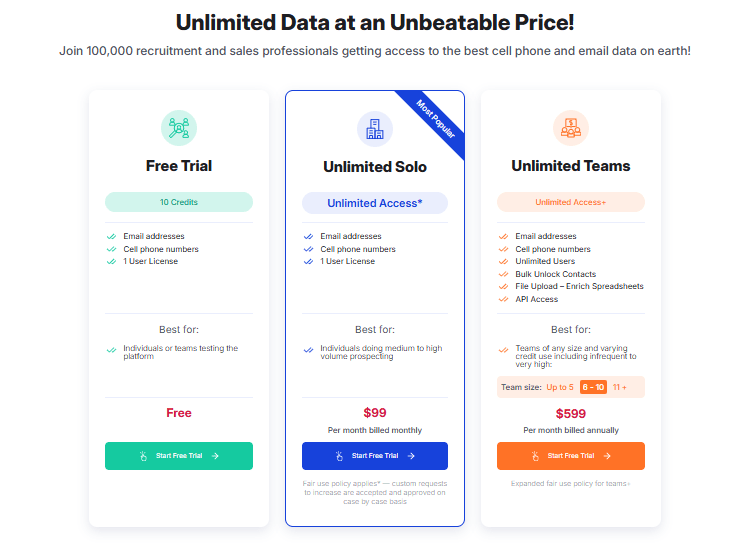
Lusha’s Credit-Based System
Lusha runs on a credit-based model where every lookup draws down a balance, and different data types cost different amounts. Verified emails typically consume 1 credit each, while phone numbers can cost several times that depending on the plan and access method. Entry plans start in the range of $29 to $37 per user per month on annual billing, with credit allotments that vary by tier and, on some plans, expire monthly without rollover. That structure works fine for occasional prospecting, but teams doing heavy phone-based outreach can burn through credits fast and end up buying top-ups mid-cycle. The credit-based pricing in the Lusha vs Swordfish.ai comparison is the main reason costs get harder to predict as volume grows.
Small Business vs. Enterprise Comparison
For Small Businesses (1-5 users):
- Swordfish.ai: $99/month provides unlimited access for one user
- Lusha: Credit-based pricing may be more cost-effective for light, occasional usage
For Enterprise Teams (10+ users):
- Swordfish.ai: $599/month for 6-10 users and advanced features offer significant savings
- Lusha: Per-seat credit costs add up quickly once multiple reps are pulling phone numbers regularly
Bulk Processing and Data Enrichment Capabilities
Swordfish.ai’s Enterprise Features
Swordfish.ai is built for bulk operations through:
- File Upload Enrichment: Upload spreadsheets and enrich existing contact lists
- API Access: Full API integration for custom workflows
- Bulk Contact Unlock: Process large datasets efficiently
- Chrome Extension: Real-time prospecting on LinkedIn and other platforms
This setup fits teams processing thousands of contacts on a regular basis. Healthcare organizations use Swordfish to access 11M+ healthcare provider contacts, while real estate professionals find contact data for hard-to-reach property owners.
Lusha’s Enrichment Approach
Lusha’s Chrome Extension pulls verified contact details from LinkedIn and the open web and syncs them into leading CRMs. It’s better suited to individual prospect enrichment and small-batch lookups than to large-scale enrichment projects; some Lusha plans cap bulk batches at a small number of contacts per upload, which makes processing long lists impractical without a separate tool.
Its real strength is depth: prospect profiles that include verified emails, direct dials, role information, and company insights, even if that comes at a higher per-contact cost for bulk needs.
Bulk Processing Winner
On bulk processing, the Swordfish vs Lusha debate comes down to Swordfish.ai’s API access and unlimited model versus Lusha’s per-batch caps. Teams needing extensive bulk enrichment will find Swordfish.ai’s file upload, API, and unlimited pricing the more workable setup. Lusha remains a solid fit for targeted, one-off prospect research.
User Experience and Customer Support
Swordfish.ai’s User-Centric Design
Swordfish.ai prioritizes ease of use with:
- Intuitive Chrome extension integration
- Simple prospect search functionality
- Reverse lookup capabilities
- Real-time phone and email validation feedback
Customer testimonials point to reliability as the standout. Serco notes: “Access to accurate phone numbers is critical, Swordfish consistently delivers.” Artemis adds: “Not many competitors could match Swordfish’s accuracy.”
Lusha’s Professional Interface
Lusha’s interface is polished and its profiles are detailed, but in day-to-day Swordfish.ai vs Lusha usage, many reviewers report that Swordfish’s simpler workflow holds up better for repetitive daily prospecting. Lusha’s advantage shows up in the context it surrounds each contact with, including company insights and role information. G2 lists roughly 1,600 reviews for the platform, filterable by company size, role, or industry, which gives a decent read on how it performs across different buyer types.
Support and Onboarding
Both platforms offer customer support, but Swordfish.ai’s unlimited model includes expanded support for team plans. Lusha’s tiered credit system ties some support features, like dedicated account management, to higher subscription levels.
Integration Capabilities and Compliance Features
Swordfish.ai’s Technical Integration
Swordfish.ai offers a full set of integration options:
- Full API access for custom applications
- Chrome extension for real-time prospecting
- CRM synchronization capabilities
- File upload and export functionality
The platform maintains CCPA compliance as a registered data broker and excludes EU-based individuals for GDPR compliance. Credits roll over monthly if subscriptions remain active.
Lusha’s Compliance Leadership
Lusha is one of the more compliance-focused B2B data providers in the space, holding certifications spanning GDPR, CCPA, SOC 2 Type II, and ISO privacy standards, with independent audits backing several of them. That combination makes it a natural fit for enterprises with strict data governance requirements, particularly those operating in the EU.
Lusha also offers native CRM integrations across major platforms, with automated data syncing that plugs directly into existing prospecting workflows.
Compliance Comparison
For EU operations and strict compliance requirements, Lusha’s certification stack provides more documented assurance. For US-focused operations prioritizing data access and cost-effectiveness, Swordfish.ai’s CCPA compliance and GDPR exclusions offer adequate protection without the added certification overhead.
Industry-Specific Use Cases
Recruitment and Talent Sourcing
Swordfish.ai Advantages:
- 400% more cleared candidates for government contracting
- Unlimited access supports high-volume candidate outreach
- Personal email and phone number access for passive candidates
Lusha Advantages:
- Detailed professional profiles with career progression
- Strong LinkedIn integration for talent research
- Compliance features for regulated industries
Sales and Business Development
Swordfish.ai Advantages:
- 5x increase in connects through accurate phone numbers
- Real-time validation prevents wasted outreach efforts
- Unlimited model supports aggressive prospecting
Lusha Advantages:
- Comprehensive company and contact context
- Intent signals for timing outreach
- Professional sales team collaboration features
Real Estate and Healthcare
Swordfish.ai Advantages:
- Specialized healthcare provider database (11M+ contacts)
- Property owner contact information
- Personal contact details for decision makers
Lusha Advantages:
- Global database coverage for international markets
- Compliance features for regulated communications
- Professional context for relationship building
Swordfish.ai vs Lusha: Making the Right Choice
Choose Swordfish.ai If You:
- Need unlimited contact access for predictable budgeting
- Prioritize phone number accuracy and direct dial capability
- Require bulk processing and API integration
- Focus primarily on US markets
- Want real-time validation to ensure contact quality
- Operate in recruitment, real estate, or high-volume sales environments
Choose Lusha If You:
- Need comprehensive prospect profiles with business context
- Prioritize strict compliance and data governance
- Focus on EU markets or global operations
- Prefer pay-per-use pricing for limited prospecting
- Value detailed company and role information
- Need extensive CRM integration capabilities
Internal Resources for Deeper Research
For more detailed comparisons and alternatives, explore these resources:
- Learn about Apollo alternatives for additional contact-finding options
- Compare ZoomInfo vs other platforms for enterprise solutions
- Discover Lusha pricing details for budget planning
- Explore best contact finding tools for comprehensive options
- Check out SignalHire alternatives for recruitment-focused tools
Conclusion: Data Accuracy Drives Success
In the Swordfish.ai vs Lusha comparison, both platforms have a clear lane. Swordfish.ai wins on cost predictability, phone accuracy, and unlimited access, which makes it a strong fit for high-volume prospecting teams. Lusha leads on documented compliance, global coverage, and prospect context, which suits enterprises with strict data governance needs.
The right choice comes down to what your team actually does day to day: volume versus context, US focus versus global reach, and unlimited access versus per-credit profiles.
Ready to test Swordfish.ai’s accuracy for yourself? Start your free trial today with 10 credits to experience real-time contact validation and unlimited potential.
About the Author
Drew Clark is Co-Founder and CRO at Swordfish.ai and Heartbeat.ai, where he’s spearheaded sales operations since 2019. Drew works with sales, recruiting, and marketing teams to develop outbound strategies, leading to 25+ new business demonstrations per week. Based in England, Drew brings over 6 years of B2B sales leadership experience. Connect with Drew on LinkedIn.