
 View Products


Last updated: September 3, 2026
Getting a C-level executive on the phone is a different problem than getting their assistant on the phone. This guide walks through seven practical ways to source direct-dial numbers for CEOs, CTOs, and other senior leaders, plus how to compare tools like Cognism, Lusha, and Kaspr, verify numbers before you dial, and stay on the right side of TCPA and GDPR rules. See our related guide on phone number verification best practices for more on that piece. The short version: no single source is reliable enough on its own — cross-checking two or three methods with real-time validation is what separates teams that reach the C-suite from teams that leave voicemails.
What Is a Direct-Dial Number, and Why Does It Matter?
A direct-dial number skips reception, assistants, and switchboards and rings straight through to the person you’re trying to reach — their desk line or, increasingly, their mobile. That distinction matters more for executives than for almost any other title, because gatekeeping is baked into how most C-suite offices operate. If your only path to a decision-maker runs through a main company line or a general voicemail box, you’re competing with every other cold call that gets screened out before it reaches anyone with signing authority.
Why Direct-Dial Access Changes the Sales Conversation
- You skip the message-taking loop. When you find direct-dial phone numbers for C-level executives, you’re talking to the person who actually approves budget, not someone forwarding a note.
- Pickup rates improve substantially. Executives tend to answer their direct lines because they expect calls from board members, partners, and other people who matter to their day. Switchboard numbers get screened; direct lines usually don’t.
- Deals move faster. Skipping the multi-day game of callback tag through an assistant means you can have a real conversation on the first attempt.
- It signals preparation. Reaching someone on a line reserved for people they expect to hear from tells them you did the work — and that tends to earn a few extra seconds of attention.
Seven Ways to Find Direct-Dial Numbers
1. Professional Networking and Referrals
- Start with people, not databases. Former colleagues, shared investors, and industry contacts often already have a direct line to the person you’re targeting.
- How to use it. Ask connections who’ve worked at the target company, show up at events your prospect attends, or tap shared board relationships. A warm introduction with a phone number attached beats a dozen cold attempts.
2. Advanced LinkedIn Research
- LinkedIn won’t hand you a phone number, but it tells you where to look. Watch for:
- Recent role changes, which often come with updated contact details on company pages
- Company announcements that list a direct contact for press or partnerships
- Event attendee lists tied to conferences the executive is speaking at
Pro tip: Check for mentions of upcoming speaking engagements — conference organizers frequently publish direct contact information for confirmed speakers.
3. Company Press Releases and SEC Filings
- Public filings sometimes hide contact details in plain sight. Check:
- Earnings call logistics and dial-in instructions
- Press releases tied to major announcements
- SEC filings and investor relations pages
- Annual reports listing management contacts
4. Industry Conference and Event Materials
- Speaker materials often include direct lines. Look at:
- Event programs and speaker bios
- Webinar registration confirmation emails
- Industry association member directories
- Speaking bureau listings
5. Professional Contact-Finding Tools
- This is where most teams should spend their time. Purpose-built platforms aggregate data from multiple sources and validate it against live signals, which is faster and generally more accurate than manual digging alone — though it works best paired with the manual methods above, not instead of them.
6. Company Website Deep Dives
- Don’t stop at the contact page. Check:
- Leadership bios that include full contact details
- Investor relations sections
- Partnership and media inquiry pages
- Acquisition or merger announcement documents
7. Social Media Intelligence
- Executives occasionally self-publish contact details. Check:
- X/Twitter professional profiles
- Industry-specific social platforms
- Author bios on professional blogs
- Podcast guest introductions
Comparing Tools for C-Level Contact Accuracy
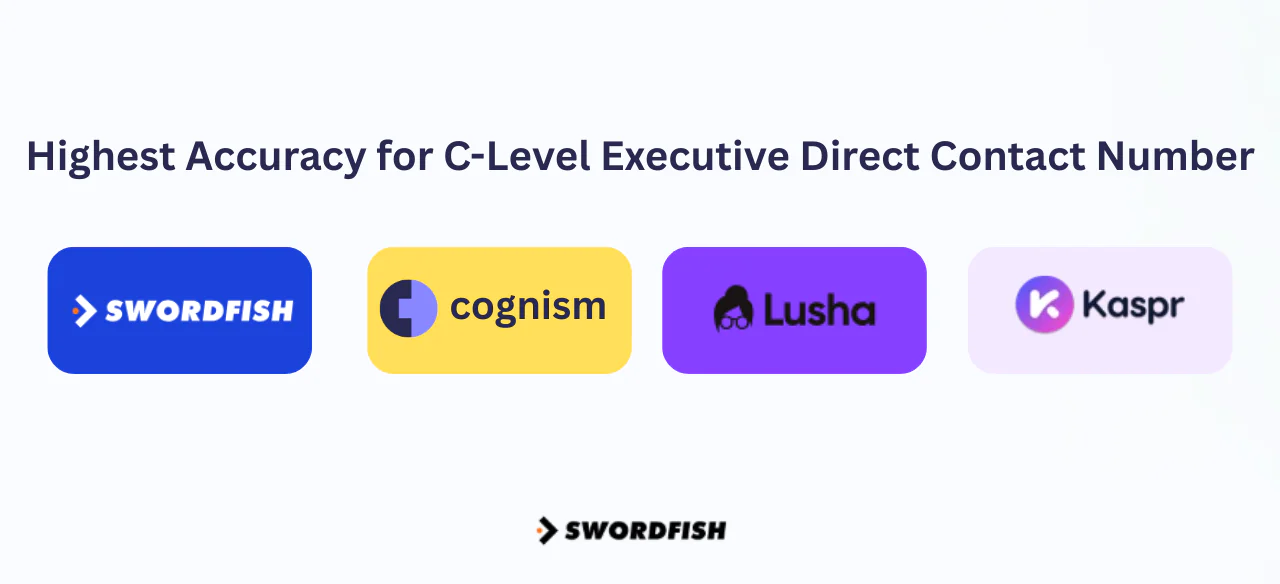
Swordfish.ai
- What it does: Combines business emails, personal emails, and cell phone numbers with validation drawn from a large network of live data partners.
- Notable features:
- Real-time phone validation to reduce dead-number outreach
- Personal cell access for executives who default to mobile
- A Chrome extension plus bulk upload for team-level prospecting
- Pricing model: An unlimited-search plan aimed at individuals doing medium-to-high volume prospecting, starting around $99/month.
Cognism
- What it does: Cognism focuses on B2B contact quality with strong coverage of senior roles, combining multiple data sources with human verification.
- Fit: Tends to perform well in technology and finance verticals; positioned toward enterprise sales teams.
- Pricing: Enterprise-tier pricing, typically requiring a custom quote rather than published self-serve rates.
Lusha
- What it does: Lusha offers broad coverage across seniority levels with a straightforward Chrome extension.
- Fit: Often a better match for mid-market targets than for large enterprise organizations.
- Pricing: See current Lusha pricing details, which vary by credit volume and seat count.
Kaspr
- What it does: Built around LinkedIn Sales Navigator workflows, making it convenient for reps already prospecting inside LinkedIn.
- Fit: Coverage tends to be stronger for European and APAC executives than for North American ones.
- Pricing: Seat-based pricing, generally more affordable when billed annually.
How to Verify a Number Before You Dial
1. Treat Every List as Perishable
- The disconnection problem is real. B2B contact data decays steadily as people change jobs, companies restructure, and numbers get reassigned — a list that’s accurate today won’t stay that way for long.
2. Verification Techniques Worth Using
- Cross-reference across sources. Don’t trust a single database. If two or three independent tools agree on a number, confidence goes up considerably.
- Test line connectivity before outreach. Tools that validate whether a line is actually live save you from burning call time on dead numbers.
- Favor recently updated records. Data refreshed within the last quarter is meaningfully more reliable than older records.
- Watch for social confirmation. Recent LinkedIn activity, press mentions, or conference appearances suggest the executive is still active in the role tied to that contact record.
3. Warning Signs of Bad Data
- Suspiciously uniform number patterns can indicate generated rather than sourced data.
- Mismatched job titles or old employer names usually mean the phone data behind them is stale too.
- No timestamp on when data was collected is a reason to be cautious about relying on it.
Compliance Considerations Before You Start Calling
1. TCPA Basics
The Telephone Consumer Protection Act (TCPA) governs business calls in the U.S., with the strictest rules applying to autodialed and prerecorded calls.
What it generally requires:
- Express consent before marketing calls to cell phones
- A working opt-out mechanism
- Accurate caller identification
- Calling only within permitted hours (generally 8 AM–9 PM local time)
- Penalties: Statutory damages typically run $500 per violation, rising to as much as $1,500 per violation when a court finds the conduct knowing or willful — with no aggregate cap, so volume outreach carries real financial exposure.
2. GDPR and Cross-Border Contacts
Reaching executives based in the EU raises separate obligations. GDPR limits how personal contact data for EU residents can be collected and processed, which is why many B2B data provider tools exclude or restrict EU-based records.
Practical steps:
- Confirm your vendor’s GDPR posture before relying on EU contact data
- Document a legitimate business interest for processing contact data
- Build consent capture into your EU outreach workflow
3. Sector-Specific Rules Worth Knowing
- Healthcare executives: HIPAA considerations can come into play depending on what’s discussed and how patient-related information is handled in the conversation.
- Financial services: Additional disclosure rules often apply to communications touching on investment products or advice.
- Government contractors: Some procurement relationships carry extra restrictions on vendor outreach.
4. Baseline Etiquette
- Honor stated preferences. If someone has indicated how they’d rather be reached, respect it.
- Keep it professional. Direct numbers exist for business purposes — using them for anything else erodes trust in the whole practice.
- Identify yourself clearly. State who you are, your company, and why you’re calling, every time.
Making the Most of a Direct-Dial Attempt
Timing
Executive calendars follow patterns. Many reps find better pickup rates during early morning hours before the day fills up, or in the late-afternoon window before evening commitments — and Tuesday through Thursday tends to outperform Monday catch-up or Friday wind-down. Treat this as a general guideline rather than a guarantee; individual schedules vary widely.
Multi-Channel Coordination
- Pair calls with email. A short email referencing a missed call attempt often gets more attention than either channel alone.
- Watch social signals. Recent activity can hint at when someone is more or less likely to be reachable.
What to Say When They Pick Up
- You have seconds, not minutes, to earn continued attention. Lead with the point.
- Be specific, not generic. A quantified benefit tied to something happening in their business beats a company overview.
- Do the homework. Recent earnings, announcements, or industry pressure points signal you understand their context rather than working from a script.
Tracking What’s Working
1. Metrics Worth Watching
- Connection rate: How often a direct-dial number actually results in a conversation with the target.
- Data accuracy rate: How often sourced numbers reach the intended person versus a wrong number or dead line.
- Conversion rate: How often those conversations turn into meetings or next steps compared with other outreach channels.
2. Refining the Approach Over Time
- Audit tool performance regularly. Accuracy varies by market segment, so track which sources actually work for your target accounts.
- Adjust by industry. Coverage and accuracy for technology leaders can look very different from manufacturing or healthcare executives.
- Feed results back into your process. What worked last quarter with one persona may not work with another.
Conclusion
Finding a working direct-dial number for a C-level executive isn’t a single-step task. It’s a combination of manual research, the right tools, and a habit of verifying data before you spend time on it. Teams that consistently reach senior decision-makers tend to cross-check contact information across two or three sources rather than trusting any one list outright.
When evaluating contact-finding tools, weigh real-time verification, breadth of data sources, and a track record with senior-level contacts specifically — general accuracy claims don’t always hold up at the executive level. And treat compliance as part of the strategy, not an afterthought: TCPA, GDPR, and sector-specific rules carry real financial and reputational risk if ignored.
The payoff for getting this right shows up in shorter sales cycles and direct access to decision-makers who can move your business forward.
Ready to find direct-dial phone numbers for your target C-level executives? Try Swordfish.ai free and access verified executive contact information with real-time phone validation across live data sources.
About the Author
Drew Clark is Co-Founder and CRO at Swordfish.ai and Heartbeat.ai, where he’s spearheaded sales operations since 2019. Drew works with sales, recruiting, and marketing teams to develop outbound strategies, leading to 25+ new business demonstrations per week. Based in England, Drew brings over 6 years of B2B sales leadership experience. Connect with Drew on LinkedIn.