

 View Products


Last updated: September 3, 2026
Commercial listings expire every day without a sale, and the agents who reach the owner first are usually the ones who close. A good commercial real estate database gets you there faster: property characteristics pulled from MLS and public records, current contact details, and ownership history in one place instead of scattered across county sites and outdated spreadsheets.
The right platform saves research time and keeps you from dialing disconnected numbers or emailing addresses that bounce. The challenge is that no two commercial real estate databases work the same way — some specialize in listings, some in ownership records, some in verified contact data, and some in market analytics.
Below are ten platforms worth evaluating in 2025, along with what each one does well, where it falls short, and how to think about picking one for your workflow.
Quick List of 10 Top Commercial Real Estate Databases
Here’s a quick overview of ten commercial real estate databases that can help you access property data and contact information efficiently:
- Swordfish AI: Offers precise contact information and networking tools, making it easier to connect with property owners directly.
- CoStar: Offers detailed market analytics and essential property data to inform real estate decisions.
- Reonomy: Access comprehensive property data, ownership details, and transaction histories.
- Redfin: Known for extensive real estate listings and a user-friendly interface for residential searches.
- CompStak: Delivers crowd-sourced commercial lease data to offer insights into rental trends and market conditions.
- PropertyShark: Provides thorough property data, including ownership records, maps, zoning, and market values.
- Cherre: Integrates multiple data sources into a single platform for actionable real estate insights.
- Crexi: Simplifies the property transaction process with tools for listing, managing, and buying commercial real estate.
- LoopNet: A large online commercial real estate marketplace with an extensive database of listings in the U.S.
- Ten-X: Offers an online platform for buying and selling commercial properties through auctions and direct sales.
Top 10 Commercial Real Estate Database: Comparison Chart
The following table compares the top 10 commercial real estate databases so you can quickly weigh the strengths and unique offerings of each platform.
Name | Database Size | Precise Contact Info | Market Analytics |
 | Over 3.5 billion data points | Direct contact details for property owners | Intent data and insights for targeted outreach |
 | Extensive coverage of properties | Detailed contact data for real estate pros | Detailed market analytics, property trends |
 | Covers over 50 million properties | In-depth ownership and contact info | Comprehensive data analysis, transactional data |
 | Millions of residential listings | Basic contact info for listings | User-friendly home search analytics |
 | Crowdsourced commercial lease data | Verified lease comps, contact details | Insights into rental trends and market conditions |
 | Detailed info on numerous properties | Detailed owner contact information and records | Comprehensive property data, market values |
 | Integrates various data sources | Accurate property contact info | Integrates data for actionable real estate insights |
 | Broad range of property listings | Contact details for transactions | Market analytics for commercial properties |
 | Extensive commercial listings | Limited contact details for listings | Extensive property listings and market analytics |
 | Specializes in commercial auctions | Contact info for auction properties | Market insights for property auctions |
Top 10 Best Commercial Real Estate Databases for In-Depth Property Insights
We looked at each tool based on database quality, data source, accuracy, and ease of use. Here’s the rundown, starting with a contact-data-focused option before moving into listing marketplaces, analytics platforms, and specialty tools.
1. Swordfish AI
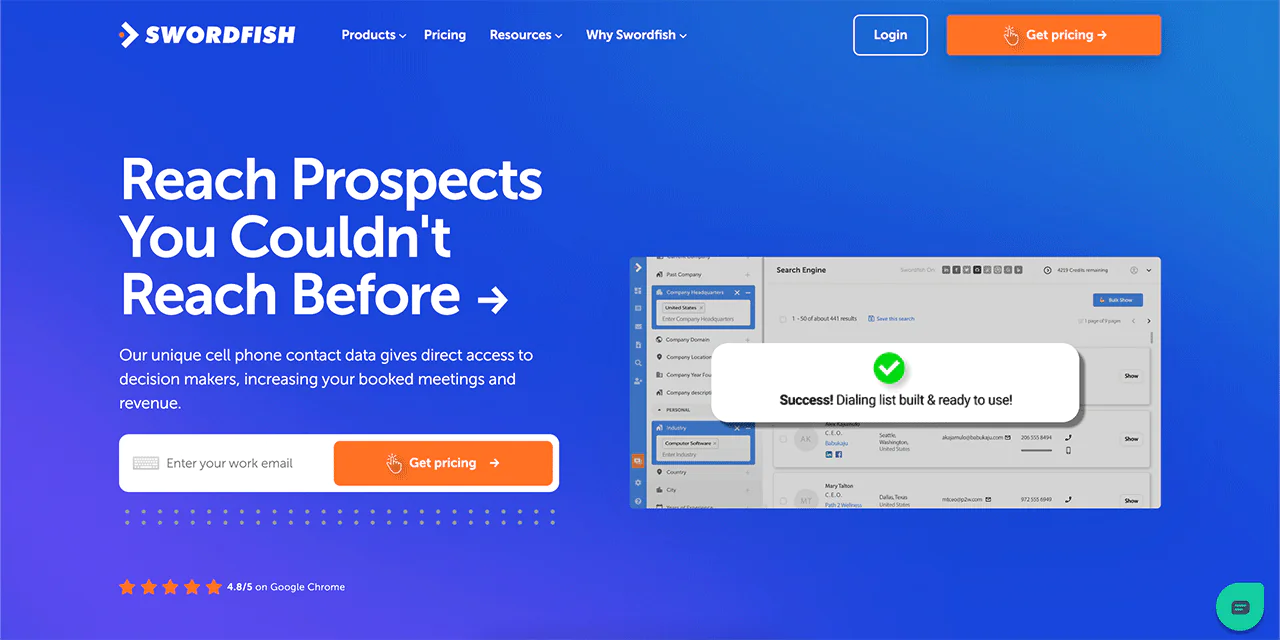
If you’re a real estate professional who needs verified contact data rather than just listings, Swordfish AI fills a gap most CRE databases leave open. Instead of focusing on property listings or market analytics, it’s built around finding and verifying direct contact information for owners and decision-makers.
Swordfish AI gives you access to a wide range of contact information, including mobile numbers and emails, customized for your industry. It aims to keep that information current, which matters most when you’re trying to reach a property owner before a competing agent does.
It also includes tools for quickly finding and verifying key contact details, which is useful for CRE professionals who want their outreach data to hold up over time rather than degrade within a few months.
About Swordfish AI
- Founding Team: Ben Argeband
- Founding Year: 2015
- Company Size: 11 to 50 employees
What Sets Swordfish AI Apart?
Swordfish AI stands out among CRE contact tools because of its database size and real-time verification, which matters most when you need quick, reliable connections with property managers and owners rather than a general market overview.
Swordfish reports access to over 3.5 billion data profiles, including business emails and proprietary cell phone data. A database at that scale increases the odds you can find a direct line to a seller or buyer instead of routing through a gatekeeper.
Swordfish also runs real-time validation on contact records, so when you reach out, the details are current rather than stale.
Features of Swordfish AI
Swordfish AI is packed with features designed to support sales lead generation and streamline outreach in commercial real estate. Here’s a quick rundown of what you can expect:
Prospect Search
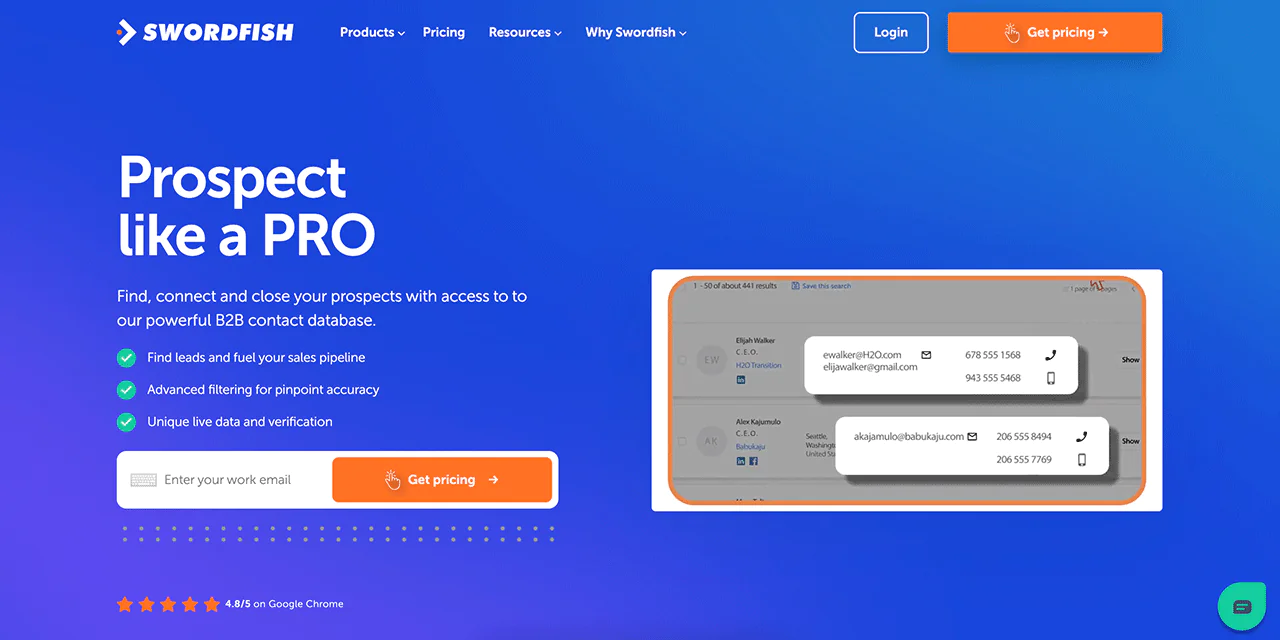
Finding new leads is faster with filters built for the search. The Prospect Search lets you quickly search through a massive database using multiple filters according to your needs, helping you find commercial real estate data and new opportunities without the hassle.
Bombora Intent Data
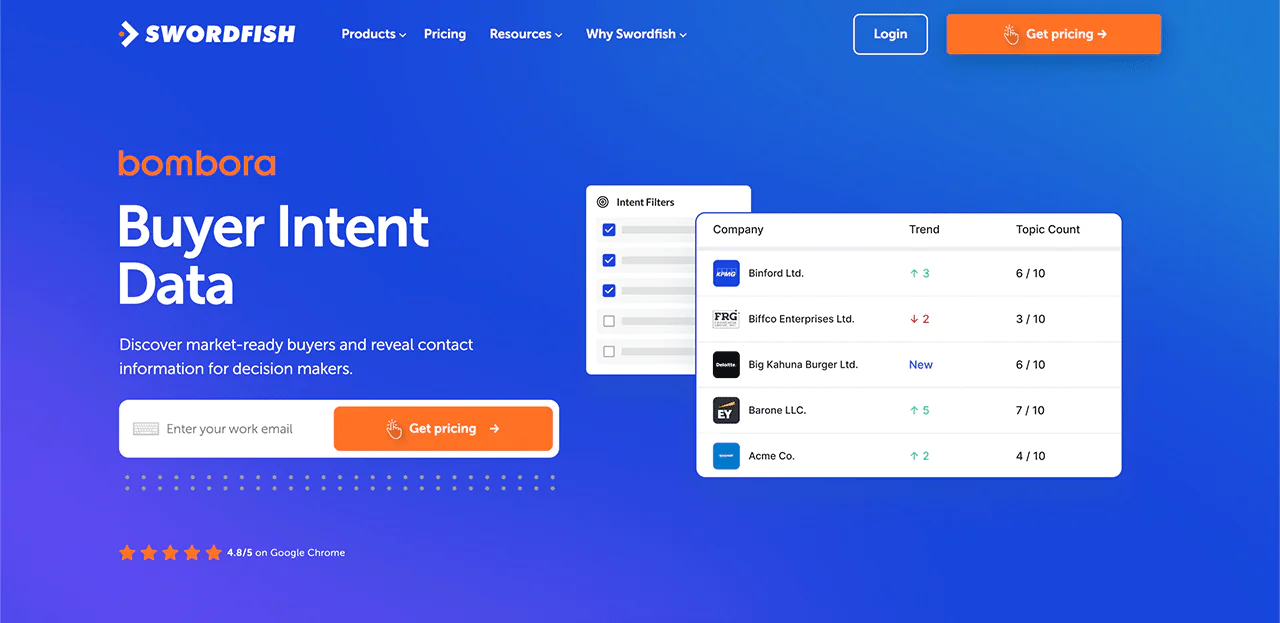
Want to know which companies are already researching topics related to your business? Bombora Intent Data does just that, pointing you toward the most promising real estate prospects instead of a cold list.
Chrome Extension
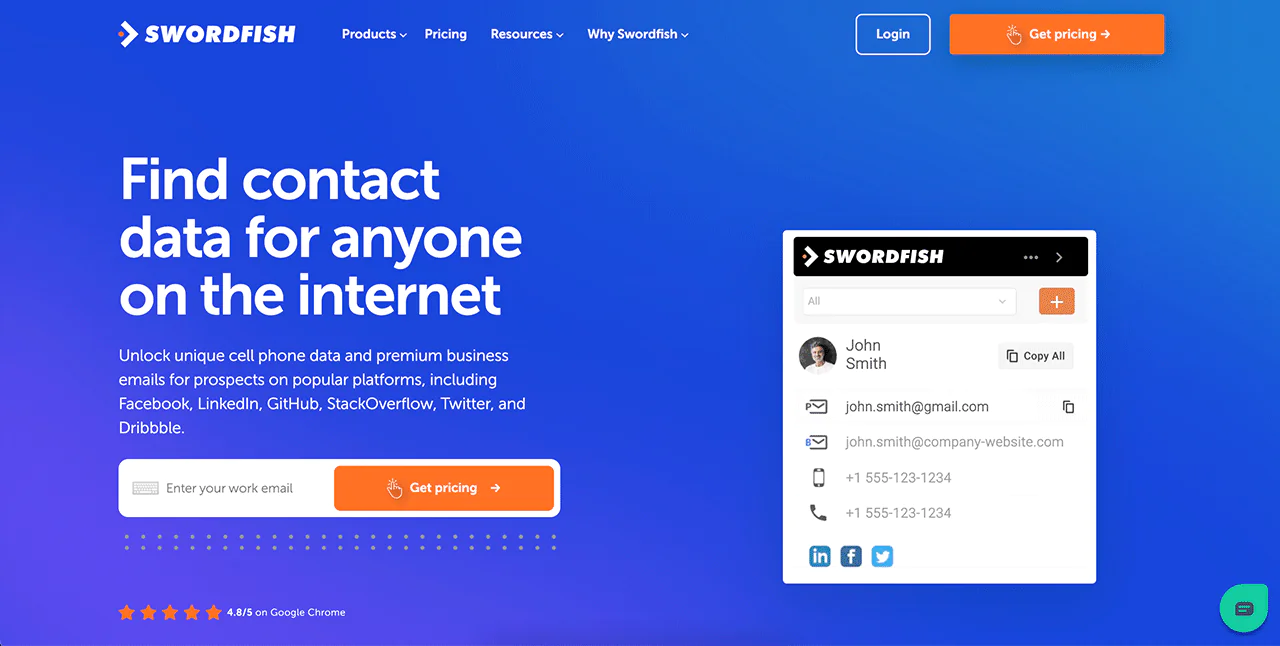
This Chrome Extension pulls contact details right from the platform without extra steps, and it integrates with Facebook, LinkedIn, Twitter, Dribble, and similar sites so you can collect contact info faster.
Reverse Lookup
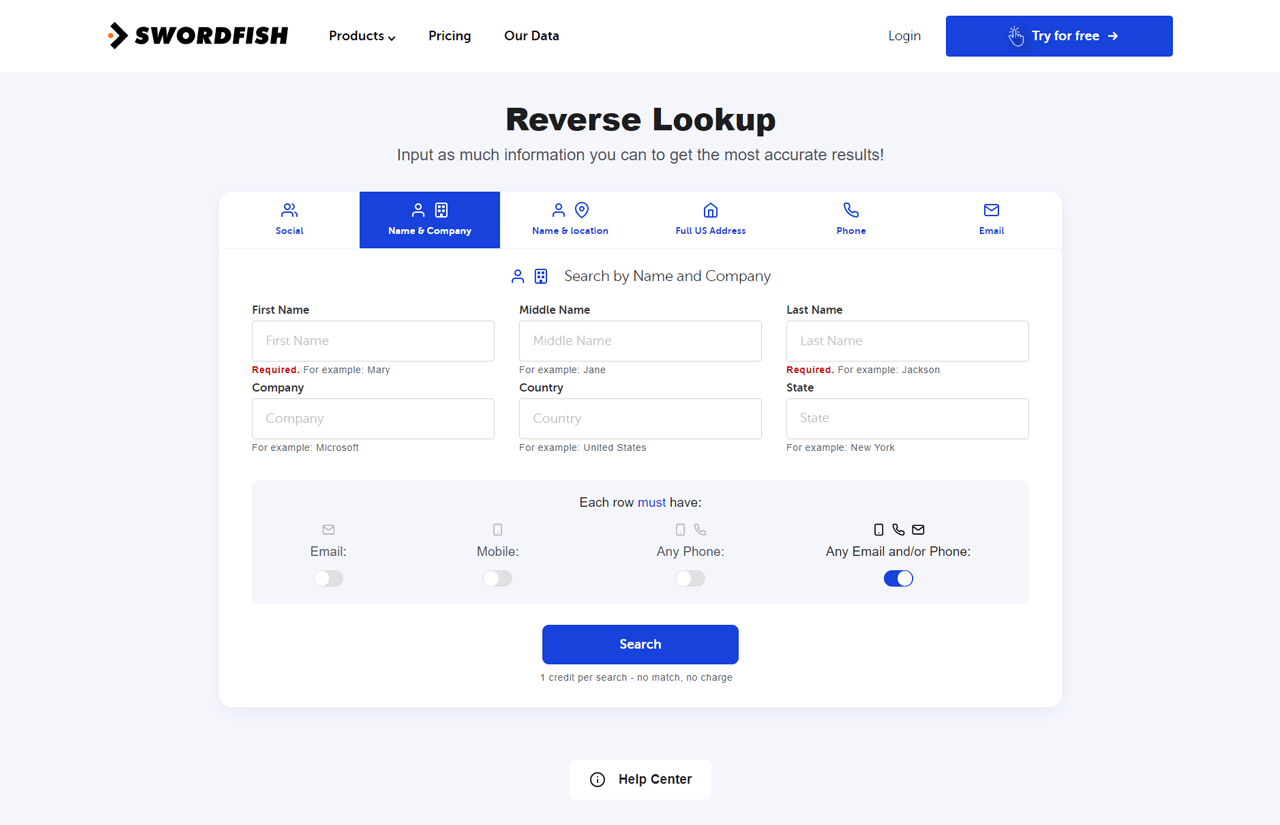
Need to fill in missing contact details when you only have a partial record? The Reverse Lookup feature works from a name, email, phone number, address, or social profile to fill in the rest.
API Integrations
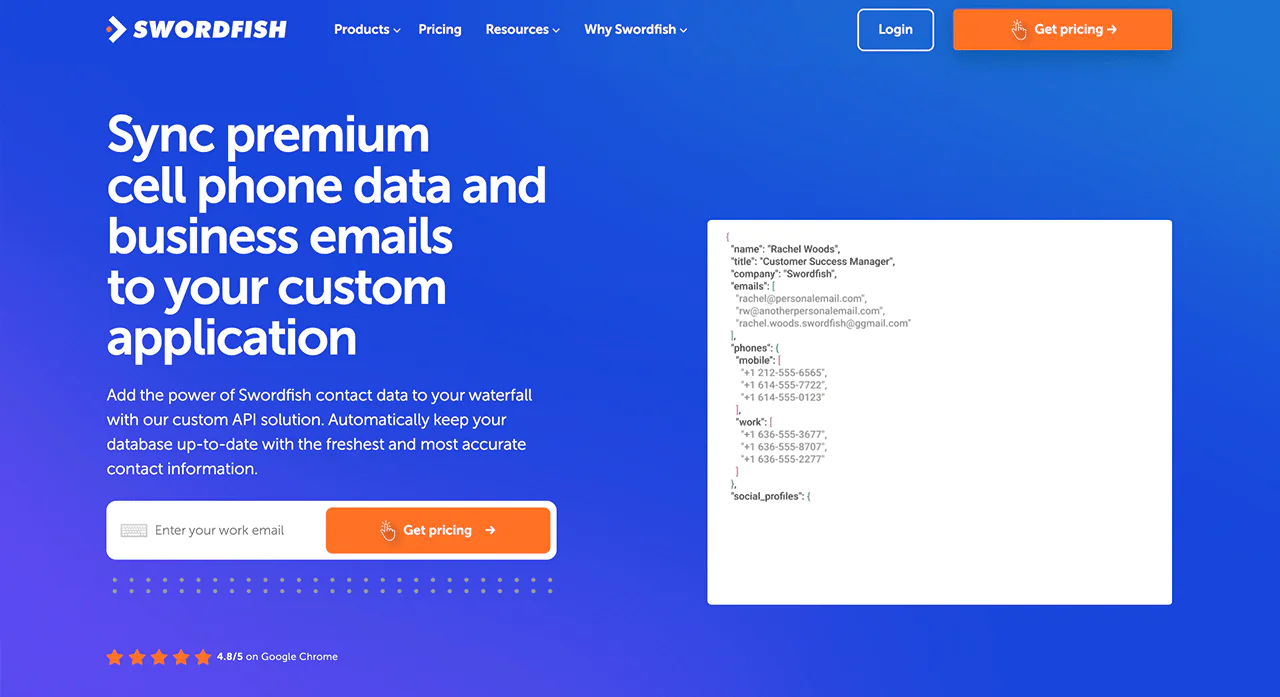
Swordfish AI’s API Integrations make it straightforward to pull real-time data into your existing systems and CRMs, which cuts down on manual data entry.
Email Verifier
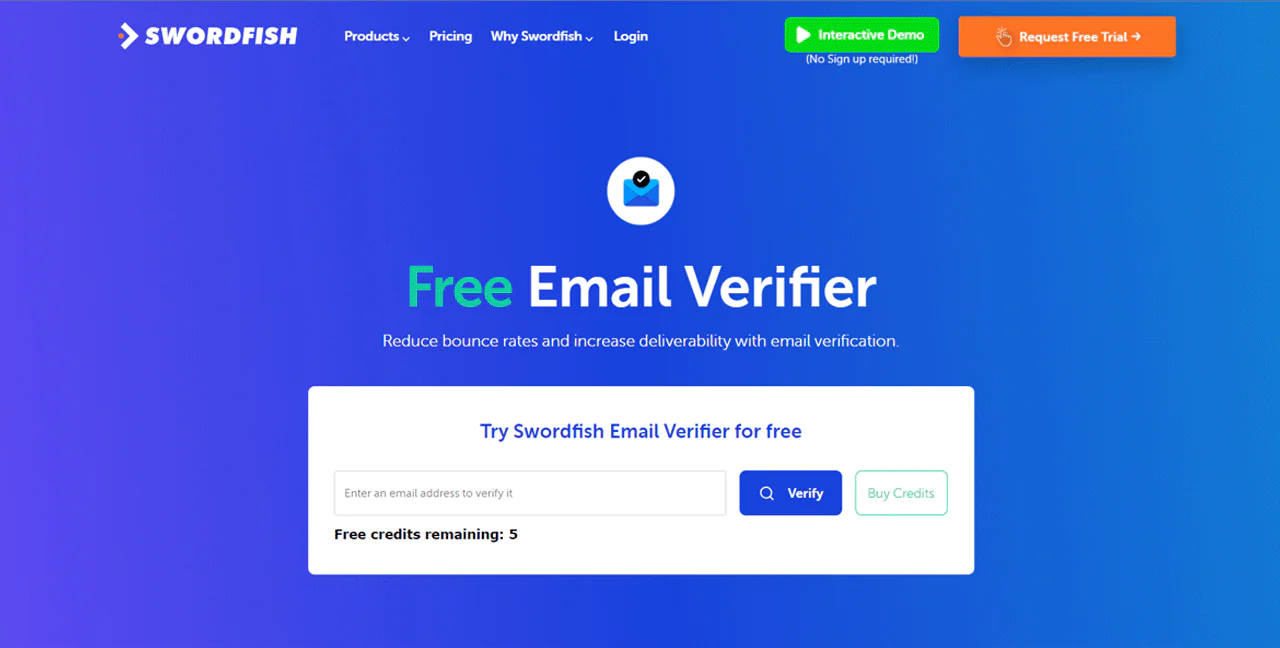
No more worrying about emails bouncing back. The Email Verifier checks whether the email addresses in your database are valid, which helps keep marketing and cold-outreach efforts sharp.
People Search Directory
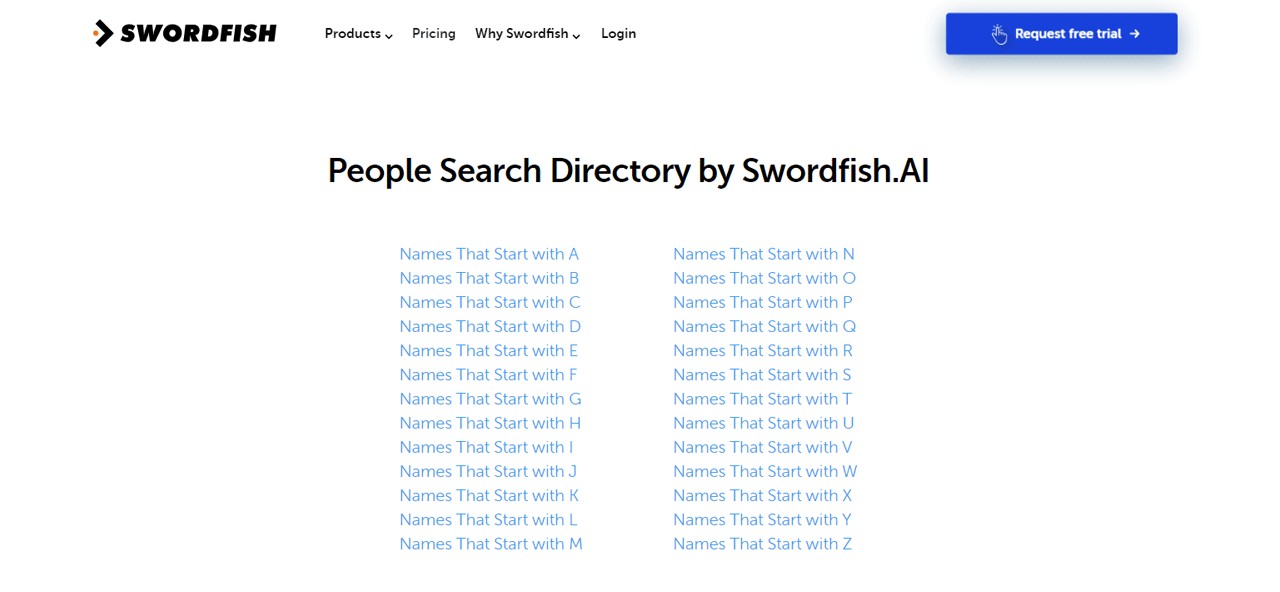
If you’re looking to reach out to new contacts, the People Search Directory is a useful starting point, with detailed contact info across various industries.
Best Use Cases of Swordfish AI
Swordfish AI serves a variety of industries with its contact data solutions. Some of the common use cases include:
- Sales: Sales teams can rapidly build targeted email lists using Swordfish’s database, increasing efficiency in outreach efforts.
- Recruitment: Recruiters use the tool to access contact information for potential candidates, speeding up the talent acquisition process.
- Real Estate: In commercial real estate, professionals rely on Swordfish to find direct contact information for property owners and decision-makers, enabling quicker negotiations and deal closures.
- Networking: You can use Swordfish to expand your professional network by finding accurate contact details for industry leaders and peers.
- Research: Research teams use Swordfish to gather contact information for primary research, ensuring they can reach relevant subjects and experts promptly.
- Outreach: For outreach and marketing campaigns, Swordfish provides verified emails and phone numbers, reducing bounce rates.
- Legal and Compliance: Legal professionals access current contact information for due diligence and compliance checks.
- Fraud Investigations: Investigators use Swordfish to trace contacts and establish connections between individuals in fraud detection efforts.
Pros of Swordfish AI
- Works easily with Chrome to find contacts on social media platforms.
- Directly connects you with key decision-makers
- Offers unique cell phone data for direct outreach.
- Checks email addresses and phone numbers in real-time.
- Integrates with various tools and CRM systems.
- Keeps email addresses updated to reduce bounce rate.
Cons of Swordfish AI
- Customized pricing and limited free trial offerings.
Swordfish AI’s Pricing
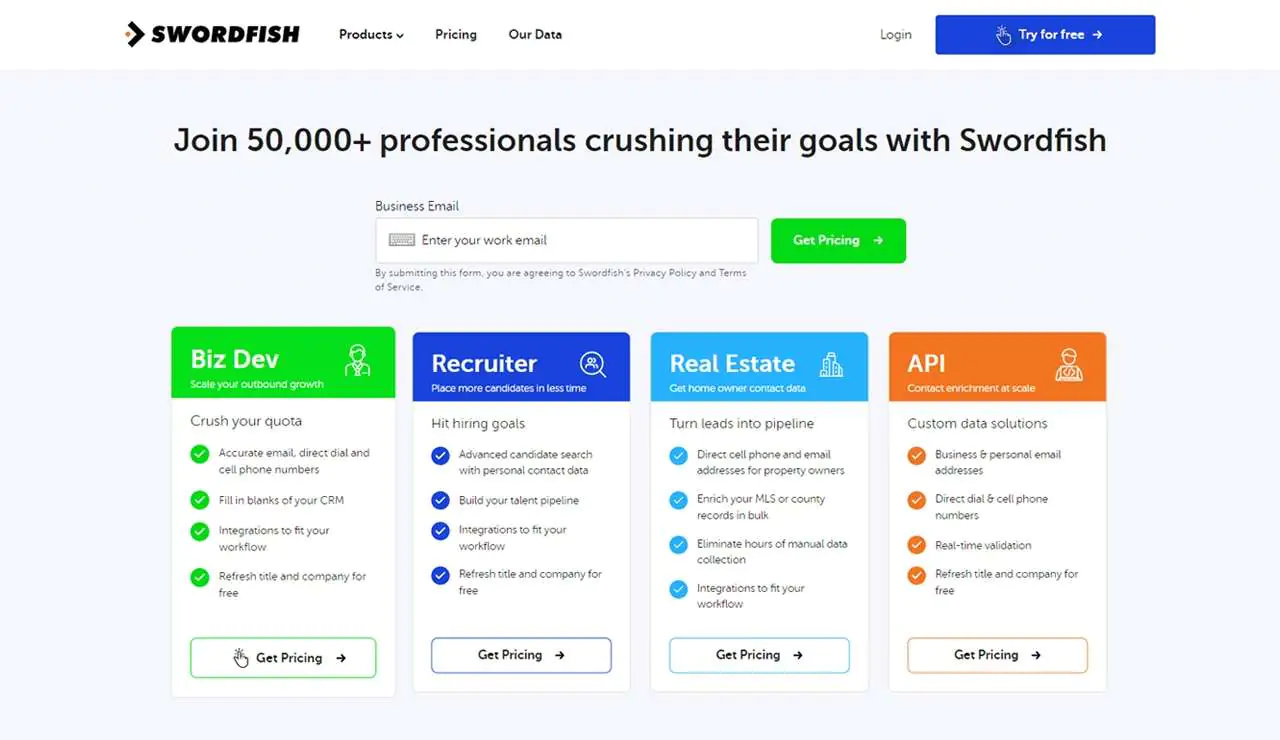
Swordfish AI offers customized pricing to fit different professional needs rather than a single flat rate.
For sales and business growth, Swordfish fills in the gaps in your CRM and integrates with your existing tools, helping scale outbound efforts.
Recruiting teams get advanced search capabilities for candidate data, aimed at building a stronger talent pipeline.
Swordfish also offers an API for large-scale contact enrichment, including custom data solutions with real-time validation and free updates.
Whether you’re in sales, recruiting, or real estate, there’s a Swordfish pricing plan built around your specific goals.
What Users Say About Swordfish AI
- G2 Review: 4.5 out of 5
“Ease of use. Keeping track of my credits and linking the Chrome Extension and Bulk Enrich Files have reduced my work by 95%.
I evaluated and used another search engine company for the critical human data I needed for my current projects. SWORDFISH was so easy that I used up my trial credits on the first day because it gave me so much information, and I immediately signed up for the Professional Credits program, which is 400 credits per month.”- Andrea W.
- Capterra: 4.6 out of 5
“Overall great app for obtaining contact data for both sales and recruiting. Simple and easy to use, great Chrome extension and contact data results are consistently accurate.
Don’t really have a con, other than the cost has gone up therefore we’ve held off on upgrading our subscription.” – Barbara G.
 Try Swordfish Ai
2. CoStar
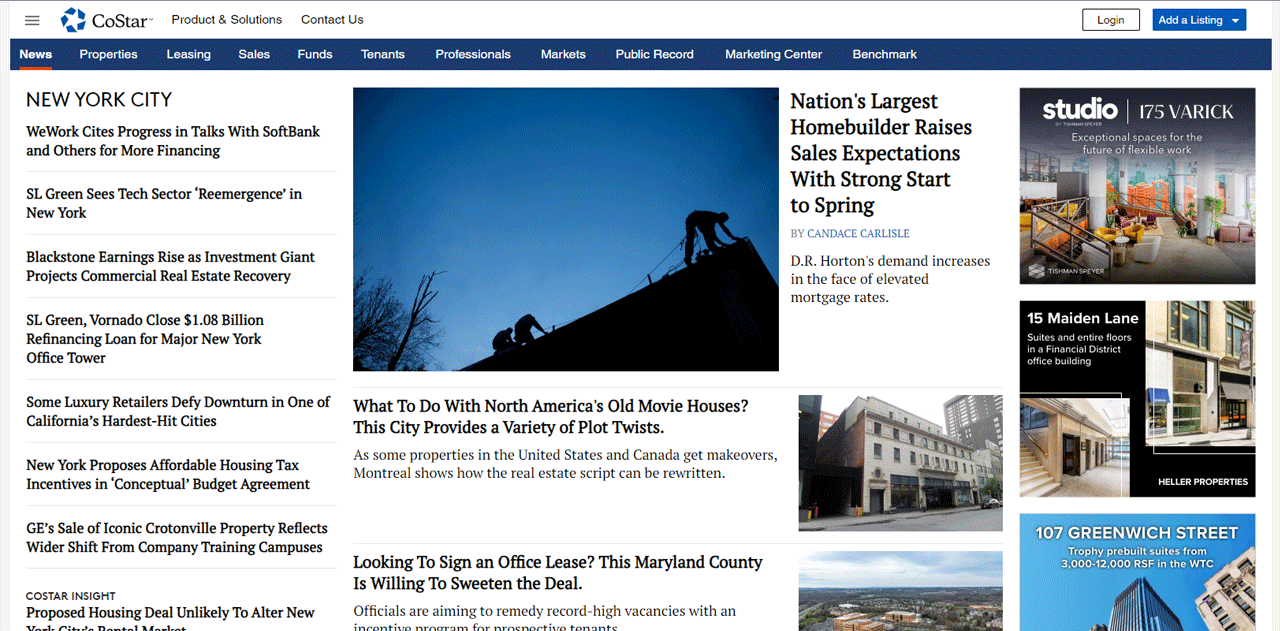
CoStar is a long-established source for commercial real estate data, covering the US, Canada, the UK, and France. It’s built to support brokers, investors, and analysts with detailed information on leasing, sales transactions, tenants, and property performance.
Whether you’re an investor, broker, or analyst, CoStar offers tools for market analysis and access to public records, with thorough coverage that supports well-informed decisions.
CoStar and Crexi both serve real estate professionals but meet different needs. CoStar leans toward detailed market analytics and forecasts, while Crexi focuses on making transactions easier through a direct buying, leasing, and selling interface. If deep data integration and market analysis matter more to your workflow than transaction convenience, CoStar is the stronger fit.
About CoStar
- Founding year: 1987
- Founder: Andrew C. Florance
- Company Size: 5,000 — 10,000 employees
Features of CoStar
Here’s a closer look at some of the key features that make CoStar a preferred tool for industry experts:
- Extensive Property Listings: CoStar has detailed listings for a wide range of properties, including offices, retail spaces, and industrial sites.
- Market Analytics: Real-time data on market trends and pricing helps you spot opportunities and gauge risk in specific areas.
- Mapping Technology: CoStar’s mapping tools give a clear view of properties and their surrounding neighborhoods, useful for checking proximity to key locations.
- Tenant Information: CoStar provides information on tenants and lease terms, essential for evaluating the stability and profitability of rental properties.
- Custom Reporting: You can build reports customized to your specific needs, pulling together the data points that matter most for a given project or client.
Pros of CoStar
- Comprehensive database covering residential, commercial, & industrial properties.
- Advanced market analytics providing in-depth insights into trends, pricing, & investment opportunities.
- Regular accurate and relevant updates for informed decision making.
- Intuitive interface for seamless access to complex information for users.
- Widely recognized and trusted in the industry.
Cons of CoStar
- Limited customization options for reports.
- The platform can be complex, intimidating new users.
Pricing of CoStar
CoStar’s pricing varies widely and is customized to different needs in commercial real estate. Depending on how many licenses you need and the areas you’re interested in, costs can be high, especially for full data access.
That cost might feel steep for smaller teams or individuals, but CoStar’s data depth, as part of the broader CoStar Group, is a meaningful part of what you’re paying for.
If you’re in the real estate industry, the investment in CoStar could be worthwhile for the depth of information it provides.
Our Review of CoStar
CoStar covers commercial real estate research and property management across the US, Canada, UK, and France.
It combines tools for tracking transactions, analyzing markets, and detailing properties, which simplifies decision-making for businesses. That said, the sheer volume of data and some of the more complex analytics tools can be a lot for new users to absorb.
Even accounting for that learning curve, CoStar provides genuinely useful insight for staying competitive in commercial real estate.
3. Reonomy
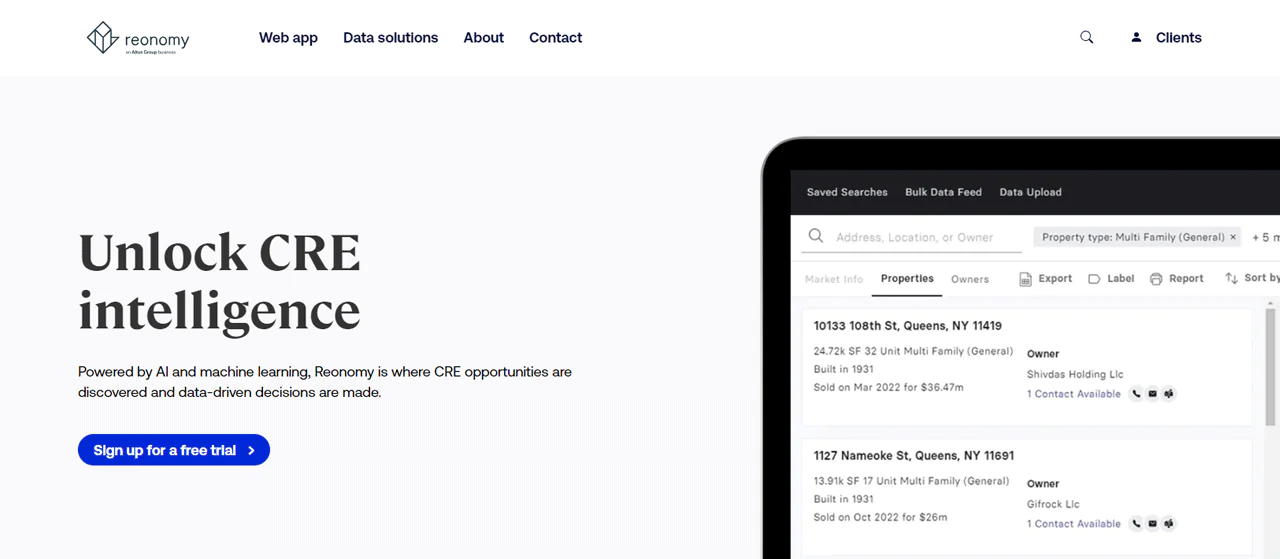
Reonomy is a commercial real estate data platform that provides property information and analysis across the United States. It uses artificial intelligence and machine learning for property intelligence, helping you surface new opportunities and off-market deals.
Its features include municipal property records, ownership information, and transaction data, along with search and filtering by property type, location, or sales history.
Compared with Cherre, Reonomy stands out for detailed property and owner information with strong search features, making it a good fit for agents who need in-depth property data and off-market leads. Cherre, on the other hand, excels at integrating data across systems, so if full data integration is your priority, Cherre is the better choice.
About Reonomy
- Founding year: 2013
- Founder: Richard Sarkis
- Company Size: 150—200 employees
Features of Reonomy
Reonomy is a resource for commercial real estate professionals. Here’s a breakdown of the key features:
- Comprehensive Property Data: Reonomy provides detailed information on properties across the United States, including ownership details, transaction histories, and debt records.
- Advanced Search Capabilities: You can filter searches by location, property type, sales history, and more.
- Owner Contact Information: Reonomy compiles contact information for property owners, useful for outreach and negotiation.
- Market Trends and Insights: The platform analyzes commercial data to surface trends and potential investment opportunities.
- Integration and Customization: Reonomy offers integration capabilities with other systems, making it easier to work its data into existing workflows.
Pros of Reonomy
- Covers over 50 million commercial properties.
- Offers AI-powered predictive analytics.
- Provides owner contact details, including emails.
- Detailed sales history for property insights.
- Access to occupant and tenant data.
Cons of Reonomy
- Lacks lease comparables data for analysis.
Pricing of Reonomy
Reonomy’s pricing varies, starting with a basic package and increasing for more advanced features aimed at larger teams or enterprises. A free trial is typically available for qualifying professionals.
Full pricing details aren’t published, so you’ll need to contact their team directly, which can make direct comparisons with other services harder without extra legwork.
If you’re considering Reonomy, be prepared to reach out to understand the full costs and features included at each subscription level.
Our Review of Reonomy
Reonomy is a solid part of a commercial real estate data stack for teams that need depth on ownership and transaction history.
The AI-driven approach adds useful precision to property data and can help surface off-market deals that would otherwise take manual digging.
New users may find the platform takes some time to master, and pricing isn’t transparent upfront, which could be a hurdle for smaller businesses. Even so, Reonomy adds real value for market insight and prospecting.
4. Redfin
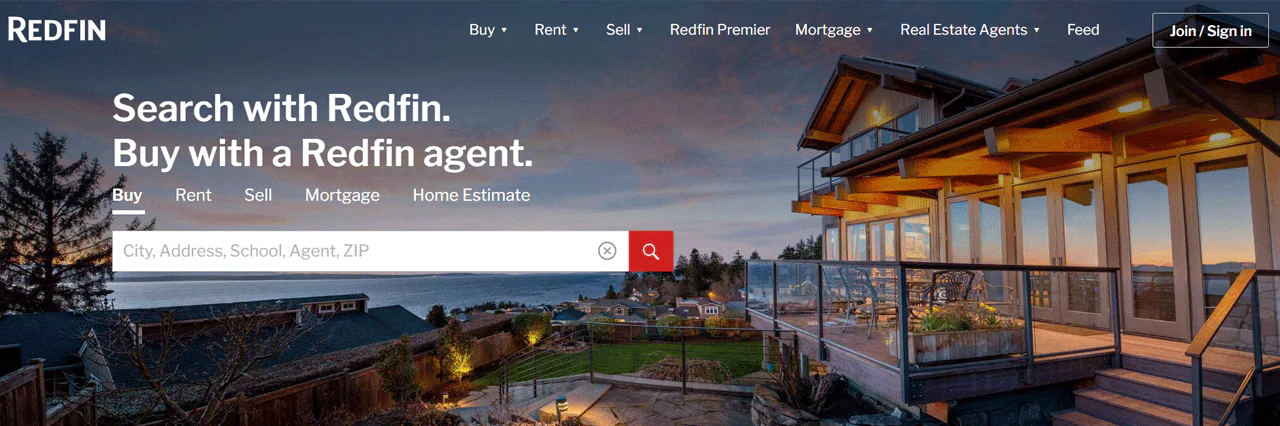
Redfin is a well-known real estate brokerage and data platform built around simplifying the buying and selling process. It combines technology with local agents, giving you access to up-to-date MLS listings through its website and mobile app.
Listings refresh every five minutes, so you’re generally working with current data rather than something stale.
Compared with Ten-X, Redfin is stronger for residential real estate, with solid search capabilities, agent backing, and consumer-first services. Ten-X, by contrast, is built for commercial real estate through a digital auction platform designed for buying and selling larger properties. Which one fits depends on whether you’re working residential or commercial deals.
About Redfin
- Founding year: 2004
- Founders: David Eraker, Michael Dougherty, and David Selinger.
- Company Size: 4,000—5,000 employers
Features of Redfin
Redfin combines technology and personalized service. Here are the features that make buying and selling more transparent and efficient:
- Real-Time MLS Listings: Redfin updates its listings every five minutes, giving buyers and sellers access to current market information.
- Comprehensive Search Filters: You can customize your search using detailed filters, including price, number of bedrooms, property type, and more.
- Tour and Open House Scheduling: Redfin lets you schedule tours and attend open houses directly through its platform.
- Agent Matching: Redfin connects you with local agents equipped to guide you through buying or selling.
Pros of Redfin
- Real-time MLS updates
- Lower commission rates
- Estimate for accurate property valuations
- Easy scheduling of tours and open houses
- Local Redfin agents provide personalized service
Cons of Redfin
- Limited coverage in certain geographic areas
Pricing of Redfin
Redfin’s pricing model emphasizes transparency and lower transaction costs for both buyers and sellers.
For sellers, Redfin advertises a lower listing fee than traditional agencies, covering listing, marketing, and managing the sale process.
This approach can be appealing if you’re trying to maximize your budget on either side of a transaction.
Our Review of Redfin
Redfin’s real-time MLS updates are genuinely useful for quickly responding to market changes, whether you’re buying or selling.
The platform is easy to use for scheduling home tours and open houses, though coverage in some regions is thinner, which can limit your options there.
Overall, Redfin balances technology and personal service well for residential transactions.
5. CompStak

CompStak gives you access to a set of crowd-sourced commercial real estate data from a network of thousands of professionals across the United States, with a strong emphasis on data verification.
Its data is sourced through a mix of crowdsourcing and validation, providing detailed insight into commercial transactions that can be hard to find elsewhere.
Compared with LoopNet, CompStak is about depth: in-depth lease and sale comparisons and analytics that matter for evaluating transactions, which makes it useful for appraisers and brokers. LoopNet is about breadth, a wide-ranging marketplace for listing and finding properties. If you need a broader market view and more visibility, LoopNet may be the better fit.
About CompStak
- Founding year: 2011
- Founders: Michael Mandel
- Company Size: 100-150 employees
Features of CompStak
Here’s a deeper look at the features that make CompStak useful for real estate professionals:
- Lease Transaction Details: CompStak provides detailed insight into lease transactions, covering rent rates, lease terms, and tenant incentives.
- Crowdsourced Data Model: Data comes from a network of real estate professionals who anonymously share lease information, resulting in a diverse dataset.
- Analytical Tools: CompStak gives you access to analytical tools for custom reports and competitive analysis.
- Geographical Coverage: CompStak covers a broad range of markets across the United States, from major urban centers to smaller regions.
- Data Accuracy and Validation: Data entering the CompStak database goes through rigorous checks before it’s usable.
Pros of CompStak
- Detailed commercial property lease and sales comps.
- Access to crowdsourced CRE data nationwide.
- Verified and up-to-date transaction insights.
- Advanced filtering for targeted property searches.
- Free credits for brokers sharing comps.
- Detailed analytics for commercial market analysis.
Cons of CompStak
- Limited customization features for users
- Inadequate customer support.
Pricing of CompStak
CompStak takes a give-to-get approach through its Exchange platform, where you can access lease and sale comparables for free by sharing your own data.
For larger organizations, CompStak Enterprise serves banks and hedge funds with a subscription model that includes broader data access and analytics tools, along with demos and personalized sales support.
Our Review of CompStak
CompStak is a useful resource for teams working on the best real estate leads for agents.
The platform’s collection of lease, sale, and loan data, verified for accuracy and covering a wide range of U.S. markets, is a real strength. On the downside, new users might find the volume of information overwhelming, and cost can be a hurdle for smaller companies.
Even with those caveats, CompStak is a solid source of market and transaction insight.
6. PropertyShark
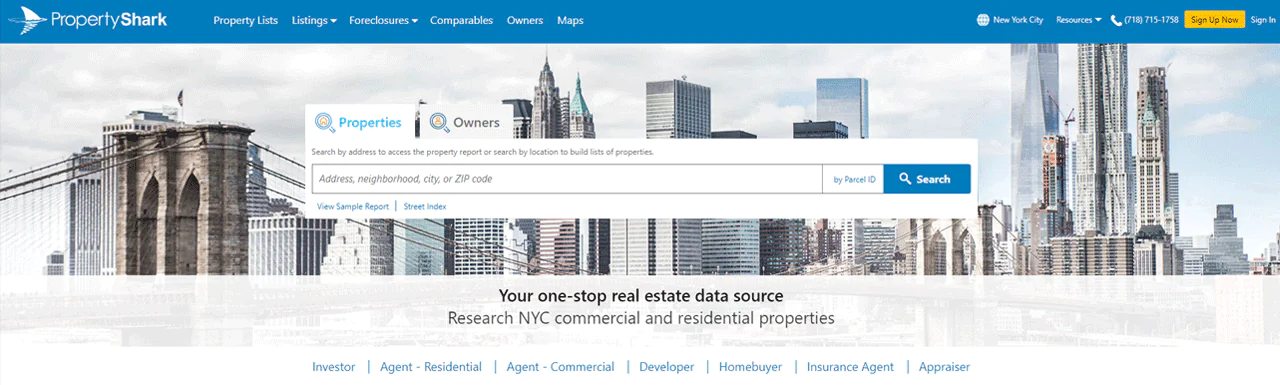
PropertyShark offers a detailed, accessible database for real estate across the United States, including ownership records, property reports, and visual aids like maps and photos.
Using the platform, you can access up-to-date information on zoning, permits, liens, and foreclosures, with a user-friendly interface for navigating complex real estate information.
Compared with Reonomy, PropertyShark is strongest for detailed property reports and ownership lookups. Reonomy is more about big-picture analysis, using AI across a wide range of property transactions to inform strategic investment decisions. If you need heavier market analysis and predictive insight, Reonomy is the more comprehensive tool.
About PropertyShark
- Founding year: 2003
- Founder: Matthew Haines
- Company Size: 70—100 employees
Features of PropertyShark
PropertyShark offers professionals extensive property information. Here are some of its core features:
- Detailed Property Reports: PropertyShark offers in-depth reports that include ownership data, property characteristics, and historical pricing information.
- Foreclosure Listings: The platform specializes in providing up-to-date, detailed listings of foreclosed properties, useful for spotting deals below market value.
- Property Maps and Zoning Information: Detailed maps show property boundaries, zoning, and other geographical data.
- Ownership and Title History: PropertyShark lets you trace title history, including past ownership, liens, and transfers, useful for due diligence.
- Permit and Land Use Data: The platform includes building permit and land use information, useful for assessing future development or renovation feasibility.
Pros of PropertyShark
- Accurate NYC property data with detailed owner information.
- Reliable owner contact information including phone numbers.
- Powerful filtering options and advanced search tools.
- Updated sales history along with title documents and property deeds.
- In-depth zoning information, including FAR details.
Cons of PropertyShark
- Limited coverage outside NYC and major cities.
PropertyShark Pricing
PropertyShark offers personalized subscription plans based on your needs and location, providing access to detailed real estate data including property reports and ownership records.
You can choose monthly or yearly billing, with the yearly option offering a cost saving similar to two monthly payments.
Larger organizations can get corporate subscriptions at discounted rates that include free training, useful for multi-user or heavy-usage teams.
Our Review of PropertyShark
PropertyShark plays a critical role for detailed real estate data, including ownership details, property reports, and foreclosure listings.
The interface can feel overwhelming to new users given the volume of information presented, but overall PropertyShark supports better market understanding and stronger real estate strategy.
7. Cherre
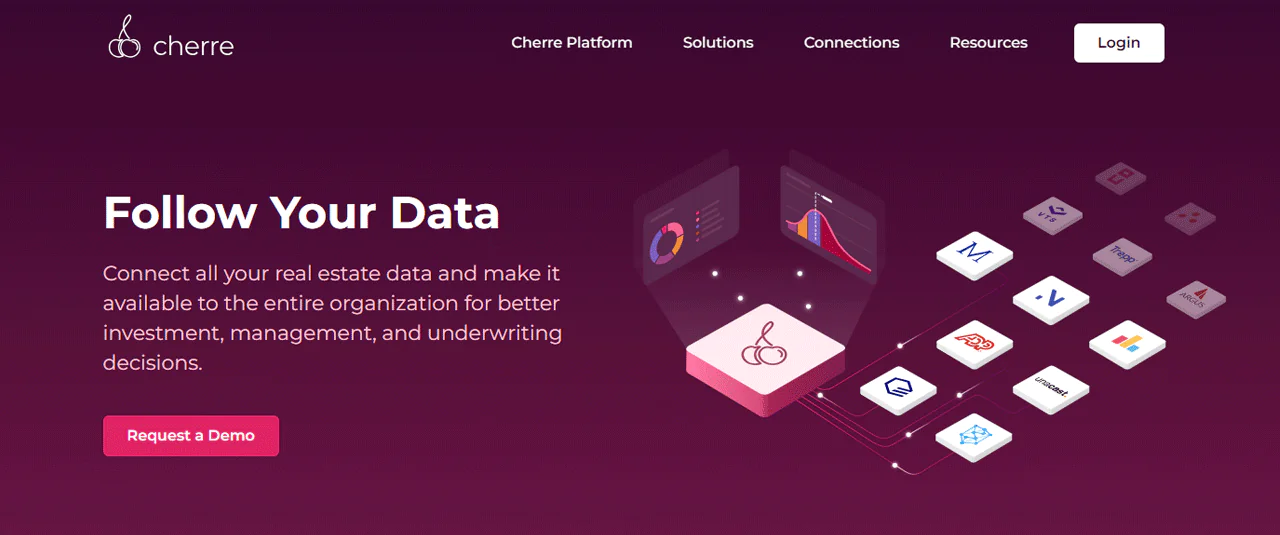
Cherre integrates real estate data into one centralized location, which supports better decision-making across investment, management, and underwriting processes.
The platform offers tools for portfolio and asset management, leasing and property management, and acquisition and financing, giving you a comprehensive portfolio view along with reporting, benchmarking, and performance tools.
Cherre and CoStar each bring different strengths. Cherre is proficient at handling complex data sets and making them easier to access and analyze, useful for professionals managing large volumes of data. CoStar covers all aspects of commercial real estate, from individual properties to market analytics, so it’s the better fit if broad market and property exploration is your priority.
About Cherre
- Founding year: 2016
- Founders: Ben Hizak and L.D. Salmanson
- Company Size: 100-150 employees
Features of Cherre
Cherre integrates and analyzes large amounts of property data to support decision-making. Some of its main features:
- Data Integration: Cherre connects and centralizes different data sets from public and private sources, giving a comprehensive view of properties, markets, and trends.
- Advanced Analytics: The platform uses analytics to surface patterns and insights that aren’t immediately obvious.
- Customizable Dashboards: Cherre provides customizable dashboards so you can tailor the interface and displayed data to your needs.
- Real-Time Updates: The platform offers real-time updates, which matters for professionals who need timely data to catch opportunities and manage risk.
- API Access: Cherre offers API access, letting you integrate its data into your own applications and workflows for greater automation.
Pros of Cherre
- Unified platform for all property data.
- AI-driven insights for better decisions.
- Integrates public, private, and third-party data.
- In-depth analytics for real estate markets.
- Efficient processing of large property datasets.
Cons of Cherre
- Initial setup can be complex and time-consuming.
- Limited customizability for specific user needs or workflows.
Cherre Pricing
Cherre doesn’t publish specific pricing, which suggests customized plans based on each client’s needs.
To understand Cherre’s pricing, you’ll need to contact their sales team directly and discuss your specific requirements.
If you’re interested in Cherre, start by reaching out to explore options based on your usage and data needs.
Our Review of Cherre
Cherre is effective at merging various commercial real estate data sources into one usable platform, which meaningfully improves decision-making.
The platform’s complexity can be a challenge if you’re not particularly tech-savvy, and initial setup and customization take some effort.
Despite that learning curve, Cherre offers a real competitive edge once you know how to use it.
8. Crexi
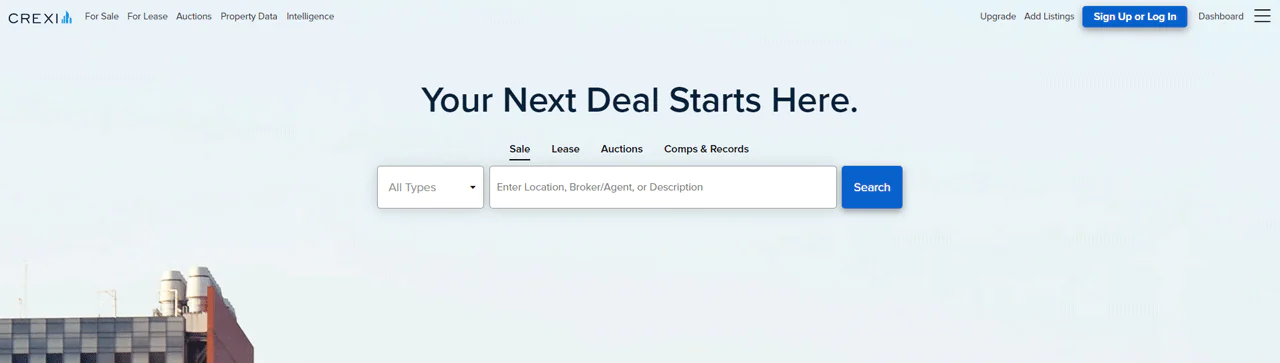
Crexi simplifies buying, selling, and leasing commercial properties as a complete marketplace where brokers, investors, and buyers connect to complete transactions, with extensive property listings.
The platform is designed to be easy to navigate, whether you’re looking for retail, office, industrial, or multifamily properties, with detailed information to support your property analysis.
Compared with CompStak, Crexi is a wide-ranging hub for buying, selling, or leasing, built to make transactions and market access smooth. CompStak is the go-to for in-depth lease and sale comparisons and property details, ideal for figuring out present value and spotting market trends. If you want direct market engagement and a diverse range of listing options, Crexi is the stronger option.
About Crexi
- Founding year: 2015
- Founding team: Mike DeGiorgio
- Company Size: 300—400 employees
Features of Crexi
Crexi simplifies transactions for brokers, buyers, and tenants. Some of its features:
- Comprehensive Listings: Crexi offers a vast array of commercial property listings across the United States, including retail, office, industrial, and multifamily properties.
- Auction Platform: The platform features an auction system that lets buyers bid on properties online in a transparent process.
- Market Research and Insights: Crexi provides users with up-to-date market data and trends for informed decisions.
- Lease Marketplace: Beyond sales, Crexi operates a lease marketplace for finding or listing leasing opportunities.
- CRM and Marketing Tools: Crexi equips real estate professionals with CRM and marketing tools to manage relationships and promote listings.
Pros of Crexi
- Comprehensive listing service for a variety of property types.
- User-friendly interface with easy search and connectivity features.
- Auction functionality to facilitate quick sales.
- Provides market insights and analytics.
- Includes lease management and marketing automation tools.
Cons of Crexi
- Expensive for smaller real estate businesses.
- Customer support response times can be slow.
- Requires technical knowledge to fully utilize all features
Crexi Pricing
Crexi offers several plans ranging from a free basic option to advanced PRO subscriptions for comprehensive real estate management, with enhanced listing management, marketing, and data analysis features.
For detailed insight into each plan, Crexi encourages a personalized demo to help you choose a plan matching your requirements.
Our Review of Crexi
Crexi offers a comprehensive platform for commercial real estate needs, with a vast range of property listings across the nation and detailed data such as lease rates.
Its advanced filters make it easy to pinpoint properties that meet specific criteria. Customer service isn’t available around the clock, which could be a drawback if you run into issues off-hours.
Even with that limitation, Crexi is a solid resource for commercial real estate professionals.
9. LoopNet
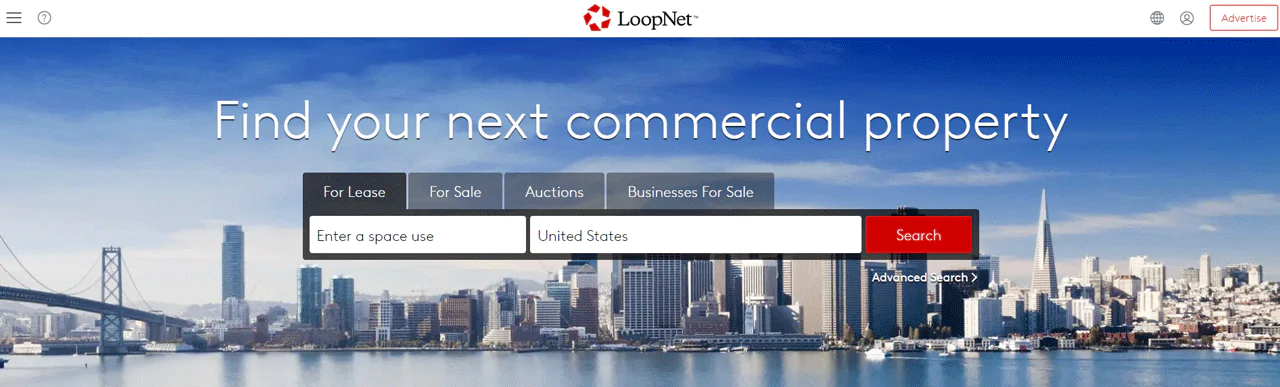
LoopNet is one of the largest online platforms for commercial real estate, offering a vast marketplace for buying, selling, mortgage, and leasing properties, along with tools for property valuation and market trend analysis.
Its user-friendly interface makes finding the right property straightforward, which is why it’s a common choice for professionals making quick, informed decisions.
Compared with PropertyShark, LoopNet excels at giving agents a user-friendly interface for browsing extensive listings. PropertyShark offers deeper property data and owner information, better suited for detailed research. For transactional activity and broad market accessibility, LoopNet’s comprehensive listing services make it the better choice.
Features of LoopNet
LoopNet connects buyers, sellers, and renters with vast property listings. Here’s what you can expect:
- Extensive Property Listings: LoopNet features a wide range of commercial properties, including office spaces, retail locations, and industrial warehouses.
- Advanced Search Filters: The platform offers advanced search capabilities to filter properties by type, location, price, and more.
- Market Trends and Insights: LoopNet provides market insights and trend data to help you understand the commercial real estate landscape.
- Email Alerts: You can set up email alerts for new listings matching your criteria, so you don’t miss opportunities as soon as they hit the market.
- Broker Profiles: LoopNet allows brokers to create detailed profiles that showcase their listings and background, helping build visibility and trust with potential clients.
About LoopNet
- Founding year: 1995
- Founding team: Dennis DeAndre
- Company Size: 400—500 employees
Pros of LoopNet
- Extensive listing of properties across the United States.
- User-friendly interface that simplifies property searches.
- Offers tools for property valuation and market trend analysis.
- High-quality photos and detailed property descriptions.
Cons of LoopNet
- Subscription models can be expensive for small users.
- Some areas may have limited property listings.
Pricing of LoopNet
LoopNet offers advertising packages designed to boost property visibility on its platform and the broader CoStar network, ranging from basic to premium levels including Diamond, Platinum, Gold, and Silver, each with different exposure and marketing tools.
The Diamond package, for example, places your listing at the top of search results with professional photos, 3D tours, and custom content, while the Silver package offers solid exposure with a larger ad placement than the basic tier.
Contact LoopNet directly to find the best fit for your needs and budget.
Our Review of LoopNet
LoopNet is a strong tool for expanding market presence and improving property transactions.
Its wide range of listings and strong search tools help you quickly locate investment opportunities and attractive properties. The volume of listings can be daunting, and highly competitive markets require careful attention, but LoopNet remains a valuable part of a commercial real estate toolkit.
10. Ten-X
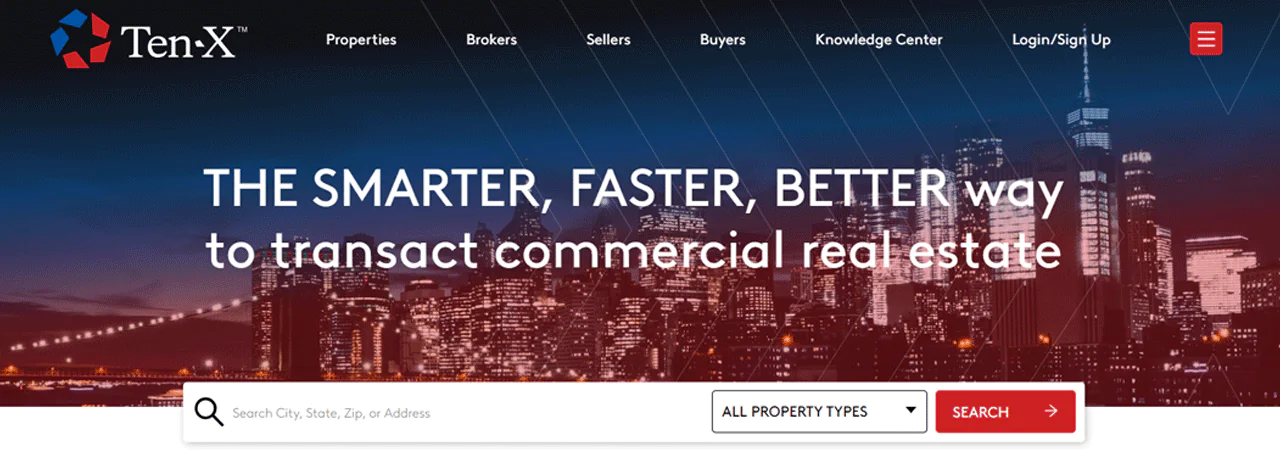
Ten-X is an online real estate platform built around a digital transaction system, letting you participate in live and timed auctions from anywhere and reach a wider market as an investor or seller.
The platform’s interactive dashboard lets you follow auction progress and get real-time updates on properties of interest.
Compared with Redfin, Ten-X specializes in commercial properties with a robust online auction system built for investors and brokers. Redfin primarily serves the residential market through listings and local agents. For commercial real estate transactions, especially large-scale auction deals, Ten-X is the stronger platform.
Features of Ten-X
Ten-X simplifies the real estate process for brokers, sellers, and buyers. Key features include:
- Online Auctions: Ten-X offers online auctions for commercial properties, a fast and efficient way to buy or sell.
- Due Diligence Materials: The platform provides comprehensive due diligence materials to help buyers make informed decisions before bidding.
- Wide Market Reach: Ten-X reaches a large audience of potential buyers, helping sellers attract more interest.
- Negotiated Sales: Ten-X also offers negotiated sales, allowing buyers and sellers to agree on a price without an auction.
- Interactive Property Listings: The platform provides interactive listings with detailed information, making it easy to view property features.
About Ten-X
- Founding year: 2007
- Founders: Jeffrey Frieden, Monte Koch, Robert Friedman
- Company Size: 1,300—1,500 employees
Pros of Ten-X
- Streamlines real estate transactions with digital auctions.
- Global access to buyers and sellers to participate from anywhere.
- Detailed property information and analytics for informed decision-making.
- Helps sell high-demand assets quickly.
- Reaches a broad audience, including tertiary markets
Cons of Ten-X
- The auction format may not be suitable for all buyers & sellers.
- Limited control over auction timelines.
Ten-X Pricing
Ten-X operates as a digital auction platform for commercial real estate, aiming to make buying and selling properties online seamless.
For sellers and brokers, using Ten-X is generally cost-free, meaning no direct charges for listing or selling properties through the platform.
The platform integrates with LoopNet and CoStar to boost reach and control for all parties, with 3D tours, professional photography, and digital marketing included to maximize exposure.
Our Review of Ten-X
Ten-X changes how you find and buy properties through easy-to-follow bidding procedures and an extensive selection of properties in its online auctions.
This efficiency can help you identify and lock in investments faster than traditional methods, though auctions can drive prices up quickly, and the online-only format may not suit investors who prefer in-person inspection.
Even with those tradeoffs, Ten-X reduces transaction times and connects you with a range of potential investments efficiently.
Why is a Commercial Real Estate Database Important?
A commercial real estate database is important for anyone involved in the property market, and here’s why:
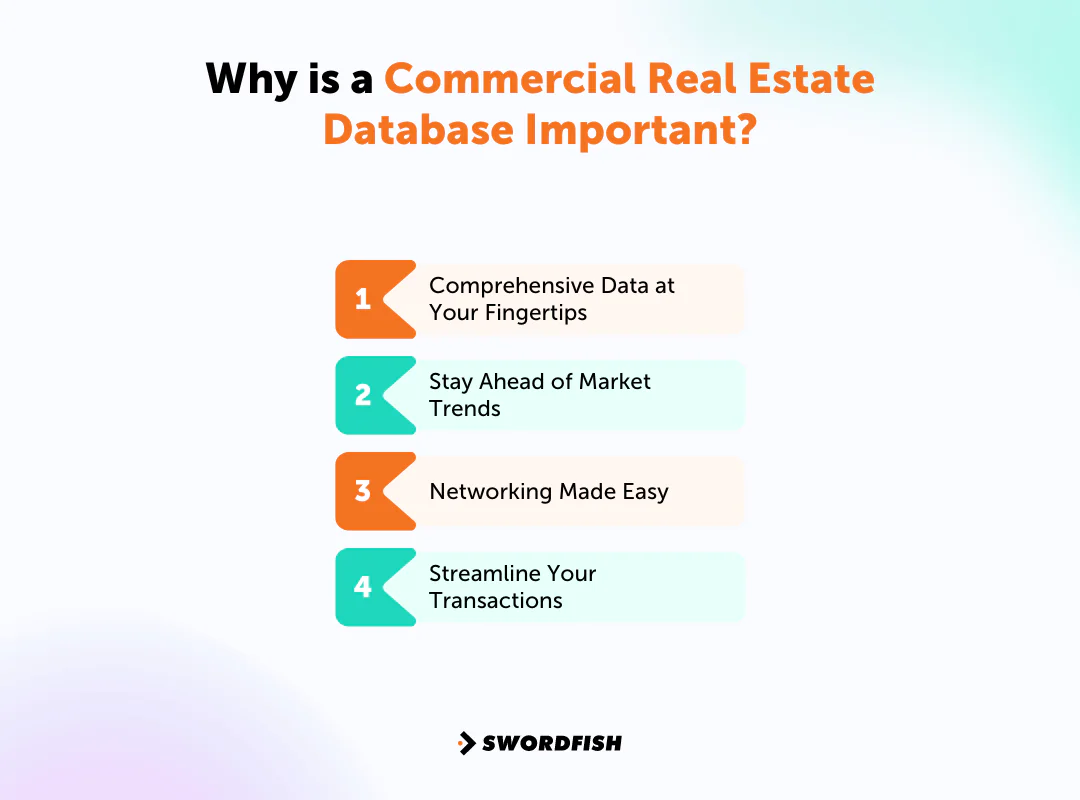
Comprehensive Data at Your Fingertips
A commercial real estate database provides detailed information about properties. This data is vital for thorough market analysis and property valuation, helping investors and brokers accurately assess potential investments and plan strategically.
Stay Ahead of Market Trends
These databases gather both historical and current market data, enabling you to identify trends and forecast future market movements. With this knowledge, you can make well-informed decisions on buying, selling, and developing properties.
Networking Made Easy
Commercial real estate databases also include contact information for property owners, brokers, and other key players, which facilitates networking. This improved connectivity can speed up deal closures and open up new partnership opportunities.
Streamline Your Transactions
Having all the necessary data in one place streamlines transactions, making them smoother and quicker. Real estate professionals can manage due diligence processes more effectively, cutting down the time it takes to go from listing to closing. In a competitive market, this efficiency is crucial for staying ahead.
Things to Consider When Choosing a Commercial Real Estate Database
Choosing the right commercial real estate database matters for your efficiency and success in the property market. Here’s what to weigh:
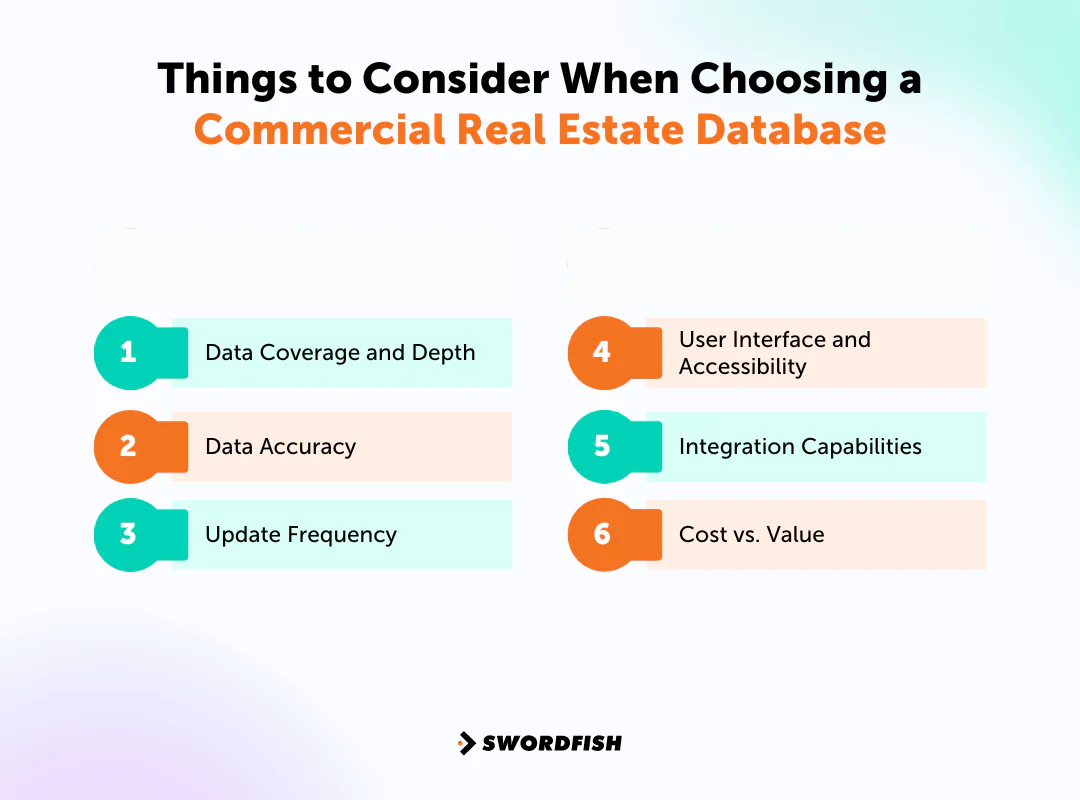
Data Coverage and Depth
Ensure the database includes extensive coverage of the property types you care about, with in-depth information on property characteristics, transaction history, and current market status.
Data Accuracy
Data accuracy matters most when reaching out to owners directly. Pick a database known for keeping its listings and market information up-to-date and trustworthy, and check reviews for complaints about stale contact records.
Update Frequency
The real estate market changes rapidly, so choose a database that updates frequently. Regular updates keep you working with current information, which matters for maintaining a competitive edge.
User Interface and Accessibility
The database should have a user-friendly interface that lets you navigate and extract information easily, ideally from multiple devices, with responsive technical support if you hit a snag.
Integration Capabilities
Check if the database integrates with your existing systems, such as your CRM or analytics tools. Integration can meaningfully improve workflow efficiency by reducing manual data entry.
Cost vs. Value
Weigh the subscription cost against the value it brings to your business. Consider whether the database offers tiered or customizable pricing that can flex as your needs change, and watch for hidden costs — the pricing structure should be transparent upfront.
Conclusion
Choosing the right commercial real estate database is important for making informed decisions and succeeding in the market.
With many options available, weigh data accuracy, user interface, and value for money against your actual workflow. The right database helps you find properties, analyze trends, and connect with the right people.
If verified contact data for property owners and decision-makers is your priority, Swordfish AI is worth evaluating alongside the listing and analytics platforms above.
FAQs
1. What is a commercial real estate database?
A commercial real estate database is an extensive collection of data about properties available in the commercial sector. This tool is essential for professionals looking to access comprehensive information to make informed real estate decisions.
2. How often is the data in a commercial real estate database updated?
The frequency of updates in a commercial real estate database can vary, but the best databases offer real-time updates. Regular updates help maintain the accuracy and relevance of the data used for market analysis and decision-making.
3. Can a commercial real estate database integrate with other business tools?
Many high-quality commercial real estate databases are designed to integrate seamlessly with other business tools. Integration capabilities allow for a more streamlined workflow and can enhance the overall efficiency and productivity of a real estate business.
4. Can I get a free commercial real estate database?
Free commercial real estate databases are rare, but there are options like LoopNet and CommercialCafe that offer some listings for free. However, to access more detailed information or listings, you often need to subscribe to a paid service like CoStar or Crexi.