
 View Products


Last updated: September 3, 2026

Leadfeeder built its reputation on a simple idea: show sales and marketing teams which companies are visiting their website, even when those visitors never fill out a form. That visibility turns anonymous traffic into a list of named accounts your team can actually work.
The platform is straightforward to set up, pairs well with common CRM systems, and has a large base of marketing and sales users. But it has real limits, too, particularly around individual contact data, traffic-dependent value, and how much manual work it takes to turn a company name into a phone call or email. For teams that need verified, person-level contact details rather than company-level signals, those gaps matter.
Below is a rundown of where Leadfeeder tends to fall short, followed by five alternatives worth evaluating, and a framework for deciding which one actually fits your workflow.
Quick List of Top 5 Alternatives to Leadfeeder
Here’s a quick list of the top five options, each with a different strength —
- Swordfish AI: Best for direct access to decision-makers with real-time validated cell phone and email data.
- Salespanel: Best for real-time visitor tracking and data-driven lead qualification in B2B marketing.
- Clearbit: Best for B2B teams seeking extensive contact databases and intent-based sales intelligence.
- Factors.ai: Best for AI-powered account identification and journey analytics to optimize marketing ROI.
- Lead Forensics: Best for businesses wanting in-depth B2B website visitor identification and actionable insights.
Reasons to Consider an Alternative to Leadfeeder
A few recurring limitations come up when teams evaluate Leadfeeder against their actual lead-generation needs —
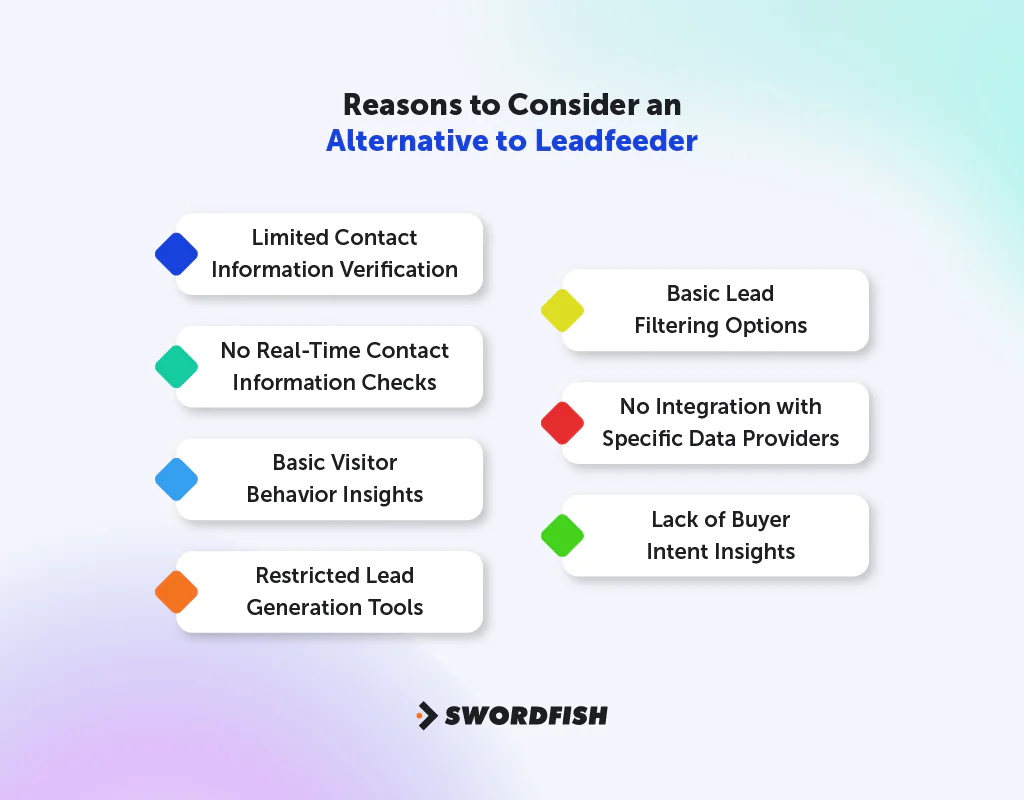
Limited Contact Information Verification
Leadfeeder can tell you which companies are visiting your site, but it doesn’t always surface verified direct-dial numbers for the people at those companies. That gap can slow down outreach when speed matters most, especially for sales teams working time-sensitive leads.
No Real-Time Contact Information Checks
Leadfeeder doesn’t run ongoing checks to confirm that contact details are still accurate and in use. Real-time validation matters because stale numbers and dead email addresses quietly erode connect rates over time.
Basic Visitor Behavior Insights
Leadfeeder can flag which companies are checking out your site, but it doesn’t always go deep on what those visitors are doing once they land there. Granular behavior data is what lets sales and marketing teams tailor outreach instead of guessing.
Restricted Lead Generation Tools
Leadfeeder is built around tracking website visitors. If your team also needs targeted outreach tools or bulk prospecting capability, you’ll likely need to bolt on additional software.
Basic Lead Filtering Options
Lead filtering and suppression on the platform are fairly basic. More advanced filtering helps teams zero in on the right leads and keep list quality high.
No Integration with Specific Data Providers
Leadfeeder doesn’t integrate directly with specialized contact-data providers, which limits how far you can extend a company-level signal into verified individual contacts.
Lack of Buyer Intent Insights
Leadfeeder doesn’t offer built-in buyer intent signals — the kind of data that tells you which accounts are actively shopping for what you sell. Without it, prioritizing which leads to chase first becomes more of a guessing game.
Top 5 Leadfeeder Competitors: Comparison Chart
Here’s a side-by-side look at how the top five alternatives to Leadfeeder stack up on the features that matter most for B2B lead generation and management.
Tools | Contact Data | Lead Generation | Data Analysis | Marketing Automation |
 | Extensive cell phone and email data, real-time validation | Targeted list creation, Chrome Extension | Real-time connectivity checks, bulk data handling | API integration, social platform support |
 | Real-time lead sync from various tools | Multiple channel lead capture | Predictive lead scoring, real-time tracking | Data sync and automation workflows |
 | 30M+ B2B contacts, high deliverability | Target account identification, buying intent analysis | HubSpot integration, CRM compatibility | Integrates with major marketing tools |
 | AI-fueled account identification | Anonymous traffic qualification | AI insights, unified sales & marketing reporting | Account intelligence for marketing and sales |
 | B2B visitor identification, quality leads | Anonymous visitor identification | Detailed intelligence reports, CRM integration | Advanced lead nurturing integrations |
Top 5 Leadfeeder Alternatives for Better Lead Verification and Identification
If you need stronger lead verification and identification than Leadfeeder provides on its own, these five tools are worth a closer look.
1. Swordfish AI
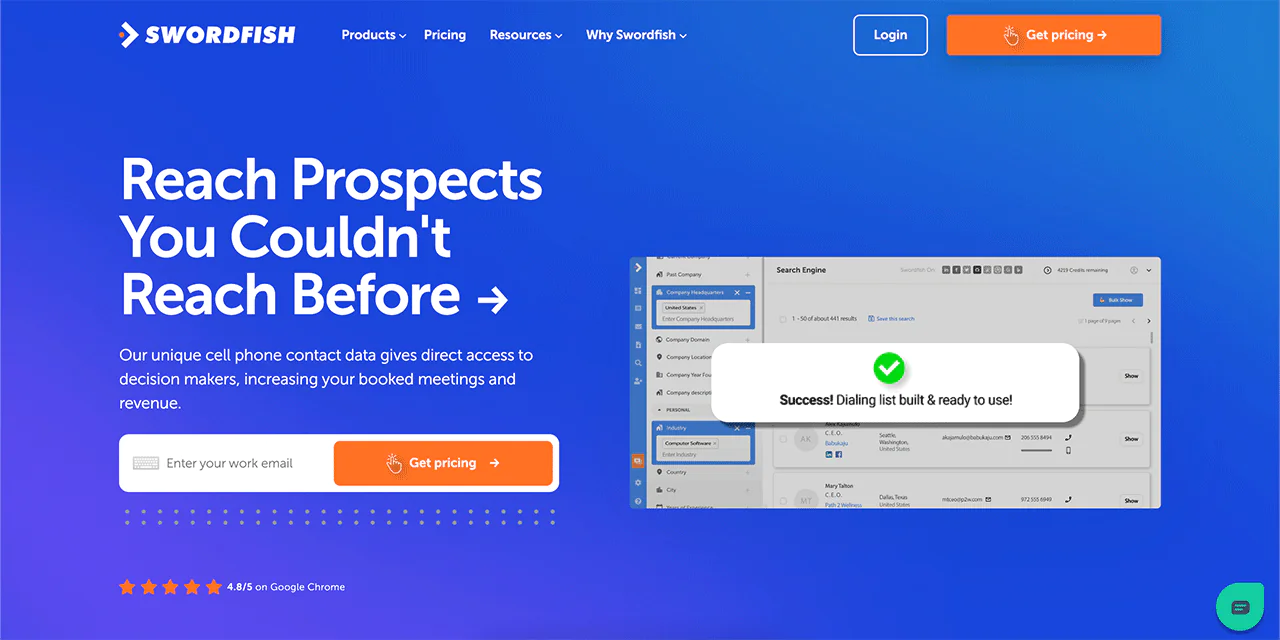
Swordfish AI stands out because it hands you direct contact details for decision-makers, including phone numbers and emails, rather than just a company name. That distinction matters when speed to first contact affects whether a lead converts.
Swordfish AI also validates those details in real time, which helps confirm they’re current before you spend time reaching out — something Leadfeeder doesn’t focus on.
Its Chrome Extension and related tools let you find contacts across various online platforms, and Swordfish AI layers in Bombora® intent data to help surface businesses actively researching products like yours.
Overall, it’s built for teams that need to move from a name to a working phone number or inbox quickly, rather than starting from an anonymous website visit.
About Swordfish
- Founding Team: Ben Argeband
- Founding Year: 2015
- Company Size: 11 to 50 employees
What Sets Swordfish Apart?
Swordfish ranks among the best B2B lead generation tools largely because of its emphasis on direct dials. It gives users access to cell phone numbers along with a system that checks these numbers for accuracy — a real advantage for cold-calling workflows.
The platform also maintains a database of over 3.5 billion profiles, giving users a wide pool of contacts to draw from. Together, these features make Swordfish a common choice for sales and recruitment teams that need to reach people directly rather than wait for them to visit a website.
Leadfeeder identifies companies visiting your site and works with CRM tools to help sales and marketing teams follow up. Swordfish AI takes a different approach: it hands you verified, direct contact details up front, which makes it a stronger fit for teams built around cold calling and direct outreach.
Key Features of Swordfish AI
Swordfish AI provides several tools for finding leads and contact information —
-
Chrome Extension
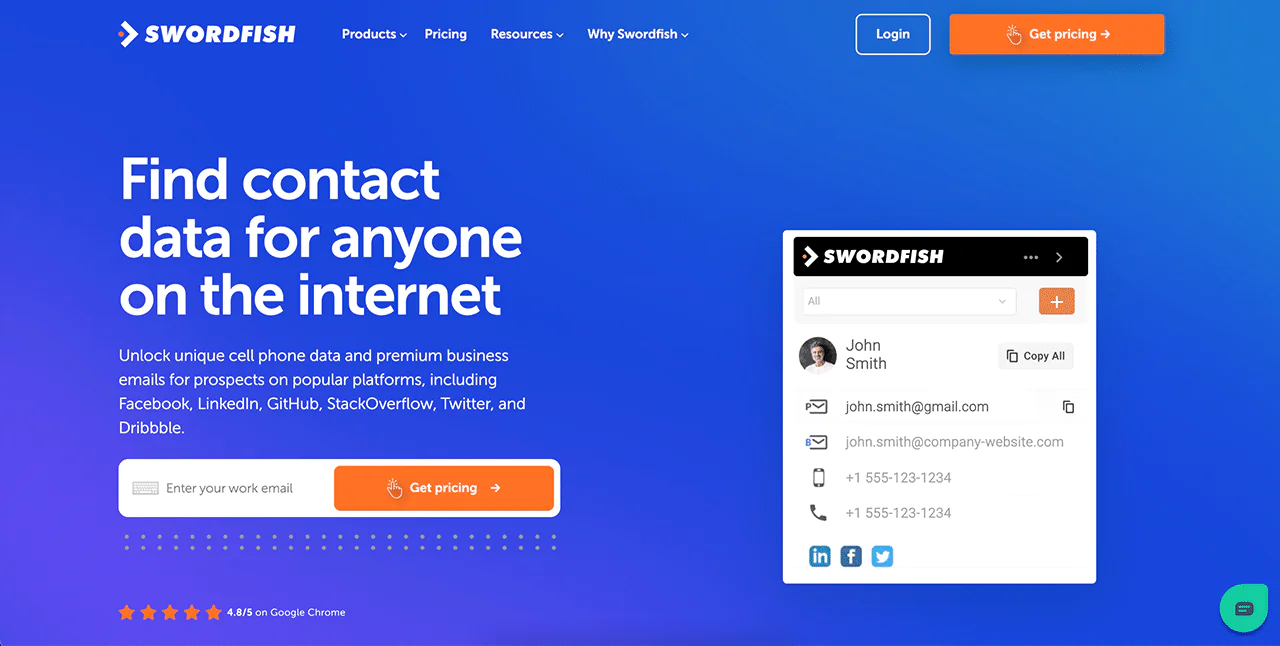
Swordfish AI’s Chrome Extension helps you find people’s contact details on sites like LinkedIn, Twitter, and Facebook. It’s a fast way to get verified contact information, making it easier to generate leads than just Leadfeeder’s tracking of website visitors.
-
Prospector
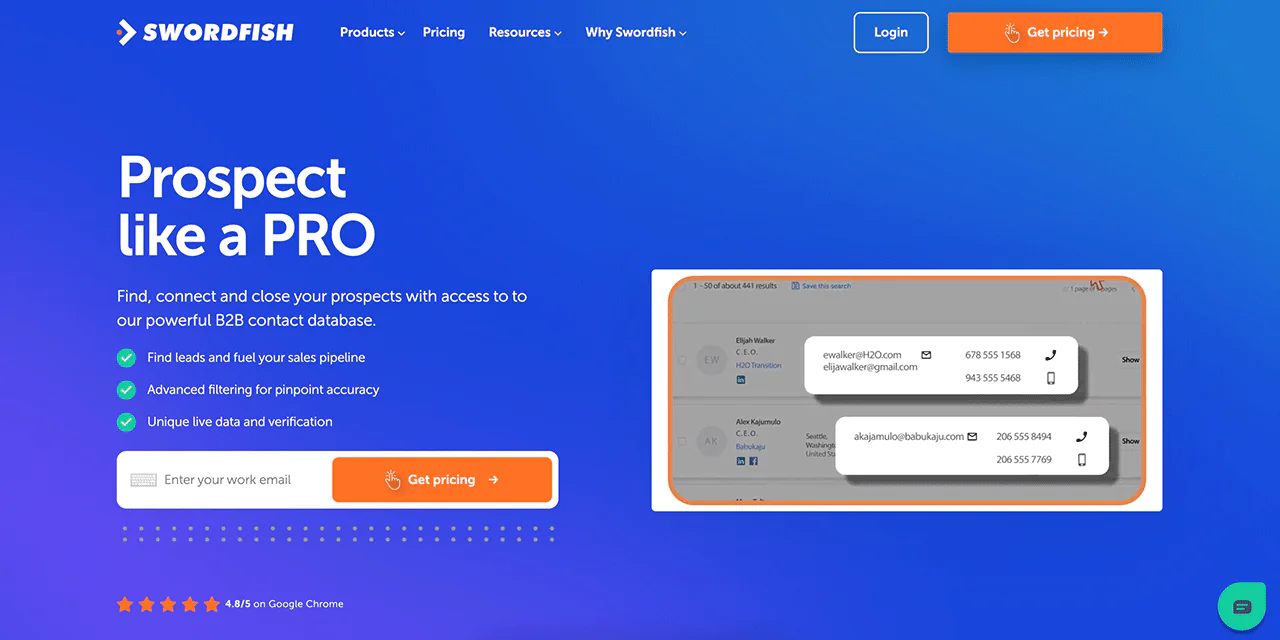
Swordfish AI’s Prospector lets you quickly build lists for calling or emailing many people at once, using detailed filters to zero in on the right leads — a more active approach than Leadfeeder’s passive visitor tracking.
-
Reverse Search
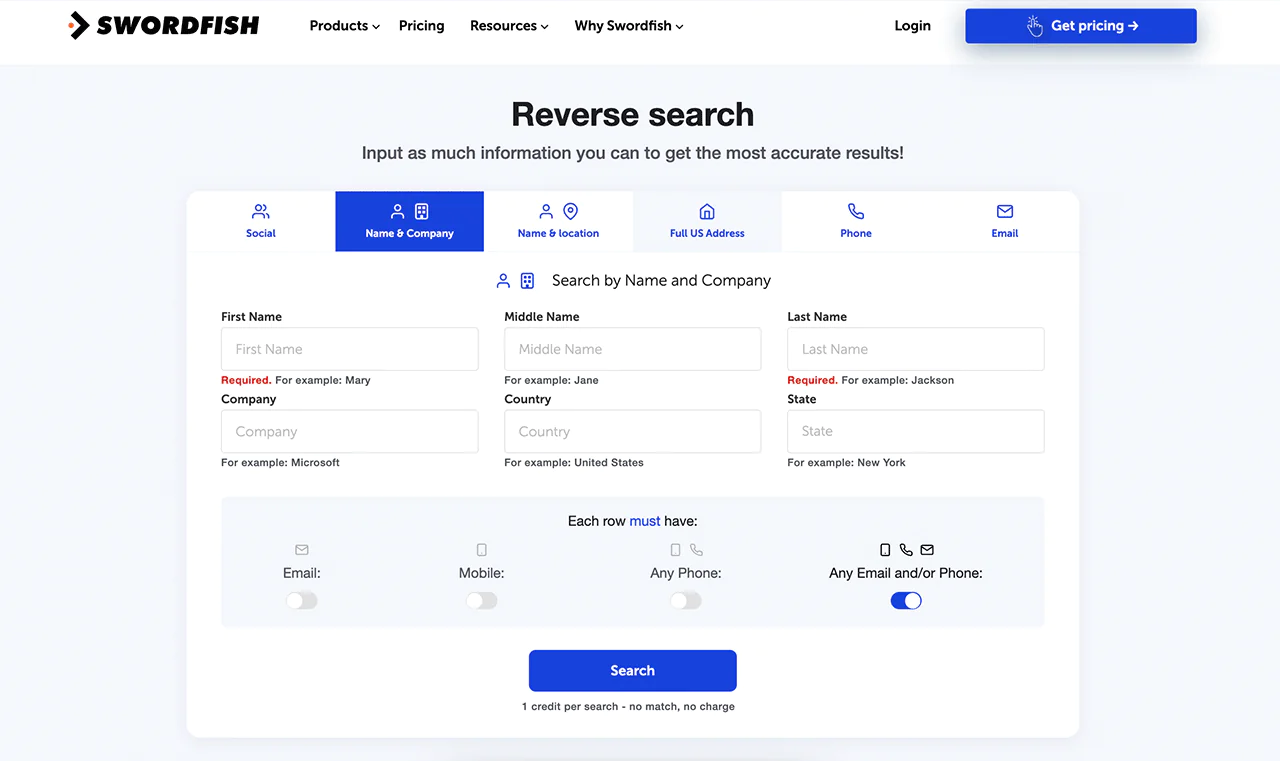
With reverse search, you can start from just a name, company, email, or phone number and pull complete contact details — a depth of contact discovery that goes beyond what Leadfeeder offers.
-
API Integration
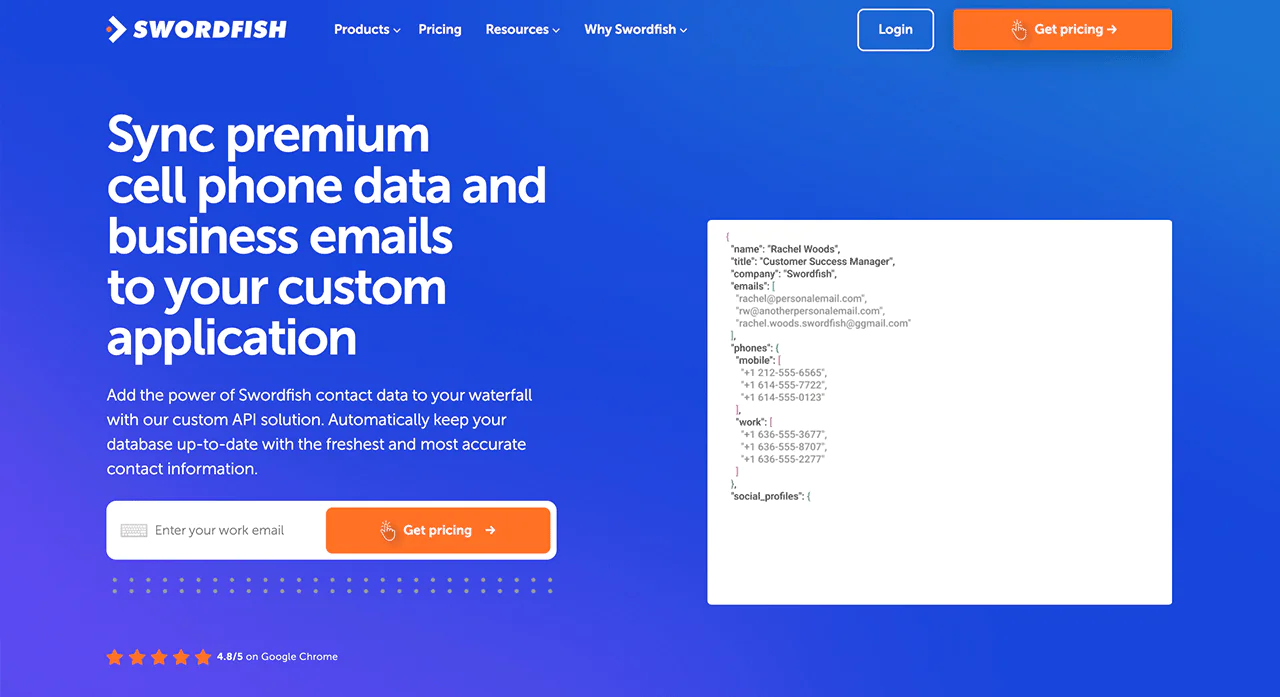
Swordfish AI also offers API integration, letting you pull Swordfish data directly into your own software — a capability Leadfeeder doesn’t emphasize.
-
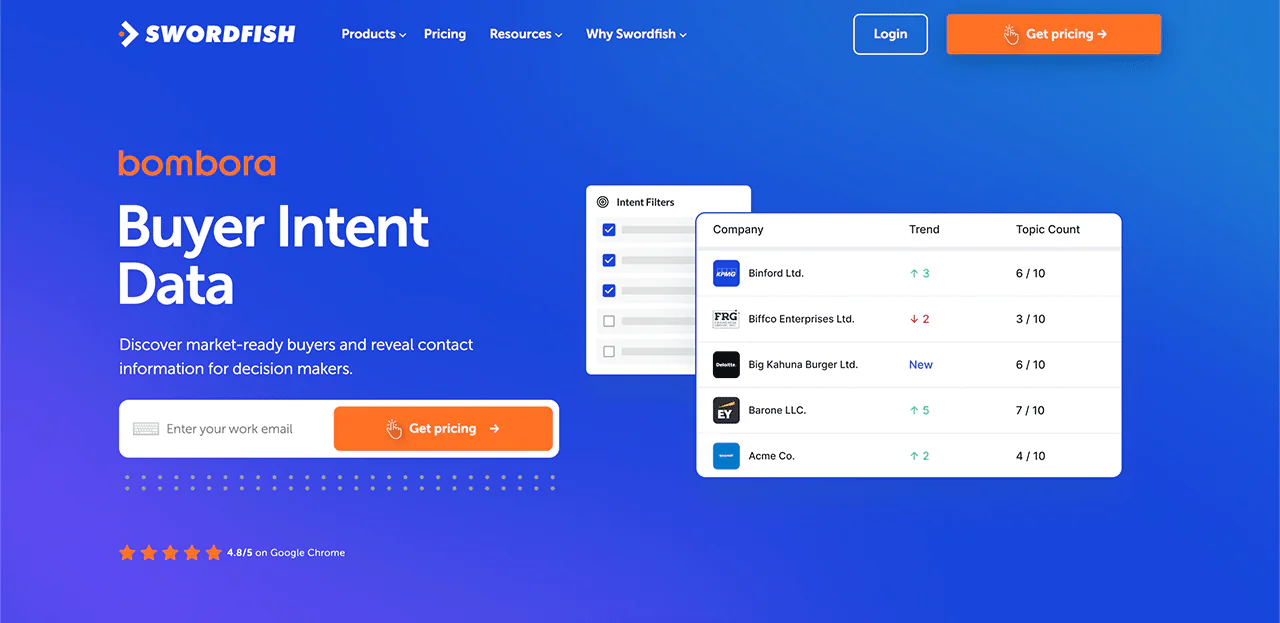
Bombora Intent Data Integration
Swordfish AI uses Bombora Intent Data to surface businesses actively researching your products or services, helping you prioritize leads more likely to buy — a step beyond simply tracking who visited your website.
Best Use Cases of Swordfish AI
- Sales Outreach: If you’re in sales and need to contact decision-makers directly, Swordfish AI is built for that — it gives you direct phone numbers and emails.
- Recruitment Processes: Recruiters can use Swordfish AI to find accurate contact details of potential candidates.
- Marketing Campaigns: Marketing professionals can build detailed contact lists for targeted campaigns.
- Business Development: Swordfish AI helps you find and connect with potential partners or clients.
- Lead Generation: Detailed contact information supports more personalized, effective outreach strategies.
- Data Enrichment: Companies can use Swordfish AI to fill in missing contact details, keeping databases current.
- Customer Research: Businesses can use it to collect contact information for customer research and feedback.
Pros of Using Swordfish
- Handles large data sets at once to generate leads.
- Allows for thorough searches on various social media platforms.
- Offers an easy-to-use interface for a better user experience.
- Connects with a wide network for greater outreach.
- Enables fast and effective gathering of data.
Cons of using Swordfish
- Higher cost for subscription upgrades
Pricing
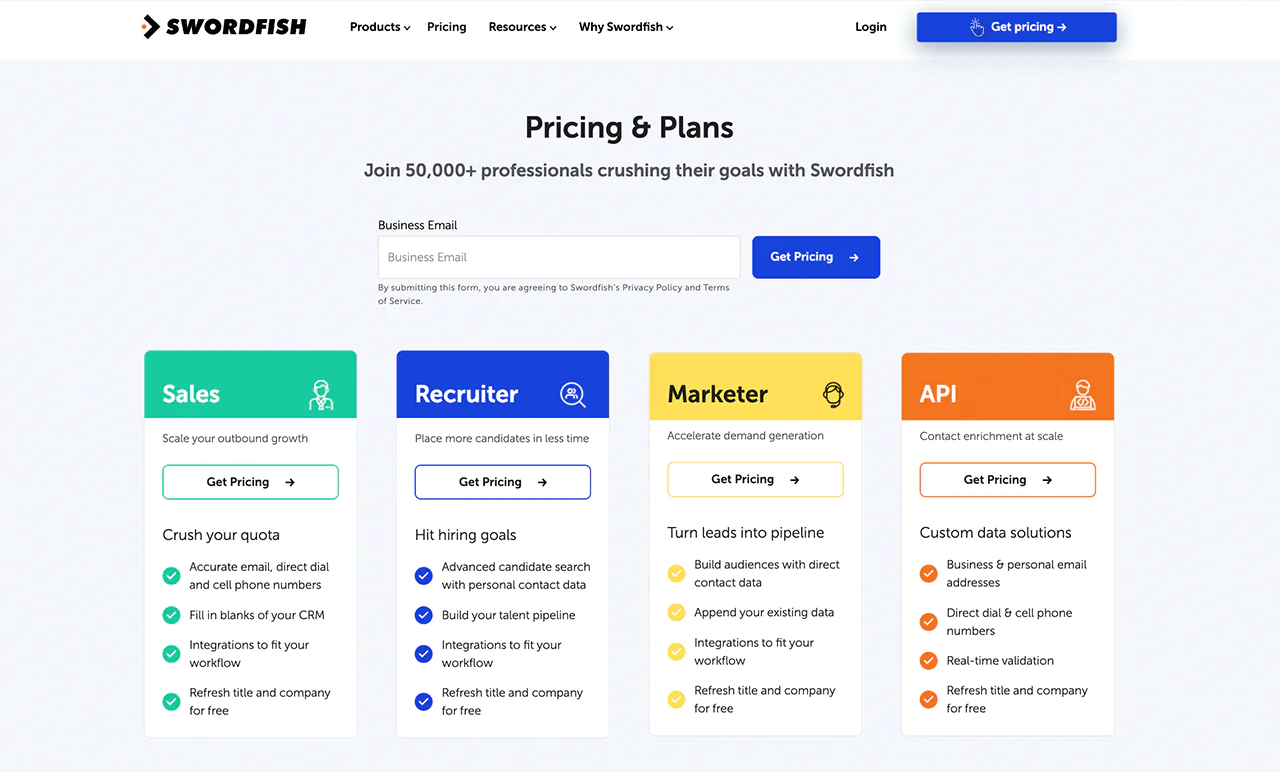
Swordfish AI builds plans around what you actually need, whether that’s sales, recruitment, marketing, or API access. Plans include accurate emails, direct dials, and cell phone numbers, plus free updates for job titles and company information. A customized free trial is available on request.
 Try Swordfish Ai
What Users Say About Swordfish?
G2 Review: 5 out of 5
“Keeping track of my credits and linking the Chrome Extension and Bulk Enrich Files have reduced my work by 95%.”
Capterra: 5 out of 5
“Phone and Email validation are only available on the Chrome Extension at the moment.”
Why Should You Choose Swordfish over Leadfeeder?
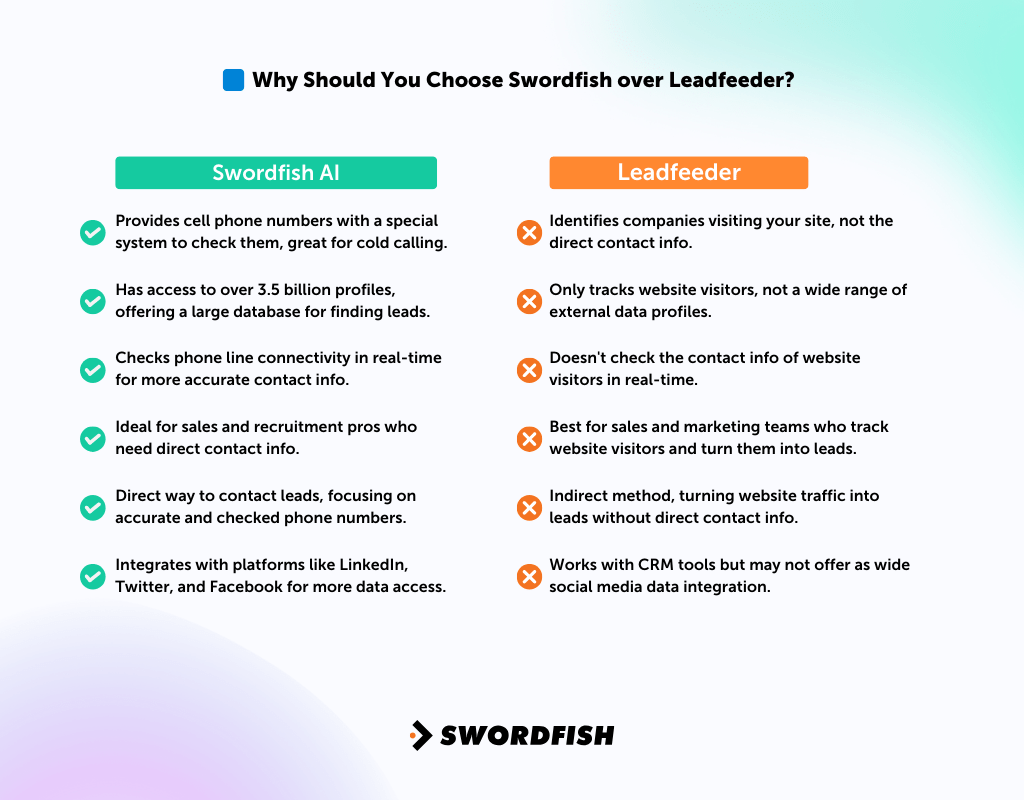
The table below breaks down where Swordfish AI addresses gaps left by Leadfeeder —
|
Swordfish AI |
Leadfeeder |
| Provides cell phone numbers with a special system to check them, great for cold calling. | Identifies companies visiting your site, not the direct contact info. |
| Has access to over 3.5 billion profiles, offering a large database for finding leads. | Only tracks website visitors, not a wide range of external data profiles. |
| Checks phone line connectivity in real-time for more accurate contact info. | Doesn’t check the contact info of website visitors in real-time. |
| Ideal for sales and recruitment pros who need direct contact info. | Best for sales and marketing teams who track website visitors and turn them into leads. |
| Direct way to contact leads, focusing on accurate and checked phone numbers. | Indirect method, turning website traffic into leads without direct contact info. |
| Integrates with platforms like LinkedIn, Twitter, and Facebook for more data access. | Works with CRM tools but may not offer as wide social media data integration. |
2. Salespanel
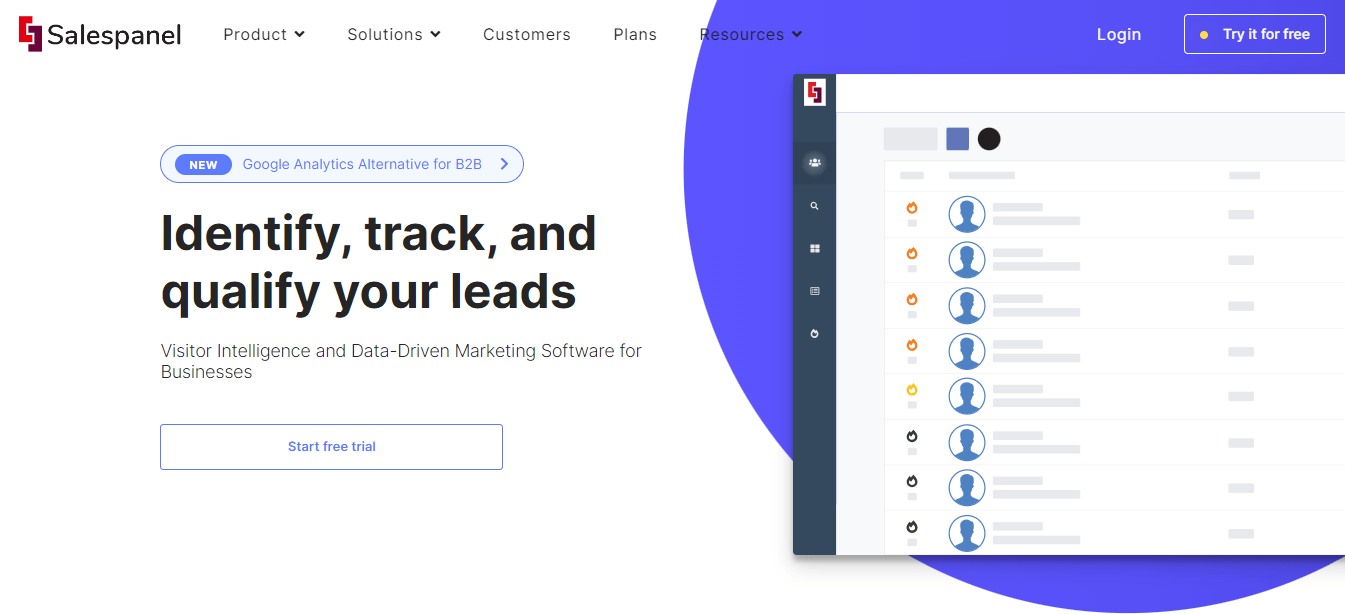
If you need deeper customer interaction analysis than Leadfeeder provides, Salespanel is worth a look. It’s a visitor intelligence and data-driven marketing tool built for identifying, tracking, and qualifying leads.
Salespanel helps sales and marketing teams understand every touchpoint with visitors, leads, and customers, and uses that data to nurture and close deals. It suits businesses already invested in CRMs and marketing tools that prioritize first-party intent data.
It’s a complete solution for lead scoring, segmenting, and marketing automation. Compared to Leadfeeder, Salespanel leans more heavily into lead tracking and customer journey analysis rather than company-level identification alone.
About Salespanel
- Founding Team: Nilangana Ray
- Founding Year: 2018
- Company Size: 2 to 10 employees
Key Features of Salespanel
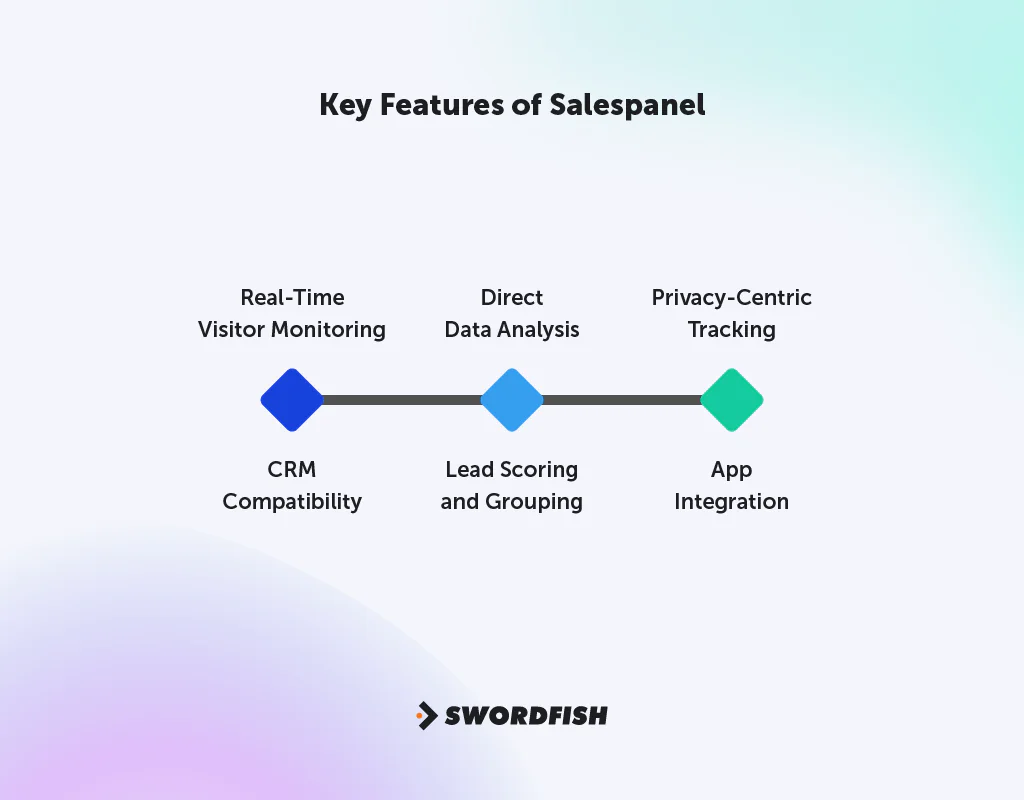
Salespanel is designed for B2B businesses that need to track customer journeys and analyze direct user data —
- Real-Time Visitor Monitoring: Tracks visitors and leads on your website as they browse, offering insights in real time.
- CRM Compatibility: Integrates smoothly with CRM and marketing tools for efficient data management and transfer.
- Direct Data Analysis: Gathers detailed data on customer interactions to support targeted marketing and sales campaigns.
- Lead Scoring and Grouping: Assesses and categorizes leads based on detailed interaction data.
- Privacy-Centric Tracking: Prioritizes user privacy with tracking methods that don’t rely on cookies.
- App Integration: Compatible with a variety of applications, including WordPress and Zapier.
Pros of Using Salespanel
- Tracks lead activities instantly, enhancing lead tracking efficiency.
- Uses direct user data for insightful analytics.
- Smoothly connects with various CRM and marketing platforms.
- Offers strong lead scoring and categorization features.
- Prioritizes user privacy through tracking without cookies.
Cons of Using Salespanel
- Missing features for automated emails and SMS.
Pricing
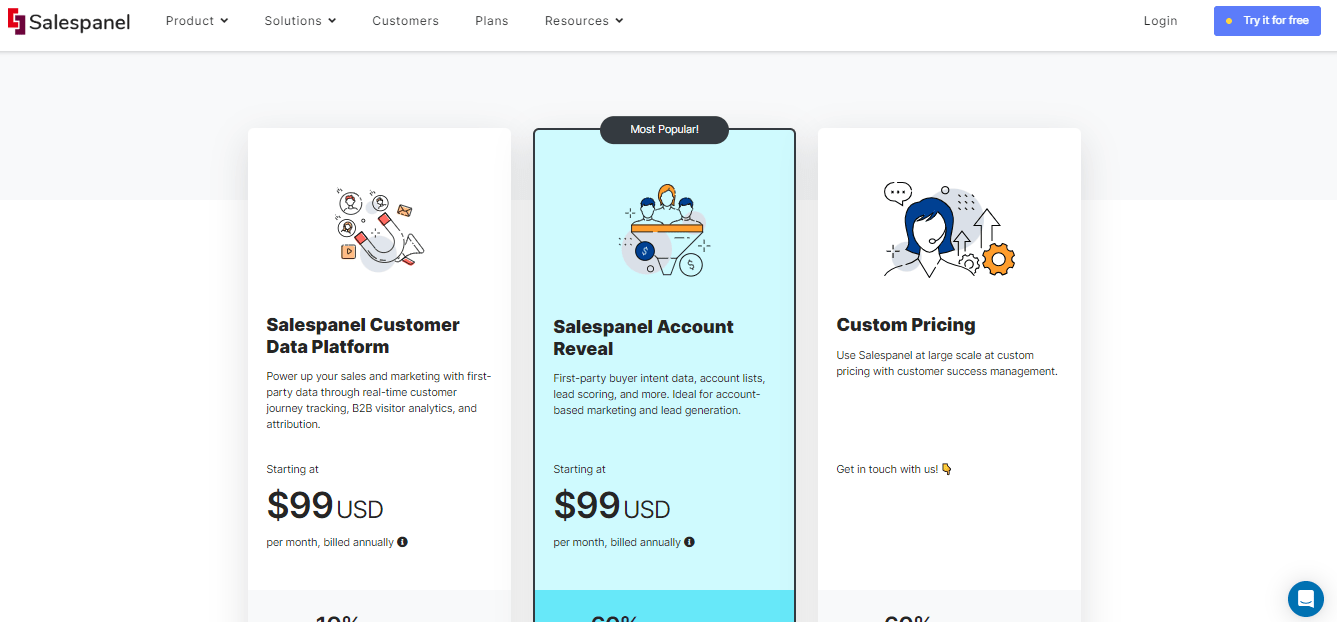
Salespanel offers three pricing tiers. The Basic plan runs $149 per month and covers up to 5,000 tracked visitors. The Growth plan, at $499 per month, covers 20,000 visitors with more advanced features. The Scale plan offers tailored pricing for larger needs.
What Users Say About Salespanel?
G2: 5 out of 5
“Install is easy, if you want to set up some automations then their tutorials are easy to follow.”
Capterra: 5 out of 5
Wish it had a few more integrations, but overall good. – Mikhail A.
Is Salespanel Better than Leadfeeder?
Salespanel and Leadfeeder serve different priorities. Salespanel shines with real-time tracking and analysis of customer intent data, which suits businesses trying to understand customer actions well enough to refine targeted marketing. Its strength is gathering and applying detailed customer intent data for a data-driven sales and marketing approach.
Leadfeeder, by contrast, excels at uncovering which companies are visiting your website, including those with remote employees, giving a broader view of company-level activity. That’s valuable for B2B teams focused on anonymous traffic patterns.
The right pick depends on your priorities: Salespanel for granular customer intent insight, or exploring Leadfeeder pricing if a company-level view of website interactions is what you actually need.
Our Review of Salespanel
Salespanel puts real emphasis on customer intent data and tracking customer journeys, and it works well with CRM systems for handling multiple clients and scoring leads.
It’s strong at tracking visitors and leads in real time, which suits businesses that want to watch customer interactions closely. That said, it lacks automated email and SMS features and can fall short on reporting depth for some use cases.
For B2B companies that value in-depth analysis of customer journey stages and data-driven marketing, Salespanel is a strong choice.
3. Clearbit
Clearbit is a more comprehensive option than Leadfeeder for lead data enrichment and email finding. It’s a sales and marketing platform built around a database covering millions of contacts and businesses.
Clearbit’s strength is lead generation paired with contact data enrichment, offering detailed insight into potential leads and accounts. Real-time data updates help keep information current rather than relying on stale details.
It also integrates well with various CRM systems, simplifying sales and marketing workflows. For businesses that need detailed customer insight rather than just visitor tracking, Clearbit goes further than Leadfeeder.
About Clearbit
- Founding Team: Alex MacCaw, Andrew O’Neal, Amit Vasudev, Matt Sornson, Harlow Ward, and Rob Holland
- Founding Year: 2015
- Company Size: 51 to 200 employees
Features of Clearbit
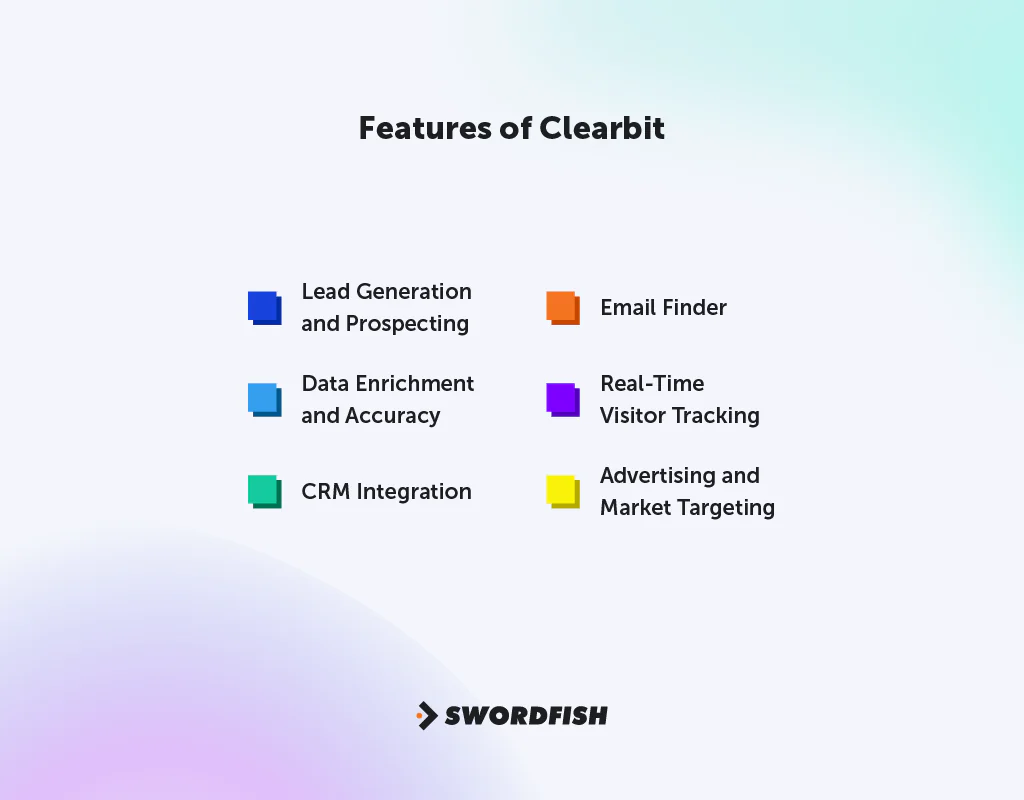
Clearbit offers a range of features designed to boost sales and marketing —
- Lead Generation and Prospecting: Tools to identify new leads from a large contact and business database, useful for expanding your customer base.
- Data Enrichment and Accuracy: Updates contact data with detailed insights, keeping information current for more accurate outreach.
- CRM Integration: Works smoothly with various CRM systems to streamline sales and marketing.
- Email Finder: Helps you find emails for direct outreach and improved engagement.
- Real-Time Visitor Tracking: Tracks website visitors in real time for instant insight into customer behavior and preferences.
- Advertising and Market Targeting: Improves ad targeting with dozens of B2B filters for Facebook ads, aiming to boost ROI and reach the right people.
Pros of Using Clearbit
- Access to a large contact database.
- Enriching and accurate data in real-time.
- Easy integration between CRMs and marketing tools.
- Helps generate leads and identify new accounts.
- User-friendly interface and easy access.
Cons of using Clearbit
- Lacks multi-user capabilities for teams.
- Higher pricing for premium features.
Pricing
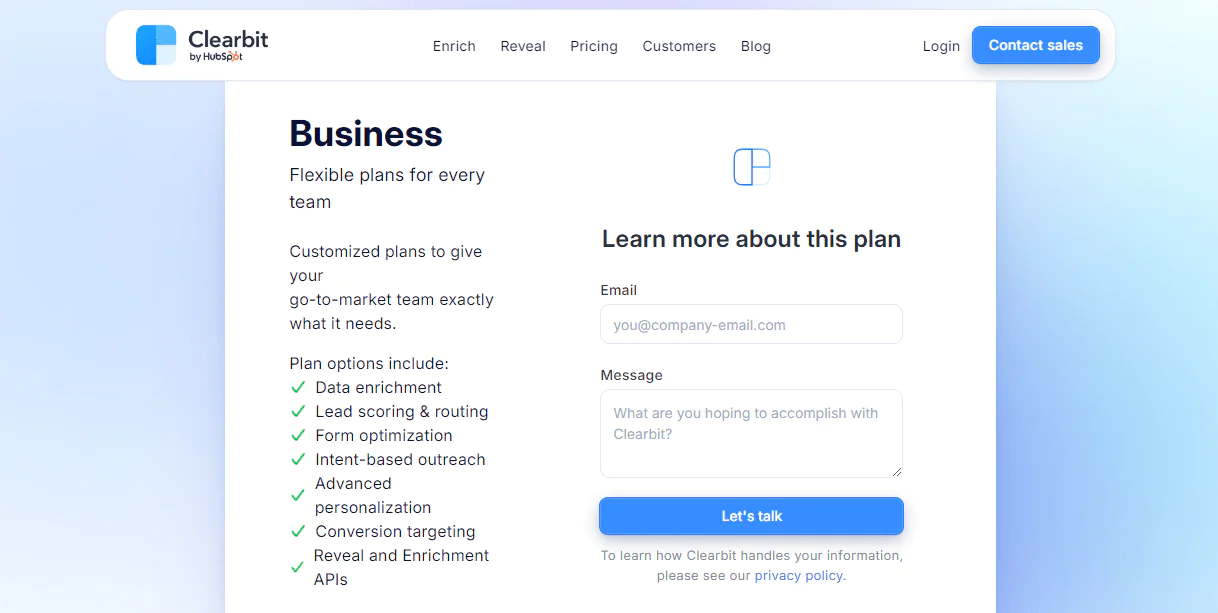
Clearbit offers several plans. You can start with the Clearbit Free plan, which includes a monthly credit allowance at no cost. The Growth plan scales credits up with pricing that increases accordingly, and the Business plan offers custom solutions with more credits and support.
What Users Say About Clearbit?
G2: 5 out of 5
“Clearbit makes it easy to enrich the leads and contacts in our database that are missing data.”
– Ryan S.
Capterra: 4 out of 5
“It would be nice to also have some kind of confidence score based on how they sourced the data.”
Is Clearbit Better than Leadfeeder?
Clearbit stands out in data enrichment and lead generation, particularly for businesses that need detailed information about potential leads and accounts. Its large database, real-time updates, and email-finding tools make it well-suited to data-reliant marketing and sales teams.
Leadfeeder is stronger at identifying companies visiting your website and understanding their behavior — useful for B2B businesses that want a broad view of company-level activity and company-specific tracking based on website traffic.
Our Review of Clearbit
Clearbit performs well at generating leads and enriching data, backed by a sizable contact database that benefits sales and marketing teams.
Its real-time data updates and thorough email-finding capability keep information current. That said, Clearbit can be less suitable for smaller businesses given its pricing and limited team-oriented features.
Overall, Clearbit is a solid choice for businesses aiming to strengthen sales and marketing through lead generation and data enrichment.
4. Factors.ai
If Leadfeeder’s tracking feels too basic, Factors.ai offers a more detailed alternative. It’s a B2B platform that identifies website visitors, maps customer paths, and measures marketing performance, aiming to grow sales while controlling cost.
Factors.ai uses AI to identify and track accounts, turning unknown website visitors into potential sales leads, and gives visibility into the buyer’s journey from first click to final conversion through analysis and AI-driven insight.
You can also track campaign, content, and sales interaction performance, and bring marketing, sales, and pipeline data together for quick, custom reporting.
Overall, Factors.ai suits businesses looking to fine-tune marketing spend and improve conversion rates.
About Factors.ai
- Founding Team: Srikrishna Swaminathan
- Founding Year: 2020
- Company Size: 11 to 50 employees
Features of Factors.ai
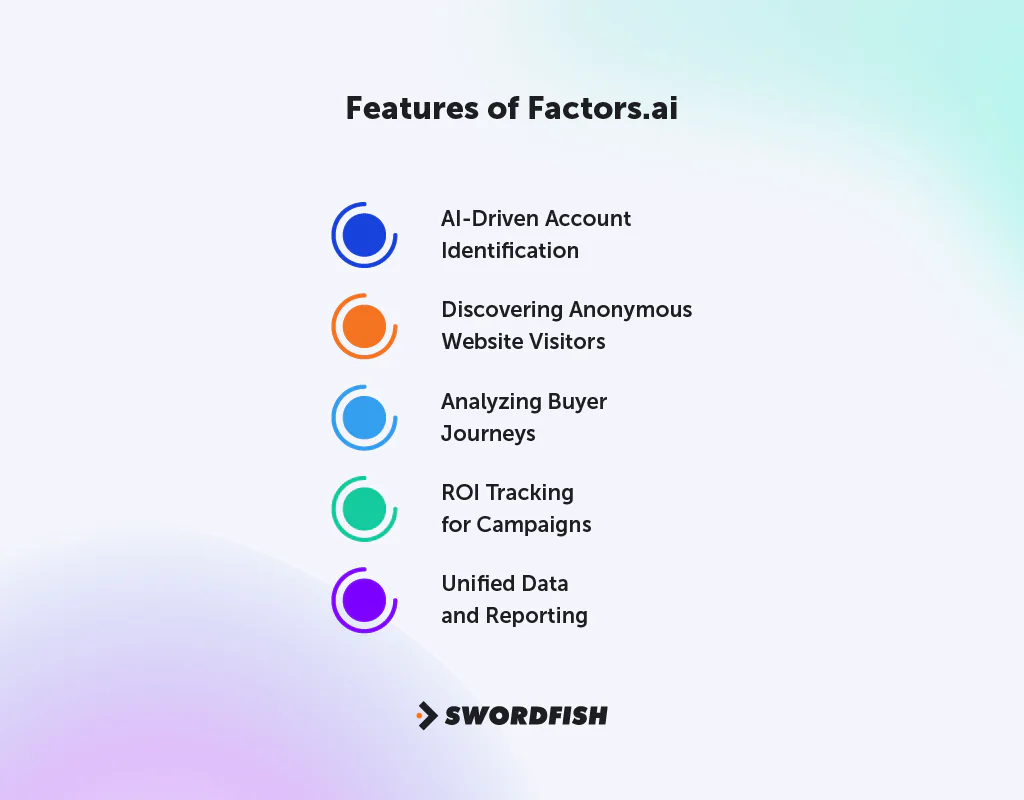
Factors.ai comes with a set of tools designed for B2B account analysis and engagement —
- AI-Driven Account Identification: Uses AI to find and track sales-ready accounts visiting your website, helping predict potential sales.
- Discovering Anonymous Website Visitors: Uses advanced IP-lookup technology, powered by 6sense & Clearbit, to identify unknown companies on your site.
- Analyzing Buyer Journeys: Uses funnels, path analysis, and AI insights to map the buyer’s journey from click to conversion.
- ROI Tracking for Campaigns: Measures campaign, content, and sales interaction success to improve marketing effectiveness.
- Unified Data and Reporting: Brings together marketing, sales, and pipeline data for a complete view and fast reporting.
Pros of Using Factors.ai
- Identifies anonymous website visitors effectively.
- Offers AI-powered insights for marketing strategies.
- Simplifies data management and reporting processes.
- Enhances marketing operations efficiency.
- Provides comprehensive website analytics at scale.
- Facilitates deep dives into a range of metrics.
Cons of Using Factors.ai
- Some users may find the interface challenging initially.
Pricing
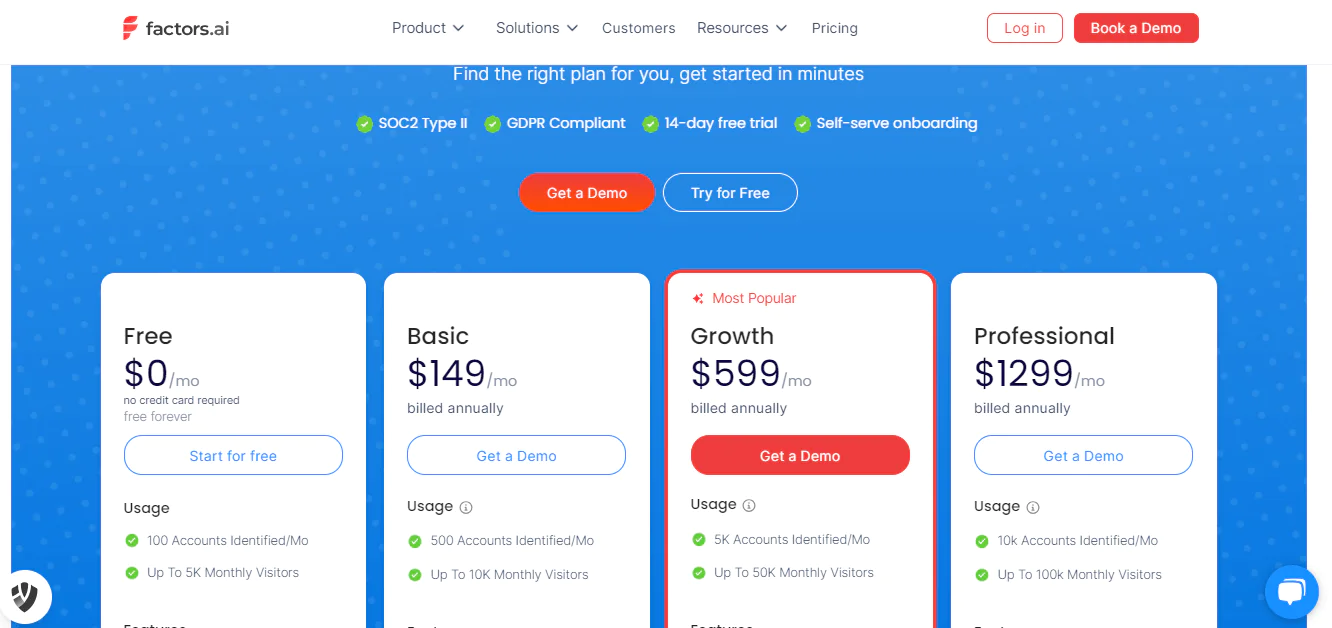
Factors.ai has four pricing tiers. The Free plan covers basic features for up to 5,000 monthly visitors at no cost. The Basic plan runs $149 per month for 10,000 visitors with more advanced features. The Growth plan, at $599 per month, supports up to 50,000 visitors, and the Professional plan is $1,299 per month for up to 100,000 visitors.
What Users Say About Factors.ai?
G2: 5 out of 5
“Implementing automated alerts by Factors has dramatically enhanced the efficiency of our sales team.”
– Ashok D.
Capterra: 4 out of 5
“Their customer support team is quick to address and solve any issues.”
Is Factors.ai Better than Leadfeeder?
Factors.ai takes a more advanced approach than Leadfeeder with its AI-driven account identification, suiting businesses that want to identify and engage potential customers from anonymous website visitors. It’s also strong at analyzing the buyer’s journey and measuring campaign success for data-focused marketing.
Leadfeeder is stronger at spotting companies visiting your website and understanding their actions, which suits B2B businesses wanting a broad view of company activity and website traffic patterns.
Our Review of Factors.ai
Factors.ai leans heavily on AI to identify and track accounts, and it’s good at finding unknown website visitors and turning them into potential customers. Its buyer-journey analysis, from first click to purchase, is a genuine strength, as is its ROI tracking across campaigns.
New users may find the interface takes some getting used to, and the more advanced features benefit from a working understanding of data analytics. Overall, Factors.ai suits B2B marketing teams focused on pipeline growth backed by detailed data.
5. Lead Forensics
If you want a more effective way to identify B2B website visitors than Leadfeeder offers, Lead Forensics is worth evaluating. It focuses on detecting anonymous B2B visitors and converting them into workable leads.
Lead Forensics identifies companies visiting your site in real time using a large, proprietary B2B IP address database, which suits businesses focused on pipeline conversion and sales speed. It provides detailed insight into visitor behavior and alerts you instantly when specific B2B clients visit your support pages, which can help customer relations teams as much as sales.
It integrates cleanly with your existing workflow, feeding key information straight into your CRM.
About Lead Forensics
- Founding Team: Paul Thomas
- Founding Year: 2009
- Company Size: 201 to 500 employees
Features of Lead Forensics
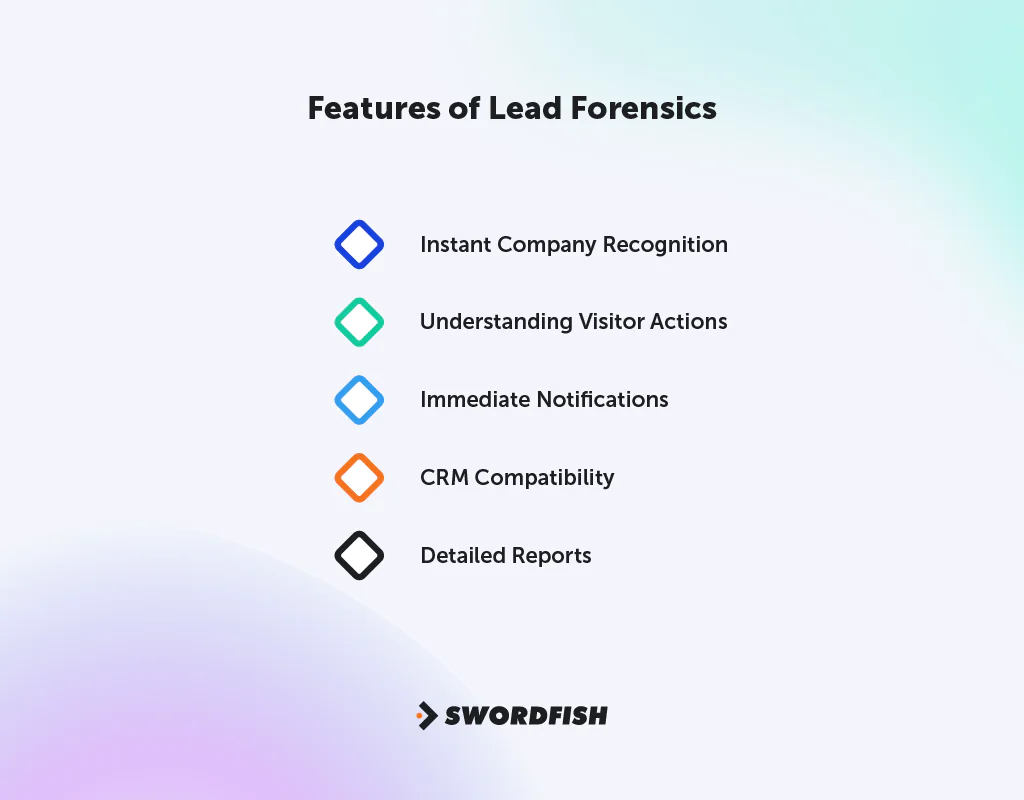
Lead Forensics has several features to improve B2B lead generation and website visitor tracking —
- Instant Company Recognition: Quickly identifies companies visiting your site using a vast B2B IP address database.
- Understanding Visitor Actions: Gives insight into what customers do on your site, helping surface more sales opportunities.
- Immediate Notifications: Alerts you when certain B2B clients visit your support pages.
- CRM Compatibility: Sends important information straight to your CRM.
- Detailed Reports: Provides in-depth reports for a thorough understanding of your website visitors.
Pros of Using Lead Forensics
- Provides detailed visitor behavior insights.
- Instant alerts for specific B2B customer visits.
- An easy integration with CRM systems.
- Advanced reporting for comprehensive analysis.
- Converts anonymous visitors into actionable leads.
Cons of Using Lead Forensics
- May be costly for smaller businesses.
- Limited personal user data availability.
Pricing
Lead Forensics tailors pricing to specific business requirements. For exact figures, contact Lead Forensics directly or request a demo through their website.
What Users Say About Lead Forensics
G2: 5 out of 5
“Real-time tracking is a game-changer, offering immediate visibility into user activity.”
Capterra: 4 out of 5
“Lead Forensics was more than enough for us to do our job effectively.”
– Sean D.
Is Lead Forensics Better than Leadfeeder
Lead Forensics outperforms Leadfeeder at instantly recognizing companies visiting your site, thanks to its extensive B2B IP address database. It suits businesses that need quick B2B lead identification, in-depth visitor insight, immediate alerts, and smooth CRM integration.
Leadfeeder is better at spotting companies on your website and understanding their actions, including those of remote employees, which suits B2B companies wanting a wide view of company activity through company-level tracking and analytics.
Our Review of Lead Forensics
Lead Forensics is effective at identifying B2B website visitors and turning unknown traffic into workable leads. It identifies companies visiting your site in real time using its large IP address database and offers in-depth insight into visitor actions to help speed up deal closing.
It can be expensive for smaller businesses, though, and focuses mainly on company-level data rather than individual users. Overall, it’s an effective tool for businesses aiming to improve lead generation and customer relationships.
How to Choose the Best Leadfeeder Alternative for Your Business
Choosing a Leadfeeder alternative comes down to matching features to your actual workflow. The right choice depends on your specific business goals, not just which tool has the longest feature list.
Up-to-Date Contact Verification
Make sure the tool you choose verifies contact details as they come in. This matters because you want confidence that you’re reaching the right people with current information — particularly important in regulated industries like healthcare, where outdated numbers waste compliance-sensitive outreach windows.
Detailed Visitor Tracking
Choose a tool that digs into how visitors interact with your website. This insight is key for crafting marketing strategies that resonate with your target customers.
Large B2B Contact List
If reaching a wide range of decision-makers is the goal, prioritize a tool with a substantial, verified B2B contact database.
Efficient Lead Generation and Assessment
Pick a tool that’s good at finding leads and smart at assessing them — one that pulls from multiple sources and uses data effectively to identify which leads are most likely to convert.
Marketing Automation and Easy Integration
Look for a tool that simplifies marketing with automation and fits into the CRMs and marketing platforms you already use. This saves time and reduces friction across teams.
Targeted Account Marketing
If your business focuses on specific sectors or company types, consider tools built for account-based marketing, which support personalized outreach to high-value accounts.
Informed Sales and Marketing Decisions
Prioritize tools that provide solid data to guide sales and marketing decisions, with clear analytics that help teams understand and nurture leads effectively.
So, What’s The Best Leadfeeder Alternative?
If you’re looking for a Leadfeeder alternative, Swordfish AI is worth strong consideration. It offers direct access to cell phone numbers and emails, helping you connect with key decision-makers without waiting on a website visit.
It also validates contact accuracy in real time, which matters for teams in sales and recruitment who need reliable information before they pick up the phone.
Beyond accuracy, Swordfish AI is known for responsive customer support and an accessible pricing structure, plus a straightforward interface backed by tools like the Chrome Extension and Prospector.
Salespanel and Clearbit are also solid options depending on your priorities. Salespanel tracks leads in real time and helps you understand them using multiple data types, while Clearbit gives access to a large database of B2B contacts and integrates well with HubSpot for identifying potential clients.
Ready to strengthen your lead generation process? Explore Swordfish AI’s features and see how it fits into your lead management workflow with a free trial.
Conclusion
If you’re aiming to improve how you find leads, it’s worth evaluating alternatives to Leadfeeder against your actual requirements. Keep contact data current, track visitor behavior carefully, and use tools built for genuine lead generation rather than passive tracking alone.
Easy integration with your current systems and solid marketing automation can also make a real difference in day-to-day efficiency.
When picking an alternative, weigh what your business specifically needs — the size of your B2B contact list, how you target accounts, or the sales and marketing decisions you’re trying to make smarter. Each option here has its own strengths and tradeoffs, so choose based on your goals and budget rather than name recognition alone.
FAQs
Does Swordfish AI validate data more effectively than Leadfeeder?
Yes. Swordfish AI checks contact details in real time, which helps keep information more accurate than what Leadfeeder typically provides.
What makes Lead Forensics better at recognizing unknown website visitors?
Lead Forensics uses a large database of business IP addresses to spot unknown visitors, giving deeper visitor insight than Leadfeeder offers on its own.
How does Salespanel improve the process of qualifying leads?
Salespanel blends personal, company, and behavior data to qualify leads, offering a more detailed evaluation than Leadfeeder’s approach.
What makes Clearbit unique in targeting specific business markets?
Clearbit’s large database and HubSpot integration let you focus precisely on your ideal business segments.