
 View Products


Last updated: September 3, 2026
By Swordfish.ai Editorial Team — Last updated Jan 2026
Who this is for
- RevOps, sales ops, recruiting ops, and procurement teams weighing ZoomInfo vs UpLead through a price-to-quality tradeoff lens, including healthcare staffing and provider-outreach teams where mobile reachability and verified emails carry extra weight.
- Outbound leaders tired of paying twice: once for the data subscription, again in SDR hours spent fixing what the data got wrong.
- Operators who have heard “integration complete” and still ended up with duplicate records, overwritten fields, and attribution disputes a month later.
Quick Verdict
- Core Answer
- Pick the tool that produces more usable conversations per dollar once you account for verification failures, missed reachability, and CRM cleanup time. If you skip testing verification definitions, phone labeling, and integration write behavior, you’re buying reassurance, not results.
- Key Stat
- The cheapest exported record is rarely the cheapest conversation. This is a price-to-quality tradeoff measured in outcomes, not field counts.
- Ideal User
- Teams willing to run a controlled seed-list test, log failure reasons by category, and enforce stop conditions before signing or renewing.
Judge the decision by what a record actually does once a rep touches it, not by what the export screen promises. Connect rate and reply rate tell you more than list size ever will.
Best for / not for (fast filter)
- ZoomInfo is a fit if you’ll use its deeper workflow tooling and can staff procurement, governance, and integration oversight to justify the broader operational surface area.
- ZoomInfo is not a fit if you want a low-friction rollout and lack the bandwidth to police field overwrites, dedupe behavior, and permissioning.
- UpLead is a fit if you want a simpler buying motion but will still enforce verification gates before sending or dialing.
- UpLead is not a fit if you assume “simple” means “no governance needed” — data decay still hits sequences and CRMs regardless of vendor.
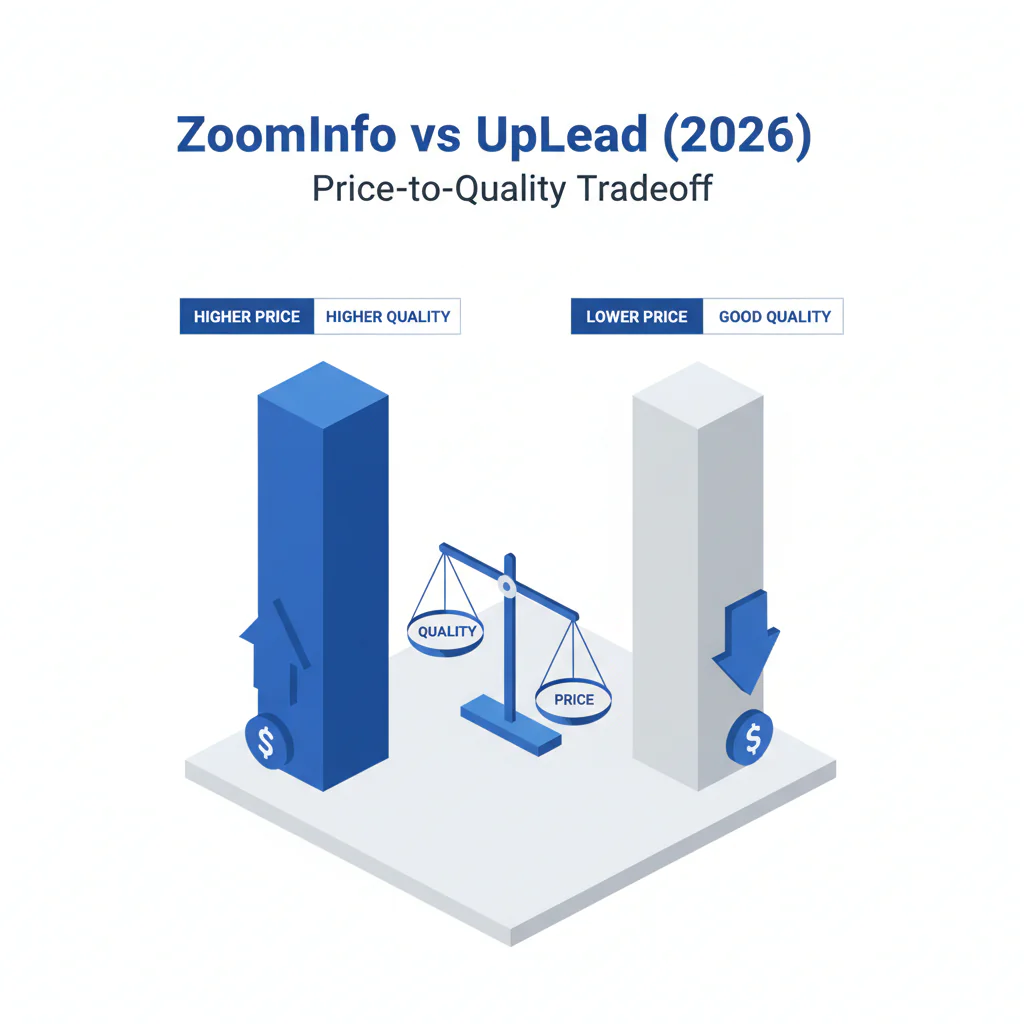
Price-to-quality tradeoff (framework you can defend in procurement)
The invoice is the visible cost. The real bill arrives later, in wasted dials, damaged email sender reputation, and hours spent undoing what an integration quietly changed. Treat ZoomInfo vs UpLead as a genuine price-to-quality tradeoff and demand evidence for both verification and reachability claims before you rely on either.
- Quality means verifiable usability: can a rep actually reach the person, and does the email land without hurting domain reputation.
- Price means effective cost per conversation: subscription cost plus usage limits plus the labor spent handling failures.
- Risk means integration and governance exposure: what the tool writes into your CRM, and whether that write is auditable and reversible.
Contract audit questions (pricing model)
- What’s included versus sold as an add-on, and which add-ons you’ll actually need for your use case (exports, enrichment, integrations).
- What language governs usage limits (caps, throttles, overages), and whether those limits shift by seat or team.
- What the vendor defines as “verified” in writing, and whether verification signals are visible at the record level.
- What happens at renewal — price adjustments, minimum commitments, and whether your usage history affects the next term.
Decision Tree: Weighted Checklist
Weights below are qualitative (High/Medium/Low), reflecting the usual failure points in contact data: ambiguous verification, weak reachability, and CRM overwrite damage.
- High impact / Low effort: Run the same seed list through both tools and measure connect and bounce outcomes before scaling any export.
- High impact / Medium effort: Define acceptance criteria for data verification — what counts as usable for a call versus usable for an email — and enforce suppression rules accordingly.
- High impact / High effort: Lock down CRM governance: dedupe rules, field-level write permissions, enrichment source-of-truth, and a rollback plan.
- Medium impact / Low effort: Track cost per conversation, not cost per record, including labor time lost to non-connects and cleanup.
- Medium impact / Medium effort: Match cadence and channel mix to real reachability — go call-first only when mobile or direct-dial coverage holds up consistently for your ICP.
Checklist: Feature Gap Table
This is a buyer’s gap map — where cost quietly leaks once contact data meets real workflow constraints.
| Hidden-cost area | What to inspect in ZoomInfo | What to inspect in UpLead | Business symptom when it fails |
|---|---|---|---|
| Pricing model behavior | Confirm what is included vs add-ons and document renewal/usage terms in the order form. | Confirm plan limits that affect exports and team usage; document what triggers throttles or overages. | Coverage drops mid-quarter because usage is constrained or budget approval drags. |
| Verification definition | Require the written definition of “direct dial” and what signals (confidence/recency) users can see. | Require the written definition of any “real-time” checks and whether they run at search time or export time. | SDRs become the verification layer, and your tool spend converts into non-connects. |
| Reachability signals | Verify whether phone types are labeled (mobile/direct/HQ) and how those labels are determined. | Verify whether sourcing prioritizes mobile/direct reachability or completeness of contact cards. | High dial volume with low connects; calling turns into a cost and morale issue. |
| CRM write behavior | Review overwrite rules, dedupe handling, and field-level permissions for enrichment pushes. | Review overwrite rules, dedupe handling, and whether enrichment respects your CRM source-of-truth fields. | Duplicates, broken attribution, and “why did this change back?” cycles. |
| Auditability | Confirm export logs and the ability to reproduce what data was used at a point in time. | Confirm export logs and whether exports can be reproduced for audit replay. | You cannot defend decisions in compliance, revenue disputes, or attribution reviews. |
Troubleshooting Table: Conditional Decision Tree
These are the stop conditions that keep you from paying for a dataset only to discover afterward that it doesn’t connect.
- If “direct” numbers repeatedly route to HQ lines, IVRs, or gatekeepers in your test, then Stop Condition: pause evaluation and require the vendor’s written definition of direct dial and sourcing method before continuing.
- If “verified” emails still bounce at a rate that forces heavy suppression, then Stop Condition: pause and require a clear explanation of what verification means operationally, including when it runs.
- If the integration overwrites trusted CRM fields or increases duplicates during a pilot, then Stop Condition: pause and fix governance before any rollout.
- If you can’t reproduce an export and explain why a record was considered usable at the time, then Stop Condition: pause and add audit-logging requirements to the purchase decision.
How to test with your own list (5–8 steps)
- Build a seed list of 200–500 contacts matching your ICP, territories, and seniority mix. Keep it stable across both tools.
- Export from ZoomInfo and UpLead using equivalent filters and identical required fields (name, company, title, email, phone, and any phone-type label if offered).
- Apply verification gates before outreach: suppress records missing a phone number, with ambiguous phone type, or without a usable email signal by your deliverability standards.
- Run identical outreach for five business days: same sequence, same call windows, same rep behavior.
- Classify every outcome: wrong number, HQ line, voicemail tree, answered, bounced, delivered, reply.
- Compute effective cost as tool cost plus labor time on non-productive outcomes, then compare cost per conversation across both platforms.
- Inspect failure clusters by segment (industry, region, role) to see whether the weak spots actually touch your core market.
What Swordfish does differently
- Ranked mobile numbers / prioritized dials: Swordfish surfaces mobile reachability first so reps spend fewer minutes navigating switchboards and phone trees.
- True unlimited/fair use: the fair-use boundary is published in writing — what actions count, automation limits, and enforcement — so volume planning doesn’t shift mid-quarter.
For adjacent operating comparisons inside the same pillar, use ZoomInfo vs Swordfish, the UpLead review, and Swordfish vs UpLead.
Evidence and trust notes
- Freshness: Last updated Jan 2026.
- Method: outcome-based evaluation under a price-to-quality tradeoff model, using verification and reachability as the decision variables.
- What to document: seed list definition, export timestamps, filters, suppression rules, field mappings, and a log of dial/email outcomes so the decision can be audited later.
- Vendor-doc starting points: use official documentation and terms pages to confirm definitions of direct dial, verification language, export/usage terms, and integration write rules before treating any claim as settled.
- Source discipline: if a feature affects price, verification, or CRM writes, get it in writing in the terms or order form before treating it as real.
For compliance baseline reading (not a vendor comparison), see the FTC’s Telemarketing Sales Rule, the FTC’s CAN-SPAM compliance guide, and a plain-language GDPR overview to keep outreach aligned with consent, lawful basis, and opt-out handling.
FAQs
Which is cheaper: ZoomInfo or UpLead?
“Cheaper” depends on contract structure and how you use the data. Compare effective cost per conversation, not sticker price: include usage constraints and labor spent on non-connects and cleanup.
Which has better verification?
Don’t accept “verified” as a label on faith. Ask what was verified, when it was verified, and what the failure states look like, then confirm with a seed-list test and documented outcomes.
Which is better for direct dials and mobile reachability?
Whichever produces more answered calls in your ICP under the same test conditions. Require a written definition of “direct dial,” log HQ-line routing as a failure category, and stop the evaluation if the label doesn’t match results.
Is UpLead accurate?
Accuracy only matters when tied to outcomes: bounce rate, reachability, and how often stale titles or duplicates force a CRM correction.
Is ZoomInfo worth it?
It’s worth it when the workflows you actually use translate into more reachable contacts and less manual cleanup. If you won’t operationalize the extra surface area, measure whether it’s adding overhead instead of outcomes.
Next steps (timeline)
- Today: set acceptance criteria for reachability and data verification, and pick a seed list.
- This week: run the controlled export-and-outreach test and classify outcomes consistently.
- Next week: compute effective cost per conversation and validate integration write behavior in a CRM sandbox.
- Before purchase: require pricing and verification terms in writing and store test artifacts for audit replay.
About the Author
Ben Argeband is the Founder and CEO of Swordfish.ai and Heartbeat.ai. With deep expertise in data and SaaS, he has built two successful platforms trusted by over 50,000 sales and recruitment professionals. Ben’s mission is to help teams find direct contact information for hard-to-reach professionals and decision-makers, providing the shortest route to their next win. Connect with Ben on LinkedIn.