
 View Products


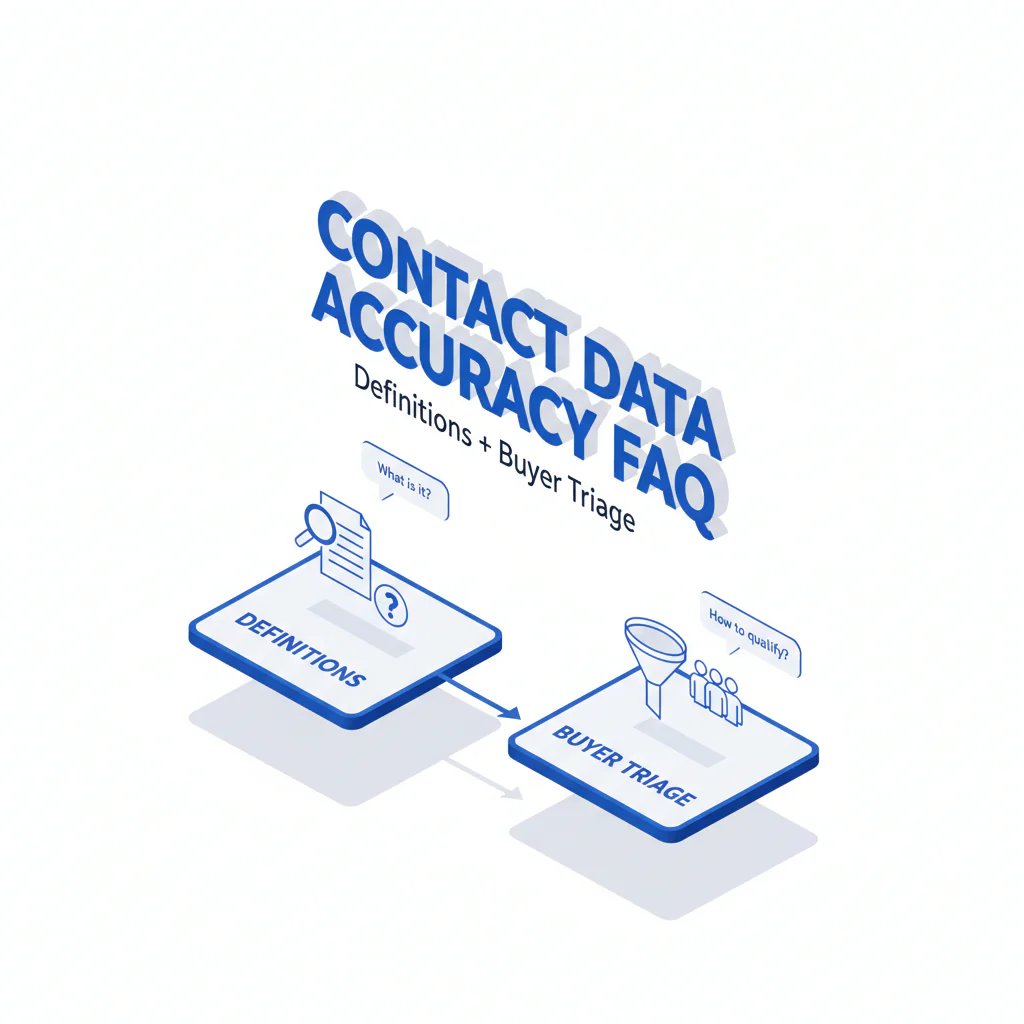
Contact Data Accuracy FAQ: Definitions + Buyer Triage
Byline: Ben Argeband, Founder & CEO of Swordfish.AI
Who this is for
This is for procurement, RevOps, and team leads who have to forecast total cost and integration effort for contact data tools. If you’ve dealt with data decay, seat-based pricing, add-ons for basic exports, or APIs that throttle the moment you automate, you’re the target reader.
Quick verdict
- Core answer
- Contact data accuracy is not one metric. To evaluate it, separate accuracy vs match rate, define verified contact data in operational terms, confirm data freshness, and verify compliance and opt-out handling before rollout.
- Key stat
- Comparable accuracy numbers are rarely published because outcomes vary by seat count, API usage limits, list quality, and industry coverage. If a vendor won’t explain variance drivers, you can’t budget outcomes.
- Ideal user
- Teams that need predictable enrichment outcomes and want fewer wrong dials and less CRM cleanup without buying extra seats or add-ons just to access verification signals.
Decision guide
Data Quality FAQ Triage: what to check first (so you don’t pay twice in rework). Start by forcing definitions (what “verified” means, what counts as a direct dial, and how mobile vs VoIP is labeled). Next, demand a variance explanation tied to your reality (seat count, API usage, list quality, industry). Then pilot with your own list and store the verification signals in your CRM so you can measure decay and re-check behavior over time.
If you want a plain-English way to talk about contact data quality metrics without vendor math, treat them as separate levers: match rate (did you get something), accuracy (was it correct), recency (how stale it is), and channel outcomes (deliverability for email, reachability for phone). Mixing these into one “accuracy” number is how teams end up paying for coverage and getting rework.
What Swordfish does differently
Most contact data tools look cheap until you try to operationalize them. The usual pattern is predictable: you buy “coverage,” then discover you need extra seats to export, add-ons to see verification fields, and an API that slows down when you scale usage. Meanwhile, data decay keeps running in the background.
- Prioritized direct dials and mobile numbers: We prioritize usable phone outcomes (including direct dial where available) instead of inflating match rate with generic lines that don’t reach the person.
- Clear labeling for mobile vs VoIP: Knowing mobile vs VoIP reduces wasted dials because reps can prioritize numbers that are more likely to behave like persistent personal lines rather than disposable routing.
- Verified contact data as a usable signal: “Verified” only helps if it’s a field you can export and automate on. If it’s trapped in a UI badge, assume you’ll be stuck with manual workflows and inconsistent CRM state.
- True unlimited under fair use: Unlimited changes behavior: teams re-check records as they age instead of hoarding credits and letting decay accumulate. If “unlimited” turns into throttling or surprise restrictions, it behaves like credits in production.
If your immediate question is “How do I check a specific number or person right now?”, use reverse search to validate a single record before you build a workflow around it.
Checklist: Feature Gap Table
| Claim you’ll hear | What it usually hides (cost or risk) | What to ask to expose the gap | Business outcome if you don’t |
|---|---|---|---|
| “High accuracy” | They’re reporting match rate, not correctness; or they exclude hard segments from the denominator. | “Define accuracy vs match rate. What is counted as verified contact data and what is not?” | More wrong dials and CRM pollution; reps stop trusting enrichment. |
| “Verified contact data” | “Verified” can mean anything from a recent observation to a weak heuristic, and it may not be exportable. | “What verification method is used for phone and email, and do we get the verification status as a field via export/API?” | You can’t route, prioritize, or audit outcomes; you pay for a label, not a control. |
| “Direct dial coverage” | They mix switchboard, main line, and VoIP into the same bucket. | “Define direct dial. Do you label direct dial vs non-direct, and do you label mobile vs VoIP?” | Lower reachability; reps burn time navigating phone trees. |
| “Fresh data” | No disclosed refresh cadence; you’re buying a snapshot that decays. | “What is your data freshness policy and refresh frequency, and can we re-check without penalty?” | Decay becomes a recurring cost center: re-enrichment plus cleanup. |
| “Easy integration” | API throttling, missing fields, or paid access to basic endpoints. | “What are the API limits, throttles, and overage rules, and which fields are available via API vs UI?” | Automation fails; you fall back to manual exports and inconsistent data. |
| “Compliance-ready” | Compliance is pushed onto you without tooling: no opt-out workflow, no suppression support, no audit trail. | “How do you support compliance and opt-out meaning in practice, and what happens when a contact opts out?” | Higher legal and reputational risk; you can’t prove responsible use. |
Decision Tree: Weighted Checklist
Quick Self-Audit (weighted by common failure points): Use this to score vendors during evaluation. The weights reflect where buyers typically get surprised: pricing mechanics, throttling, decay, and missing verification signals.
- High weight: Can you export and automate verification signals (verification status, phone type such as mobile vs VoIP, and a recency indicator) without add-ons or extra seats? If not, you’ll pay in manual work and inconsistent routing.
- High weight: Are API limits, throttles, and enforcement disclosed in writing? If not, your integration will work in a demo and fail when you scale usage.
- High weight: Does the vendor explain variance drivers (seat count, API usage, list quality, industry)? If not, you can’t forecast outcomes or compare tools honestly.
- Medium weight: Are direct dial and non-direct numbers separated and labeled? If not, reps will call more low-yield numbers and waste time.
- Medium weight: Is data freshness defined with a refresh policy you can operationalize, including re-check rules? If not, decay becomes a predictable re-enrichment tax.
- Medium weight: Is there a documented compliance posture with a working opt-out process that prevents re-importing suppressed contacts? If not, you’ll build controls under pressure.
- Lower weight: Are definitions for verified contact data, direct dial, and mobile vs VoIP written in documentation your team can reference? If not, internal reporting will drift and arguments will replace measurement.
Troubleshooting Table: Conditional Decision Tree
- If the vendor cannot define verified contact data beyond marketing language, then treat “accuracy” claims as non-comparable and require a pilot using your own lists.
- If they report only match rate, then require an accuracy vs match rate explanation by segment because list quality and industry coverage skew results.
- If they can’t label direct dial separately from other phone types, then expect lower reachability and budget extra rep time for wrong paths.
- If they can’t distinguish mobile vs VoIP, then assume higher wasted dials and a harder compliance review for outbound calling programs.
- If “unlimited” has undisclosed throttling or enforcement, then model cost as credits anyway because your re-check behavior will be constrained.
- If refresh cadence is vague, then assume faster decay and plan a re-enrichment cycle; confirm whether re-checking is penalized.
- Stop condition: If pricing depends on add-ons for exports, verification fields, or API access, stop and re-price the tool as “base + required add-ons,” because that’s the number procurement will end up paying.
Limitations and edge cases
- Accuracy varies by your inputs: Clean, current lists behave differently than scraped or old CRM data. If you don’t test with your own list, you’re buying a demo result.
- Industry and geography skew results: Some sectors churn phone assignments faster; some regions have different numbering behaviors. If a vendor won’t discuss weak spots, you’ll find them after rollout.
- Mobile vs VoIP is not a value judgment: VoIP can be legitimate, but it often correlates with lower persistence. If your workflow assumes “phone = call-ready,” you’ll waste time.
- Compliance is shared responsibility: A vendor can support compliance, but your team still needs permissible use policies, suppression lists, and an opt-out process that is enforced across systems.
Evidence and trust notes
Variance explainer (why vendor numbers don’t transfer): Reported outcomes change with seat count (who can access/export), API usage (batch vs real-time), list quality (freshness and formatting), and industry coverage. If a vendor won’t state these assumptions, their “accuracy” is not auditable.
Auditability check (what to require before procurement approval): Ask for a sample export schema and API field list that includes verification status, phone type (including mobile vs VoIP), and a recency indicator you can store. If those fields aren’t available outside the UI, treat the tool as non-automatable and budget for manual work.
Pricing model behavior note (credits vs unlimited): Credits push teams to avoid re-checking, which increases decay and cleanup. Unlimited plans change behavior by encouraging re-validation as records age. The catch is enforcement: “unlimited” that becomes throttling behaves like credits in production. Swordfish offers true unlimited under fair use; require any vendor to state fair use terms in writing.
Responsible use: Contact data should be used for permissible business purposes with suppression and opt-out handling. If you need the compliance specifics, start with contact data compliance.
For Swordfish-specific methodology details, see how we verify mobile numbers and data refresh frequency. For the broader framework, see data quality.
FAQs
What is verified contact data?
Verified contact data is contact information with an explicit verification signal you can act on, not just “we found something.” In practice, you want a definition that includes what was verified (phone or email), how it was verified, and whether the verification status is exportable and usable in automation.
What is a direct dial?
A direct dial is a number intended to reach a specific person without going through a main line or switchboard. If direct dials are mixed with generic numbers, your reps waste time and your reachability drops.
Mobile vs VoIP: what’s the difference and why does it matter?
The mobile vs VoIP distinction affects outcomes. Mobile numbers tend to be more persistent for individuals, while VoIP numbers can be reassigned or used as disposable routing more often. If your workflow treats all phones as equal, you increase wrong-contact attempts and reduce productive talk time.
What is phone validation?
Phone validation is any process that checks whether a phone number is plausible and/or reachable. Some “validation” is just formatting and carrier plausibility, which won’t stop wrong dials. Ask what method is used and whether the result is a field you can store and re-check over time.
What is data freshness?
Data freshness is how recently the contact data was observed, verified, or refreshed. Freshness matters because contact data decays. If a vendor can’t state refresh frequency and re-check rules, you can’t forecast decay cost.
Accuracy vs match rate: what’s the difference?
Match rate is how often a vendor returns something. Accuracy is how often that returned data is correct and usable. A tool can show a high match rate by returning low-quality numbers, which is why you need definitions tied to your use case.
Why do I see a high match rate but low reachability?
This usually means the tool is returning a phone number that exists, but not one that reaches the person. The common causes are unlabeled non-direct numbers being counted as “matches,” and missing phone-type signals like mobile vs VoIP. Reps pay the bill in time spent on wrong paths.
Why does contact data go stale so fast?
Because people change roles, numbers get reassigned, and routing changes. If you don’t have a usable recency indicator and a re-check policy that doesn’t punish you, decay becomes a recurring cleanup project instead of a controlled maintenance task.
What should I store in my CRM to audit accuracy over time?
Store the returned value and the signals that explain it: verification status, phone type (including mobile vs VoIP), and a recency indicator. Without those fields, you can’t separate “bad vendor data” from “stale record,” and you can’t build routing rules that reduce wasted rep time.
What does opt-out mean?
Opt-out means a person has requested not to be contacted, or not to have their data used in certain ways depending on context and jurisdiction. Operationally, it means suppression that propagates across systems and prevents re-importing the same contact later.
What is contact data compliance?
Compliance is the combination of permissible use, honoring opt-outs, and maintaining controls that reduce misuse. If a vendor can’t explain how they support opt-out handling and auditability, you’ll end up building those controls yourself.
What does permissible use mean?
Permissible use means you’re using contact data for allowed business purposes under your policies and applicable rules, and you can enforce suppression and opt-outs across your systems. If you can’t explain your permissible use internally, you can’t audit it externally.
Next steps
- Day 0–1: Write down your definitions for verified contact data, direct dial, mobile vs VoIP, and data freshness. Use those definitions in vendor calls so you don’t compare mismatched claims.
- Day 2–4: Run the Quick Self-Audit against 2–3 vendors and force written answers on throttling, add-ons, and export/API field availability.
- Week 2: Pilot using your own lists, not vendor-provided samples. Segment results by industry and list source so you can see variance instead of averaging it away.
- Week 3: Decide based on operational fit: can you store verification signals, re-check without penalty, and enforce opt-out across systems without buying extra modules?
About the Author
Ben Argeband is the Founder and CEO of Swordfish.ai and Heartbeat.ai. With deep expertise in data and SaaS, he has built two successful platforms trusted by over 50,000 sales and recruitment professionals. Ben’s mission is to help teams find direct contact information for hard-to-reach professionals and decision-makers, providing the shortest route to their next win. Connect with Ben on LinkedIn.