
 View Products


Last updated: September 3, 2026

Cold calling for real estate can feel uncomfortable the first few times you try it, especially if most of your calls go to voicemail or end in a polite “not interested.” That’s normal. Only a fraction of calls turn into real conversations, but the ones that do can lead directly to a listing or a closed deal.
Some agents lean entirely on digital lead generation and treat the phone as an afterthought. That’s a mistake. Cold calling still works because it’s personal — you’re not competing with a hundred other emails in someone’s inbox, and you get to adjust your pitch in real time based on how the person responds.
Below are 20 real estate cold calling scripts covering the scenarios you’ll actually run into: FSBOs, expired listings, referrals, online leads, and more. Treat them as starting points, not word-for-word transcripts. The goal isn’t to sound rehearsed — it’s to have a structure you can lean on so you don’t freeze up or ramble.
A script only works if the conversation feels genuine on the other end. Keep that in mind as you go through these.
What is a Real Estate Cold Calling Script?
A real estate cold calling script is a conversation outline that helps agents talk to potential clients over the phone with a clear structure in mind. It covers how to open the call, how to build rapport quickly, and how to steer the conversation toward a next step — a meeting, a listing appointment, or simply permission to follow up.
The point isn’t to read from a page. It’s to know your talking points well enough that you can adapt them on the fly, address objections without stumbling, and keep the call moving toward something useful for both sides.
A few statistics worth knowing before you start:
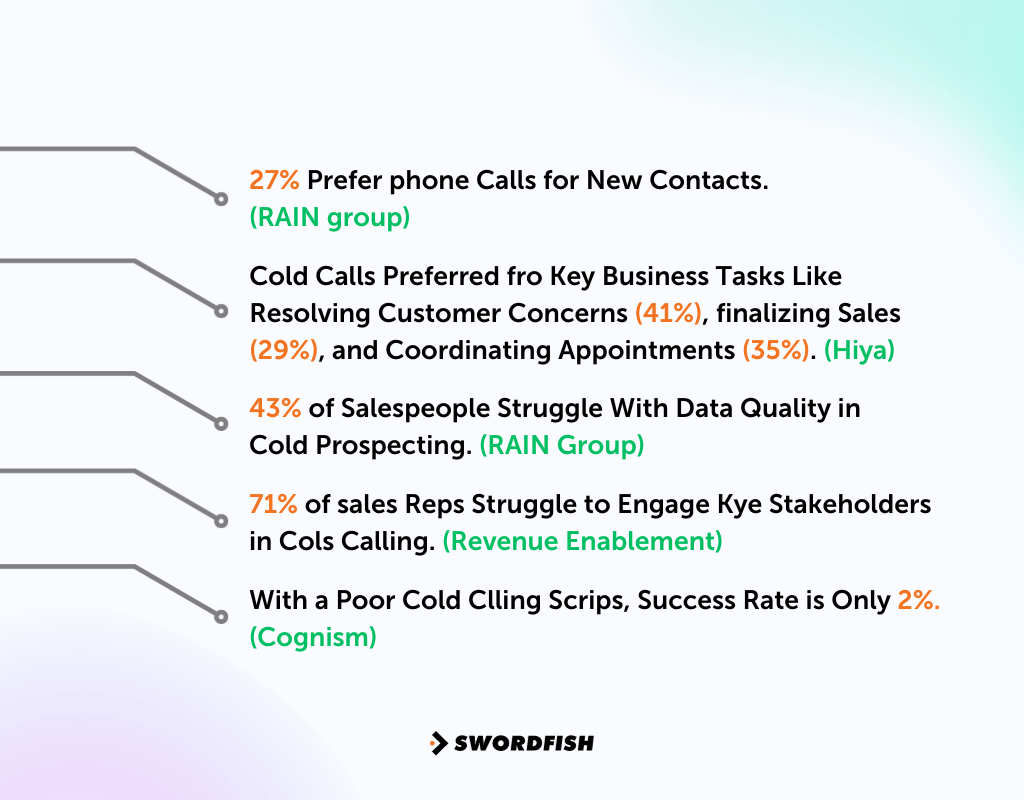
- 27% of sellers say making a phone call to a new contact is more effective than other outreach methods.
- According to Hiya’s research, businesses still favor calls for critical tasks such as resolving customer concerns (41%), finalizing sales (29%), and coordinating appointments (35%).
- Nearly half of salespeople, accounting for 43%, cite obtaining higher quality contact data as their primary challenge in cold prospecting efforts.
- 71% of sales representatives find that the hardest part of cold calling is connecting with and engaging key stakeholders and decision-makers.
- A poorly written script drags results down fast — the average cold calling success rate is often cited around 2%, which is a strong argument for preparation over improvisation.
The Importance of Cold Calling in Real Estate
Cold calling remains a core customer acquisition channel in real estate, and it’s one of the marketing best practices experienced agents still rely on. Agents reach out to homeowners who haven’t necessarily signaled interest in buying or selling, which raises an obvious question: where do those phone numbers come from?
Agents typically source numbers through public records, online listing databases, brokerage marketing tools, or third-party prospecting lists. Similar to email marketing, the return depends heavily on the quality of the contact data and the relevance of the message — a generic pitch to a mismatched list wastes everyone’s time.

Cold calling still moves the needle in this industry. Roughly 28% of cold calls get a response, and a majority of real estate agents continue to rank telemarketing among their top lead sources. It won’t replace referrals or a strong online presence, but it fills a gap those channels can’t: direct, immediate contact with someone who may not be actively searching yet.
Different Types of Real Estate Scripts for Sales Calls
Different call types call for different scripts because the person on the other end is in a different situation. A homeowner trying to sell without an agent has different concerns than someone whose listing just expired, and a past client responds differently than a stranger.
Below are five common script categories, each with an example you can adapt.
Type 1: For Sale By Owner (FSBO) Script
FSBO stands for “For Sale By Owner” — the homeowner is trying to sell without an agent. Convincing them to bring you on takes some finesse, since they may be defensive about commission fees or skeptical that an agent adds enough value to justify the cost.
You: Hey there, this is [Your Name] from [Your Real Estate Company]. I noticed your property at [Address] listed for sale. Are you the legal homeowner?
Prospect: Yes, I am.
You: Fantastic! I hope I’m catching you at a good time to talk about it.
Prospect: Sure, go ahead.
You: Great! I came across your listing and wanted to confirm your asking price for the property.
Prospect: [Provides the price.]
You: I see. Can you tell me how long it’s been on the market?
Prospect: [Shares the duration.]
You: Alright. Before our call, I did some market research on houses in your area. On average, homes here have been selling at about [mention a price] over the past 5 years, and they typically take [mention the number] days to sell. With the right marketing plan, we can speed up your process and help you get the best value for your property. Would you be open to going through a marketing plan I’ve tailored specifically for your house?
This script opens a conversation with FSBO homeowners without immediately attacking their decision to go it alone. Lead with market data, not pressure.
Type 2: Elevator Pitch Script
The elevator pitch is a short, memorable introduction for moments when you only have a few seconds to explain what you do — a networking event, a chance encounter, or the opening seconds of a cold call before someone decides whether to hang up.
Prospect: “So, what do you do?”
You: “I’m a real estate agent with [firm]. You know how the market has become even more difficult for first-time homebuyers?”
Prospect: “Yeah, it’s true.”
You: “So, I work specifically to help first-time home buyers make sure they get the home they want at a fair price, so they can enjoy being homeowners without any regret. If anyone you know is thinking about buying their first home, I’d be happy to chat with them. Does anyone come to mind?”
Prospect: “Actually, my brother and his wife are looking for their first home.”
You: “That’s great! I’d be delighted to assist them in finding their dream home. Thanks for thinking of me!”
This works because it frames you as a solution to a common problem rather than a salesperson looking for business. Referrals often come from exactly this kind of low-pressure exchange.
Type 3: Expired Listings Script
An expired listing means the homeowner tried to sell and it didn’t work. They’re likely frustrated, so your job here is to rebuild confidence, not just pitch yourself as a replacement agent.
You: Hi [contact’s name], I am [your name] from [your company’s name]. I am calling regarding the property on [give the exact address of the property that you are referring to]. Are you the legal property owner?
Prospect: Yes.
You: I see you listed your property for sale about a year ago, but the listing has expired now. Is this a good time to discuss your needs?
Prospect: Yes.
You: Awesome! Are you looking to put it up for sale again?
Prospect: I’m not sure. It didn’t work last time — we got barely any interest from potential buyers.
You: I understand your concern. But let me assure you that your house is a great property in a great location, which is why I am interested in helping try to find the right buyer. What was the highest offer you received last time?
(Prospect gives an answer.)
You: I see. Did the buyers mention any key issues that caused them to not purchase the property?
(Prospect gives an answer.)
You: Alright. I can see major areas of improvement here. According to the recent market research I carried out on your neighborhood, I can assure you that I can get you a much better price for your property.
I actually also sold a house on your street two months back. Do you know of the [mention the property name or address] house? I got the seller a great price of [mention the selling price of the property]. Would you be interested in meeting me and discussing how we can alter our sales approach and help you get the best value out of your property?
Prospect: Yes, definitely!
Note the pivot: acknowledge what didn’t work, then bring specific local proof, not vague reassurance.
Type 4: Referrals Sales Script
Past clients are your cheapest source of new business. This script checks in on a previous transaction and asks for both a review and a referral in the same call.
You: Hi [your client’s name]. This is [your name] from [the name of your company]. I helped you buy your home [mention the address of the property]. I wanted to check in and see how you’re doing.
Prospect: Yes, of course. I am doing great. How are you? How is business?
You: I’m great! I recently sold a house in your neighborhood, which is why I thought of you. How are things going? How’s the house?
Client: (Gives an answer.)
You: That is great. I am so glad. I wanted to get in touch with you and see how things were going. We are expanding our business and believe our past happy clients are our best brand ambassadors. Would you be willing to write a review of our company? Your good words would really help spread our business clientele.
Client: I’d be happy to! You guys really got me the best value for my money.
You: I am so glad to hear that. Just a quick confirmation — should I send over the link to this [email or phone number]?
Client: Yes!
You: Great. I just sent it over. Would you mind if we used your name on our website when mentioning your review?
Client: I don’t mind at all.
You: Awesome! Also, the link has a small section where you can refer any leads that you might know of who are looking to buy or sell a house. Please let me know if you know of anyone looking.
Client: My cousin is actually looking to buy a house. I’ll put her contact information in the form.
You: That’s great, [your client’s name]. It was good talking to you.
Asking for a review and a referral in one call doesn’t feel greedy if you lead with genuine interest in how they’re doing.
Type 5: Online Buyer Lead Script
Online leads are colder than they seem — filling out a form isn’t the same as expecting a phone call. Move quickly, since interest fades fast, and reference the specific form they submitted so the call doesn’t feel random.
You: Hi [contact’s name], this is [name] from [your company’s name] calling about the online form you filled out on our website regarding your interest in buying a house. Do you remember filling out the form?
Prospect: Yes.
You: Great! I hope this is a good time to talk about it.
Prospect: Sure.
You: Awesome! I wanted to make sure you get the information you requested since we did not receive a reply from our response email. I know how overwhelming the inbox can be sometimes! I see you want to buy property in [area]. Any reason why you chose this area in particular?
(Prospect answers.)
You: (Acknowledge the points they mentioned.) This is a great neighborhood choice. I actually sold a house in this area a few weeks ago at [mention a price]. The buyer especially liked this neighborhood because of the [benefit]. Would you want to meet tomorrow and discuss the details in person?
This script demonstrates local expertise fast and shows you follow through — a small thing that matters when a lead is deciding whether you’re worth their time.
Mastering Real Estate Cold Calls: 20 Proven Scripts for Success
These scripts cover a wide range of situations you’ll run into as you build out your prospecting routine. Whether you’re new to real estate cold calling or looking to sharpen an existing approach, use these as templates rather than scripts to memorize word for word.
Script 1: Introducing Your Real Estate Company and Service
“Hi there! I’m [Your Name], and I represent [Your Company]. We specialize in helping buyers and sellers like you connect with their ideal properties. Our focus is on ensuring a smooth and successful experience.
I wanted to reach out to you today to see if you’d be open to exploring potential opportunities in the real estate market. Would you be interested in setting up a meeting to discuss your goals and how we can assist you?”
This establishes who you are and invites a low-pressure conversation about the prospect’s own goals rather than jumping straight to a pitch.
Script 2: Measuring Prospect Interest and Engagement Levels
This script works whether you’re using a real estate script for sellers or buyers — it’s designed to gauge interest quickly without overcommitting either side.
“Hi, I’m [Your Name]. Are you thinking about selling your home? I’ve got some buyers who might be interested.” It’s a friendly way to open the door to a potential opportunity. Remember, it’s all about starting the conversation and seeing where it goes.
Script 3: Establishing a Human Element in Real Estate Interactions
“Hey there! I’m [Your Name], and I’ve been living in this area for over a decade now. It’s such a wonderful place to call home. As an agent who specializes in [mention the area], I’m always on the lookout for great opportunities.
Have you ever considered finding a perfect buyer for your property? I’d love to chat more about it if you’re open to it.”
Leading with a personal, local connection before mentioning business tends to lower a prospect’s guard.
Script 4: Using Recent Sales to Your Advantage
“Hello! I’m [Your Name], calling from [Your Company]. I recently had the pleasure of closing a deal in your neighborhood at [mention address].
The interest in the area has been quite high. Given this, have you ever considered selling your home? With the current market conditions, it might be an excellent time.”
Recent sales data is one of the strongest credibility signals you can offer on a cold call — it’s specific, local, and verifiable.
Script 5: Crafting a Personalized Pitch for Familiar Faces
“Hey [Prospect’s Name], it’s [Your Name]! We had the chance to meet at [Event or Occasion]. How have you been?
I wanted to catch up with you because, as [Mutual Friend’s Name] might have mentioned, I work with [Your Company] in real estate.
I’m reaching out to friends and acquaintances to see if they’ve thought about making any moves in the property market. [Prospect’s Name], have you considered a change, especially considering the current market trends?”
This leans on an existing relationship, however loose, to make the call feel warmer than a true cold call.
Script 6: Following Up on Leads
“Hi, I’m a realtor in your area. I noticed your property listed for sale by the owner. With my experience in this neighborhood, I can help you navigate the selling process effectively. How are you managing the offers coming in?”
This positions you as a resource for someone who might be overwhelmed managing a sale solo.
Script 7: Direct Approaches in Cold Calling
“Hi, this is [Your Name] from [Your Real Estate Agency]. I’m reaching out because we have buyers interested in properties in [Prospect’s Area]. Are you considering selling your home either now or in the near future?”
This one respects the prospect’s time by getting straight to the point. If they’re not interested now, note them for a future follow-up rather than dropping the lead entirely. Timing matters too — research suggests 4 pm to 5 pm tends to produce better response rates than late-evening calls.
Script 8: Engaging Sellers Yet to Close a Property Deal
“Hi, this is [Your Name]. I noticed your property listed for sale privately. Have you had any success so far?”
Engage in a conversation about their experience. Then, segue into:
“Selling a home on your own can be challenging. How long has your property been on the market? What kind of response have you received from potential buyers?”
After gathering some information, offer your assistance:
“I understand how demanding this process can be. I specialize in connecting sellers with the right buyers. Would you be open to discussing how I can help you achieve your selling goals?”
Only use this script if the seller isn’t already represented by another agent — reaching out to someone else’s client can create real problems.
Script 9: Reaching Out to Prospects with Expired Listings
“Hi [Prospect’s Name], it’s [Your Name] from [Real Estate Agency]. I wanted to touch base about the appraisal I conducted on your home in [Month of Appraisal]. There’s been significant activity in your area. Have your thoughts about selling changed?”
This references a past interaction and current market movement to give the prospect a reason to reconsider now.
Script 10: Referrals
“Hello [Previous Client’s Name]! It’s [Your Name] from [Your Real Estate Agency]. I wanted to take a moment to thank you for being a valued client. Your trust in me means a lot.
I’ve recently had the pleasure of helping more families find their perfect homes, and it got me thinking about our journey together. If you know anyone who could benefit from my services, would you be open to connecting us? Your recommendation would mean the world to me.”
This is built for reconnecting with past clients specifically to seek referrals — gratitude first, ask second.
Script 11: If You Don’t Want to Miss Out
“Hi, is this [Prospect’s Name]? I’m [Your Name] from [Real Estate Agency]. I noticed your property was listed about a year ago, but the listing has expired. I wanted to check if you’re open to relisting it. Are you interested in setting up a meeting to discuss this?”
An expired listing is a real pain point for a homeowner. Acknowledging that directly, then offering a path forward, tends to work better than pretending nothing happened.
Script 12: Reconnecting with Dormant Leads
“Hi [Prospect’s Name], it’s [Your Name] from [Your Real Estate Agency]. I know it’s been a while since we last spoke. I just wanted to check in and see if you’d like to move forward with my assessment of your property. Has anything changed for you since we last connected?”
Acknowledging the gap in contact upfront is more honest than pretending the last conversation just happened.
“Hi [Prospect’s Name], this is [Your Name] calling from [Your Real Estate Agency]. It’s been some time since we last talked, and I wanted to touch base. I’ve been keeping an eye on the market, and there have been some interesting developments.
Would you be open to a conversation about your property? I believe there might be some new opportunities worth exploring.”
Mentioning that you’ve been tracking the market gives the prospect a concrete reason to pick the call back up.
Script 13: Strategic Circle Prospecting Techniques
“Hi, this is [Your Name] from [Your Real Estate Agency]. I recently spent some time in your neighborhood, and I must say, it’s a fantastic area.
The community spirit here is palpable. I’ve been helping families find their dream homes in areas just like this. I’m curious, have you ever considered making a move within this neighborhood? If so, I’d love to chat and see how we can make that happen.”
Circle prospecting works best when you have something specific to say about the area — vague flattery doesn’t land the same way.
Script 14: Internet Lead Engagement
“Hi, this is [Your Name] from [Your Real Estate Agency]. I noticed you filled out a form on our website expressing interest in buying a property. I wanted to personally reach out and offer my assistance.
I have a deep understanding of the local market and can help you find the perfect home. Are you available to chat for a few minutes about your preferences and what you’re looking for in a property?”
Speed matters more than polish here — a quick, personal call beats a delayed, perfectly worded one.
Script 15: Neighborhood Involvement
“Hello, this is [Your Name] calling from [Your Real Estate Agency]. I’ve recently been involved in several successful sales in your neighborhood. Being a local resident myself, I truly understand the charm and advantages of living here.
If you’re considering selling your property, I’d love to discuss how I can help you achieve the best possible outcome. Could we set up a meeting to explore your options?”
This taps into local pride, which is often underestimated as a motivator in these conversations.
Script 16: Probate Leads
“Hello, this is [Your Name] calling from [Your Real Estate Agency]. I hope this call finds you well. I recently came across the property at [Address], and I understand it may have come into your possession.
If you’re considering what to do with it, I’d be happy to discuss how we can assist. We have experience in handling inherited properties, and I’d love to explore the best options for you.”
Probate calls require more sensitivity than most other scripts — lead with empathy, not urgency.
Script 17: When You Get the Voicemail Script
“Hi, this is [Your Name] from [Your Real Estate Agency]. I recently listed some homes in your area and wanted to share some exciting opportunities with you. I’ll be trying to reach you again soon, but feel free to call me back at [Your Phone Number]. Looking forward to connecting with you!”
Voicemail is common — Hiya’s research found that businesses and consumers spend close to 98 minutes a month on voicemail calls alone. Keep the message short, curious, and free of pressure so the prospect has a reason to call back rather than delete it.
Script 18: Tailored Carrot Scripts
“Hello, this is [Your Name] from [Your Real Estate Agency]. I hope this call finds you well. I wanted to talk to you about a unique opportunity. Currently, I have motivated buyers who are eager to find their dream home in your area.
However, there are limited listings available. If you’ve ever considered selling your property, this could be the perfect time. Would you be open to exploring this opportunity further?”
This works by pointing to real demand and limited supply in the prospect’s area — just make sure the claim is actually true before you use it.
Objection Handling Scripts: Turning No into Yes
Objection handling scripts are prepared responses agents use to address the concerns that come up mid-call — fee questions, market skepticism, or simple hesitation. Having a calm, ready response for the common ones keeps the conversation moving instead of ending abruptly.
Handling Objection: “How Did You Find My Number?”
You: “That’s a great question! I’ve been doing some research on properties in this area, and I believe I could help you achieve your goals. But I completely understand if you prefer not to disclose that information. Let’s focus on how I can assist you in your real estate journey.”
Handling Objection: “I Already Have a Meeting with Another Agent”
You: “That’s fantastic! It’s always good to explore your options and get multiple perspectives. I’d be more than happy to provide you with a second opinion. If you find that my approach aligns with your goals, we can discuss further steps, including reaching out to the other agent.”
Handling Objection: “I’m Going to Sell It Myself”
You: “That’s an admirable decision! Selling a property independently can be a rewarding experience. If you ever feel you need additional support, or if you’re curious about market trends and pricing strategies, don’t hesitate to reach out. I’d be glad to provide guidance along the way.”
Handling Objection – “I need more time to think about it.”
You: “Of course, I completely understand that this is a big decision. Take all the time you need. In the meantime, is there any specific information or details you’d like to know more about to help you make your decision?”
Respect the prospect’s decision-making pace and offer information rather than pressure — pushing here usually backfires.
Handling Objections – “I’m not interested in selling right now.”
You: “I appreciate your honesty. It’s important to consider your options at the right time. Can I ask, is there a particular reason you’re not looking to sell at the moment? Understanding your situation better can help me provide you with the right information for when the time is right.”
This gives you insight into their timeline, which is useful information for a future follow-up even if this call doesn’t convert.
Mistakes to Avoid in Real Estate Cold Calling Scripts
A handful of avoidable errors show up again and again in real estate prospecting scripts:
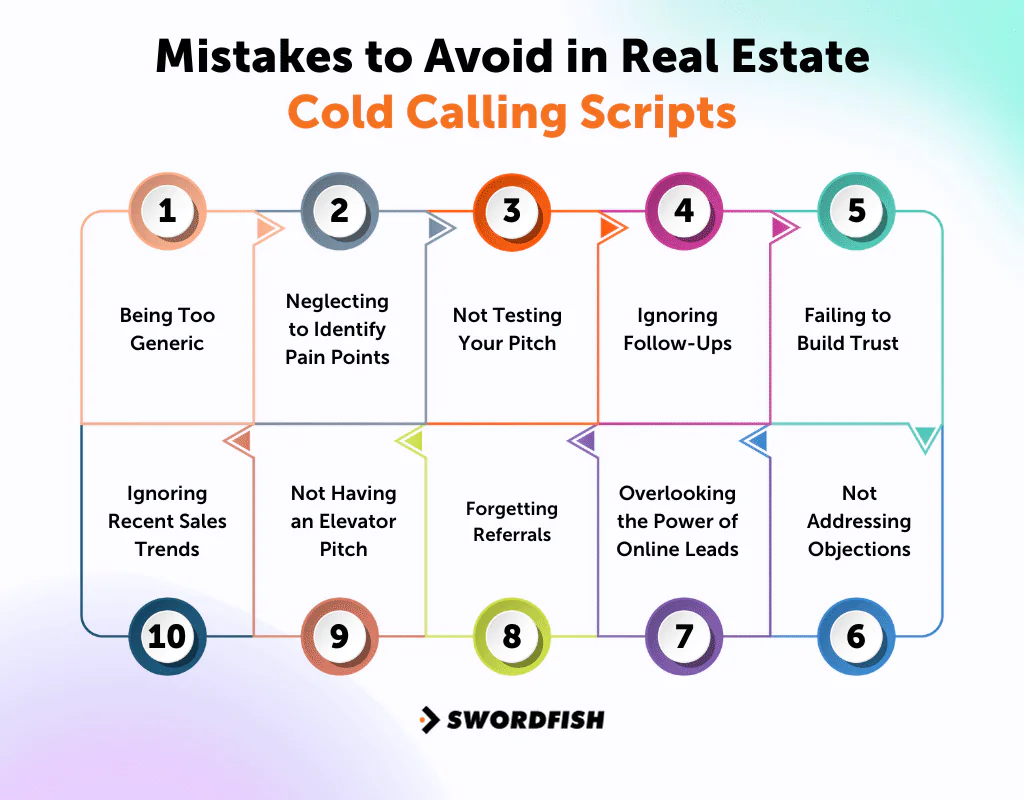
- Being Too Generic: Don’t use a one-size-fits-all approach. Tailor your script to address specific situations like FSBO calls, expired listings, referrals, etc.
- Neglecting to Identify Pain Points: Understand the pain points of your leads. Addressing these concerns can greatly increase your chances of success.
- Not Testing Your Pitch: Practice your script with role play to see how it flows. This helps you refine it over time.
- Ignoring Follow-Ups: Don’t just make one call and forget about it. Consistent follow-ups can turn a “no” into a “yes.”
- Failing to Build Trust: Rushing into a sales pitch without establishing trust can be off-putting. Take the time to connect with your leads.
- Ignoring Recent Sales Trends: Knowing the recent market trends in a neighborhood can be a powerful conversation starter. Use this information wisely.
- Not Having an Elevator Pitch: Be prepared to quickly and effectively explain what you do and how it benefits potential clients.
- Forgetting Referrals: Referrals are a goldmine. Don’t forget to ask your satisfied clients for them.
- Overlooking the Power of Online Leads: Inbound leads from your website or listings can be incredibly valuable. Don’t just rely on email; follow up with a call.
- Not Addressing Objections: Anticipate objections and have responses ready. This shows your leads that you’re prepared and knowledgeable.
Tips for Effective Real Estate Cold Calling Scripts
A few practical habits that make these scripts perform better in real conversations:
- Personalize Your Approach: Tailor your script to the specific situation, whether it’s an FSBO call, an expired listing, or a referral. Personalization shows that you’ve done your homework.
- Identify Pain Points: Understand the concerns and needs of your leads. Addressing their pain points demonstrates that you’re genuinely interested in helping them.
- Practice, Practice, Practice: Role-play with a colleague or record yourself to refine your delivery. Practice builds confidence and ensures you sound natural on the call.
- Build Trust: Start the conversation by establishing trust. Listen actively, ask open-ended questions, and show empathy for their situation.
- Follow Up Consistently: Don’t be discouraged by initial rejections. Follow up regularly to stay top-of-mind. Persistence often pays off.
- Leverage Recent Sales Trends: Use recent market trends in their neighborhood as a conversation starter. This demonstrates your expertise and relevance.
- Craft an Elevator Pitch: Have a concise, engaging introduction ready. It should explain who you are, what you do, and how you can help.
- Ask for Referrals: Satisfied clients can be a fantastic source of referrals. Don’t hesitate to ask if they know anyone looking to buy or sell.
- Nurture Online Leads: For online leads, a quick call can make a big difference. It shows you’re proactive and interested in helping them find the right property.
- Anticipate Objections: Be prepared to handle objections gracefully. Addressing concerns confidently shows your expertise and can turn a hesitant lead into a motivated one.
Conclusion
Cold calling in real estate isn’t just about making calls and offers. It’s about understanding your prospects’ needs, showing empathy, and proving you’re the right realtor for their journey.
Whether you’re re-establishing connections or forging new ones, the approach stays consistent: listen, understand, and position yourself as the trusted expert who can help them get where they’re trying to go.
Good scripts don’t replace judgment — they free you up to focus on the conversation instead of worrying about what to say next.
FAQs
How often should I follow up with leads?
The frequency of follow-ups depends on the prospect’s timeline and level of interest. In general, it’s good practice to follow up every 7-10 days, but adjust based on the prospect’s preferences. If they express a longer timeline, respect it and check in when they indicate they’d be ready.
What should I do if a prospect rejects my offer?
First, acknowledge their decision respectfully. Ask for feedback to understand their concerns. This information can be valuable for refining your approach. If appropriate, leave the door open for future contact by expressing your willingness to assist in the future.
How can I effectively personalize scripts for different prospects?
To personalize scripts, gather information about the prospect before the call. This could include details about their property, their specific needs, and any previous interactions. Tailor your script to address their individual situation and concerns, showing that you’ve taken the time to understand their unique needs.