
 View Products


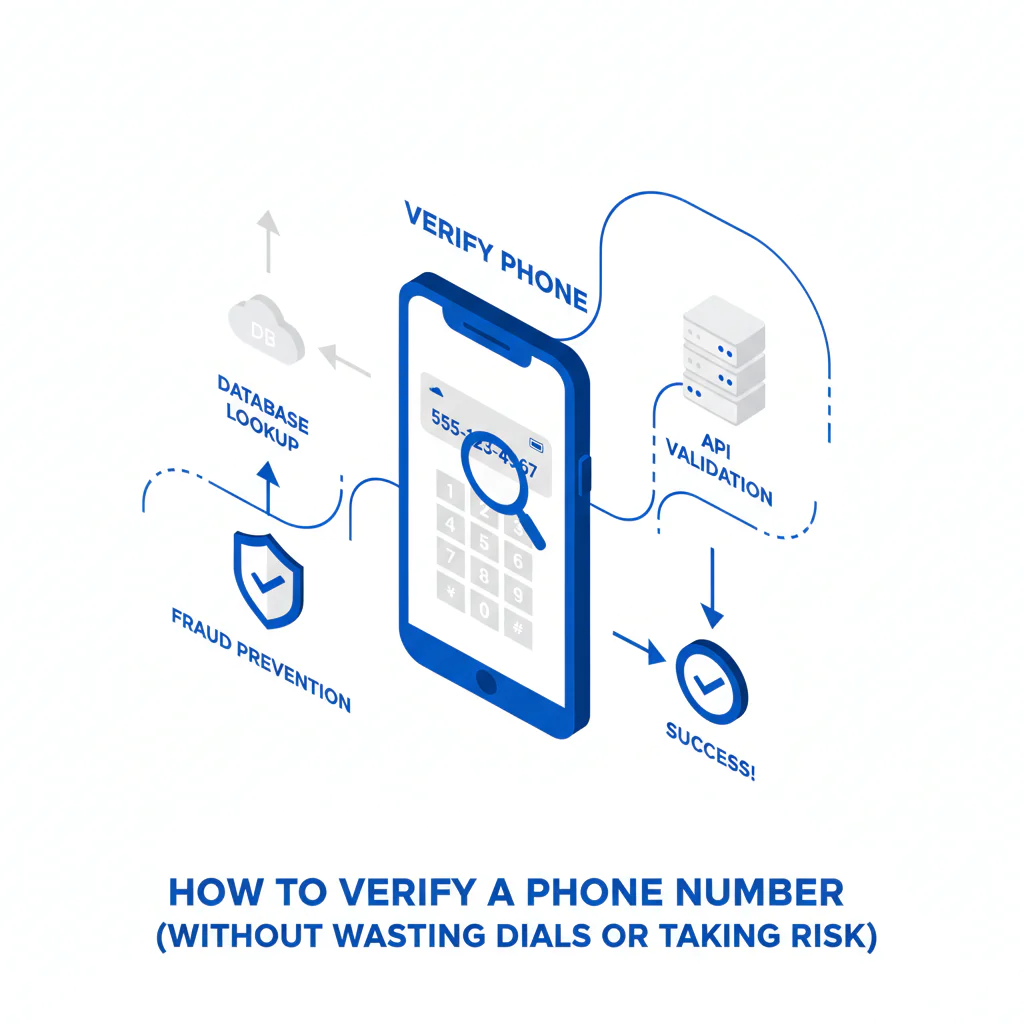
How to Verify a Phone Number (Without Wasting Dials or Taking Risk)
By Ben Argeband, Founder & CEO of Swordfish.AI
Who this is for
RevOps, recruiting ops, and sales ops teams cleaning lists to reduce dead dials and risk.
Quick Answer
- Core Answer
- Verify a phone number by normalizing format, identifying line type, validating carrier assignment, and checking recent reachability signals, then suppress disconnected or reassigned numbers.
- Key Stat
- Verification reduces wasted dials, but format ≠ validity; deeper checks are required to catch disconnected numbers and manage reassigned numbers risk.
- Best For
- RevOps and recruiting ops owners responsible for call list cleanup and outbound governance.
Compliance & Safety
This method is for legitimate business outreach only. Always respect Do Not Call (DNC) registries and opt-out requests.
Framework: The Verification Ladder: Format → Type → Valid → Recent
Most teams treat phone number verification like a single yes/no check. Operationally, it’s a ladder. Each rung answers a different question, and skipping rungs is how you end up with “valid” numbers that still don’t connect.
When someone asks to check if number is real, this ladder is the operational answer: each rung reduces wasted dials and wrong-person calls.
Format asks: “Is this number structured correctly for a country/region?” This catches typos and broken imports, but it does not tell you whether the number exists.
Type asks: “Is this mobile vs landline, or VoIP?” That matters because your channel strategy and compliance posture change by line type.
Valid asks: “Does the carrier/network recognize this number as assigned and callable?” This is where phone number validation starts to reduce wasted dials. Typical outputs are assigned/disconnected status plus line type metadata you can store for routing. If you’re implementing this rung, start with phone number validation.
Recent asks: “Is there a recent signal that it’s still reachable by the intended person?” This is where reassigned numbers risk lives. A number can be valid and still belong to someone else now. This requires manual verification, especially for high-stakes outreach.
Quick Self Audit
If a prospect answers and says “wrong person,” do you have a documented step that stops outreach and suppresses the number across systems?
Step-by-step method
-
Normalize the number into a consistent format (Format rung).
Standardize to E.164 where possible (country code + national number). Split extensions into a separate field. If you can’t normalize, you can’t reliably dedupe or validate.
-
Detect line type: mobile vs landline vs VoIP (Type rung).
Line type drives routing decisions: SMS eligibility, whether to prioritize a direct dial, and whether to treat it as a shared business line. VoIP is not “bad,” but it often behaves differently for connect rates and can be a higher-fraud surface in some workflows.
-
Run carrier/network validation (Valid rung).
This is the core of phone number validation: checking whether the number is assigned and callable. It’s also where you catch disconnected numbers that still look “well-formed.” Disconnected/reassigned numbers are common, so treat this as recurring data hygiene, not a one-time cleanup.
-
Add a “recentness” signal (Recent rung).
Use a Real-time connectivity check or Signal validation where available to reduce the chance you’re calling a number that changed hands. This is a point-in-time network signal, not proof of current ownership. The trade-off is you reduce uncertainty, but you don’t eliminate identity mismatch.
-
Rank and route before outreach.
Don’t treat all “valid” numbers equally. Rank + verify before outreach so reps start with the highest-likelihood options. If your workflow supports it, use ranked mobile numbers by answer probability to prioritize dials when you have multiple candidates per contact.
-
Apply suppression rules and write back to your CRM.
Suppress disconnected numbers, flag potential reassignment risk, and store metadata (line type, last checked date, validation status). If you don’t write it back, you’ll pay the same verification cost again next week.
-
Spot-check a sample (manual verification).
Automated checks reduce waste, but they don’t confirm the person. This requires manual verification for executive outreach, sensitive recruiting, or regulated industries.
Example 1: “Valid” landline that’s a switchboard
If validation says the number is assigned but line type is landline, treat it as a routing option, not a direct dial. Route to a switchboard play (ask for the person, confirm extension), and log it as a shared line in the CRM.
Example 2: Valid number, no recent signal, high-stakes contact
If the number validates but you have no recent reachability signal and the contact is high-value, pause automation. This requires manual verification to reduce reassigned numbers risk. The trade-off is slower outreach versus fewer wrong-person calls.
Example 3: VoIP detected in a sequence that assumes mobile
If line type comes back as VoIP, don’t assume SMS will behave like mobile. Route based on policy: voice-first, email-first, or manual verification. Store VoIP as the line type so reps don’t keep retrying the wrong channel.
Checklist: Weighted Checklist
- Highest impact: Validate beyond format (Valid rung). Format ≠ validity; deeper checks prevent “pretty” numbers that still fail to connect. The trade-off is added cost and processing time versus fewer wasted dials.
- High impact: Detect and route by line type (mobile vs landline vs VoIP). Correct channel selection reduces wasted attempts and improves routing. The trade-off is occasional misclassification and the need to store metadata.
- High impact: Suppress disconnected numbers. Disconnected numbers are common and drive dead dials. The trade-off is you may suppress a number that was recently reactivated; re-check on a cadence.
- High impact: Manage reassignment risk with “Recent” signals. Reassigned numbers create both performance and compliance exposure. The trade-off is that “recent” signals still aren’t identity proof; escalate to manual verification for high-risk segments.
- Medium impact: Rank + verify before outreach. Prioritizing the best candidate number first improves rep efficiency. The trade-off is you need a consistent scoring/ranking rule and rep training.
- Medium impact: Write-back + timestamp every check. Data hygiene depends on knowing what was checked and when. The trade-off is CRM field governance and avoiding field sprawl.
Decision Tree: Conditional Decision Tree
- If the number cannot be normalized to a valid country format, then mark as “Bad format” and send to enrichment/cleanup. Stop condition: do not dial.
- If the number is a landline and your motion requires SMS, then route to voice-only or request an alternate mobile. Stop condition: do not send SMS.
- If the number is VoIP and your policy restricts VoIP for certain sequences, then route to an alternate channel or require manual verification. Stop condition: do not auto-enroll in the sequence.
- If carrier validation indicates disconnected/invalid, then suppress and trigger enrichment. Stop condition: do not dial.
- If validation is “valid” but there is no recent signal and the contact is high-value/high-risk, then require manual verification. Stop condition: no outreach until verified.
- If multiple numbers exist and at least one passes validation, then dial in ranked order (prefer mobile direct dials first). The trade-off is you may miss a reachable secondary number if you don’t cycle after no-answer.
Troubleshooting Table: Diagnostic Table
| Symptom | Likely root cause | Fix |
|---|---|---|
| High dead-dial rate even though numbers “look right” | Only format checks were performed; no carrier validation | Implement phone number validation (carrier/network) and suppress disconnected numbers; re-check on a cadence |
| Reps complain “valid” numbers still don’t reach the person | Number reassignment; identity mismatch | Add a Recent rung (Signal validation) and require manual verification for high-stakes contacts |
| SMS deliverability is inconsistent | Line type mismatch (landline/VoIP treated as mobile) | Detect mobile vs landline vs VoIP; route by channel policy and store line type in CRM |
| Duplicate contacts with different phone fields | Inconsistent formatting and lack of normalization | Normalize to E.164, split extensions, dedupe on normalized value, and enforce input rules |
| Compliance team flags outreach to wrong recipients | Reassigned numbers not managed; no “last verified” timestamp | Track last-checked date, add reassignment risk handling, and escalate to manual verification when needed |
| Connect rate is acceptable but complaints are rising | Opt-out handling gaps or reassigned numbers not being suppressed after “wrong person” feedback | Document and enforce suppression rules, honor opt-outs immediately, and require manual verification for high-risk segments |
Diagnostic: Why this fails
Most failures come from treating verification as a one-time enrichment step instead of ongoing data hygiene. Lists decay. People change jobs, carriers recycle numbers, and imports introduce formatting errors.
Second, teams confuse “valid” with “reachable.” A carrier can recognize a number as active while it’s no longer owned by your intended contact. That’s reassignment risk, and it’s why “Recent” matters.
Third, workflows break when verification results don’t get written back into the system of record. If reps can’t see line type, last verified date, and suppression status, they’ll dial anyway and waste time on dead dials.
How to improve results
1) Verify in batches, not one-by-one. If you’re cleaning a list, do it like an ops project. For enterprise workflows, batch processing via file upload is the fastest path. Swordfish supports this with the File Upload tool so you can verify 1,000 numbers in minutes rather than one by one. The trade-off is you need clear governance on what fields get overwritten versus appended.
2) Put verification on a cadence. Re-check before launching a new call campaign, and re-check lists that show spikes in dead dials or wrong-person answers. Disconnected/reassigned numbers are common, so treat verification as ongoing data hygiene.
3) Write back the fields that make the next action obvious. Store: normalized_e164, line_type (mobile vs landline vs VoIP), validation_status, last_verified_at, and suppression_reason. If you don’t store it, reps will re-learn it the hard way.
4) Route by line type and intent. Mobile vs landline vs VoIP should change what you do next (call, SMS, or alternate channel). This reduces wasted attempts and improves rep throughput.
5) Treat call list cleanup as recurring phone number hygiene. Doing it on a cadence reduces wasted dials and keeps sequences from burning rep time on disconnected numbers.
If you want how we handle verification signals, see how we verify mobile numbers.
Legal and ethical use
Use verification to reduce mistakes, not to justify aggressive outreach.
- Consent and opt-out: Honor opt-outs immediately and suppress the number across systems.
- DNC and local rules: Respect DNC registries and jurisdiction-specific requirements. Different rules and risk apply to voice vs SMS and B2B vs B2C; align sequences to counsel-approved policy.
- Reassigned numbers: If someone indicates you reached the wrong person, stop outreach and treat it as a reassignment signal until you re-verify. This requires manual verification for sensitive segments.
- Not for sensitive decisions: Don’t use phone verification to make decisions about eligibility, credit, housing, or employment outcomes. Keep it scoped to contactability and routing.
- Auditability: Document opt-outs and suppression actions so you can prove process, not intent.
Evidence and trust notes
- Country and carrier differences: Some carriers expose better portability and assignment signals than others, so confidence varies by region.
- Time since last check: A number can be valid today and reassigned later. The longer you wait, the less you should trust the result.
- Portability: Numbers can move carriers and sometimes change line-type classification; re-check before major campaigns.
- Line type ambiguity: Mobile vs VoIP classification can be noisy, especially with number portability. Treat line type as a routing hint, not absolute truth.
- Identity vs reachability: Network validation can indicate reachability, not that the intended person answers. That’s why the Recent rung and manual verification exist.
- List source quality: Some sources decay faster. Tighten verification requirements for higher-risk sources to protect data hygiene.
Sources
- GDPR (official portal)
- FTC Telemarketing Sales Rule (TSR)
- FCC guidance on telemarketing and robocalls (TCPA-related)
- National Do Not Call Registry
Limitations and edge cases
- “Valid” doesn’t mean “belongs to your contact.” Reassigned numbers are the core edge case. The trade-off is you can reduce risk with recent signals, but you can’t eliminate it without manual verification.
- Shared numbers and switchboards: A landline may be a company main line that’s reachable but not a direct dial. Treat it as a routing option, not a personal identifier.
- VoIP and forwarded numbers: Some VoIP numbers are legitimate; others are disposable. Use policy-based routing and don’t assume intent from line type alone.
- International context: Normalization errors create false negatives. Validate country context before suppressing.
- Stale CRM fields: If reps overwrite fields manually, your verification metadata becomes unreliable. Lock fields or enforce governance.
FAQs
What’s the difference between phone number verification and phone number validation?
Phone number verification is the overall process (format, type, valid, recent). Phone number validation is the “is it assigned/callable?” rung. You need both to reduce wasted dials.
How do I check if a number is real without calling it?
Use the ladder: normalize format, detect line type, run carrier validation, then add a recent reachability signal. This requires manual verification if the outreach is high-risk or the identity must be confirmed.
Why do I still get wrong-person answers on numbers marked valid?
Because valid can mean “active,” not “owned by the same person.” That’s reassignment risk. Add a Recent rung and tighten suppression/escalation rules for high-value contacts.
How often should we re-verify numbers?
Re-verify before launching new campaigns and on a schedule for active sequences. Disconnected/reassigned numbers are common, so treat verification as ongoing data hygiene.
Does line type (mobile vs landline vs VoIP) really matter?
Yes, because it changes routing and channel eligibility. It also affects how you interpret outcomes (for example, a switchboard “no answer” is different from a mobile “no answer”).
Where should I start if my CRM is already messy?
Start with batch cleanup and write-back: normalize, validate, suppress disconnected numbers, and store last-verified + line type. For related workflows, see cell phone number lookup and data quality.
Next steps
Day 1
- Define your Verification Ladder fields in CRM: normalized number, line type (mobile vs landline vs VoIP), validation status, last verified date, suppression reason.
- Align on suppression rules for disconnected numbers and reassigned numbers risk.
- Standardize what “valid” means in your org using phone number validation.
Day 3
- Run a batch verification on one active list and write results back. If you need scale, use File Upload.
- Train reps on routing: mobile vs landline vs VoIP, and when to stop for manual verification.
- Align expectations on signal checks with how we verify mobile numbers.
Day 7
- Operationalize cadence: re-verify before campaigns and on a schedule for active sequences; treat it as data hygiene.
- Standardize intake: new lists must pass format + type + valid checks before reps can dial.
- Audit list sources and fix upstream quality issues using data quality.
About the Author
Ben Argeband is the Founder and CEO of Swordfish.ai and Heartbeat.ai. With deep expertise in data and SaaS, he has built two successful platforms trusted by over 50,000 sales and recruitment professionals. Ben’s mission is to help teams find direct contact information for hard-to-reach professionals and decision-makers, providing the shortest route to their next win. Connect with Ben on LinkedIn.