
 View Products


Last updated: September 3, 2026
By Ben Argeband, Founder & CEO of Swordfish.AI
Who this is for
This guide is for reps and ops teams who need to decide how to treat a number before they build a call list. If you run outbound, route inbound calls, or clean CRM data, you need a reliable way to answer one question: is this a cell phone or a landline, and what should you do when the honest answer is “probably”?
Quick Answer
- Core Answer
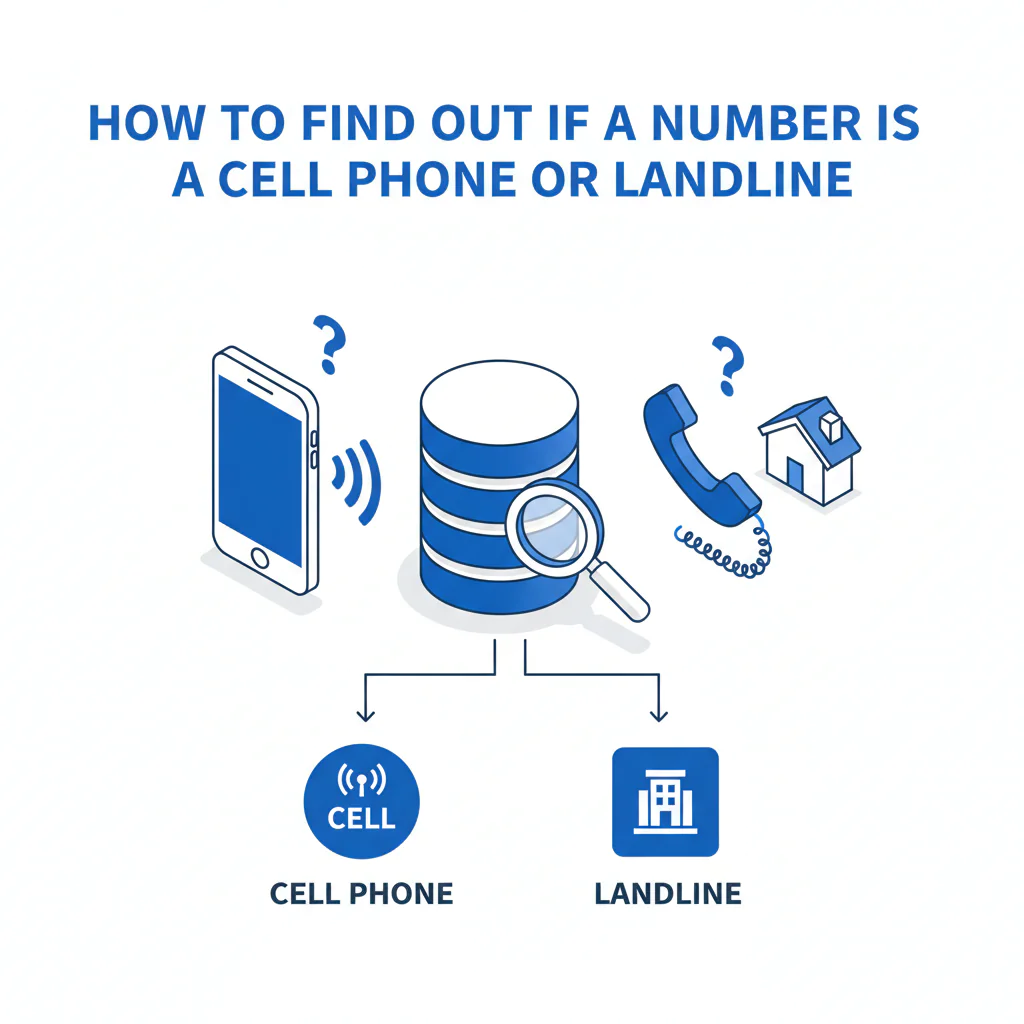
- To tell if a number is a cell phone or landline, run a line type lookup (wireless vs wireline) and confirm with phone number validation for reachability and recency. Treat the result as a signal, not a fact, because VoIP and number porting can change how a number actually behaves.
- Key Insight
- Mobile vs landline changes your connect strategy, but type checks are signals. VoIP and porting complicate certainty unless you add validation and recency checks on top.
- Best For
- SDR managers, RevOps, and recruiting ops building call strategy and routing rules.
Compliance & Safety
This method is for legitimate business outreach only. Always respect Do Not Call (DNC) registries and opt-out requests.
Framework: The “Type First” Rule
If you don’t know the line type, you can’t choose the right call strategy. Mobile vs landline changes connect strategy, compliance risk, and what “good data” actually means inside your CRM.
The “Type First” rule is simple: determine line type before you build sequences, dialer rules, or routing. Then treat that result as a confidence signal rather than a settled fact. The trade-off is a bit more work up front, but it pays off in fewer wasted dials and fewer workflow mistakes downstream.
Operationally, you run a line type lookup, follow it with phone number validation for reachability and recency, and then spot-check edge cases like VoIP vs landline and number porting. High-value accounts and any list you plan to dial at scale deserve manual verification on top of the automated checks.
Common Mistake
Are you treating a line type label as “truth” and building your entire call strategy around it without a second signal?
Step-by-step method
-
Run a line type lookup (mobile vs landline)
Use a line type lookup to classify the number as mobile (wireless), landline (wireline), or VoIP. This becomes your first routing signal for call strategy and channel choice.
Running line type lookup up front cuts wasted attempts, because you stop treating every number as if it supports the same dialer mode and follow-up path.
-
Confirm with phone number validation (reachability + recency)
A line type label without validation is exactly how teams end up with “mobile” numbers that don’t ring, or “landlines” that turn out to be wireless after porting. Use phone number validation to confirm the number is reachable and add a recency-oriented confidence layer.
-
Use carrier lookup details to catch VoIP and porting signals
Carrier lookup typically returns the carrier plus a line type label, and depending on the source, it may include portability or VoIP indicators. If a number has been ported, the original assignment implied by area code and exchange is far less useful, so downgrade your confidence and adjust call strategy accordingly.
-
Decide how you’ll treat VoIP and “unknown” in your workflow
Most teams stumble here. They force every number into a clean mobile-vs-landline bucket and pretend the model is perfect. Instead, define explicit rules: VoIP might mean “call OK, no SMS,” or “manual review for Tier 1 accounts.” The trade-off is slightly slower list prep in exchange for fewer compliance and deliverability problems.
-
When signals conflict, use a simple action rule
Example 1: Line type = mobile, validation = reachable, carrier shows porting. Action: treat as mobile for call strategy, but flag for manual verification on Tier 1 accounts.
Example 2: Line type = landline, validation = reachable, but behavior suggests VoIP (inconsistent routing or voicemail). Action: move to the VoIP/unknown segment and avoid SMS assumptions.
Example 3: Any line type, validation = unreachable. Action: suppress from dialing and re-source; don’t burn rep time on dead numbers.
If validation says unreachable, suppress regardless of line type. If validation is reachable but line type is VoIP or unknown, route to manual review for Tier 1 accounts. If carrier lookup shows porting, downgrade confidence and avoid automation assumptions.
-
Don’t use area code as a shortcut
Area code patterns aren’t a reliable way to tell if a number is mobile or landline. Number porting breaks the assumption that an area code implies a fixed line type, and the FCC’s own porting rules exist specifically to preserve numbers across carrier and technology changes.
-
Split your list in bulk before you dial
If you’re working from a CSV, classify once and split the list into segments: mobile, landline, and VoIP/unknown. Splitting by line type first means dialer rules match the number, so reps aren’t improvising mid-call. Swordfish bulk upload supports this. Use File Upload to take a CSV and enrich it with “Line Type” status in bulk.
-
Spot-check high-value records with manual verification
For executives, strategic accounts, or any list you’ll dial aggressively, spot-check a sample: call once, listen for the voicemail type, and cross-check the company’s public contact page. Automated signals alone can’t fully resolve VoIP and porting ambiguity, which is why manual verification still matters for the records that carry the most risk.
Checklist: Weighted Checklist
- Highest impact: Segment by mobile vs landline before sequencing — Mobile vs landline changes connect strategy; mixing them creates avoidable low-connect blocks and wrong channel choices.
- Highest impact: Add phone number validation + recency — Validation and recency improve confidence; without them, you’ll over-trust stale classifications and waste dials.
- High impact: Treat VoIP/porting as uncertainty, not a category you can ignore — Type checks are signals; VoIP and porting complicate certainty, so your workflow needs an “unknown/needs review” path.
- Medium impact: Use carrier lookup to support routing rules — Carrier lookup helps explain why a number behaves differently than expected and supports better call strategy decisions.
- Medium impact: Bulk-enrich and split lists before dialing — Bulk processing reduces rep-by-rep inconsistency and makes outcomes measurable by segment.
Decision Tree: Conditional Decision Tree
-
If you have a list you plan to dial at scale, then run line type lookup plus phone number validation first.
-
If line type = mobile, then route to your mobile call strategy, and to SMS only if you have consent and policy coverage.
-
If line type = landline, then route to landline call strategy with a business-hours bias, receptionist paths, and no SMS assumptions.
-
If line type = VoIP or unknown, then downgrade confidence and require a second signal from carrier lookup details plus validation.
-
If validation fails or shows the number is unreachable, then suppress from dialing and attempt alternate sourcing.
-
Stop Condition: If the number is unreachable or the contact has opted out or is on a DNC list for your use case, stop outreach and log the suppression reason.
Troubleshooting Table: Diagnostic Table
| Symptom | Likely root cause | Fix |
|---|---|---|
| “Mobile” numbers rarely connect, lots of fast busy / unreachable | Stale data; validation not run; number reassigned | Run phone number validation and prioritize recency; suppress unreachable numbers and re-source for key accounts |
| “Landline” numbers accept texts or behave like wireless | Number porting changed the underlying carrier/line type | Use carrier lookup + validation; treat ported numbers as lower confidence and require manual verification for Tier 1 |
| VoIP numbers misclassified as landline | VoIP vs landline ambiguity in upstream datasets | Route VoIP to a separate workflow; avoid assumptions about SMS and autodialing; add a second signal before outreach |
| Reps argue about “what the number is” and do their own thing | No standard operating definition of line type and no segmentation rules | Implement the “Type First” rule; split lists by line type in bulk; enforce routing in CRM/dialer |
| Connect rates vary wildly by rep even on the same list | Inconsistent list prep; mixed mobile vs landline; no validation | Centralize enrichment; measure outcomes by segment; retrain on call strategy per segment |
Diagnostic: Why this fails
Common mistake: Teams treat a line type lookup as a fact and skip validation, then wonder why connect rates collapse.
The second failure is not operationalizing the result. If your CRM has a “line type” field but your dialer and sequences ignore it, you’re paying for enrichment and still dialing blind.
The third failure is forcing certainty where it doesn’t exist. Type checks are signals; VoIP and porting complicate certainty. That’s exactly why manual verification still matters for the records where the cost of being wrong is high.
How to improve results
Measure outcomes by segment. Track connect rate, conversation rate, and opt-out rate separately for mobile, landline, and VoIP/unknown. This turns “line type” into a controllable lever in your call strategy rather than a static label.
Use two signals, not one. Combine line type lookup with phone number validation. The trade-off is extra processing, but it reduces wasted dials and helps you avoid building workflows on stale classifications.
Use mobile number verification to suppress dead ends before reps spend attempts. Treating mobile number verification as a gating step reduces time spent on unreachable records and keeps sequences cleaner.
Handle uncertainty explicitly. Create a VoIP/unknown path: manual review for top accounts, email-first for ambiguous records, or a lighter call attempt policy. Ambiguity is common with VoIP vs landline and ported numbers, so build the path rather than ignore it.
Use ranked mobile numbers by answer probability when you have multiple options. If a contact has several possible mobiles, prioritize the one most likely to be answered so you’re not burning attempts on low-probability numbers.
Apply outbound calling best practices by segment. Different talk tracks and timing for mobile vs landline tend to produce more consistent connects and fewer wasted attempts.
Re-check before it matters. Run validation on import and again before major campaigns so you’re not dialing stale records.
Make the CRM enforce the workflow. Store line type, validation status, last-checked date, and consent/source so routing and suppression decisions are auditable.
Legal and ethical use
This method is for legitimate business outreach only. Maintain suppression lists, honor opt-outs immediately, and respect DNC requirements for your jurisdiction and use case.
Number porting can be done between wireline, IP, and wireless providers as long as you stay in the same general geographic area, which is part of why a number’s original assignment can no longer be trusted as a reliable type indicator. Outbound calling rules vary by region and by how you dial, whether manual or automated. If you’re calling mobile numbers, be conservative about consent and dialing methods. Get consent before SMS where required by your policy and local rules. Log consent/source and the last-checked date in your CRM so you can explain why a record was contacted.
Do not use line type, carrier lookup, or phone number validation to make sensitive decisions about a person, such as eligibility, housing, or employment. Use it to route communications and reduce operational waste.
Evidence and trust notes
- Line type classification is probabilistic because the phone ecosystem changes and datasets refresh at different times.
- Number porting works across wireline, wireless, and VoIP within the same geography, which can move a number between carriers and sometimes between service types, making older labels wrong.
- VoIP vs landline is not always cleanly separable from a single source, so “VoIP/unknown” needs a defined workflow.
- Validation plus recency improve confidence because they focus on whether the number is reachable now, not what it used to be.
- “Real-time” should be treated as a real-time connectivity check or signal validation, not an assumption that the world’s phone records updated instantly.
- When results vary, check your inputs: country coverage, list age, porting prevalence, and whether your dialer workflow actually uses the line type field.
Sources
Limitations and edge cases
Ported numbers: Area code assumptions fail. A number that “looks mobile” can be a landline now, and vice versa. Treat porting as a confidence downgrade.
VoIP ambiguity: VoIP providers can present numbers that look like traditional assignments. Build a workflow that can hold “unknown” without forcing a bad decision.
International numbers: Line type lookup coverage varies by country. If you sell globally, test by region and don’t assume parity with US data.
Workflow mismatch: If your dialer ignores line type, your enrichment won’t change outcomes. Fix routing before you buy more data.
FAQs
How can I tell if a number is mobile?
Use a line type lookup and confirm with phone number validation. Don’t rely on area code patterns; number porting makes those unreliable.
Is a carrier lookup the same as line type lookup?
They’re related. Carrier lookup tells you the carrier and often includes a line type classification. Line type lookup is the specific output you use to route call strategy.
Why do tools disagree on whether it’s mobile vs landline?
Different data sources, different refresh cycles, and different handling of VoIP and number porting. This requires manual verification for high-stakes records.
Can you tell if it’s mobile or landline from the area code?
No, not reliably. Number porting breaks the link between area code patterns and current line type.
What should I do with VoIP numbers?
Treat VoIP as its own segment. Decide whether you’ll call them, whether you’ll avoid SMS, and when you require a second signal, such as validation plus carrier details, before outreach.
How do I operationalize this in bulk for a call list?
Enrich the list with line type and validation results, then split it into segments before reps dial. Swordfish bulk upload can split lists by line type; start from a CSV using File Upload.
Next steps
Day 1
- Write down your routing rules for mobile vs landline vs VoIP/unknown: what gets called, when, and how.
- Decide what you store in CRM: line type, carrier lookup output, validation status, and last-checked date.
Day 3
- Run a pilot on one list: line type lookup plus phone number validation, then segment and measure outcomes by segment.
- Review mismatches and document the edge cases you see, including porting, VoIP, and stale records.
Day 7
- Move enrichment upstream: bulk process CSVs and standardize segmentation using File Upload.
- Update your internal SOP with supporting references: mobile number lookup, cell phone number lookup, and data quality.
About the Author
Ben Argeband is the Founder and CEO of Swordfish.ai and Heartbeat.ai. With deep expertise in data and SaaS, he has built two successful platforms trusted by over 50,000 sales and recruitment professionals. Ben’s mission is to help teams find direct contact information for hard-to-reach professionals and decision-makers, providing the shortest route to their next win. Connect with Ben on LinkedIn.