
 View Products


By Swordfish.ai RevOps
Who this is for
- SDRs and AEs who want higher connect rate and fewer dead dials.
- Talent Acquisition and recruiting ops who need to reach candidates fast without cycling through stale numbers.
- RevOps / CRM owners accountable for list hygiene, routing, and auditability.
- Collections, support, and appointment teams where the wrong number creates compliance risk and wasted labor.
Quick Answer
- Core Answer
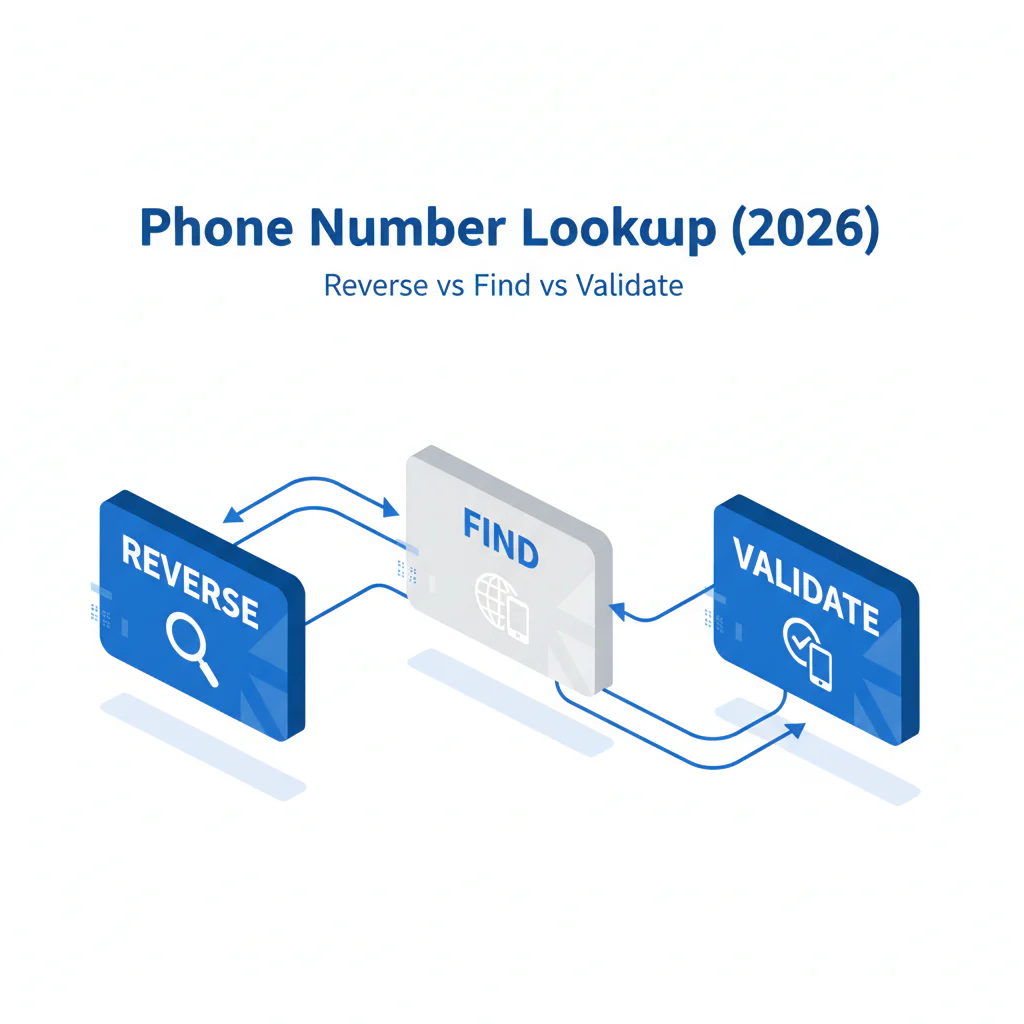
- Phone number lookup means one of three workflows: reverse lookup (number→person), finding a number (person/company→number), or phone number validation (list→dialability, line type, and risk signals). Pick the workflow first, then measure success by connect rate and right-party contact.
- Key Stat
- Key Stat: Accuracy degrades mainly because numbers get reassigned and ported; treat results as time-bound and revalidate before campaigns.
- Best For
- Teams doing legitimate outreach who need to (1) identify an unknown caller, (2) find a reachable business contact, or (3) clean a list to reduce wasted dials and reassigned-number risk.
Compliance & Safety
This method is for legitimate business outreach only. Always respect Do Not Call (DNC) registries and opt-out requests.
Results vary by line type and recency. Use for legitimate interest and honor opt-out/consent requirements.
If your goal is consumer spam-caller identification, your workflow is different. Using consumer spam-ID workflows for outbound ops increases wrong-party calls and wasted dials.
Framework: The Phone Lookup Decision Tree: Reverse vs Find vs Validate
Three examples so you pick the right path fast:
- Sales: You have a lead record with two numbers; you validate and route by mobile vs landline to protect connect rate.
- Recruiting: You have a candidate profile but no direct dial; you find a likely number using identity context, then verify before you call.
- Support/collections: You have an inbound number and need the correct party; you reverse lookup and record confidence levels.
Quick Self Audit
When your team says “data quality is bad,” do you know whether the failure is reassignment, number porting, wrong line type (VoIP vs mobile), or missing validation before dialing?
Step-by-step method
- Define the job to be done. Decide whether you need reverse lookup, find a number, or phone number validation. If you skip this, you’ll optimize the wrong metric.
- Collect minimum inputs. For “find” workflows, identity context should be business-relevant: name, company, and location. Don’t collect extra personal data you won’t operationalize.
- Handle partial identity context (common case).
- If you only have a name: add company and location before you attempt to find a number, otherwise confidence levels will stay low.
- If you only have a company: pick the role/person first (decision-maker or recruiter target), then find a direct line; general switchboards don’t help connect rate.
- If you have a LinkedIn URL: use it as context to reduce ambiguity, then validate before dialing.
- Run line type intelligence first. Your downstream action changes with mobile vs landline vs VoIP. Pair it with carrier lookup so you can troubleshoot exceptions.
- Account for number porting. If a number was ported, carrier attributes can change without the number changing. Store the “checked at” timestamp so you know how stale the attribute might be.
- Assign confidence levels you can enforce. Create simple bands (high/medium/low). Base them on source agreement, identity context, and recency. Low confidence should not be first-touch.
- Write back audit fields to the CRM. Store these fields so teams stop re-solving the same problems.
Minimum CRM writeback fields (operator version)
- Line type: mobile vs landline vs VoIP, for routing and staffing.
- Carrier: for carrier lookup troubleshooting and compliance support workflows.
- Porting-aware timestamp: “checked at” date/time so you can judge freshness when number porting is common.
- Confidence levels: so sequences and dialers can suppress or downgrade risky records.
- Last validation date: so campaigns don’t reuse stale numbers.
- Source: so audits and dispute handling are possible.
How to improve results
Phone number verification should be treated as a pre-dial gate so reps spend time on conversations, not retries and wrong-party contacts.
Validation ladder (what to check, in order)
- Format and plausibility checks: normalize to consistent formatting and weed out obvious garbage.
- Line type intelligence: classify mobile vs landline vs VoIP so routing isn’t guesswork.
- Carrier lookup + porting awareness: store carrier and “checked at” because carrier can change with number porting.
- Signal validation: treat “real-time connectivity check” as a reachability signal, not a guarantee of identity.
- Suppression rules: suppress disconnected/high-risk records and honor opt-outs across systems.
- CRM writeback: store confidence levels and last validation date so campaigns don’t reuse stale numbers.
What this does not do: it does not guarantee current ownership, and it does not override consent requirements. It reduces wasted dials and reduces reassigned-number risk by tightening process.
Routing guidance that usually moves the needle:
- Mobile supports faster right-party contact; treat it as the first attempt when confidence is high.
- Landline is often a slower path; use it with tighter time windows and better context.
- VoIP is frequently a PBX/forwarding environment; handle it differently and track dispositions so you don’t keep dialing loops.
Operator policy example: if a number is VoIP and you don’t have inbound intent, route it to email-first and only dial after you’ve confirmed the right party.
For implementation detail, align your validation steps with how to verify a phone number, then roll the fields into your broader data quality standards.
Validate a List via File Upload
How to evaluate a phone lookup vendor (without buying the wrong thing)
- Workflow fit: can it do reverse lookup, finding a number, and validation, or only one?
- Recency signals: does it provide timestamps and confidence levels you can act on?
- Line type and carrier attributes: can you route by mobile vs landline vs VoIP and support carrier lookup troubleshooting?
- Bulk operations: can you validate lists and write back to CRM reliably?
- Writeback/export: can you push fields into CRM with timestamps and confidence levels?
- Compliance support: does the workflow support opt-out handling and audit trails?
Diagnostic: Why this fails
Variance explainer: outcomes change because phone numbers are not stable identifiers. Recency, region, line type, and identity context drive the spread of results.
- Reassignment: the number now belongs to someone else, which creates wrong-party contacts.
- Number porting: the carrier changes, so carrier lookup can be inconsistent unless you store timestamps.
- Stale sources: public records and scraped profiles lag reality; “old but confident-looking” is common.
- VoIP ambiguity: some VoIP numbers behave like business front desks or routing trees, not direct dials.
- No gating: teams dial before validation, then blame the dataset instead of the process.
Checklist: Weighted Checklist
Use this to prioritize fixes. Weighting is based on standard failure points (reassignment, porting, stale data) and what impacts connect rate and compliance exposure.
- High impact / low effort: Split work into reverse vs find vs phone number validation so teams don’t use the wrong workflow.
- High impact / medium effort: Add validation as a campaign gate to reduce dead dials and reassigned-number risk.
- High impact / medium effort: Route by mobile vs landline vs VoIP and enforce different contact policies per line type.
- Medium impact / low effort: Add confidence levels and suppress low-confidence numbers from first-touch.
- Medium impact / medium effort: Standardize CRM fields: line type, carrier lookup, last checked date, source.
- Medium impact / high effort: Automate revalidation windows based on your cycle length and how quickly your lists decay.
Framework: The Phone Lookup Decision Tree: Reverse vs Find vs Validate
Decision Tree: Conditional Decision Tree
- If you have a number and need the owner, then start with reverse phone lookup, store confidence levels, and treat identity as probabilistic when recency is unknown.
- If you have a person/company and need a reachable line, then use mobile number lookup or cell phone number lookup, then validate before dialing. When you have multiple options, start with ranked mobile numbers by answer probability.
- If you have a list and a deadline, then run phone number validation first and suppress disconnected/high-risk records.
- If carrier lookup changes unexpectedly, then assume number porting and re-check with a fresh timestamp before you rewrite CRM fields.
- Stop Condition: If consent/opt-out status is unknown for a jurisdiction where you require opt-in, stop dialing and switch to an allowed channel until consent is documented.
Troubleshooting Table: Diagnostic Table
| Symptom | Root Cause | Fix |
|---|---|---|
| Match rate looks fine, connect rate is weak | Wrong line-type mix; stale numbers; no routing | Validate before campaigns, route by mobile vs landline vs VoIP, and enforce confidence levels |
| Carrier lookup conflicts between systems | Number porting or different refresh cycles | Store “checked at” timestamps and treat carrier as a changing attribute |
| Reps report “wrong person” | Reassignment | Increase validation gating, suppress risky records, and require more identity context for higher confidence levels |
| Calls ring but never reach a person | VoIP PBX trees or forwarding loops | Flag VoIP, change handling (alternate channel or front-desk script), and track dispositions |
| Regional campaign underperforms | Different consent norms and data recency | Shorten revalidation windows and align dialing rules with local consent requirements |
Legal and ethical use
- Consent and opt-out are non-negotiable. Keep suppression lists, respect DNC registries, and propagate opt-outs across your CRM, dialer, and sequencing tools.
- Not for sensitive decisions. Don’t use lookup/validation data to make employment, housing, credit, or insurance decisions.
- Don’t use this for background checks. This workflow is for outreach routing and contact hygiene, not for evaluating individuals.
- Minimize what you store. Keep only the fields required for outreach operations and auditing.
- Document your basis. For US/Canada you still need DNC + opt-out hygiene; for EU consent contexts, don’t dial without a lawful basis and documentation.
Non-vendor references: FTC privacy and security guidance, FCC telemarketing and robocalls overview, and Twilio’s explanation of line type intelligence.
Evidence and trust notes
Last updated: 2026-01-05
- Known limitation: reassignment and number porting can invalidate prior lookups; store timestamps and revalidate before outreach bursts.
- Confidence levels: use identity context, source agreement, and recency to create bands your routing rules can enforce.
- Match rate vs connect rate: match rate is a data metric; connect rate is an ops metric. Track both so you don’t reward the wrong behavior.
- Audit trail: store source and last checked date for every number you dial at scale.
- Opt-out handling: suppression must be centralized and synced across systems, not parked in rep notes.
- Cost control: if credits change behavior, it changes process; align packaging to ops reality, including unlimited contact credits.
Next steps
- Day 1: Choose your path using Framework: The Phone Lookup Decision Tree: Reverse vs Find vs Validate. If you’re identifying owners, start with reverse phone lookup.
- Day 3: For outbound lists, run phone number validation, then align fields and suppression rules with data quality.
- Day 7: Standardize your verification process across teams using how to verify a phone number and build routing by line type (mobile vs landline vs VoIP) into campaigns.
Run a Phone Lookup with Swordfish
FAQs
What is phone number lookup?
Phone number lookup is a label for three tasks: reverse lookup to identify who a number belongs to, finding a number for a person/company using identity context, or validating a list to reduce dead dials and reassigned-number risk before outreach.
How do I find out who a number belongs to?
Use reverse lookup, then store line type, carrier lookup, and a timestamp in your CRM. Treat identity as probabilistic unless you have strong identity context and recent validation.
How can I tell if a number is mobile or VoIP?
Run line type intelligence. It classifies the number as mobile vs landline vs VoIP. Pair it with carrier lookup and assume carrier attributes can change because of number porting.
What does phone number validation check?
Phone number validation checks whether a number is likely dialable and how it should be handled (mobile vs landline vs VoIP), plus basic risk signals so you can suppress disconnected or high-risk records before campaigns.
Why do lookups fail?
Lookups fail because numbers are reassigned, carriers change via number porting, and source data gets stale. Operationally, they fail when teams dial without validation and don’t store confidence levels or timestamps.
What’s the difference between reverse lookup and validation?
Reverse lookup answers “who is behind this number?” Validation answers “should we dial this number, and how should we handle it?” (dialability signals, line type, timestamps, and confidence levels). Reverse is identity-focused; validation is operations-focused.
About the Author
Ben Argeband is the Founder and CEO of Swordfish.ai and Heartbeat.ai. With deep expertise in data and SaaS, he has built two successful platforms trusted by over 50,000 sales and recruitment professionals. Ben’s mission is to help teams find direct contact information for hard-to-reach professionals and decision-makers, providing the shortest route to their next win. Connect with Ben on LinkedIn.