
 View Products


Last updated: September 3, 2026
ZoomInfo MarketingOS combines a large B2B contact database with intent signals and campaign tools, aimed at helping demand generation and account-based marketing (ABM) teams find accounts that are actively in-market and reach the right people inside them.
The platform ties together account data, ad targeting, website visitor identification, and workflow automation so marketing and sales teams can work from the same signals instead of separate spreadsheets and tools.
This guide walks through what MarketingOS does, how its main components work, what it costs, how it stacks up against alternatives like Swordfish AI, Demandbase, and 6sense, and what to watch for if you’re evaluating it for a healthcare or other regulated B2B use case.
What is ZoomInfo MarketingOS?
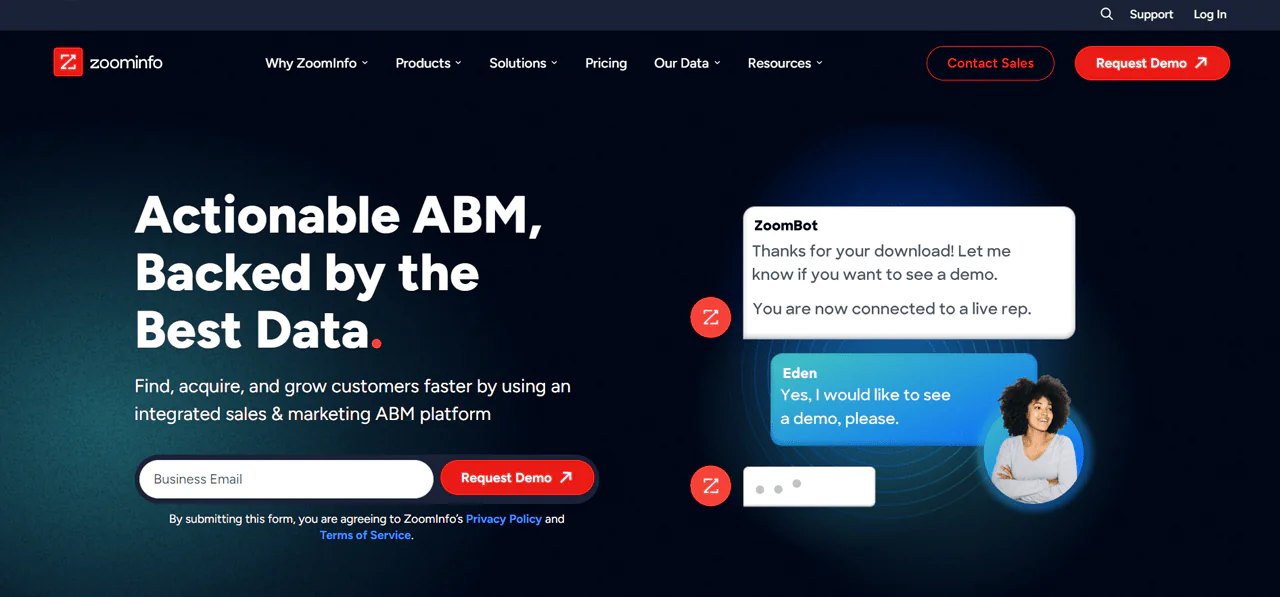
ZoomInfo MarketingOS is an integrated sales and marketing ABM platform built to help businesses identify in-market accounts and convert them through data-driven targeting and personalized engagement. It sits inside ZoomInfo’s broader go-to-market suite and is designed to address a common ABM problem: teams often waste budget targeting the wrong accounts because their data is stale or their sales and marketing systems aren’t aligned.
The platform draws on ZoomInfo’s contact and company database, layering in real-time intent signals, technographic data, and website visitor identification so teams can prioritize accounts that show actual buying behavior rather than guessing.
MarketingOS is positioned for both growing businesses and larger enterprises refining an existing ABM motion. A core part of its pitch is de-anonymizing website traffic and surfacing likely purchase intent, on top of standard ad targeting across digital channels.
Key Features of ZoomInfo MarketingOS
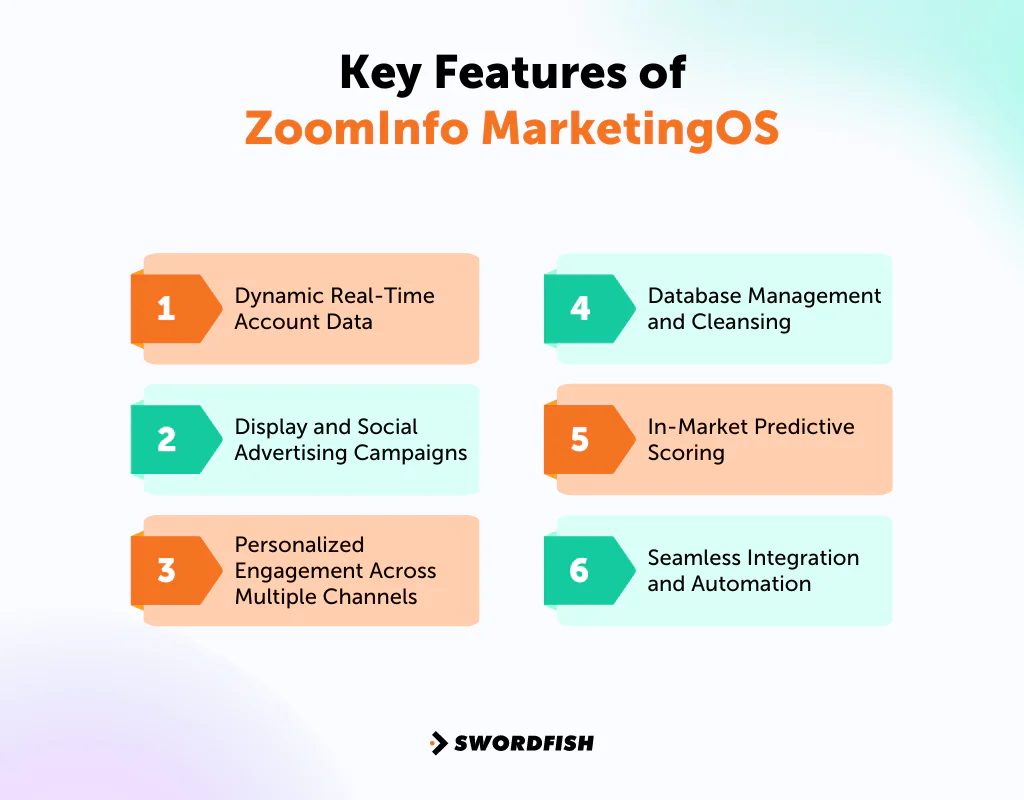
-
Dynamic Real-Time Account Data
Account data refreshes on an ongoing basis, so campaign and outreach decisions are based on current firmographic and contact details rather than a stale snapshot.
-
Display and Social Advertising Campaigns
Ads can be targeted to individuals at companies already showing interest in a given category, which is meant to concentrate ad spend on accounts more likely to engage.
-
Personalized Engagement Across Multiple Channels
Messaging can be tailored across channels, including display and social advertising, email, and SMS, so outreach feels less generic to the recipient.
-
Database Management and Cleansing
Built-in tools help clean and manage contact lists, cutting down on duplicates and outdated records that quietly erode campaign performance.
-
In-Market Predictive Scoring
An in-market predictive score ranks where prospects sit in their buying journey, helping teams decide who to prioritize and when to reach out.
-
Seamless Integration and Automation
MarketingOS connects with common CRM and marketing automation tools and automates routine lead-routing tasks, which is meant to free up time for strategy rather than data entry.
How ZoomInfo MarketingOS Works
ZoomInfo groups MarketingOS’s functionality into four stages: TARGET, EXECUTE, OPTIMIZE, and ALIGN. Here’s what each one covers in practice.
TARGET
The TARGET stage is about surfacing which accounts are actually worth pursuing, using business intelligence and real-time intent data rather than a static list.
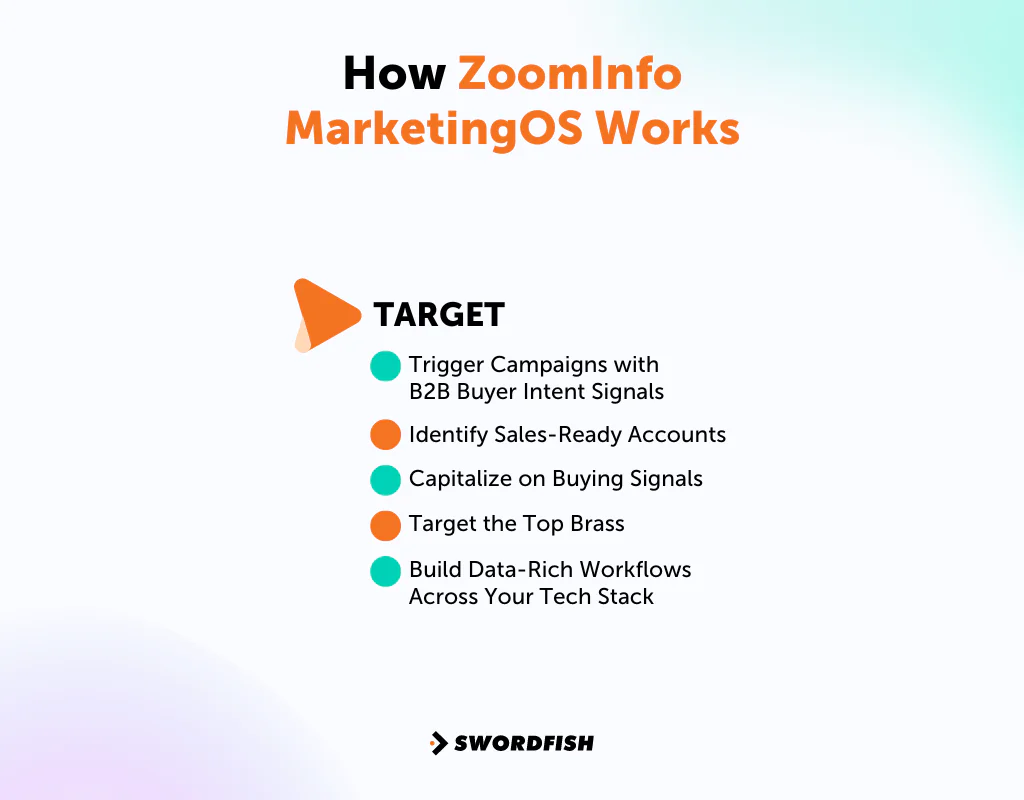
-
Trigger Campaigns with B2B Buyer Intent Signals
MarketingOS pulls from de-anonymized site traffic, industry news, and technographic data to flag when accounts are researching solutions similar to yours, which lets you time targeted advertising campaigns closer to the moment prospects are actually receptive.
-
Identify Sales-Ready Accounts
The platform gives access to a large company and contact database along with thousands of company attributes, which teams use to find and reach key buyers earlier in their research process rather than after they’ve already narrowed their shortlist.
-
Using Buying Signals to Find Sales Opportunities
ZoomInfo compares your ideal customer profile against its database to flag promising accounts, drawing on tracked behavioral data and search activity tied back to the companies behind them. The idea is to surface accounts showing real interest so sales can prioritize outreach instead of cold-calling broadly.
-
Reach Decision Makers to Increase Sales
MarketingOS can identify entire buying committees researching a relevant topic, so outreach through phone, email, or ads can go to the people who actually influence or approve a purchase.
-
Automate Data-Driven Workflows Across Systems
Ready-made integrations push contact and intent data into CRM and marketing tools, so teams can build automated workflows that route qualified leads without manual handoffs.
EXECUTE
Once accounts are identified, EXECUTE is where campaigns actually launch. MarketingOS includes an in-house demand-side platform (DSP) and targeting algorithms built specifically for B2B advertising, aimed at running display and social campaigns consistently across sales and marketing.
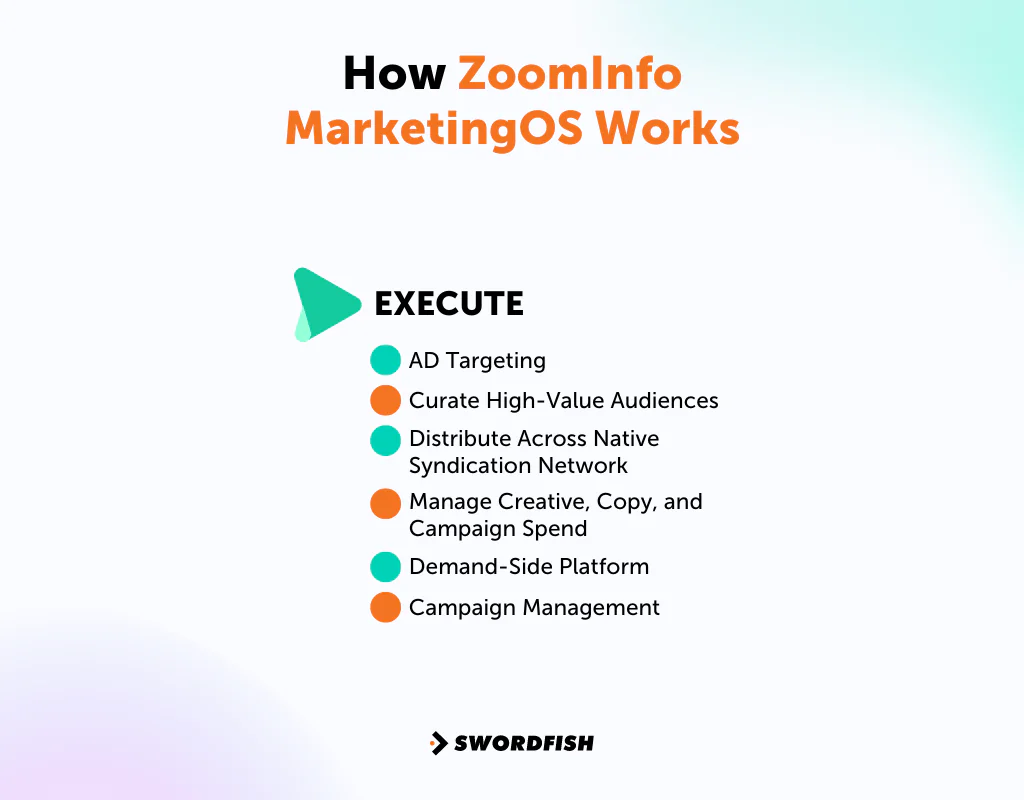
-
AD Targeting
Rather than broad campaigns, ads can be aimed at companies actively researching relevant solutions, filtered further by job title, management level, and department.
-
Curate High-Value Audiences
Audiences can be built from company attributes and buying signals, including intent and technographic data, so campaigns reach the right buyers at a relevant moment rather than a generic list.
-
Distribute Across Native Syndication Network
Campaigns can be pushed across a native syndication network, extending reach to curated audiences across a range of sites and platforms.
-
Manage Creative, Copy, and Campaign Spend
Creative, copy, and budget can all be managed from a single place, making it easier to adjust campaigns without switching tools.
-
Demand-Side Platform
ZoomInfo’s native DSP syncs demand data with ad distribution across major networks, with ongoing optimization intended to reduce manual campaign management.
-
Campaign Management
Targeting, distribution, and campaign mechanics are handled within one platform, which is meant to keep campaigns cohesive rather than scattered across separate tools.
OPTIMIZE
OPTIMIZE focuses on converting site visitors once they arrive. ZoomInfo says it uses IP-to-company mapping across a large set of tracked IP addresses to identify the companies behind anonymous site traffic, and pairs that with tools like meeting scheduling to shorten the path from visit to conversion.
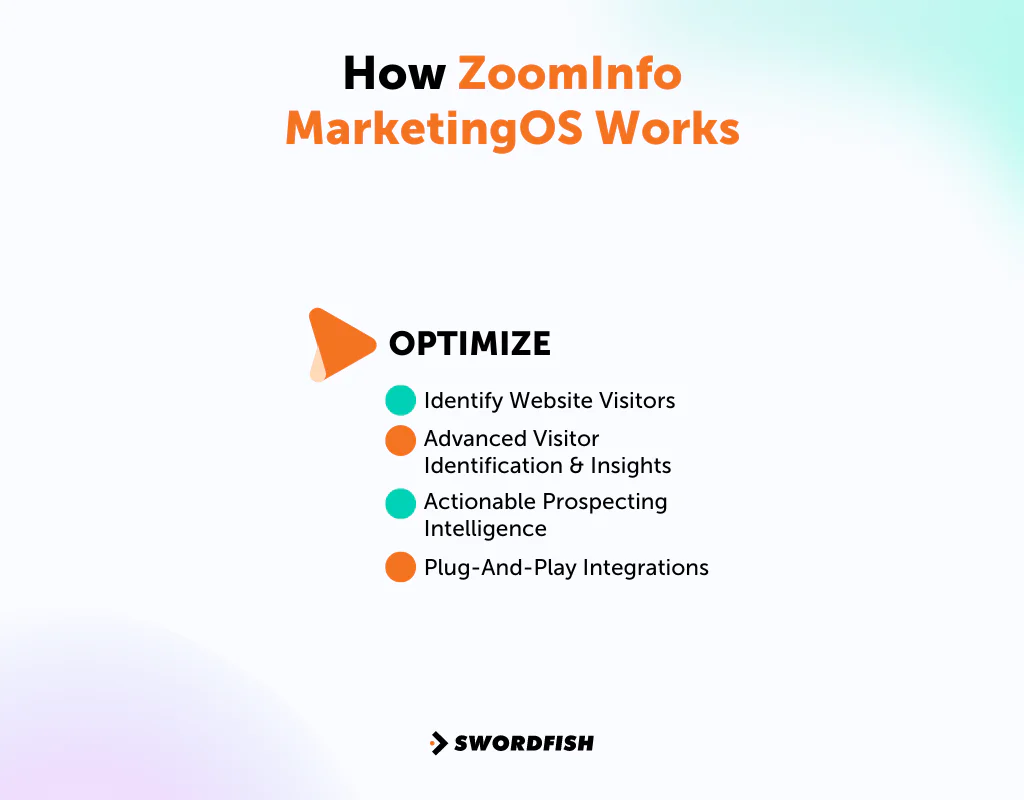
-
Identify Website Visitors
Visitor identification reveals which companies are browsing your site, even when a visitor hasn’t filled out a form, which is useful for catching interest that would otherwise go unnoticed.
-
Advanced Visitor Identification & Insights
Traditional analytics get paired with visitor tracking so you can tell which visiting companies actually match your ideal customer profile, rather than treating every visitor the same.
-
Actionable Prospecting Intelligence
The platform aims to surface likely decision-makers at visiting companies, including names, titles, and contact details, so sales can follow up with context instead of a cold intro.
-
Plug-And-Play Integrations
Visitor data can flow directly into CRM and marketing platforms, extending from contact creation through outreach and ad targeting without manual data entry.
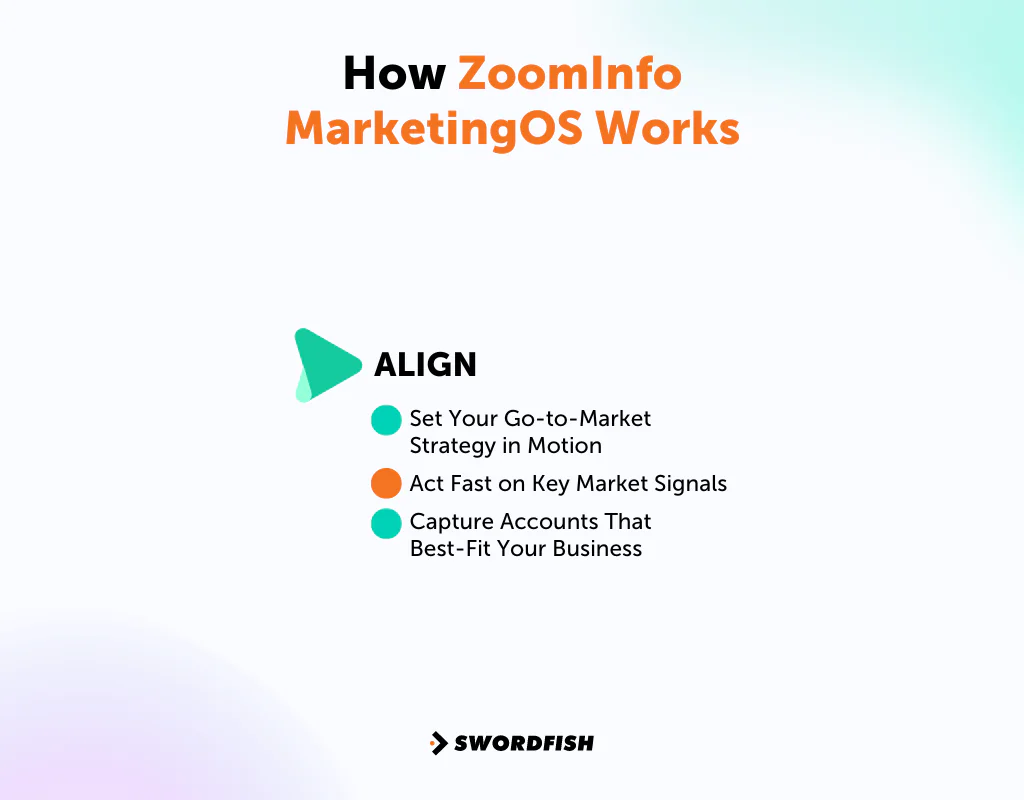
ALIGN
ALIGN is about connecting go-to-market activity across teams so sales and marketing are reacting to the same signals instead of working from separate priorities.
-
Set Your Go-to-Market Strategy in Motion
Workflows can be automated based on buying signals from your target market, aiming for more consistency across campaigns as they scale.
-
Act Fast on Key Market Signals
Signals like funding news, hiring surges, new technology installs, or a competitor’s non-renewal can trigger personalized outreach, which is meant to help teams respond while the signal is still relevant.
-
Capture Accounts That Best Fit Your Business
Buying signals get cross-referenced against firmographics and technographics to flag the accounts most likely to fit your ideal customer profile, concentrating effort where it’s likely to pay off.
Benefits of Using ZoomInfo MarketingOS
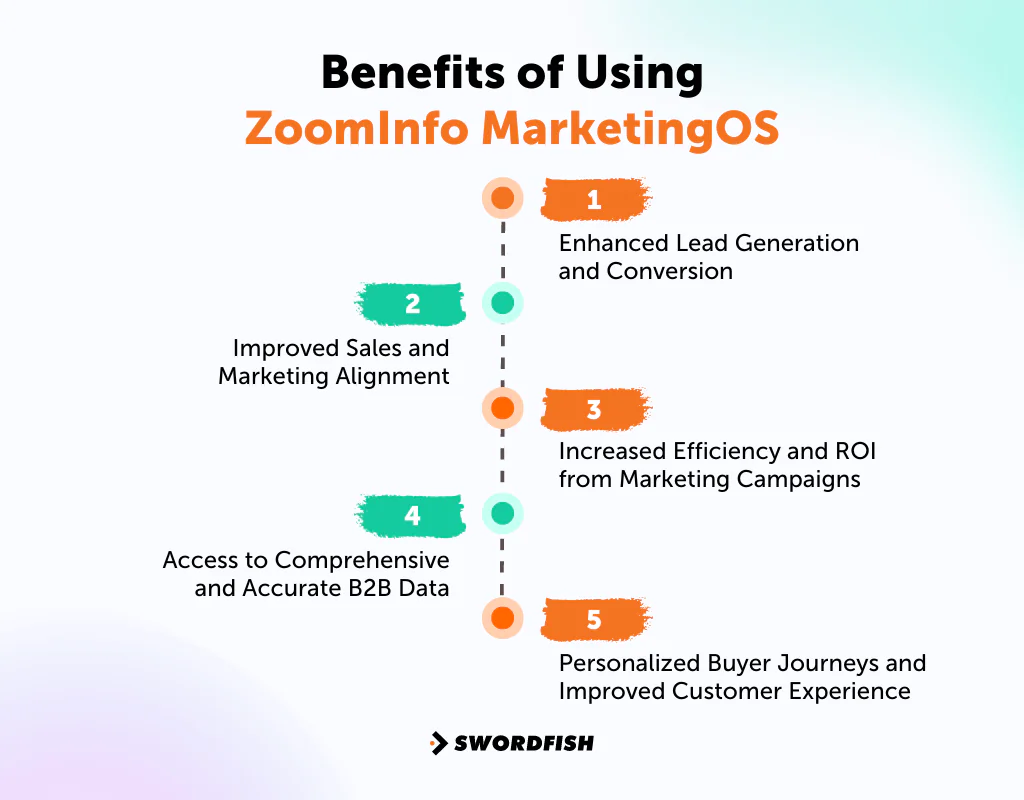
Enhanced Lead Generation and Conversion
By surfacing accounts already showing interest, MarketingOS is meant to shift outreach from cold contact lists toward conversations with people more likely to engage.
Improved Sales and Marketing Alignment
Shared signals and data give sales and marketing a common reference point, so marketing campaigns support sales priorities instead of running independently.
Increased Efficiency and ROI from Marketing Campaigns
Narrower targeting and automated workflows are intended to reduce manual effort and put budget behind accounts with a real chance of converting.
Access to Comprehensive and Accurate B2B Data
A large underlying B2B dataset gives teams a broader base to work from when building segments or evaluating account fit.
Personalized Buyer Journeys and Improved Customer Experience
Channel-specific personalization is meant to make outreach feel more relevant, rather than generic messaging sent to a broad list.
Getting Started With ZoomInfo MaketingOS: 3-Step Guide
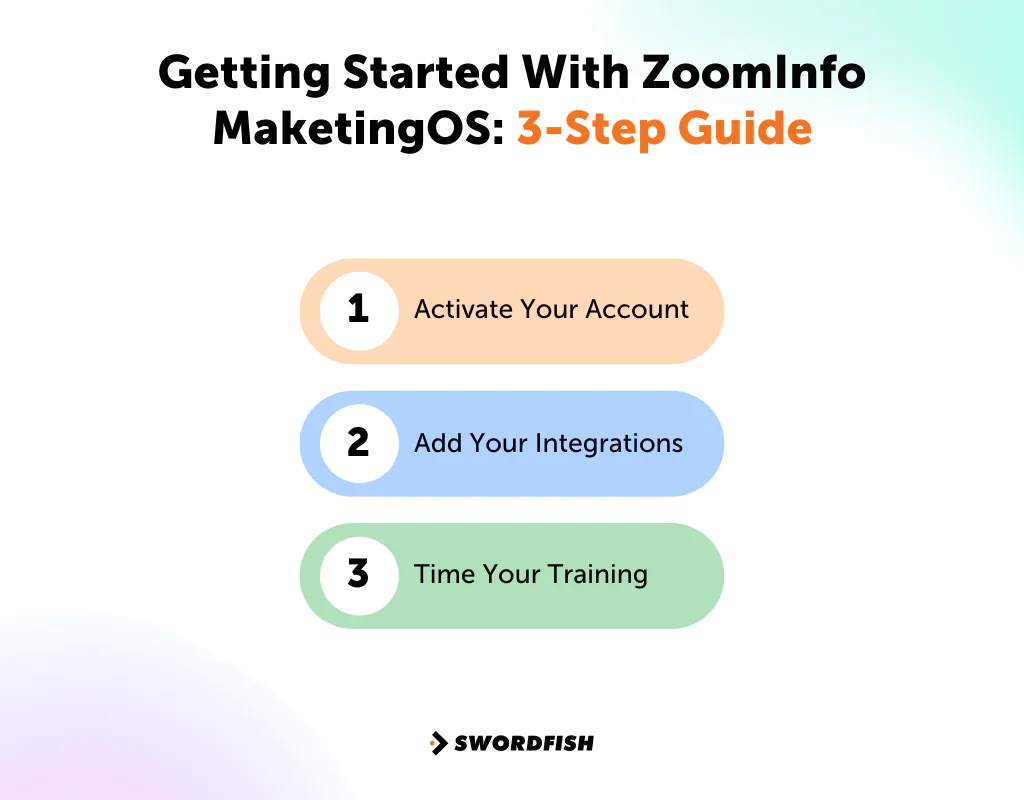
STEP 1: Activate Your Account
Activate your admin account through the automated email ZoomInfo sends after signup. If it doesn’t arrive, check spam or request a reset from the login page, then add your team members so they can start using the platform.
STEP 2: Add Your Integrations
Set up integrations with your existing CRM or marketing tools early, since doing this upfront tends to get more value out of the platform sooner. ZoomInfo’s onboarding team is available through a chatbot for setup issues.
STEP 3: Time Your Training
Get your team through a training session that fits their schedule. This step matters more than it sounds, since MarketingOS has enough surface area that teams who skip training tend to underuse it.
Implementing ZoomInfo MarketingOS: How to Use It
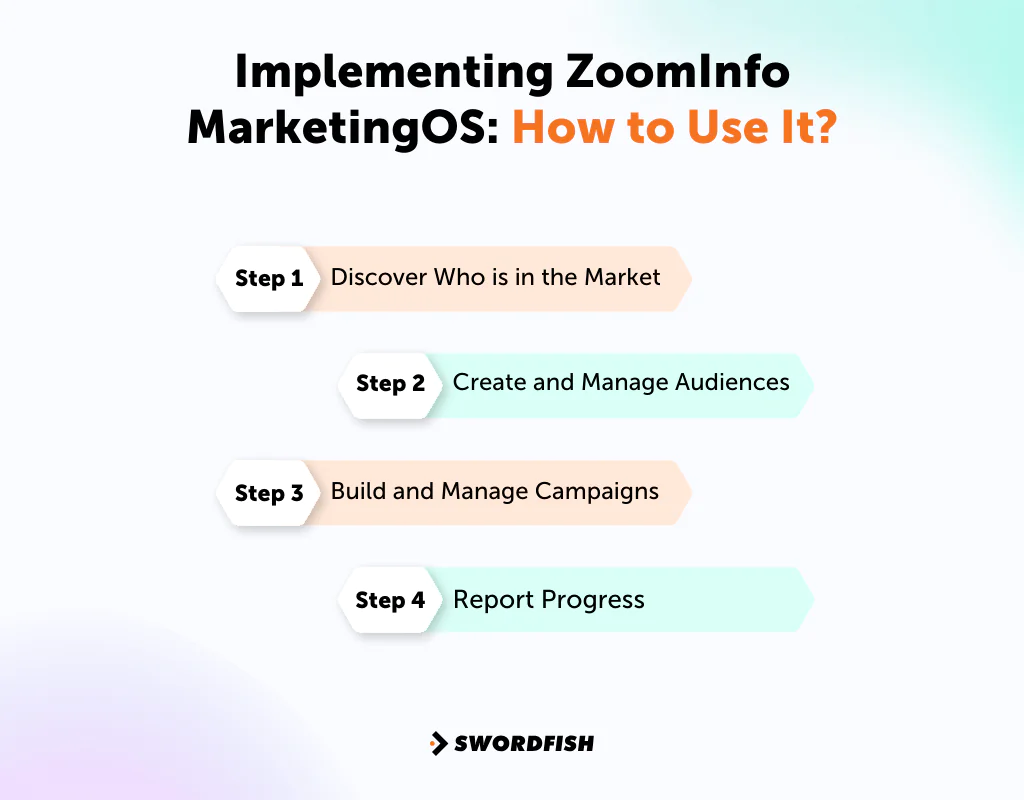
Step 1: Discover Who is in the Market
Objective: Identify and target the right accounts with predictive discovery.
Action: Use the analytics and predictive discovery tools to surface accounts actively researching solutions like yours, and focus initial marketing effort there.
Step 2: Create and Manage Audiences
Objective: Build targeted audiences for digital marketing across various channels.
Action: In the Audiences section, segment discovered accounts by criteria like industry, company size, and buying signals, then keep the segments updated as new data comes in.
Step 3: Build and Manage Campaigns
Objective: Launch and oversee marketing campaigns across digital platforms.
Action: In the Campaigns section, pick your channel, set budget and duration, launch, and monitor performance so you can adjust as results come in.
Step 4: Report Progress
Objective: Evaluate the success of your marketing campaigns.
Action: Use the reporting tools to review campaign performance and audience engagement, then feed those findings back into future campaign planning.
ZoomInfo MarketingOS on Reddit
For ZoomInfo reviews from actual users rather than marketing copy, Reddit is a decent place to check. Here’s what stood out in discussions among Reddit users.
- Practical Experience: Users describe using ZoomInfo to source industry-specific contacts and pair it with other marketing tools for targeted campaigns.
- GDPR Considerations: Some users note that business contact data collected under a legitimate interest basis doesn’t require opt-in consent under GDPR, particularly in the UK context they discuss.
- Legitimate Interest Clause: Discussions reference the GDPR \”legitimate interest\” provision, which can allow contact without explicit opt-in as long as the person hasn’t opted out.
- Concerns on Effectiveness: Other users push back, questioning how effective marketing to non-opted-in contacts really is.
- Legal and Ethical Warnings: A few commenters flag the legal risk of importing personal email addresses without consent, which is worth taking seriously if you operate in a regulated industry like healthcare.
ZoomInfo Marketing OS Pricing
ZoomInfo doesn’t publish MarketingOS pricing on its site. Based on discussions among Reddit users, entry-level ZoomInfo contracts have been reported around $15,000 for three seats on a two-year term, though actual cost depends heavily on a few variables:
- Credit Usage: How many contacts or records you need access to shifts the price, with bulk credit allotments reportedly in the 5,000–10,000 range annually plus additional bundles.
- Features and Capabilities: Add-ons like automation, website chat, or lead enrichment push the price up.
- Number of Licenses: Plans generally scale from around 3 to 10 users, with cost rising accordingly.
Here’s a general sense of what each plan tends to cover:
|
Plan |
Features |
|
Demand |
|
|
Advertising |
|
|
ABM |
|
|
Sales and Marketing Alignment |
|
User Reviews and Feedback
Across review sites, MarketingOS gets consistent credit for an easy-to-use interface, accurate contact and company data, and real-time updates that help teams track market shifts. Sales automation features draw praise for cutting down manual work, and customer support is generally described as responsive.
-
G2: 4.4/5 (88 reviews)
\”What do you like best about ZoomInfo MarketingOS? The best thing about Marketing OS is its simplicity and it’s ease of use, Sales and marketing go hand in hand, and we need to have a solid Marketing platform that can filter leads and also give the right context to the sales rep who needs to do a good job out there and ZoomInfo Marketing does that. It can create multiple segmented lists with various categories into consideration and give a curated segment that can enhance your demand generation.
What do you dislike about ZoomInfo MarketingOS? Using ZoomInfo for the first time can seem like a tough task, it can come across as way too many options and overwhelming at the first go. But, with time and a lot of exploring one can figure out their way around the marketing platform.\”
-
Gartner: 4.3 · 71 reviews
\”What do you like most about the product or service? Insightful, more conversion rate and keeps us informed better. Also, features which include data driven actions are helping our team to focus on result oriented actions swiftly.
What do you dislike most about the product or service? Expensive integrations with different platforms and turnaround time for issues raised.\” – Gartner
-
Capterra: 4.3( 4 reviews)
\”ZoomInfo helps to enrich the data with the most accurate info and this really helps to minimize the number of fields on websiteThe ZoomInfo UI although is fine but can improve to make it more useful as an Iframe on CRM\” – Farhan T
Best ZoomInfo MarketingOS Competitors and Alternatives
Among the top ZoomInfo competitors worth comparing against MarketingOS are Swordfish AI, Demandbase, and 6sense. Each takes a distinct approach to data, intent signals, and account-based marketing, so the right pick depends on what your team actually needs.
1. Swordfish AI
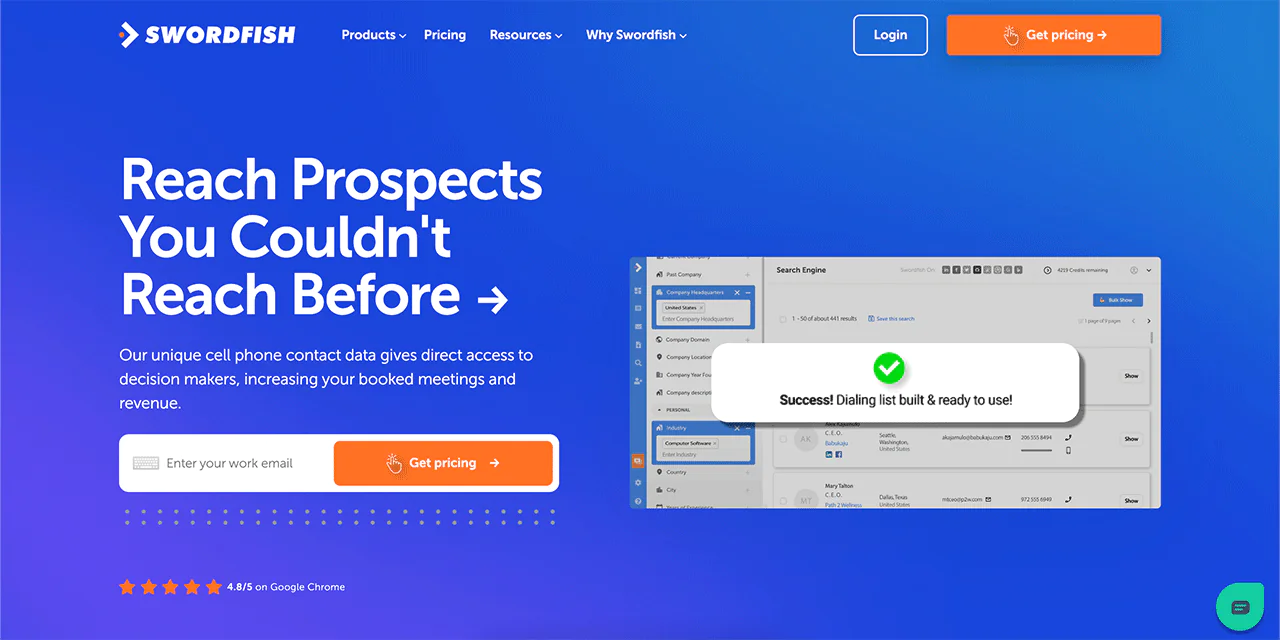
Swordfish is built around getting sales, recruitment, and marketing teams a direct line to decision-makers, with a particular strength in verified cell phone and email data rather than broad account-level intelligence alone.
Its database and matching approach are the differentiator here, positioning Swordfish as a practical option when the priority is reaching a specific person rather than mapping an entire account universe.
ZoomInfo Marketing OS Vs Swordfish AI Comparison Table
|
Features |
Swordfish |
ZoomInfo MarketingOS |
|
Data Volume and Composition |
3.5 billion data points and uses proprietary algorithms to compose data. | Access 260M+ Contact profiles across firmographics, technographics, psychographics, and intent data. |
| Core Offering | Specializes in providing direct cell phone contact and email data. |
Comprehensive B2B data platform offering a wide range of insights. |
|
Unique Selling Point |
Highest accuracy and match rates for cell phone numbers, with real-time line connectivity validation. | Offers a deep database for B2B contacts and company profiles |
| Data Accuracy | 33%+ more cell phone numbers and 45%+ more accurate cell phone numbers than leading providers. |
Known for its reliable and accurate B2B data, constantly updated for freshness and relevance. |
|
Intent Data |
Offers Bombora® Intent Data to discover businesses ready to buy your product. | Provides insights into which accounts are actively researching products or services. |
| Integration Capabilities | Integrates with leading platforms like Drift, Zapier, Hubspot, Salesforce, etc. |
Integration with CRM and marketing automation tools Like Pipedrive, Marketo, CloudTalk, etc. |
|
Target Audience |
Sales, marketing, and recruitment professionals looking for direct access to decision-makers via cell phone data. | Businesses looking to target and get B2B leads |
| Customer Feedback | Highly praised for its cell phone number accuracy and impact on recruitment and sales efficiency. |
Trusted by a wide range of industries for its depth of data and ability to drive targeted marketing campaigns. |
 Try Swordfish Ai
Pricing
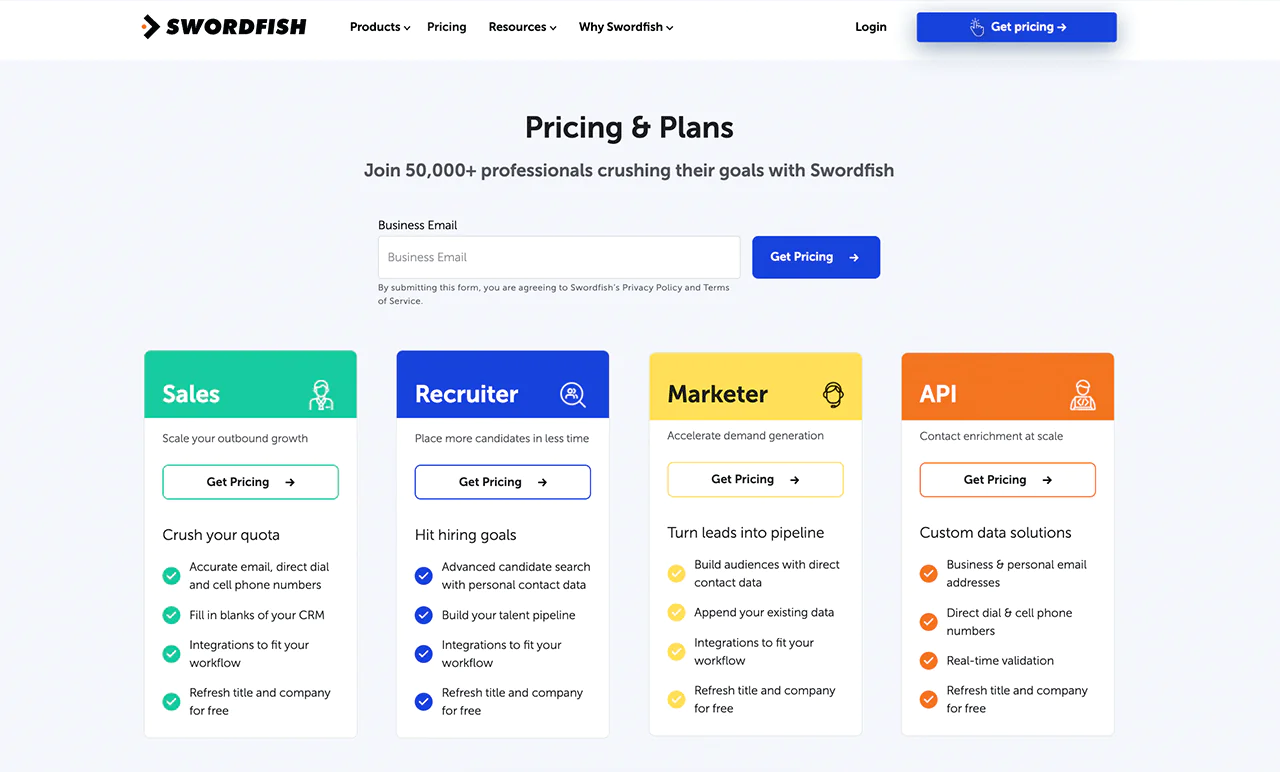
If ZoomInfo’s pricing is a concern, Swordfish offers plans built for sales, recruitment, marketing, and API integration use cases, each including verified email addresses and direct cell phone numbers along with regularly updated job role and company details.
Specific pricing is provided on request rather than listed publicly, so reaching out is the fastest way to get a plan that matches your actual usage.
2. Demandbase
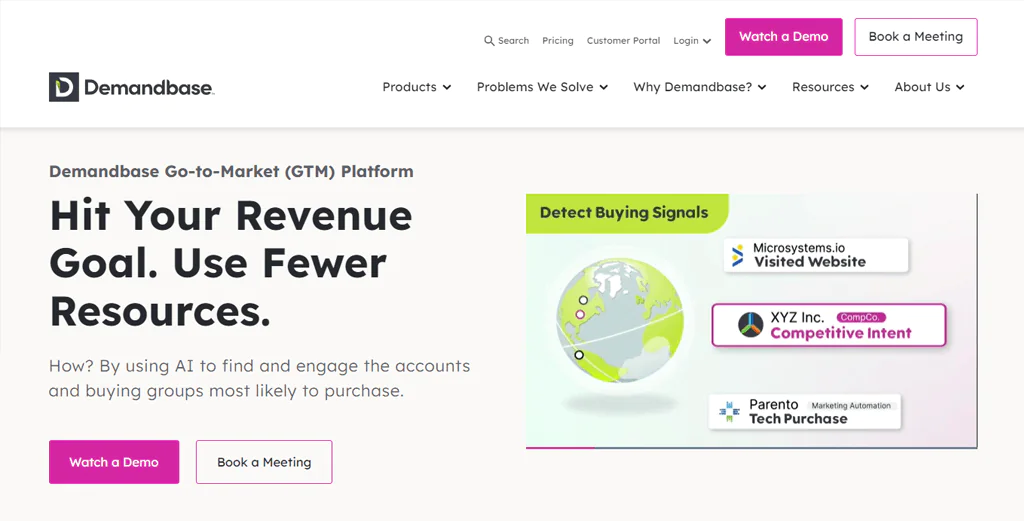
Demandbase leans into a full account-based marketing and account-based experience (ABX) platform, focused on visibility across the entire B2B funnel rather than contact data alone.
Where ZoomInfo’s strength is contact-level detail, Demandbase tries to unify account intelligence across the buyer journey so teams aren’t stitching together insights from disconnected systems.
The platform emphasizes personalized engagement and directing budget toward high-intent accounts, positioning itself around what it calls a Smarter GTM approach.
ZoomInfo Vs Demandbase Comparison Table
|
Features |
ZoomInfo MarketingOS |
Demandbase |
|
Core Offering |
AI-driven platform with extensive B2B data for sales and marketing. | AI-driven platform for ABM and B2B solutions. |
| ABM & ABX | Tools for account engagement and personalization. |
ABM and ABX solutions for improved customer journeys. |
|
Sales Intelligence |
Actionable insights on target accounts for sales. | Insights and tools for effective target account engagement. |
| Buying Intent | Identifies interested accounts for timely engagement. |
Insights into accounts researching related products/services. |
|
Predictive Analytics |
AI and machine learning predict buying readiness. | AI for prioritizing accounts likely to convert. |
| Advertising | Targeted digital display campaigns. |
B2B advertising on network and social media. |
|
Data Foundation |
Vast B2B contact and account database. | First-party data, Demandbase data, and AI for intelligence. |
| Market Focus | Suitable for all business sizes for lead gen and sales. |
For enterprises and mid-sized businesses with a focus on ABM and sales. |
Pricing
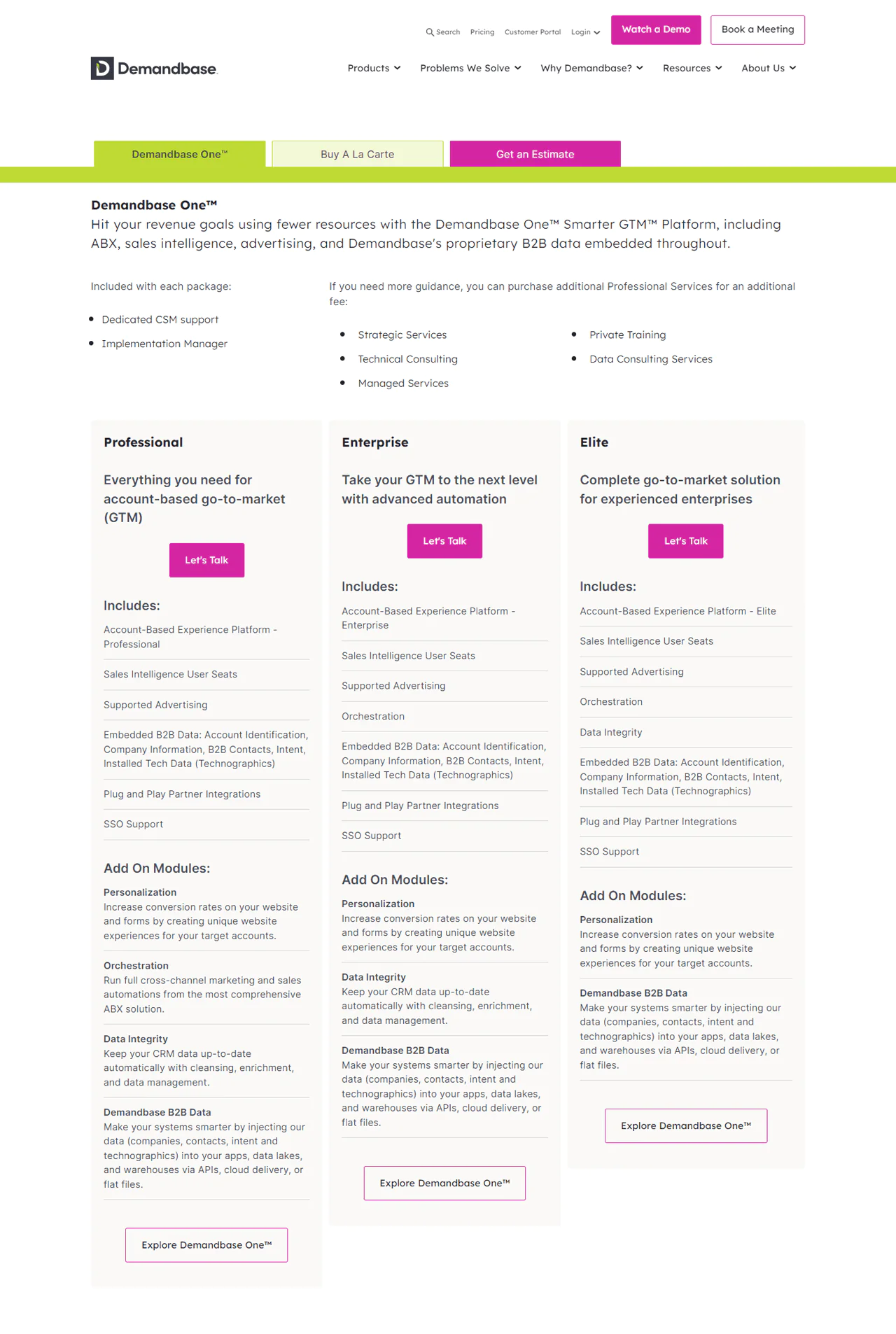
Demandbase organizes its plans into Professional, Enterprise, and Elite tiers, each aimed at a different level of go-to-market maturity. Exact pricing isn’t published, but user feedback suggests contracts starting around $80k annually.
Costs scale with account size and data volume; for example, managing around a million contacts with heavier data storage needs has reportedly run near $2,500 monthly. Add-ons for personalization, orchestration, and data integrity are also available separately.
3. 6Sense Revenue AI
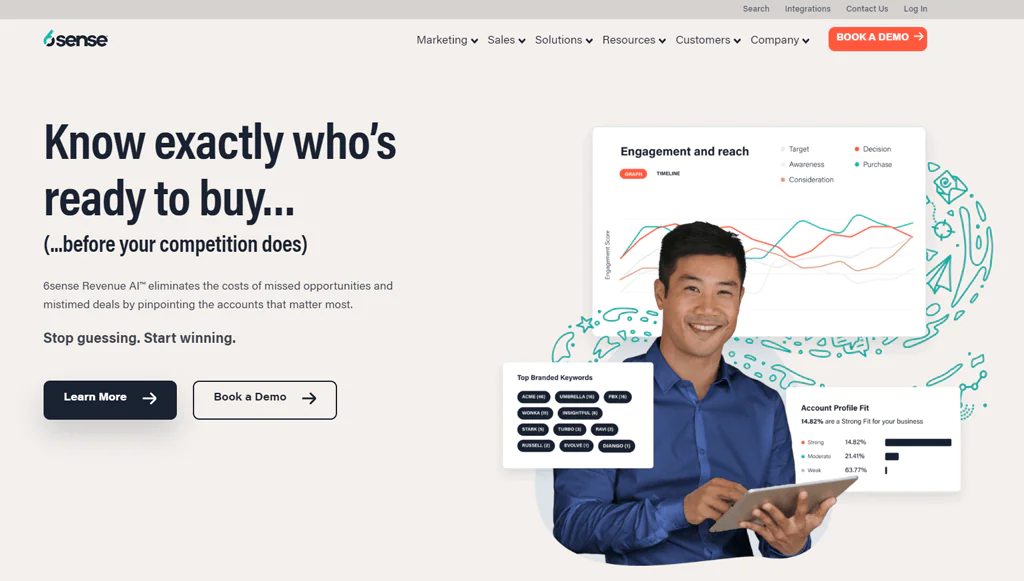
6sense positions its Revenue AI platform around removing guesswork from identifying and engaging buyers, with a particular emphasis on uncovering anonymous research activity that never touches a form fill.
Where ZoomInfo leans on the size of its contact database, 6sense leans on AI-driven behavioral analysis, aiming to catch buyer signals earlier in what it calls the \”Dark Funnel\” — the research activity that happens before a prospect ever identifies themselves.
ZoomInfo Vs 6Sense Comparison Table
|
Features |
ZoomInfo MarketingOS |
6sense |
|
Core Offering |
Data platform with vast B2B contacts and profiles. | AI platform specializing in anonymous buying behavior and predictive analytics. |
| ABM and ABX | Tools for personalized marketing campaigns using extensive data. |
Identifies \”Dark Funnel™\” accounts with actionable ABM intelligence. |
|
Sales Intelligence |
Actionable insights on target accounts. | Detailed intelligence, including intent data and buying stage predictions. |
| Buying Intent | Identifies interested accounts for engagement. |
Uncovers hidden buying signals for a deep understanding of intent. |
|
Predictive Analytics |
AI predicts buying readiness for prioritization. | Advanced AI predicts buying stages and recommends actions. |
| Advertising | Targeted digital campaigns using B2B data. |
Intent-driven display, video, retargeting, and social ads. |
|
Integration & Automation |
Enhances CRM and marketing tools with data insights. | Integrates with tech stacks for centralized audience creation. |
| Unique Selling Proposition (USP) | Comprehensive B2B database for detailed insights. |
Dark Funnel™ insights into unprecedented buyer behavior. |
Pricing
6sense doesn’t publish pricing either, preferring a custom quote based on business needs. Based on available research, first-year costs have been reported around $120k with a two-year commitment, and there’s no free trial.
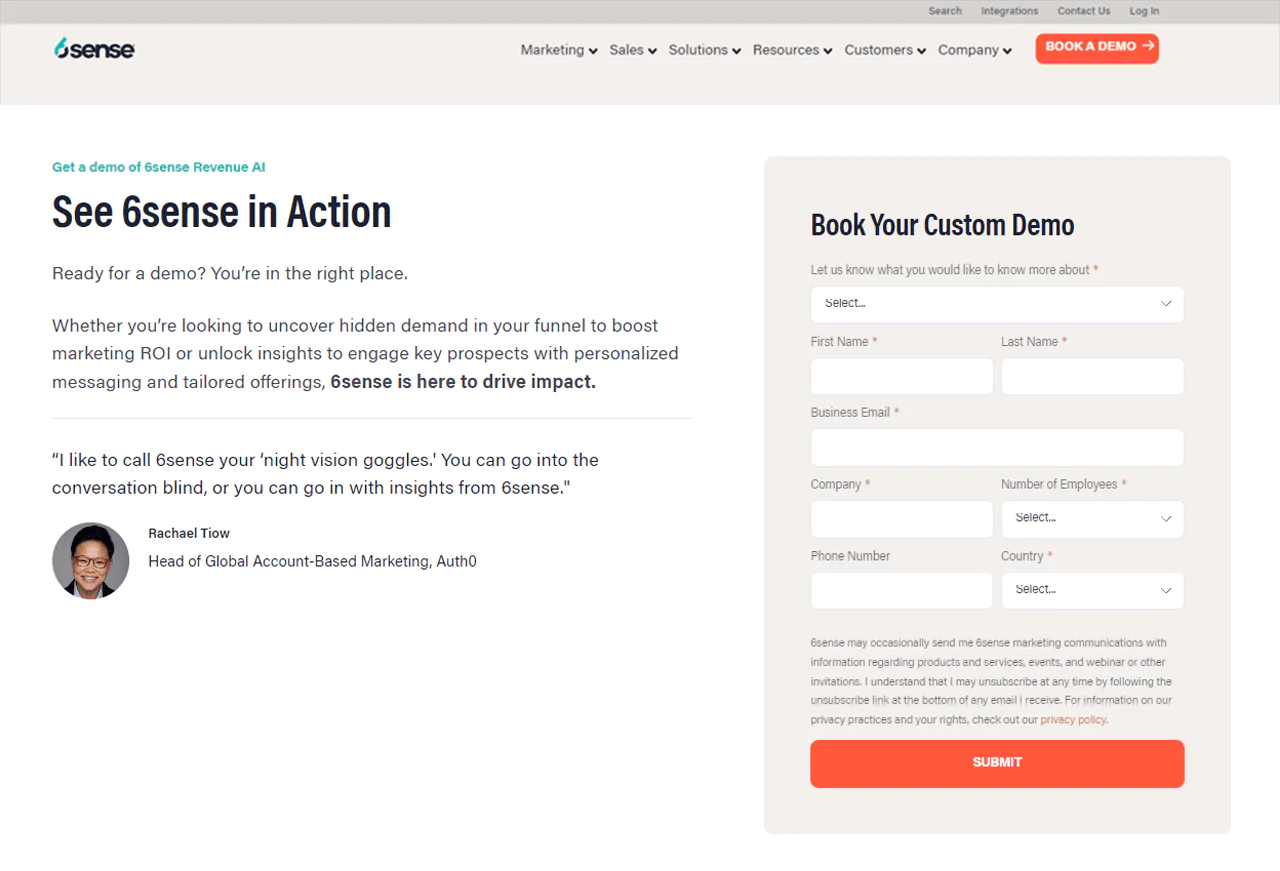
Premium plans include access to a proprietary intent network, company graph, third-party profile data, and dynamic segmentation. A demo is generally the starting point for getting a specific quote.
Conclusion
ZoomInfo MarketingOS brings together account data, intent signals, and campaign execution in one platform, aimed at helping sales and marketing teams work off the same signals instead of separate systems. The TARGET, EXECUTE, OPTIMIZE, and ALIGN framework gives a reasonably clear structure for how the pieces fit together.
Whether it’s the right fit depends on budget and how much of that functionality you’ll actually use. Contracts can run into the tens of thousands of dollars, and some reviewers note the platform can feel overwhelming at first.
If your priority is verified direct-dial and email contact data rather than a full ABM suite, Swordfish AI is worth a look as a more focused, budget-conscious alternative for sales and marketing teams.
FAQs
What makes ZoomInfo MarketingOS different from other ABM platforms?
Its combination of a large, frequently refreshed B2B database with predictive scoring and broad integration options is the main differentiator versus platforms that specialize in just one piece, like intent data or contact records alone.
How does ZoomInfo ensure data accuracy and completeness?
ZoomInfo relies on a mix of automated collection, machine learning verification, and a research team to keep records current, though like any large database, accuracy varies by record and should be spot-checked for critical contacts.
Can ZoomInfo MarketingOS integrate with existing CRM and marketing automation tools?
Yes, it connects with common CRM and marketing automation platforms including Salesforce, HubSpot, and Zoho, letting existing workflows pull in ZoomInfo’s data rather than requiring a full platform switch.
What types of businesses can benefit most from ZoomInfo MarketingOS?
B2B companies running an account-based marketing motion, particularly those large enough to justify the investment, tend to get the most value, though the entry cost may be steep for smaller teams.
How does ZoomInfo MarketingOS handle privacy and compliance issues?
ZoomInfo says it follows data governance practices aligned with major data protection regulations, but as the Reddit discussions above note, teams in regulated industries like healthcare should independently verify compliance requirements before importing contact data into their own systems.