
 View Products


Last updated: September 3, 2026
If a company is already researching a solution like yours, you want to know before your competitor does. Intent data is what makes that possible: it flags businesses that are actively investigating a category of product or service, often well before anyone at that company fills out a form or picks up the phone.
Not every intent data provider collects or verifies that signal the same way, though. Methodology varies a lot from vendor to vendor, and that variation shows up directly in how reliable the data turns out to be once your sales team starts working it.
Picking the wrong provider is not a small mistake. It means reps spend hours chasing accounts that were never actually in-market, and it erodes trust in the data internally the next time a genuinely hot account shows up in the feed.
This guide walks through what separates a strong intent data provider from a mediocre one, how the major players in the space actually source and verify their signals, and how to match a provider to your team’s workflow.
What is Intent Data?
Intent data is information collected to understand a potential buyer’s purchase intent based on their online behavior. It includes insights from activities such as website visits, content downloads, and search queries.
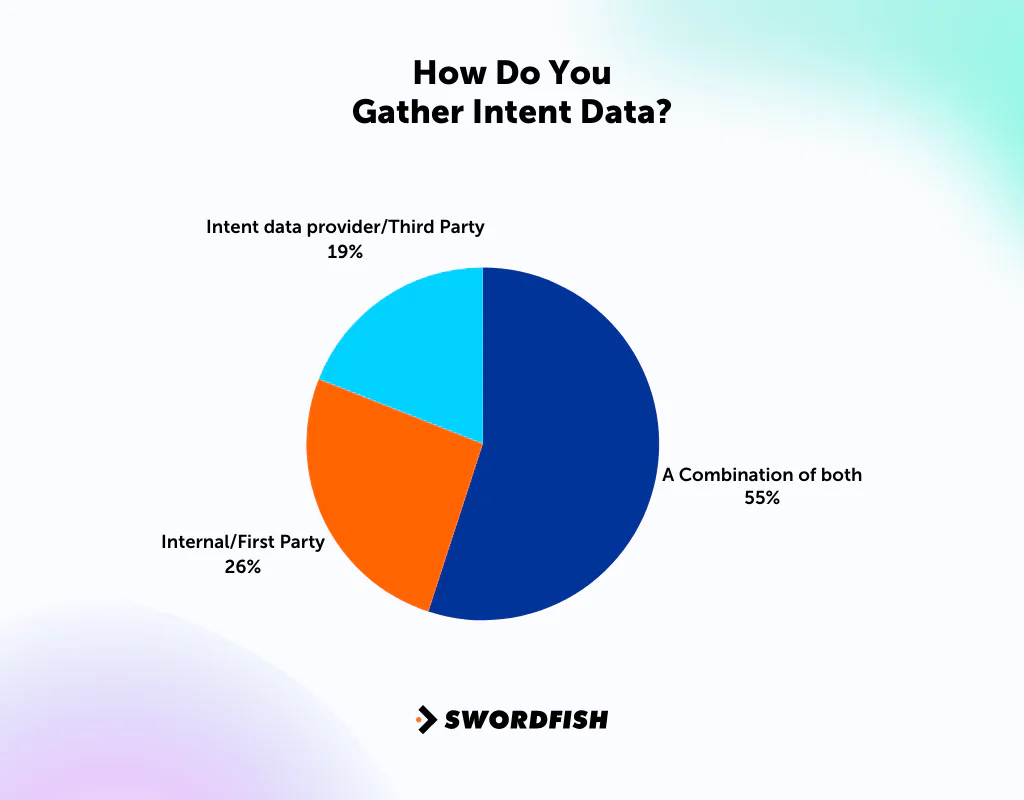
According to InboxInsight, 26% of B2B marketers use their own data, 19% use data from outside sources, and 55% use a mix of both.
These signals can come from the websites a buyer visits, the content they read, the keywords they search, or their activity on social platforms. Even so, HubSpot found that 61% of these marketers struggle to get traffic and leads.
Intent data providers exist to collect these scattered signals and turn them into something a sales or marketing team can actually act on. Understanding what a buyer is likely interested in puts you closer to a deal, but interest alone does not guarantee budget or authority to buy. That’s why most providers layer intent signals on top of firmographic details and technology usage data, so you get a fuller read on whether an account is actually a fit.
Intent data generally falls into three categories, each with different strengths:
- First-party intent data: This comes from your own sources, like your website or social media. It tracks how leads interact with your brand, helping you gauge their interest.
- Second-party intent data: Data that you purchase from another company. It might come from places like review sites, such as TrustRadius or G2.
- Third-party intent data: This data is collected by external vendors from various online sources. They process and organize it to give you a broad view of what your potential customers are interested in.
Quick List of Best Intent Data Providers
Here’s a fast overview of where each provider on this list tends to earn its keep:
- Swordfish AI: Best for merging phone and email searches with Bombora’s data.
- Bombora: Best for comprehensive, privacy-compliant B2B intent data insights.
- Lusha: Best for connecting with decision-makers based on their solution search.
- ZoomInfo: Best for using real-time buyer data for focused outreach.
- Demandbase: Best for international B2B intent data with campaign insights.
- 6sense: Best for comprehensive B2B data and future trend predictions.
- DemandScience: Best for varied intent data centered on clear buying indicators.
- Dealfront: Best for spotting potential customers showing immediate interest.
- Lead Onion: Best for sales engagement powered by up-to-date intent data.
- Terminus: Best for marketing strategies based on account-specific intent data.
Top Intent Data Provider Comparison Chart
Before digging into each provider individually, it helps to see how they stack up side by side on the features that matter most for evaluating fit.
Intent Data Providers | Database | Real-Time Data & Accuracy | Intent Data |
 | 3.5 billion data profiles | Real-time line connectivity validation | Bombora Intent Data |
 | 4 million average unique domains | Measures prospects’ digital journey | Quality data from the Intent data Co-op |
 | 50 million enterprise business profilesn total records | High data accuracy | Company-Level Intent Scores |
 | Over 135 million verified phone numbers and 260 million professional profiles | Advanced search and filtering options history | Streaming Buyer Intent Data |
 | Over 50 million B2B contacts | ABM/ABX for targeted marketing | Global B2B Buyer Intent Data |
 | Over 415 million B2B buyer profiles published | Predictive analytics for buying stages | Predictive Models |
 | Over 570 million contact records updated | Content Syndication for lead generation | Multi-Source Intent |
 | In Europe over 83 million contacts and in the USA and the Rest of the World over 145 million contacts | Sales Intelligence for lead generation | Website Activity Tracking |
 | 117 million contact profiles | Intent-driven sales engagement platform | Buyer intent B2B data |
 | B2B data with account-based marketing focus | Multi-channel engagement strategies | First-party relationship data |
10 Top Intent Data Providers to Increase Your Business ROI
With this many options on the market, narrowing the field takes some legwork. Below is a breakdown of ten providers worth evaluating, based on how they source data, how deep their coverage runs, and what else they bundle in, from real-time validation to CRM integration.
1. Swordfish AI
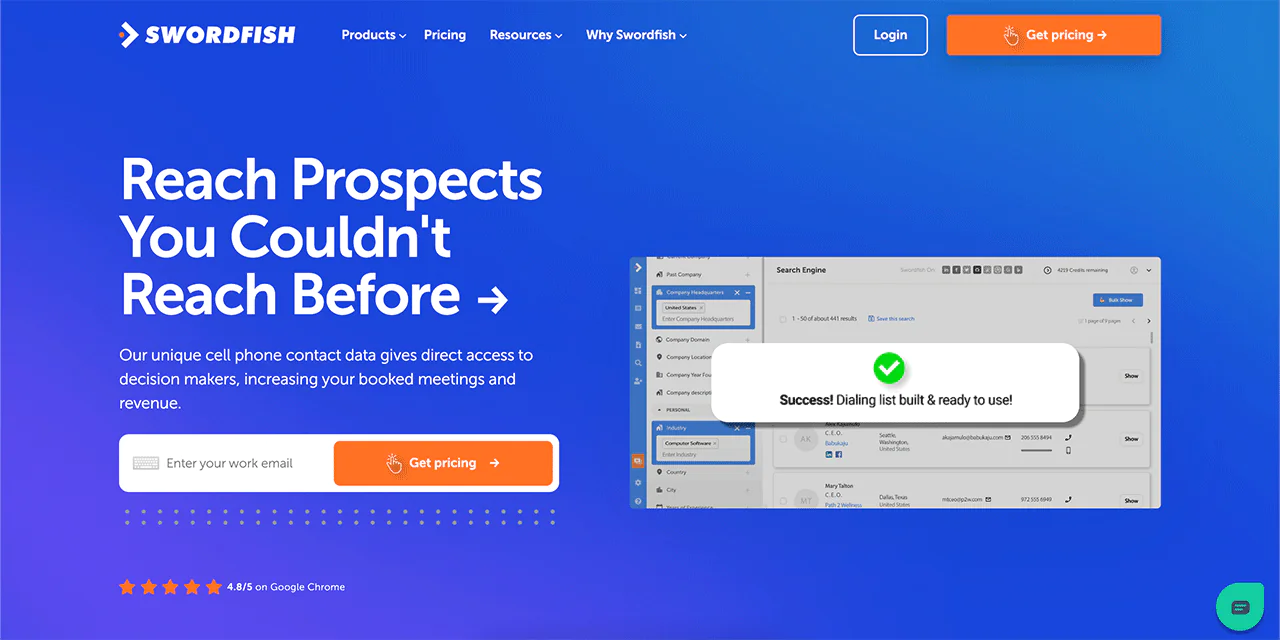
Swordfish AI is built around finding both B2B and B2C intent and contact data, and it scans social profiles for professionals to keep results current.
The platform maintains a unique cell phone number database and a proprietary cell phone verification system, with access to over 3.5 billion data profiles.
Swordfish AI applies its own matching algorithms to keep contact records accurate and current, which is the piece that actually determines whether outreach lands or bounces.
About Swordfish
- Founding year: 2015
- Founding team: Ben Argeband
- Company Size: 11 to 50 employees
Features of Swordfish AI
Here’s what’s inside the platform.
-
Bombora® Intent Data
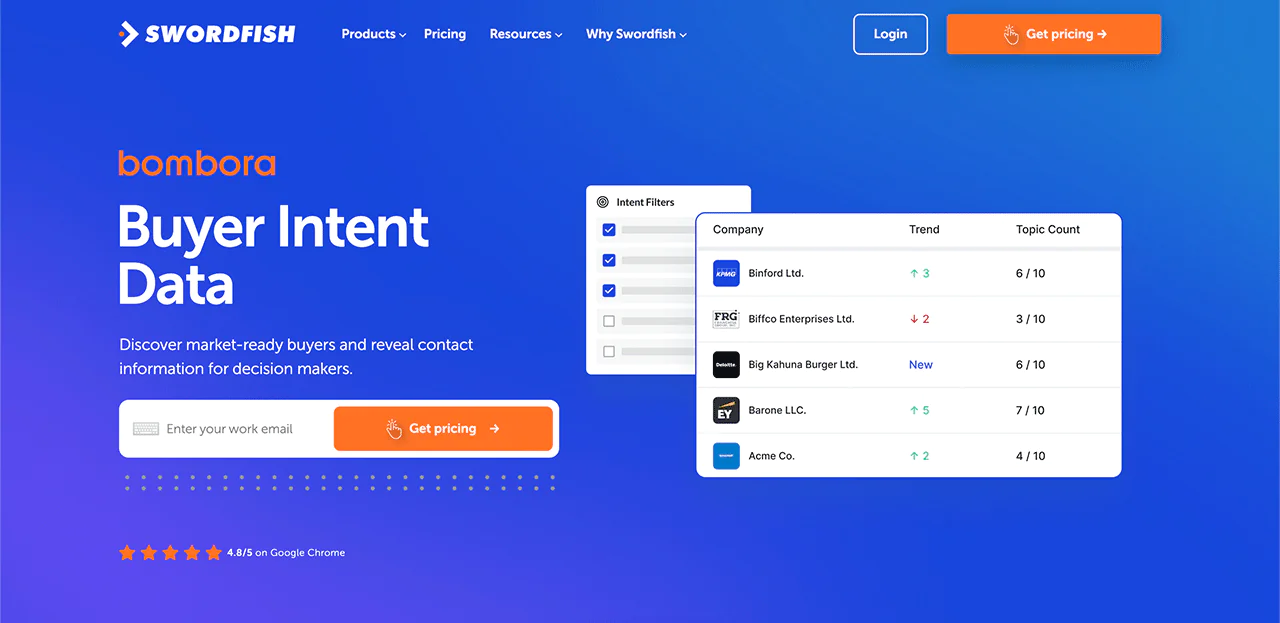
This tool uses information from Bombora intent data to pinpoint businesses that are ready to interact or buy something, which helps you focus outreach on accounts that are already showing signals.
-
Chrome Extension
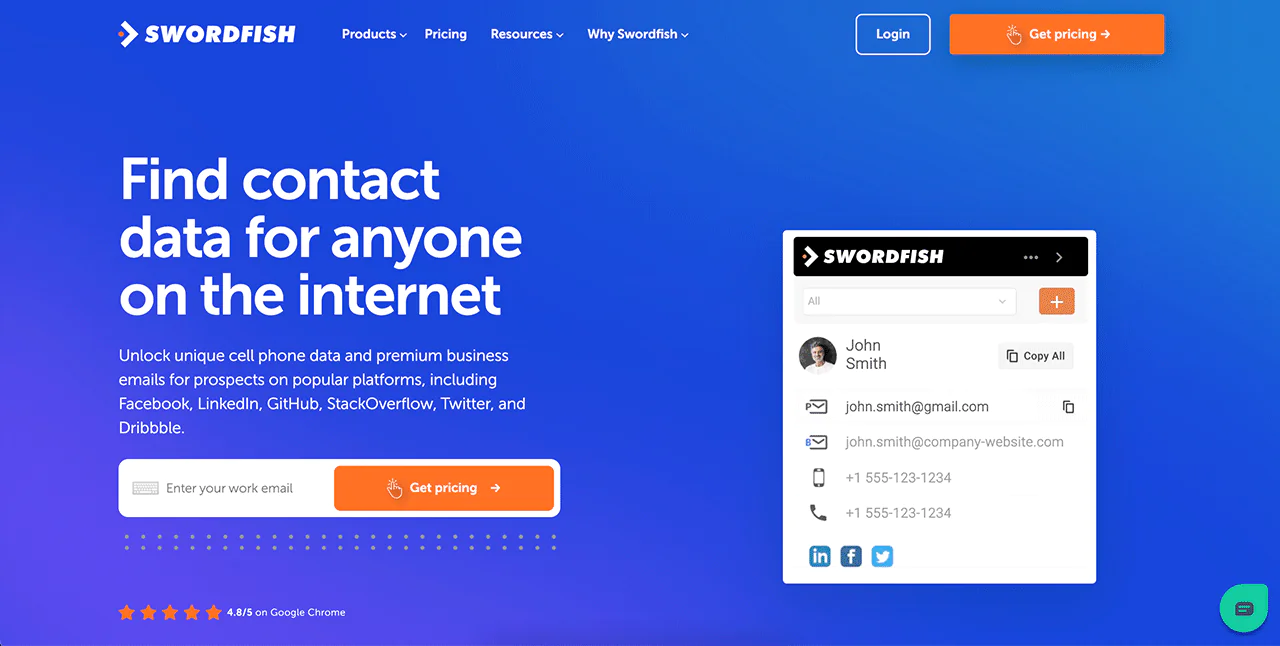
The Chrome extension lets you pull contact details directly from the page you’re browsing, useful for anyone prospecting on LinkedIn or a company site.
-
Prospector
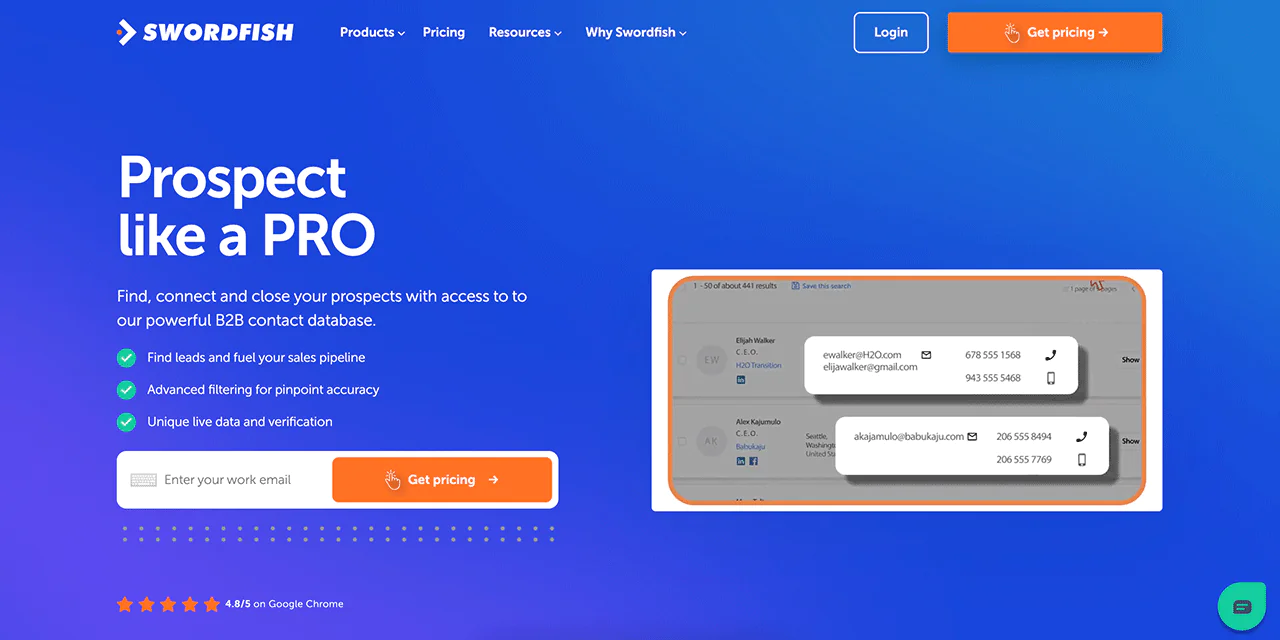
Prospector builds calling and emailing lists quickly using filters designed to keep the output accurate, which is useful for anyone trying to streamline their lead generation process.
-
File Upload
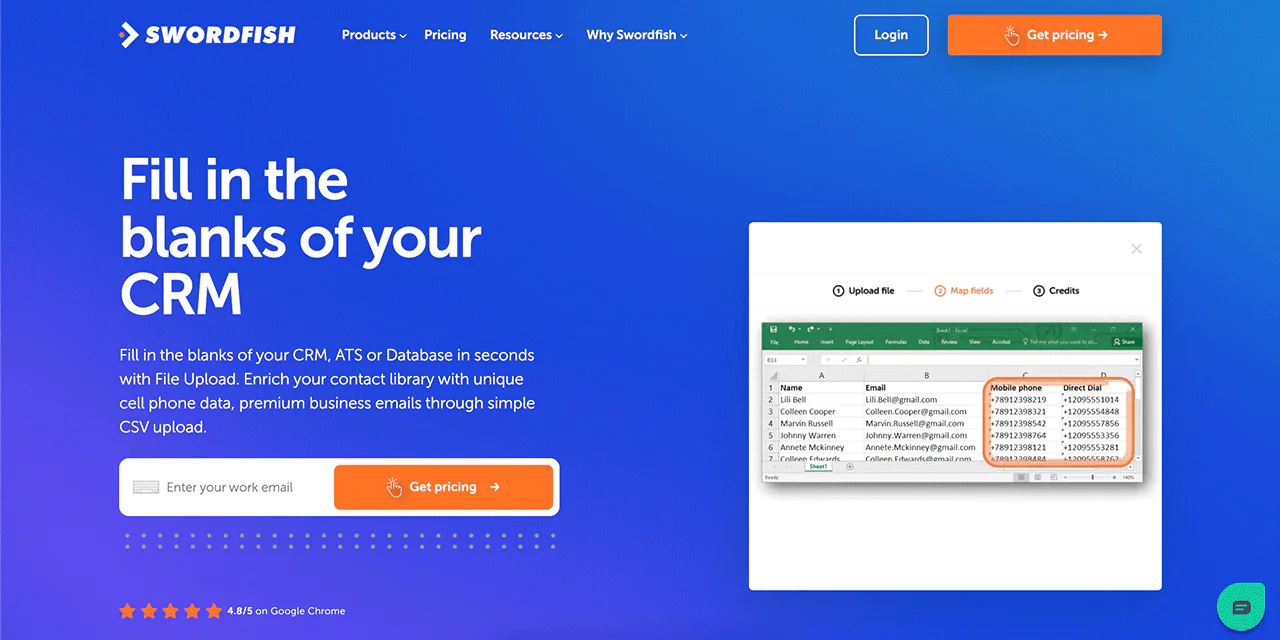
The File Upload tool cleans up a CRM database in bulk. Upload a CSV and Swordfish AI fills in missing phone numbers and emails, which cuts down on manual data entry considerably.
-
Reverse Search
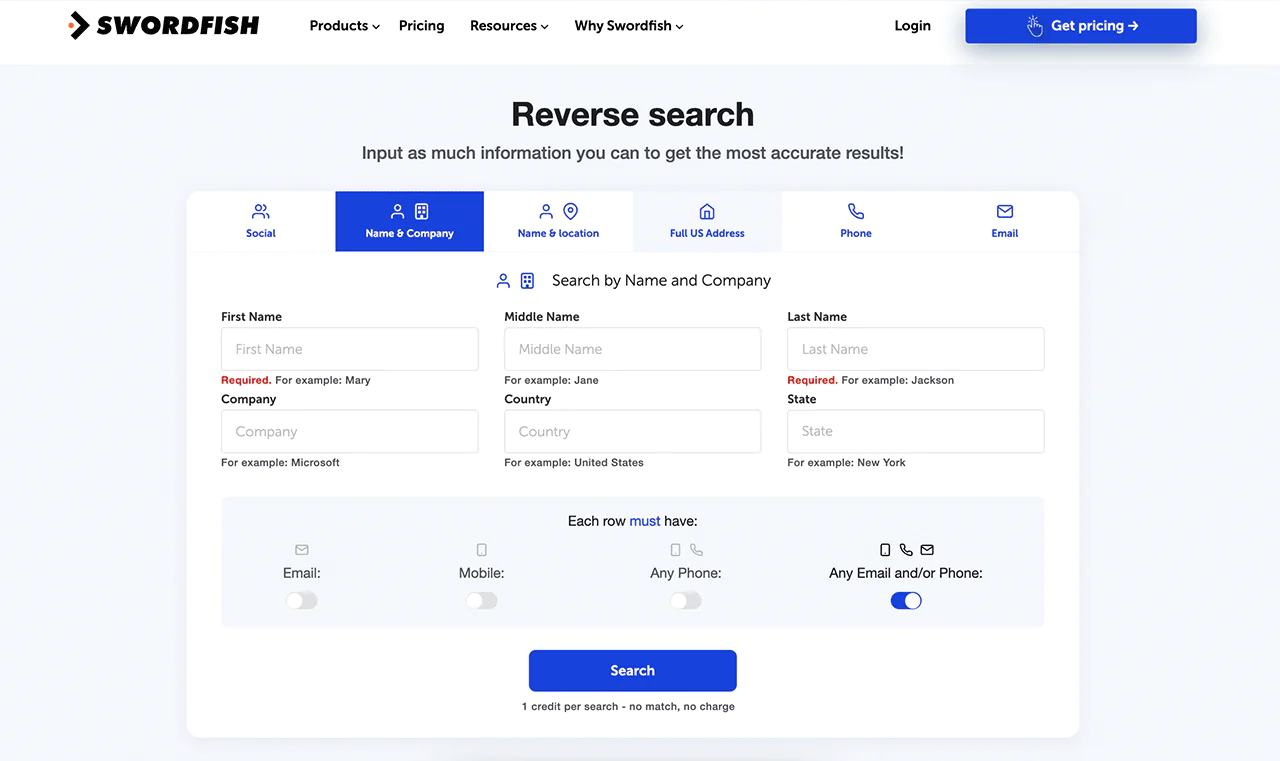
With Reverse Search, a partial name or email is enough to pull full contact details, which makes it a flexible option for research and outreach alike.
-
API
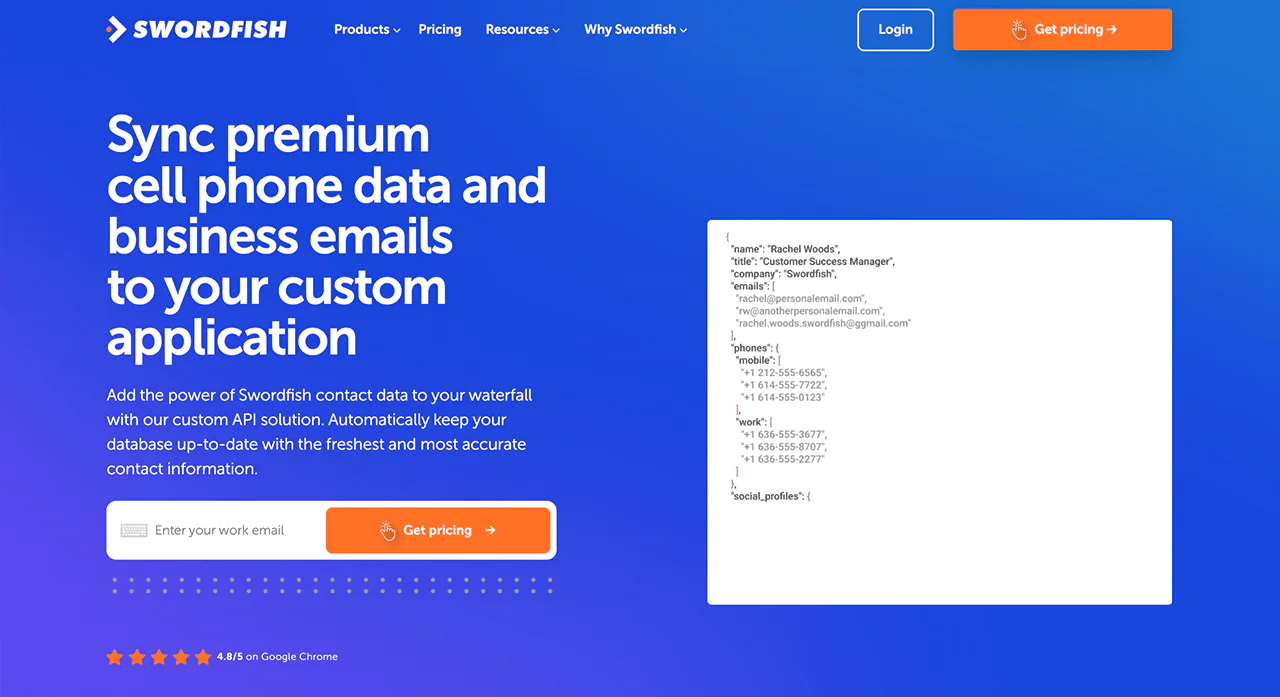
The API integration lets developers and teams pull contact data directly into their own applications or systems.
Best Use Cases of Swordfish AI
Where Swordfish AI tends to fit into a workflow:
- Lead Generation: Swordfish AI’s Intent Data helps in finding businesses that are actively looking into topics related to your products or services. It helps sales teams focus on the right decision-makers who are more likely to be interested in what they’re offering.
- Market Research: Use Bombora Intent Data to get a clear picture of what’s trending in the market and what businesses are interested in. This information is valuable for creating marketing strategies that really hit the mark.
- Enhanced Sales Strategy: For sales professionals, Intent Data is a key tool. It helps them identify businesses that are ready to buy, making their sales efforts both more focused and more successful.
- Personalized Marketing: Marketing teams can use Intent Data to shape their campaigns to meet the specific interests and needs of different companies.
Pros
- Increases booked meetings with unique cell phone data.
- Reduces sourcing time with rapid data retrieval.
- Enhances email campaign success with validated emails.
- Eases lead generation with bulk prospecting tools.
- Improves data accuracy with proprietary matching algorithms.
- Provides on-the-spot data access via Chrome extension.
Cons
- Small businesses may find price quotes challenging
Pricing
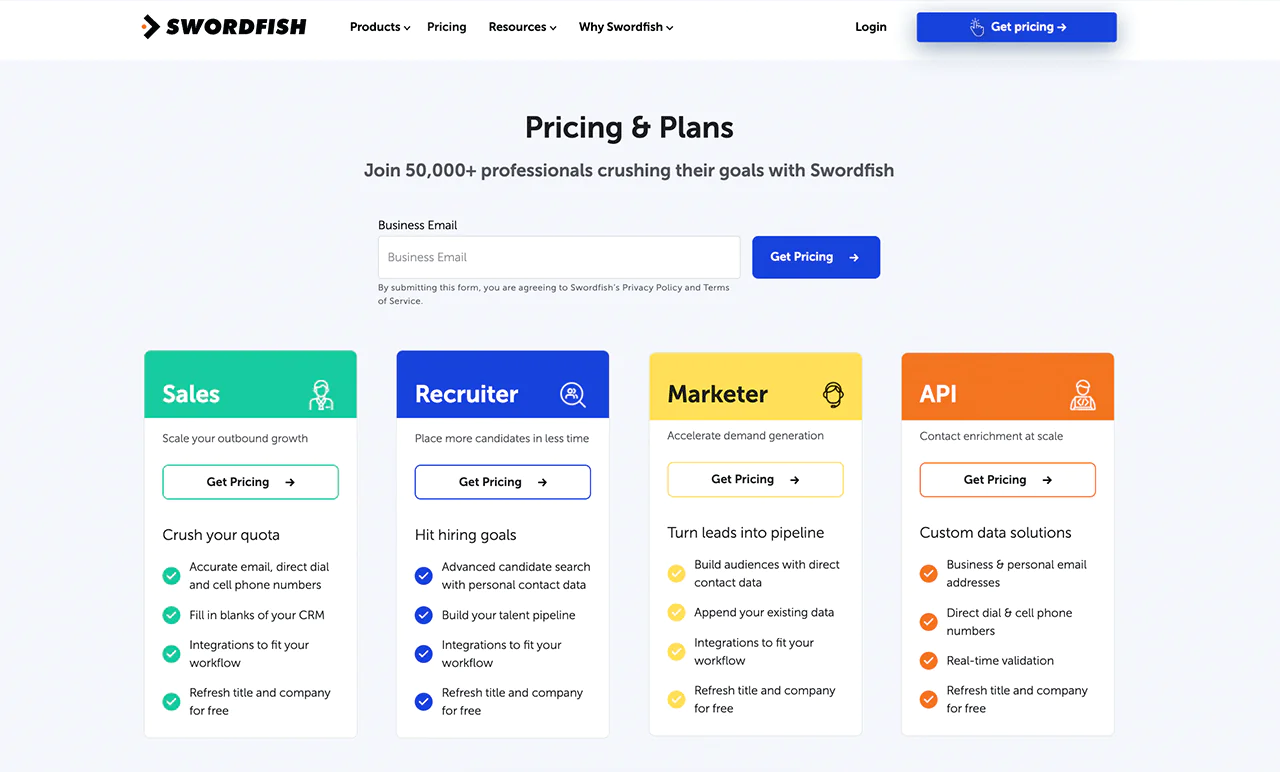
Swordfish AI tailors its pricing plans to fit different needs, whether you’re in sales, recruitment, marketing, or need API integration. Exact prices aren’t published; you’ll get a quote based on your specific requirements.
These plans cover everyday tasks like searching for phone numbers and emails, integrating with CRM systems, and accessing current data. Contact Swordfish AI directly for specific pricing.
 What Users Say About Swordfish AI
- G2: 4.5 · 84 reviews
“The ability to use forensic data to track both leads and suspects that are abusive and a danger to corporates in their capacity and risk” – Chris S.
- Capterra: 4.6 · 12 reviews
“very very good and the best piece of software to use with linkedin” – Uma U. Try Swordfish Ai
2. Bombora
Bombora created the B2B intent data category over a decade ago and remains the benchmark that many competitors get measured against. Its consent-based Data Co-op sources signals from thousands of B2B publisher sites, which is a meaningfully different model than pulling data from the ad bidstream.
Bombora’s cooperative tracks content consumption across millions of business domains and billions of monthly interactions, and a large share of that data is shared exclusively with Bombora, which limits how easily competitors can replicate its signal set. That data integrates with most major sales, advertising, and marketing technology platforms.
About Bombora
- Founding year: 2014
- Founding team: Erik Matlick
- Company Size: 250 employees
Features of Bombora
Key features include:
- Data Cooperative: Bombora gathers its data from a wide network of B2B publishers, offering a diverse range of market insights.
- Company Surge® Analytics: This tool uses sophisticated technology to analyze web content, giving a clear view of what buyers are interested in.
- Business Identity Mapping: Bombora uses a mix of data types, like behavior and IP information, to identify businesses accurately, enriched with additional business and demographic details.
- Detection of In-Market Intent: Bombora can tell when a company is ready to buy by looking at its online research activities.
- Extensive Topic Taxonomy: Bombora organizes its data into thousands of topic categories, helping to simplify and clarify buyer interests.
- Integration with Major Platforms: Bombora’s data integrates smoothly with existing B2B systems, improving sales and marketing efforts without hassle.
- Ethically Sourced and Privacy Compliant Data: Bombora responsibly collects data from consented websites, adhering to privacy standards.
Pros
- Broad market insights from a vast B2B publisher network.
- Advanced analytics for accurate buyer interest interpretation.
- Precise business identification enhances targeting accuracy.
- Timely detection of companies ready to purchase.
- Simplifies understanding of buyer interests with extensive taxonomy.
Cons
- The reports are not easy to analyze and read.
Pricing
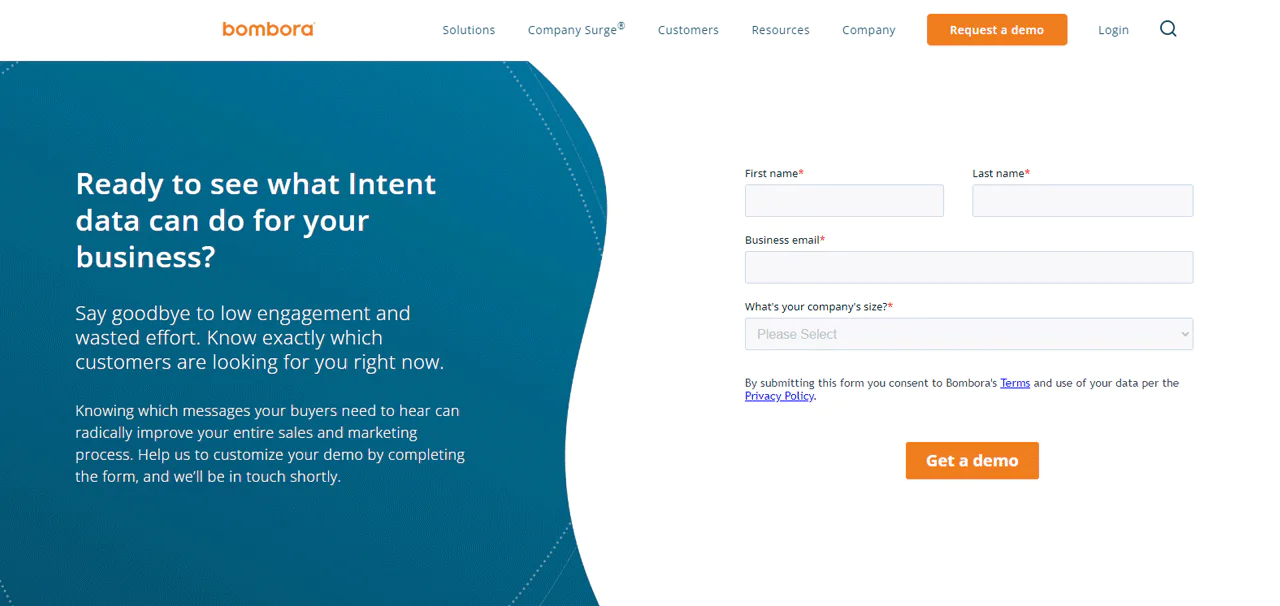
To get your customized pricing, fill out the form, and they’ll get back to you within two business days.
What Users Say About Bombora
- G2: 4.4 · 154 reviews
“The platform is incredibly intuitive and the user experience is easy to use. My favorite part of the tool is the automatic surge report and net-new account to HubSpot. We come in each Monday with a new set of accounts actively shopping for our services and solutions can pull contacts from those intent companies to ensure our content is in front of them.The Bombora and Hubspot integration is also incredibly robust. We can see a contact’s surge score, the # of topic they’re searching for, which topics, and if they’re surging on any clusters right off of the contact screen.” – Ashden K.
Our Review of Bombora
Bombora’s core differentiator is its cooperative sourcing model. Bombora invented the B2B intent data category (founded 2014) and was recognized as a Leader in The Forrester Wave: Intent Data Providers for B2B, Q1 2025, receiving the highest possible score in 10 criteria, which gives some independent weight to its reputation as a category leader.
Company Surge® Analytics, powered by machine learning that reads the meaning behind page content rather than just keyword matches, gives a fairly nuanced read on buyer interest. Bombora has also stayed consistent on privacy positioning, running its co-op on consent-driven collection rather than bidstream data.
Where it can fall short is that Bombora is a data provider, not a full outreach platform, so you’ll typically pair it with a CRM or sales engagement tool to actually act on the signals it surfaces.
3. Lusha
Lusha is specifically designed to improve intent data for finding contact lists and boosting conversion rates. This functionality helps in identifying potential clients actively seeking solutions, making Lusha even more effective for sales prospecting.
It also offers a Chrome extension for pulling data from LinkedIn, and works across Chrome, Firefox, and Edge.
Plus, with a solid database for accurate and current information, Lusha is used by over 800,000 sales professionals and is trusted by major companies like Google, Amazon, Salesforce, and Apple
About Lusha
- Founding year: 2016
- Founding team: Assaf Eisenstein and Yoni Tserruya
- Company Size: 340 employees
Features of Lusha
Standout features:
- Verified B2B Data: Lusha rigorously checks its data, providing you with trustworthy and accurate business profiles.
- Audience Definition Tools: It offers filters to help you easily identify businesses that fit your target market.
- Intent Data Providers List: Lusha keeps track of rising buying intent data and sales signals, helping you spot new business opportunities.
- Decision-Maker Identification: The platform assists in locating key contacts within a company, especially those in influential roles, and keeps track of any recent role changes.
- Direct Contact Data: Lusha gives you direct and verified contact information, making it easier to reach out to potential leads or partners.
- Dynamic Data Updates: The data on Lusha is regularly updated, ensuring you always have the latest and most relevant information for your business.
- Compliance with GDPR & CCPA: Lusha maintains important privacy regulations like GDPR and CCPA, promising that the data you use is responsibly obtained and legally sound.
Pros
- Access to accurate and verified business profiles.
- Easy identification of target markets with specific filters.
- Keeps track of current market opportunities effectively.
- Simplifies finding key decision-makers in organizations.
- Provides direct and reliable contact information.
- Regularly updated data ensures relevance and accuracy.
Cons
- May be less effective outside B2B contexts.
Pricing
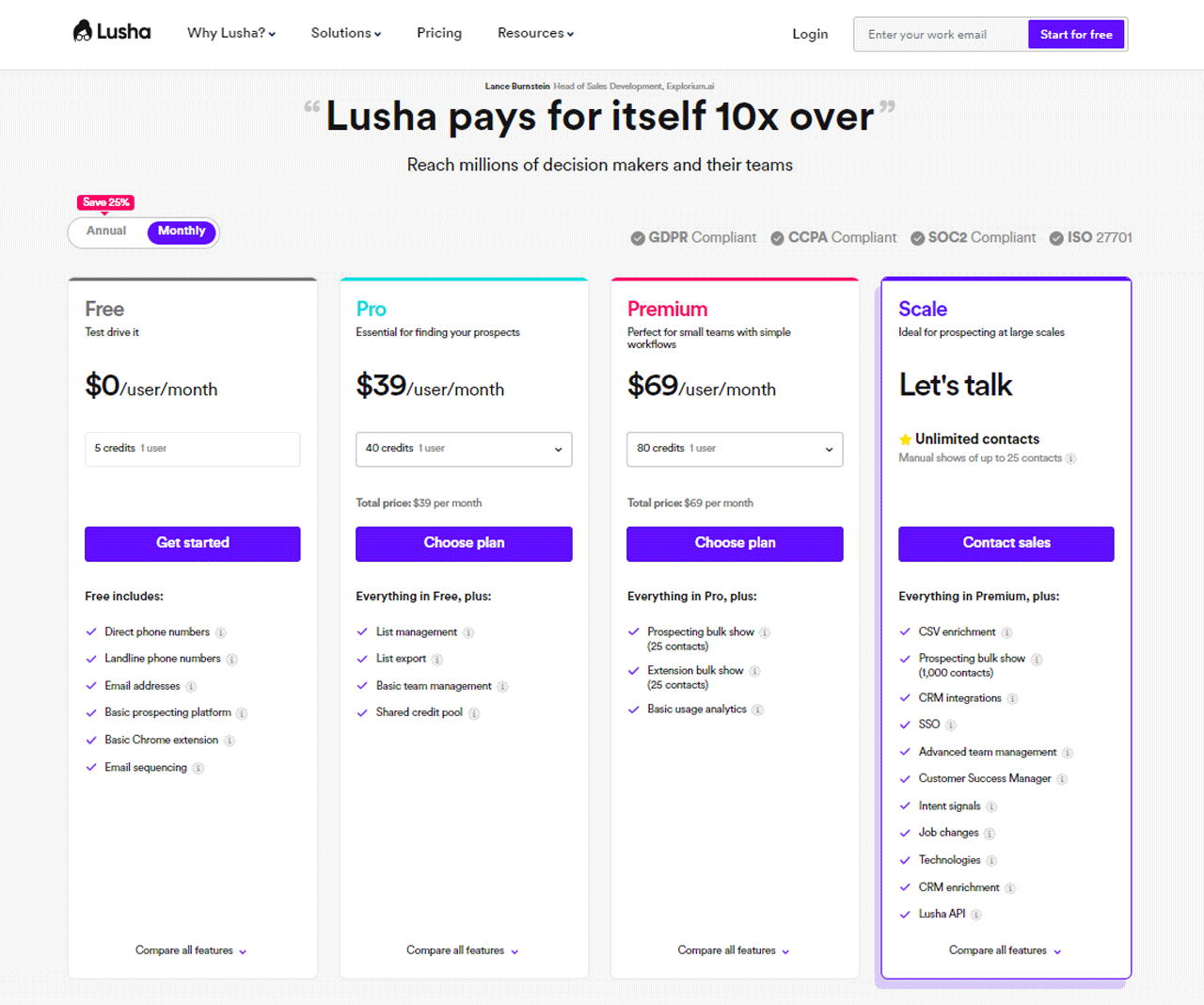
New users get a free package with 5 credits, no charge. If you’re working alone and want a bit more depth, the Advanced package runs $39 per user per month for 40 credits.
For a small team wanting a more complete solution, the Elite package is $69 and includes 80 credits plus 25 bulk-prospecting contacts.
Larger companies get a custom quote directly from Lusha.
What Users Say About Lusha
- G2: 4.3 · 1,427 reviews
“It provides accurate information and has a very high ease of implementation. And there are so many features useful for business.” – Manjinder S.
- Capterra: 4.1 · 359 reviews
“Lusha is a straight forward solution that offers value for money. Compared to expensive competitors it does a fairly good job. Some of the data could be better however it is grate product for speeding up the time taken to find information and generate leads.” – Ben B.
Our Review of Lusha
Lusha earns its reputation mainly on simplicity. It’s easy to onboard a rep on, and the accuracy of its contact records holds up well against comparable tools.
Its main strength is delivering precise, current details on businesses and professionals across a wide range of industries.
The platform is genuinely easy to use day to day. It pairs contact information with social profiles, which matters for reps trying to personalize outreach rather than blast generic templates.
Features like ‘Intent’, which flags a company’s buying potential, and job-change alerts add real value for prospecting at the right moment.
Read More About: Options instead of Lusha
4. ZoomInfo
ZoomInfo built its reputation in B2B intelligence largely on the strength of its buyer intent feature.
It helps sales teams identify prospects actively researching topics tied to their business, which makes ZoomInfo a solid fit for targeted prospecting, lead generation, and recruiting.
Beyond that core feature, ZoomInfo pairs a large database with its own technology to push for coverage, accuracy, and depth.
Serving tens of thousands of customers, from small businesses to global enterprises, it helps these organizations reach their ideal buyers. The platform provides access to tens of millions of direct dial phone numbers and millions of verified email addresses.
ZoomInfo positions itself as a go-to-market intelligence platform built for B2B sales and marketing teams, and its data breadth makes it a reasonable fit for larger outbound motions.
About ZoomInfo
- Founding Team: Henry Schuck
- Founding Year: 2007
- Company Size: 3,941 employees
Features of ZoomInfo
ZoomInfo’s feature set includes:
- Advanced Search Filters: ZoomInfo allows businesses to find the right leads by using detailed search options like job roles, company size, and industry.
- AI-Powered Prospecting Tools: The platform uses AI to automate the process of finding and improving contact data, making it more accurate and efficient.
- Real-Time Account Alerts: ZoomInfo sends updates about important changes in target companies. In turn, businesses can quickly adjust their B2B prospecting strategies.
- CRM Integration: The tool works well with common CRM and marketing systems, making it easy to move and use data in existing business processes.
- Intent Data Platforms: As a key player in intent data platforms, ZoomInfo identifies potential buyers by analyzing their online activities and interests.
- Comprehensive Company and Professional Information: ZoomInfo offers detailed, current information about companies and professionals, supporting better business decisions and planning.
Pros
- Buyer intent feature for sales-ready prospects
- Conversation Intelligence for sales call analysis
- Automated sales workflows based on buying signals
- Precise targeting with advanced search options.
- Timely updates on key account changes.
Cons
- Segmenting the leads is challenging
Pricing
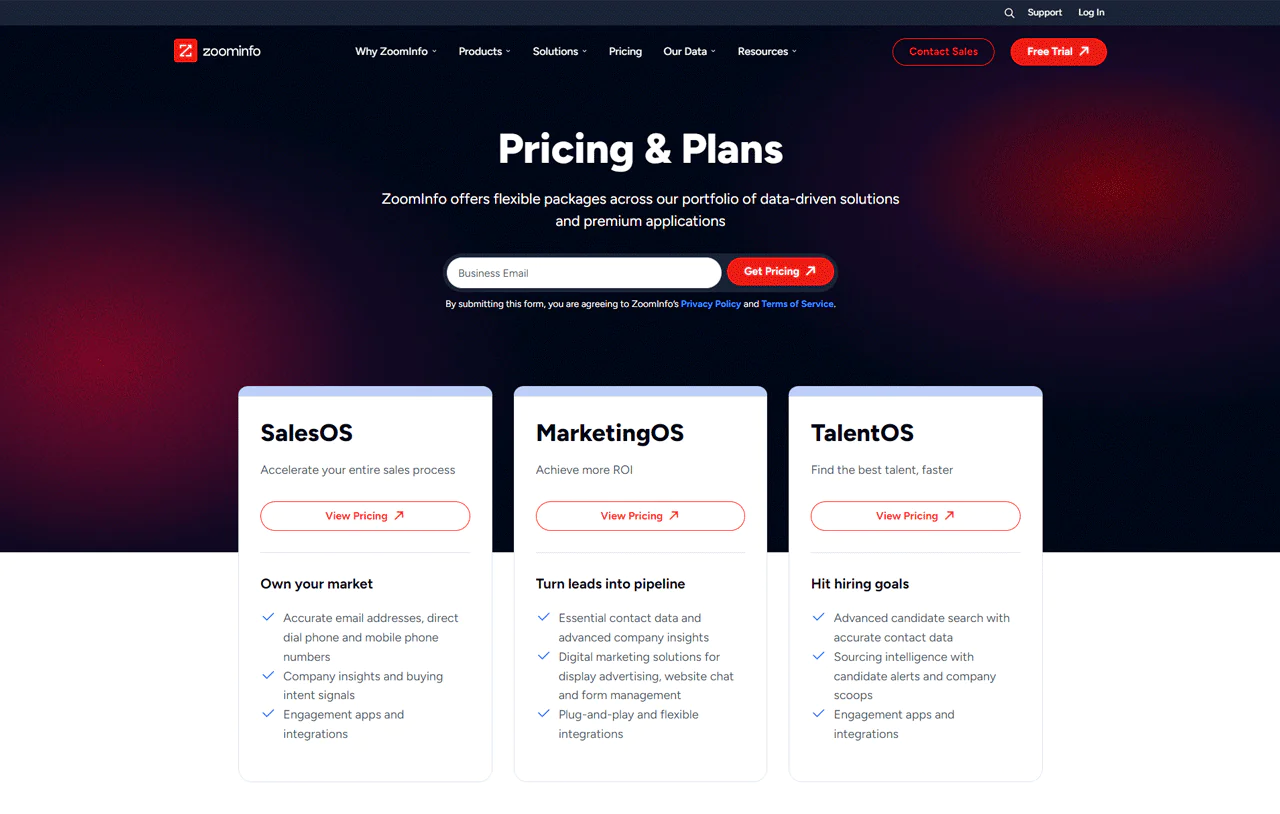
ZoomInfo runs on quote-based pricing, but here’s a general idea of what packages tend to look like, based on our research:
|
Packages |
Price |
Suitable For |
|
Pro+ (without intent data) |
$8,000 yearly |
Ideal for basic outreach |
|
Advanced+ (with intent data) |
$12,000 yearly |
Best for targeted marketing |
|
Elite Plan |
$41,000 yearly |
Comprehensive for larger teams |
What Users Say About ZoomInfo
- G2: 4.4 · 7,871 reviews
“Getting contact information immediately that integrates directly into our CRM. If I am on a webpage or LinkedIn I can use the ZoomInfo icon to get the information while I am on the page. WebSights has also been fun to use. We can see which companies have been on our website. We have actually converted several visitors to customers. Creating lists has been a game changer as well. Each week I receive an email with companies that are reseraching what our company provides. Really has been a wonderful tool!” – Shelane B.
- Capterra: 4.1 · 279 reviews
“Zoom is a great tool for prospecting. It helps bridge the gap from leads to new clients. I leverage it daily as I look to acquire new customers.” – Adam D.
Our Review of ZoomInfo
ZoomInfo’s biggest advantage is scale. Its contact and company database covers a huge footprint, which matters a lot for teams running high-volume outbound.
What sets it apart from a pure contact database is the intent layer sitting on top, which is built to flag when accounts are likely close to a purchase decision so reps can prioritize timing rather than guess at it.
ZoomInfo also bundles in AI-assisted prospecting, CRM integration, and detailed search filters. The tradeoff is cost and a learning curve; it’s built for teams that plan to use most of what’s in the package, not just the contact lookup.
5. Demandbase
Demandbase is a tool that helps sales and marketing teams work together on account-focused tasks. It provides tools for sales insights, account details, and advertising to strengthen your corporate marketing strategies.
As an intent data provider, Demandbase stands out with its unique approach to go-to-market intelligence designed for B2B sales and marketing professionals. The platform is designed to help you locate, prioritize, and measure the effectiveness of in-market accounts.
Due to its ability to deliver precise insights, Demandbase has become a vital tool for growing quality pipelines and increasing customer lifetime value.
About Demandbase
- Founding year: 2006
- Founding team: Chris Golec
- Company Size: 940 employees
Features of Demandbase
Key features:
- First-Party Data Integration: Demandbase brings together your sales and marketing information, like CRM and email data, for a full view of your customer interactions.
- Ethically-Sourced Third-Party Data: The platform adds external data to yours, giving a broader and more ethical perspective on your accounts.
- Predictive Models: Demandbase uses AI to sift through data, providing useful insights and advice to pinpoint the best business opportunities.
- Lead-to-Account Mapping: This tool links leads directly to the appropriate accounts, making your team’s work more targeted and efficient.
- Targeted Segmentation: You can create specific groups based on detailed factors, allowing for more focused marketing activities.
- Engagement Heat Maps: Demandbase identifies the most interested prospects, helping you concentrate your efforts where they’re most effective.
- Automated Data Cleansing and Enrichment: The platform regularly updates and improves your data, ensuring you always have the most current and accurate information.
Pros
- AI-driven insights for strategic decision-making.
- Efficient lead-to-account matching improves targeting.
- Precise segmentation for tailored marketing efforts.
- Engagement tracking focuses resources on active prospects.
- Continuous data accuracy through automated updates.
Cons
- There’s room for improvement in reporting
Pricing
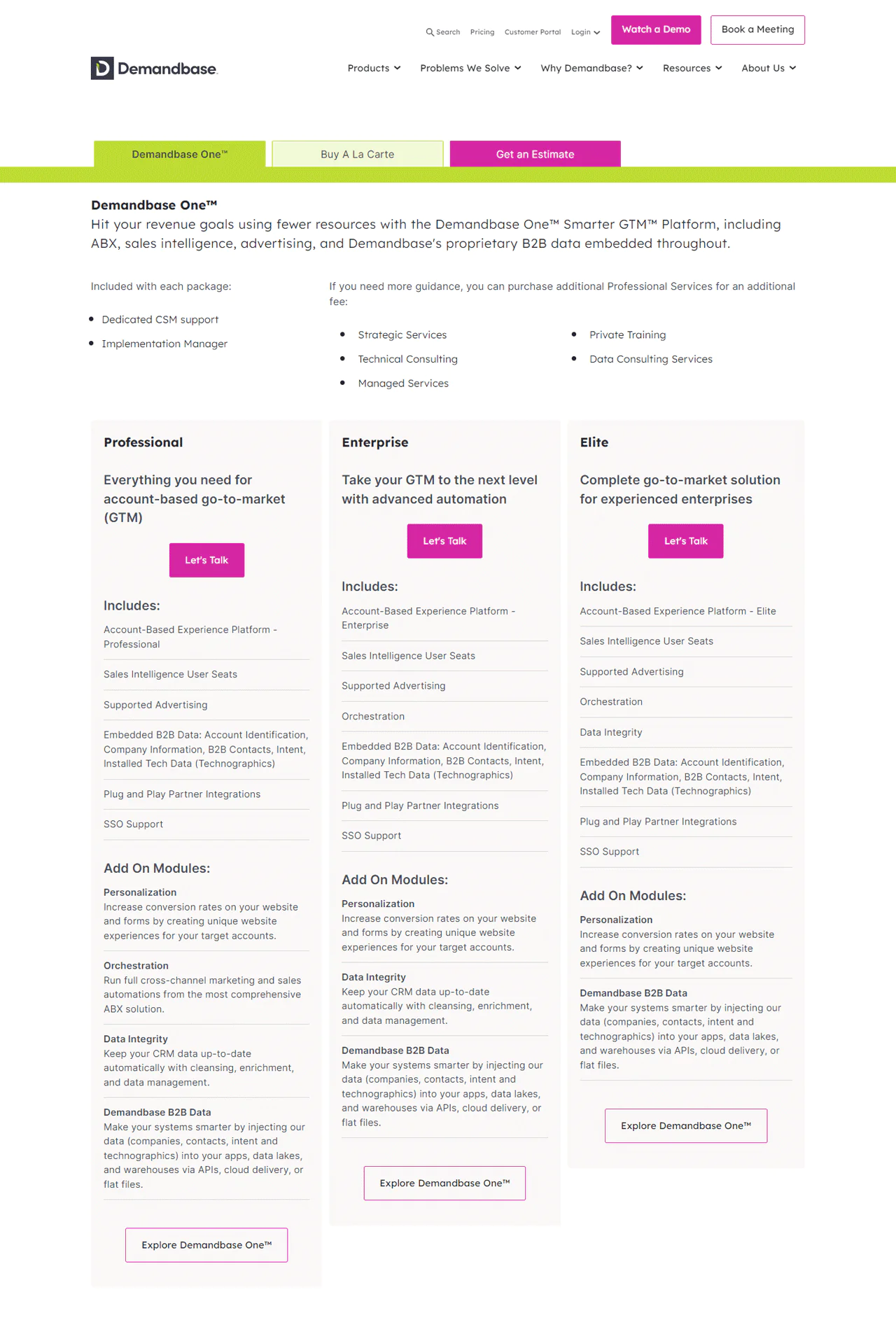
You can choose from Professional, Enterprise, or Elite plans. However, you’ll need to contact them to find out the price.
What Users Say About Demandbase
- G2: 4.3 · 1,555 reviews
“Demanbase One has make it easy for me to find, filter and analyzing buyer intent account that show interest on our service niche. We then collect and warm-up that account for targeted marketing campaigns. It is one of tools that we use daily.” – Jill W.
- Capterra: 4.3 · 16 reviews
‘There are so many insight about what companies are doing and how they are interacting with your site. The visibility is so helpful with my day to day.” – Lauren M.
Our Review of Demandbase
Demandbase’s strength is blending internal CRM and email data with external signals to build out a fuller B2B account picture. The AI layer that turns that combined data into practical recommendations is a real differentiator.
Its data matching and cleansing process helps keep Account Intelligence reliable, and the ability to track buyer journey stage alongside engagement level is genuinely useful for prioritizing marketing spend.
Overall, Demandbase’s mix of ethical data sourcing and predictive scoring makes it a reasonable option for teams running account-based programs at scale.
6. 6sense
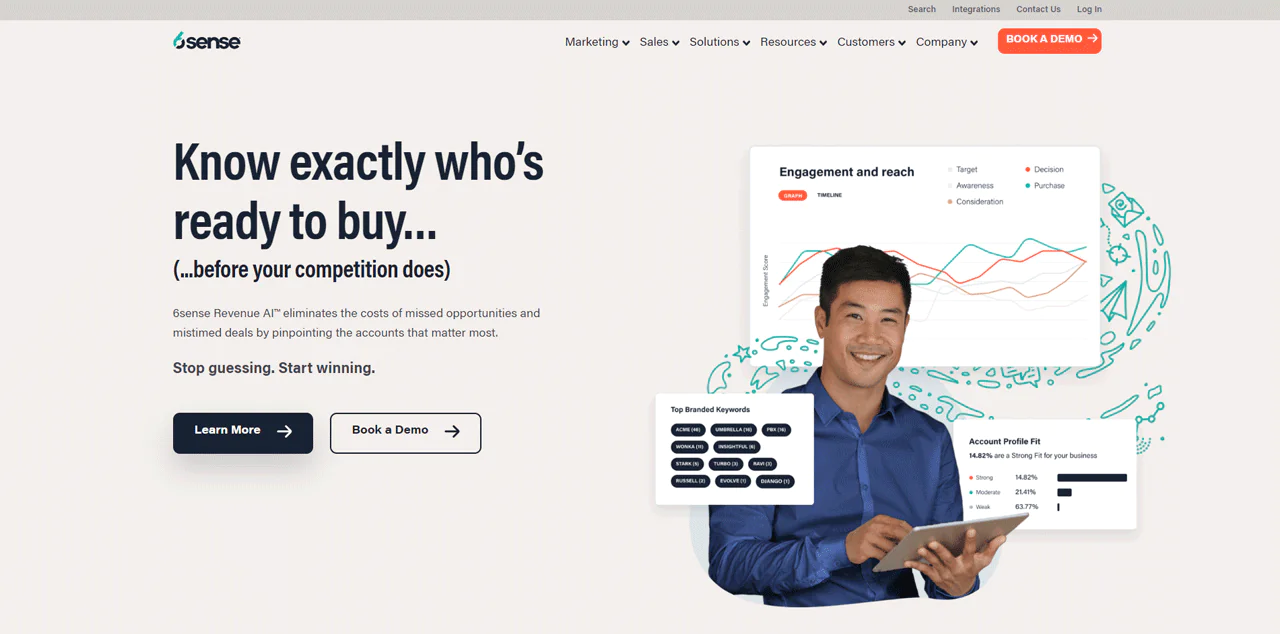
6sense is a dynamic platform that focuses on B2B intent data to reveal hidden buying signals and interests. This feature is crucial for businesses as it helps in identifying potential clients who are actively researching related products or solutions.
Additionally, 6sense offers comprehensive insights into buyer journeys, enabling sales teams to prioritize accounts effectively. This makes it a powerful tool for businesses looking to utilize the power of data to drive growth and revenue.
Through its Property Intent Network, 6sense tracks and analyzes a wealth of data from millions of B2B web domains. This is important for understanding and predicting buying behaviors across various industries.
With its AI-powered scoring for accounts, leads, and contacts, 6sense offers actionable predictions, suggesting the next steps for sales teams.
About 6sense
- Founding year: 2013
- Founding team: Premal Shah and Viral Bajaria
- Company Size: 1,000 Employees
Features of 6sense
Key features:
- AI-Driven Predictive Analytics: 6sense uses AI to analyze market data and predict upcoming trends and customer actions. This helps businesses plan better for the future.
- Comprehensive Intent Data: The platform digs deep into buyer searches and interests. As a major player in intent data providers list, it helps businesses understand and meet market demands.
- Account-Based Marketing (ABM) Strategies: 6sense enhances ABM efforts by pinpointing and focusing on key accounts, leading to more effective marketing.
- Dynamic Segmentation: This allows companies to categorize their audience instantly based on different criteria, leading to more tailored marketing messages.
- Advanced Lead Scoring: 6sense employs AI to rank leads based on their conversion potential, helping sales teams focus on the most promising leads.
- Sales Intelligence: The platform provides insights that help sales teams customize their approach and concentrate on the most valuable prospects.
- Data Enrichment: 6sense improves existing customer data with extra information, giving a fuller picture of leads and market opportunities.
Pros
- Predicts market trends accurately with AI analytics.
- Deep insights into buyer intent for targeted marketing.
- Improves ABM campaigns by identifying key accounts.
- Enables real-time, dynamic audience segmentation.
- Prioritizes leads effectively with advanced scoring.
- Provides actionable sales insights for better outreach.
Cons
- Intent data visualization problems
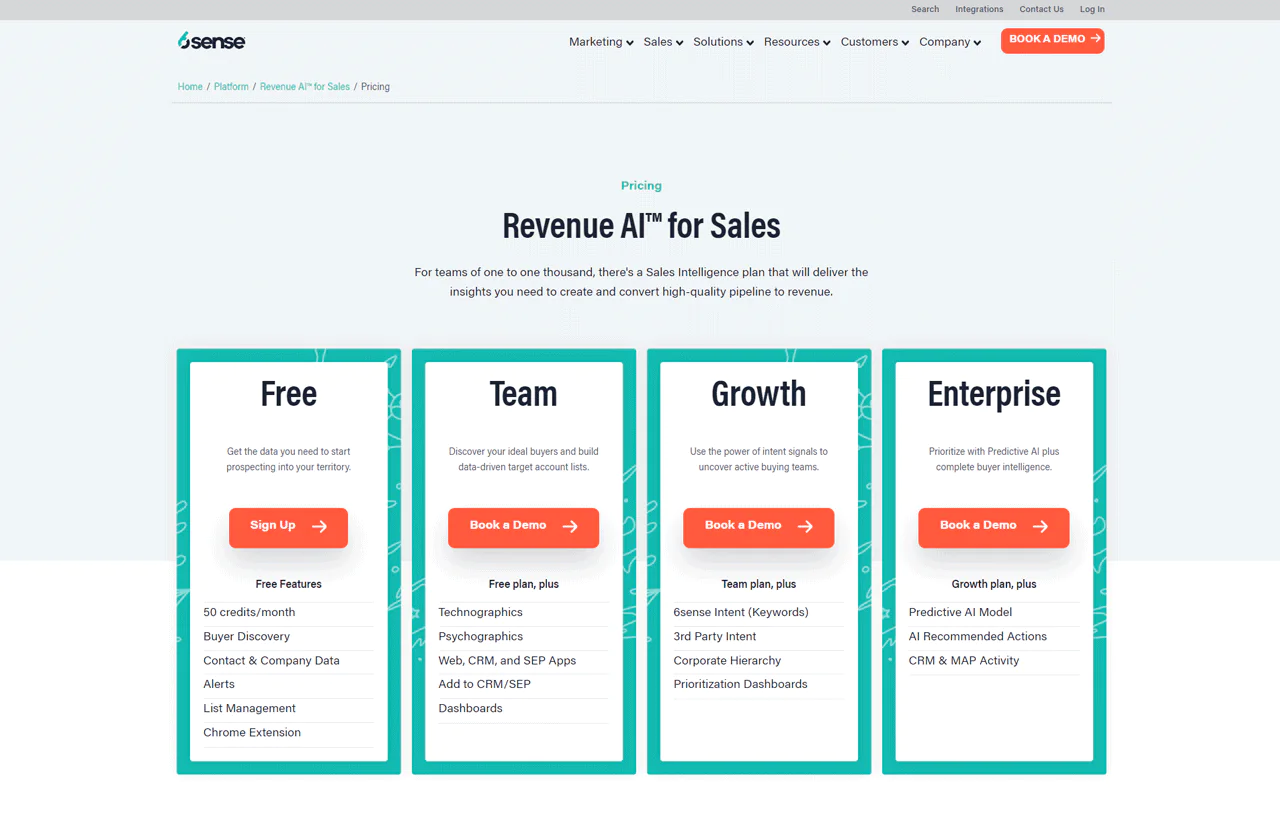
Pricing
They provide a free brief demo for your convenience and then you can customize a plan based on your needs.
What Users Say About 6sense
- G2: 4.4 · 726 reviews
“The data uncovered by Revenue AI, along with the Sales Intelligence feature, is absolutely amazing for understanding how your marketing is actually doing. It takes so much of the guess-work out of revenue attribution, and helps facilitate a more harmonious Sales<>Marketing alignment (which is critial when running a multi-threaded ABM approach).I could not recommend this feature enough.” – Katya Z.
- Capterra: 4.7 · 20 reviews
“The 6Sense platform provides a foundation for an account based marketing program and is a perfect platform for sales + marketing ABX/ABM. The ability to prioritize target accounts based on intent signals is key to making your sales and marketing efforts resonate with the right accounts, at the right time.” – Jaimie B.
Our Review of 6sense
6sense leans heavily into predictive AI. Its analytics dig into market trends and customer behavior patterns in more depth than most contact-database-first tools.
It’s particularly strong at surfacing demand that hasn’t surfaced anywhere else yet, which is the core promise behind most intent data platforms. Real-time intelligence for both marketing and sales is a genuine strength here, and data enrichment plus CRM integration round it out.
For teams centered on predictive analytics and intent signals rather than raw contact volume, 6sense is worth a serious look.
7. DemandScience
DemandScience is a leading company in the B2B generation sector, focusing on improving marketing and sales strategies. At the heart of its services is the Live Data Factory.
This facility uses advanced technology to provide businesses with precise intent data, enriched with important intent signals. By focusing on intent data, you can move customers from their first interest to their final purchase.
With its presence in seven countries, DemandScience extends its impact and effectiveness globally. The company offers a range of solutions like PureABM, PureSyndication, and PurePush.
It uses intent data to quickly find and connect with the right potential customers at different stages of the sales process.
About DemandScience
- Founding year: 2012
- Founding team: Melissa Chang and Barry Harrigan
- Company Size: 600 employees
Features of DemandScience
Notable features:
- First-Party Data Collection: DemandScience gathers information from its own marketing efforts, giving insights from direct customer interactions. This approach leads to a database that’s both accurate and relevant.
- Third-Party Data Integration: The platform combines data from different external sources, providing a fuller picture of the market and adding depth to the available data.
- Intent Signals Tracking: DemandScience monitors a wide array of intent topics, totaling over 7,000, to grasp potential buyers’ interests. This is key for spotting market trends and understanding what buyers want.
- Data Enrichment: The platform updates contact details regularly, ensuring they’re correct and current. It’s vital for successful marketing and sales activities.
- Machine Learning Classifications: DemandScience uses AI to sort and standardize data, making it easier for businesses to use and understand.
- Confirmed Connect Technology: This feature checks and confirms every email record for trustworthiness and precision.
- Continuous Data Updates: DemandScience frequently refreshes its data, keeping the database complete and aligned with the latest market trends.
Pros
- Accurate data from direct marketing campaign engagements.
- Wide market view with third-party data integration.
- Tracks a wide range of buyer intent topics.
- Regularly updated and enriched contact records.
- AI-driven data organization for ease of use.
Cons
- Intent data delays due to minor issues
Pricing
You can get it upon request.
What Users Say About DemandScience
- G2: 4.4 · 191 reviews
“The team at Demand Science is very involved in the programs they run with us. They are always helpful and walk me through each step of the process in getting our content syndication up running. I appreciate that they genuniely care about the success of the programs and provided great advice on nurturing leads.” – Ciera C.
- Capterra: 4.2 · 32 reviews
“PureB2B has been a great lead-gen vehicle consistently providing us with quality leads that fit our target market. Their team is extremely knowledgeable and they seamlessly integrate with our marketing automation software making lead delivery a breeze.” – Francois N.
Our Review of DemandScience
DemandScience combines first-party marketing engagement data with third-party sources, which gives it a wider market view than providers relying on a single data stream.
Tracking over 7,000 intent topics shows a genuine commitment to granular buyer research, and the platform’s ongoing data refresh cycle keeps records from going stale.
Overall, DemandScience is a solid fit for teams that want current, actionable B2B data paired with syndication and outreach tools already built in.
8. Dealfront
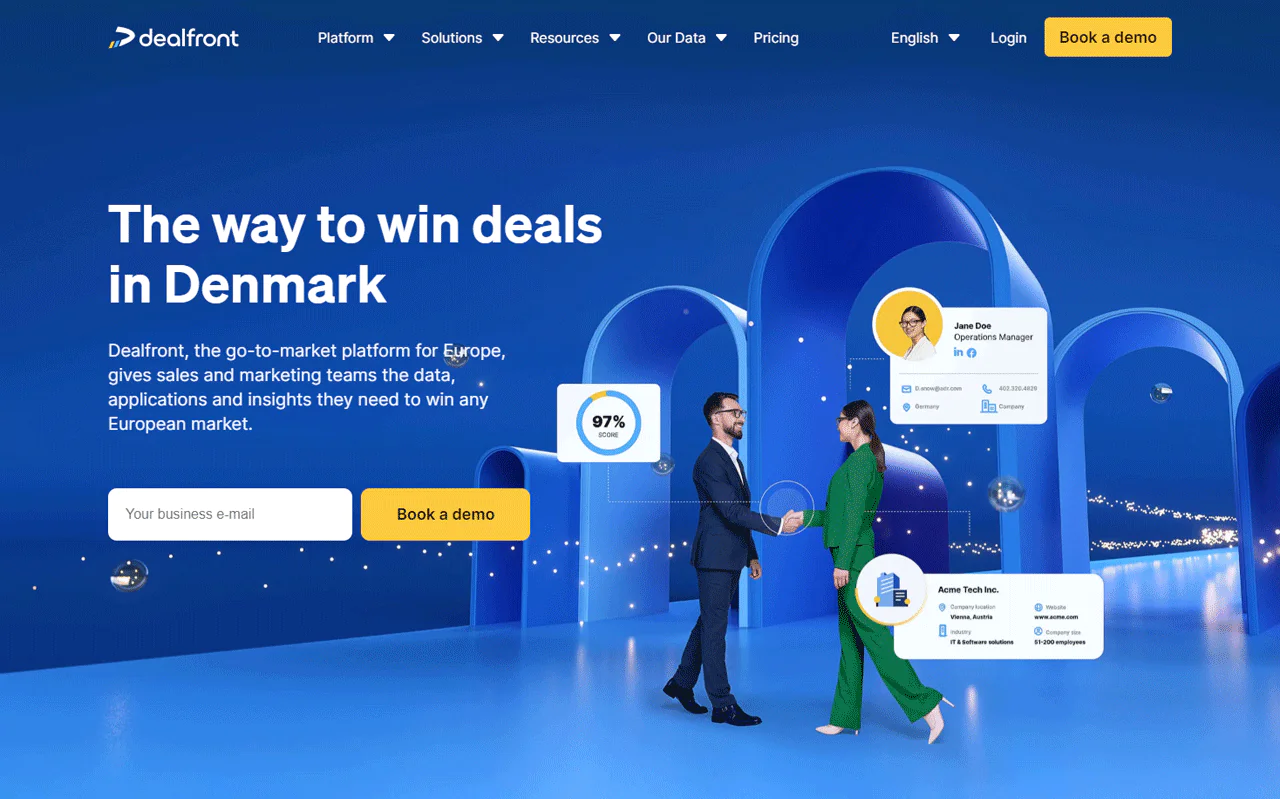
Dealfront, born from the union of Leadfeeder and Echobot, improves sales and marketing efforts. It excels in providing in-depth B2B data, particularly for the European market, and ensures compliance with GDPR standards.
The platform’s primary role is to monitor website visitors and convert them into promising sales leads. Besides, Dealfront’s tools are user-friendly and effective. They assist in comprehending sales prospects, pinpointing website visitors, and improving data quality.
Thus, you can stay informed about important events and news with Dealfront, which uses AI and machine learning.
One of Dealfront’s standout features is its thorough approach to data collection. It sources data from official trade registers and public records, as well as comprehensive financial data.
It’s especially useful for identifying key decision-makers and connecting with them.
About Dealfront
- Founding year: 2012
- Founding team: Melissa Chang and Barry Harrigan
- Company Size: 600 employees
Features of Dealfront
Its most important features:
- Lead Generation Tool: Dealfront’s system is designed to pinpoint promising leads and establish connections with sales-ready contacts, in line with B2B data guidelines.
- Website Visitor Tracking: This feature identifies unknown companies visiting your website and transforms them into potential leads for your CRM system.
- Combined Data Sources: Dealfront blends information from its direct marketing efforts with data from other sources, offering a more comprehensive market overview.
- Company Event and News Tracking: This service keeps an eye on significant happenings and updates related to companies, providing valuable information for sales and marketing strategies.
- Website Traffic and IP Analysis: Dealfront scrutinizes the activities of companies on your site, helping in understanding their specific interests.
- Detailed European Company Data: Specializing in the European market, Dealfront delivers thorough data on numerous companies and contacts across Europe.
- Commitment to GDPR and Data Standards: Dealfront is dedicated to complying with GDPR, ensuring its data handling adheres to the highest standards of European data protection.
Pros
- Precise tracking of potential leads from website visits.
- Broad market understanding using diverse data.
- Regular updates on important company developments.
- Detailed website visitor behavior analysis for strategy.
- Large collection of data on European businesses.
Cons
- Limited focus outside of Europe.
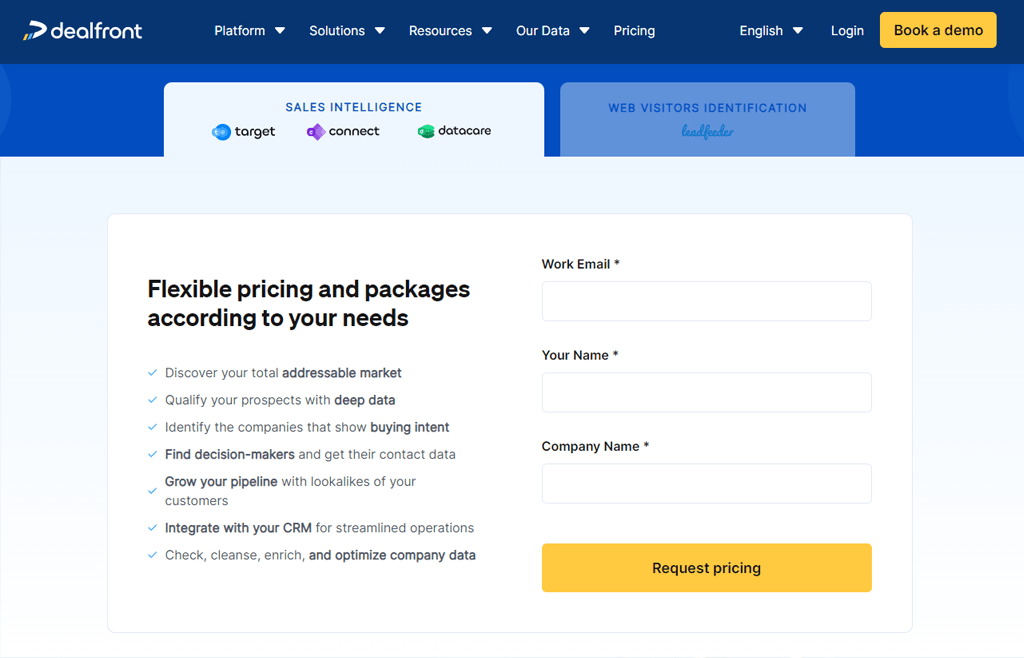
Pricing
Dealfront offers customized pricing plans based on individual business requirements. Their approach involves starting with a foundational price, with the option to include additional features depending on your specific needs.
For detailed pricing information that matches your unique situation, it’s recommended to contact them directly.
What Users Say About Dealfront
- G2: 4.3 · 770 reviews
“We’re able to customize our feeds to allow a focus on our target markets.” – Pam J.
- Capterra: 4.3 · 129 reviews
“The ease of use. This program is very intuitive to use. Additionally I like how robust the custom feeds feature is. I can set up any number of feeds from repeat visitors to how they actually came to our website (google cpc, bing cpc, organic, etc.)” – Robert E.
Our Review of Dealfront
Dealfront’s approach to B2B data and sales intelligence is solid, especially for teams targeting Europe. Combining the former Leadfeeder and Echobot products gives it a well-rounded feature set for sales and marketing.
Its detailed and GDPR-conscious B2B data, geared specifically toward the European market, is the main reason to consider it over a US-centric provider. Dealfront is genuinely good at spotting potential leads from website traffic and nurturing them into real sales prospects.
It also tracks a wide range of company events, giving a fuller picture of target businesses, and its European company database is continuously updated.
9. Lead Onion
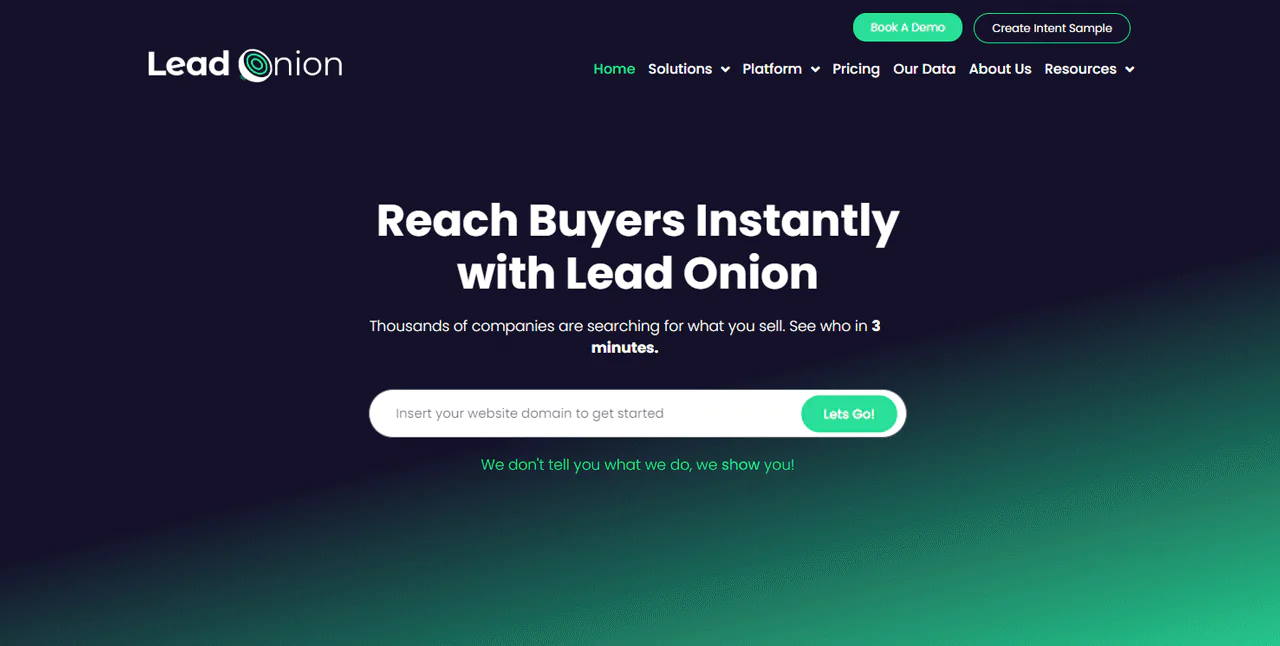
Lead Onion is a tool that transforms how sales and marketing are done. It uses 17 different sources of Intent data and a detailed B2B Contact Database to help users find and connect with the right prospects quickly.
The platform is known for its up-to-date, compliant data on B2B buyer intentions. It makes creating and sorting lead lists to fit specific buyer profiles easy and stress-free. Lead Onion also brings advanced lead intelligence and AI-driven tools for sales outreach, making campaigns more effective.
With Lead Onion, you can save time on manual research, get better response rates, and boost campaign success. This makes it an essential tool for small and medium businesses, marketing agencies, and recruitment firms.
About Lead Onion
- Founding year: 2020
- Founding team: Michael Carlin
- Company Size: 11 to 50 employees
Features of Lead Onion
The major features of Lead Onion:
- 18 Sources of Buyer Insights: Lead Onion gathers data from 18 varied sources, offering a wide view of what buyers are interested in.
- Comprehensive Intent Data: The platform merges data from direct interactions and external studies, giving a fuller picture of what buyers want.
- Regulation-Compliant Contact Information: Lead Onion ensures all its contact data meets GDPR and global data standards, making it both safe and reliable.
- Monitoring Content Engagement: The service tracks engagement across a wide array of content, providing insights into what captures your audience’s attention.
- Direct Contact Access: Lead Onion offers direct phone and email details, simplifying the process of contacting key decision-makers.
- Targeted List Creation: Utilizing specific company tech and demographic data, the platform helps in crafting precisely targeted marketing lists.
- Identifying Active Buyers: Lead Onion pinpoints companies currently in the market to buy, focusing your efforts on the most viable leads.
Pros
- Real-time messaging enhances instant communication.
- Comprehensive task management system.
- In-depth monitoring of content interactions for better audience understanding.
- Targeted marketing using detailed company and demographic data.
- Quickly identifies businesses looking to buy.
Cons
- Mainly suitable for B2B, less so for other areas.
Pricing
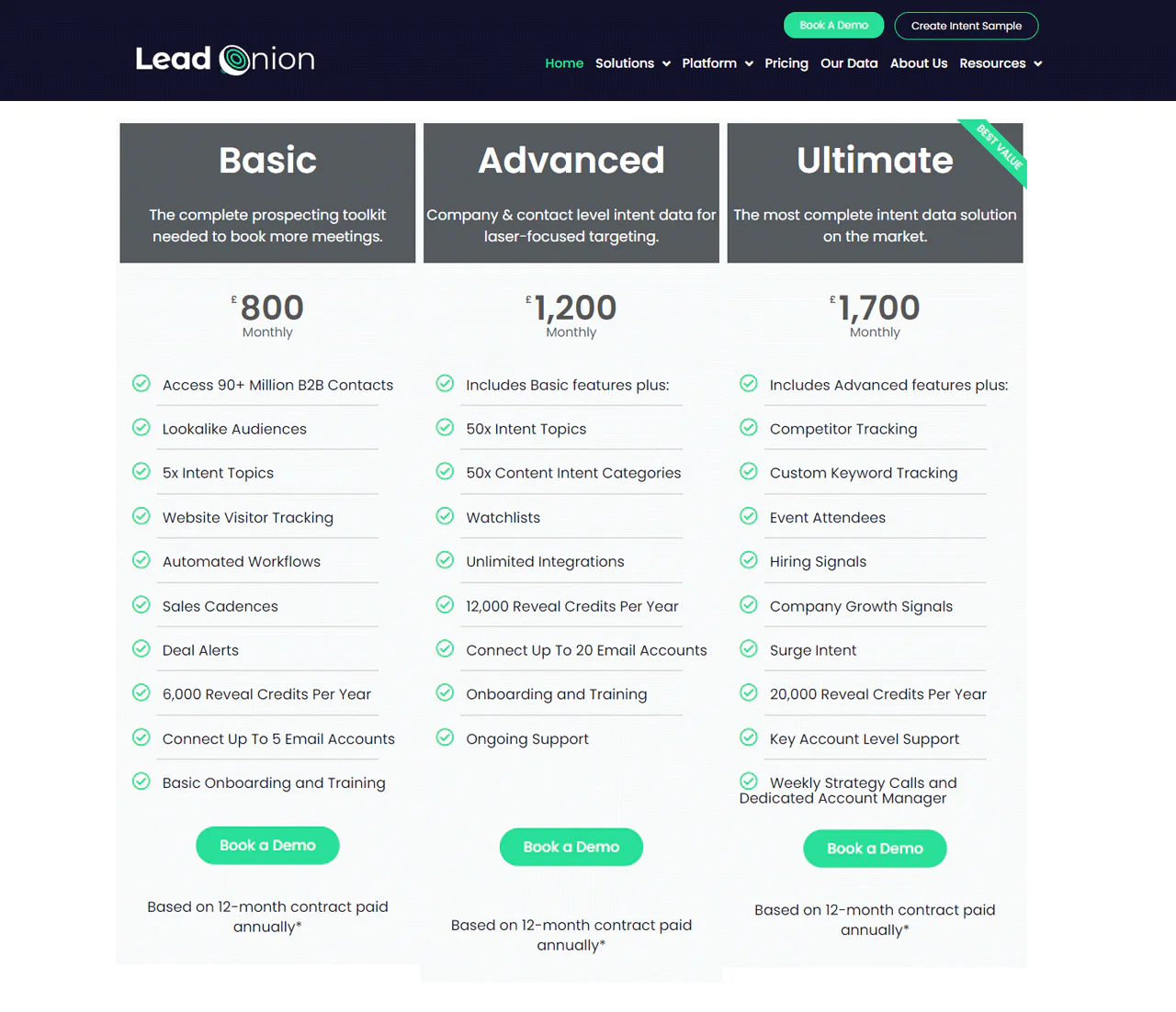
Lead Onion’s pricing is designed to match your specific requirements and budget. They offer plans suitable for different business sizes. The ‘Basic’ option costs £800 per month and gives you access to over 90 million B2B contacts and 6,000 credits annually.
If you need more, the ‘Advanced’ plan at £1,200 monthly includes 50x more intent topics and 12,000 credits. For the most in-depth service, the ‘Ultimate’ plan at £1,700 monthly offers the fullest range, including competitor analysis and 20,000 credits.
With Lead Onion, you’re charged only for the leads you actively choose, making it an efficient choice for your B2B lead generation strategy.
What Users Say About Lead Onion
- G2: 4.3 · 22 reviews
“Lead Onion is a great marketing and sales tool. It combines what every Marketing person wants to see with the kind of that every Sales person wants to get.It’s the first tool I access every morning. The implementation took no time at all and they helped us with all the integration and support we needed.” – Brunna T.
Our Review of Lead Onion
Lead Onion combines sales engagement functionality with a fairly deep B2B contact database, and it’s genuinely good at quickly flagging companies that look ready for a sales conversation.
Pulling from 18 different intent sources gives it a varied read on buyer interest, which cuts down on manual research time considerably.
AI-driven outreach and automated workflows help push conversions along. It’s a practical fit for small to medium businesses and agencies working in sales, marketing, or recruitment.
10. Terminus
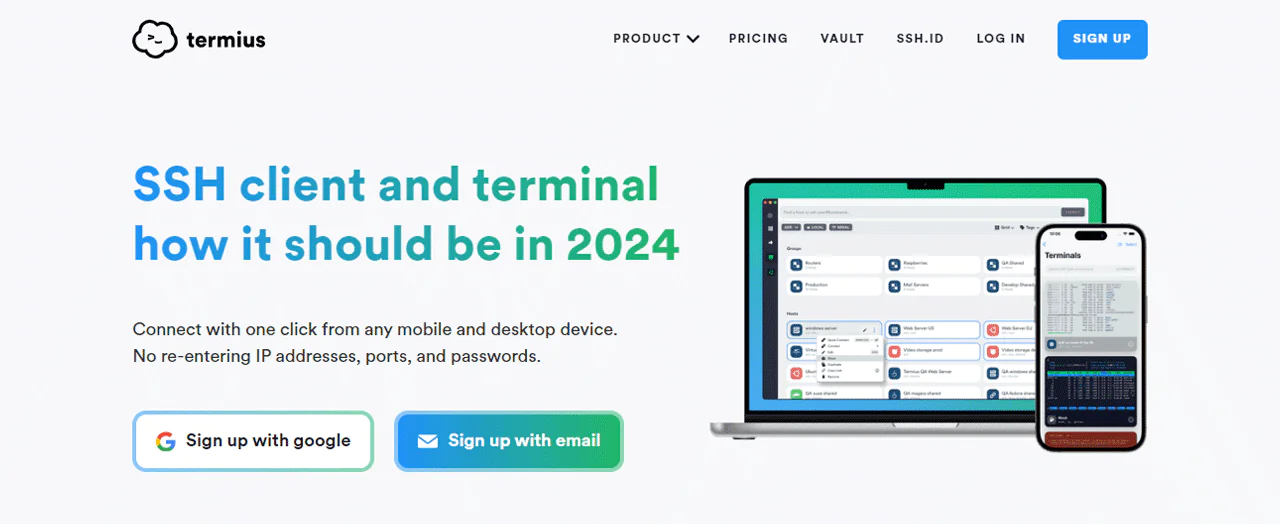
With over 200 million business professionals in its database, Terminus stands out as a leading account-based marketing software. It’s achieved using both proprietary and cookie data.
Terminus not only focuses on accounts but also offers insights into engagement, funnel progression, and media spending. It smoothly integrates with Salesforce CRM, allowing for a more simplified advertising experience for each account.
What makes Terminus unique is its ability to pinpoint the exact individuals associated with a particular brand or business. It then reaches out to these individuals across various platforms, including web, mobile, and social.
As a result, persona-based campaigns deliver the right messages.
Moreover, Terminus Cloud for ABM provides users with the ability to design, implement, and scale an account-based marketing solution.
About Terminus
- Founding year: 2014
- Founding team: David Cummings, Eric Vass, Eric Spett, and Sangram Vajre
- Company Size: 201 to 500 employees
Features of Terminus
Significant features:
- Unified Strategy for Market Success: Terminus enhances teamwork across sales, marketing, and operations, combining and improving data for smarter strategies and decisions.
- All-Around Multi-Channel Approach: This feature ensures a full, varied approach to engage your key accounts effectively and on time.
- Comprehensive Reporting: Terminus merges different data types to give you a clear picture of your program’s performance, helping you make informed choices.
- Identifying Active Buyers: The platform spots accounts looking to buy, both new and existing in your CRM, helping you focus your marketing.
- Effective B2B Advertising: Terminus targets every member involved in the buying process, making sure your marketing budget is used wisely.
- Interactive Chat Features: The platform lets visitors on your website talk directly with your team, driving interaction and information sharing.
- Customizing Website Experiences: Terminus enables you to tailor visitor experiences on your website, improving engagement and the likelihood of conversion.
Pros
- Delivers a varied approach for engaging customers.
- Gives detailed, unified reports for better choices.
- Quickly finds and focuses on potential buyers.
- Makes B2B advertising more effective for reaching important buyers.
- Customizes website visits to increase user interaction.
Cons
- Mainly designed for B2B, not as effective for B2C.
Pricing
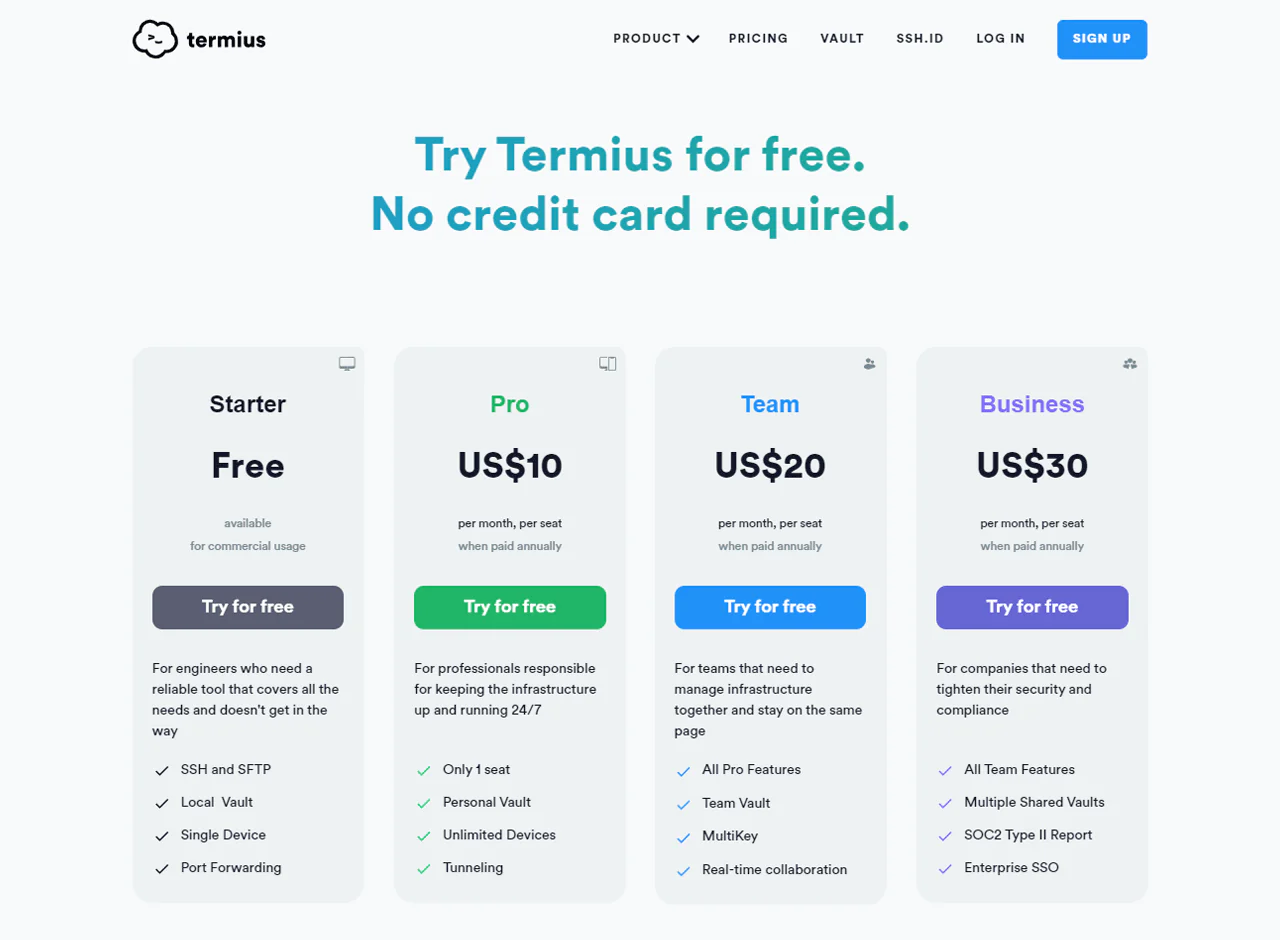
They offer a demo where they learn about your business and mechanism. And then, you can ask for a customized plan with pricing.
What Users Say About Terminus
- G2: 4.4 · 453 reviews
“Besides being user-friendly, easy-to-implement, loaded with exceptional features, easy-to-integrate with, this ABM tool is built to target clients/markets with military precision. Unlike any similar tool out there. It’s backed by outstanding user support too. An ABM tool that hunts and helps capture reliably.” – Cynthia C.
Our Review of Terminus
Terminus is effective at driving coordinated B2B growth because it ties sales, marketing, and operations into a single dataset rather than three siloed systems.
What stands out is its ability to run a rich, multi-channel experience for key accounts. Layering intent data and unified reporting on top of standard ABM tactics gives a deeper read on where accounts actually stand.
The platform is clearly built around personalized, relevant buyer experiences, and it’s designed to turn those insights into concrete pipeline and revenue actions rather than just dashboards.
Why Should You Use Intent Marketing Tools?
Intent marketing tools offer several advantages. They provide detailed insights about website visitors, such as company size, revenue, and industry, helping you understand your ideal customer and validate lead information.
These tools guide on how to approach potential customers, leading to benefits like:
Better Understanding Of Your Audience
You can get a clearer picture of who you’re targeting by looking at various details, like the company’s size, the technology they use, and personal demographics. This helps your team decide which leads to focus on and which ones might not be the right fit.
More Effective Campaigns
With detailed data, marketing campaigns can be more accurately designed to address the specific requirements of different customer segments. This precision leads to higher engagement and conversion rates.
Personal Touch
Sending messages that feel personal can make a big difference in B2B sales. When you address prospects by their name and role, and offer content that fits their current needs, they’re more likely to engage.
Better Customer Support
Intent data allows for a deeper understanding of customer behavior and preferences. This knowledge enables you to offer more personalized support, improving the overall customer experience and fostering loyalty.
What are the Intent Data Collection Methods?
Collecting intent data comes down to understanding two broad types.
First-Party Intent Data
Use your website’s analytics tools to track what visitors do, like form submissions. Plus, engage these visitors with ads or emails to turn their interest into sales.
This method is effective if they’re on your site looking for solutions you offer.
Third-Party Intent Data
When prospects are on other sites, you need data from external sources. Now, you can buy this data from third-party vendors who monitor various B2B sites and media publishers.
They track online activities and analyze how content is consumed over time. Look for spikes in topic searches, which signal strong buyer interest. These spikes, identified by algorithms, help you target prospects with relevant ads at the right time.
Important Pricing Facts to Consider While Choosing Best Intent Data Providers
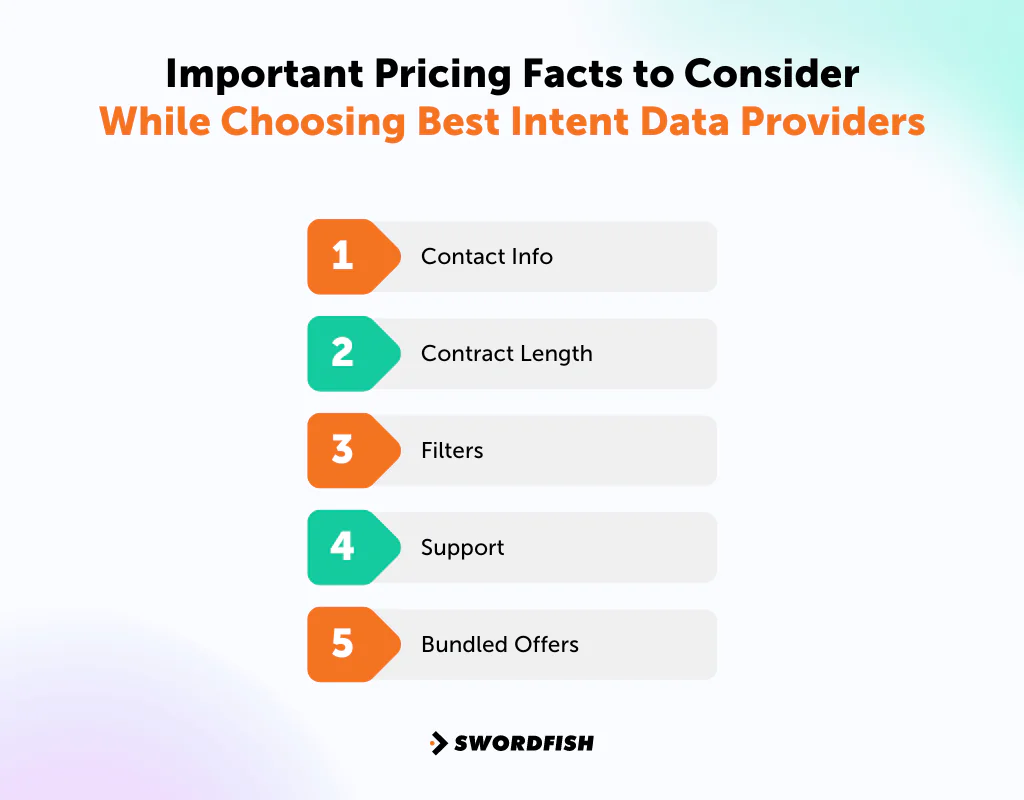
When it comes to pricing, it’s worth understanding exactly what you’re paying for:
Contact Info
Some companies offer basic details like names and company contacts. Others provide direct contact info like emails and phone numbers. It’s important to know how accurate and relevant this information is.
If a company gets its data from multiple places, it might be more reliable.
Contract Length
Some companies want you to sign up for three years, others for just one year or even a few months. While technology and its effectiveness keep evolving, shorter contracts might seem less risky.
However, longer contracts might come with discounts.
Filters
If you’re new, you might get too much data. Good filters can help. Some tools let you set up profiles of your ideal customers and then filter the data to match. It’s also handy if you can easily move this data to your other marketing tools.
Support
Since intent data is still relatively new to many teams, learning how to use it well is key. Some tools are straightforward, while others have a steeper learning curve. A good vendor will guide you from the start and offer strong support.
Bundled Offers
Some companies include intent data in a bigger software package. This means you’re paying for multiple features. It’s best to choose packages where you’ll use most of the tools.
A few tools can even be combined for more detailed results, like pairing intent data with tools that help identify potential buyers in a company.
How Do You Pick the Right Intent Data Software?
Choosing the right intent data software from so many options can be tricky. Here’s what to consider:
- Integration: Make sure the software works well with your existing marketing tools. This helps you use the data smoothly in your campaigns.
- Customization: Good software lets you filter and group data. This way, you can focus your campaigns on the right people.
- Reporting: Look for tools that offer clear analytics. This helps you see how well you’re doing and where you might need to change things up.
- Cost: Find software that fits your budget. Check what features it offers and its monthly price to see if it’s a good deal.
- Reviews: While reviews can’t tell you everything, they can give you a sense of how useful a tool is, its features, and the quality of its support.
Understanding what intent data actually is, and isn’t, will help you make a more informed choice. Weigh your business needs against what each tool actually offers, rather than the feature list alone.
What are the Common Features of Buyer Intent Data Providers?
Buyer intent data providers are helpful assistants for businesses, giving them insights into what potential customers might be interested in. This information is vital for shaping marketing and sales strategies.
Here’s a breakdown of the features that tend to show up across most of these platforms.
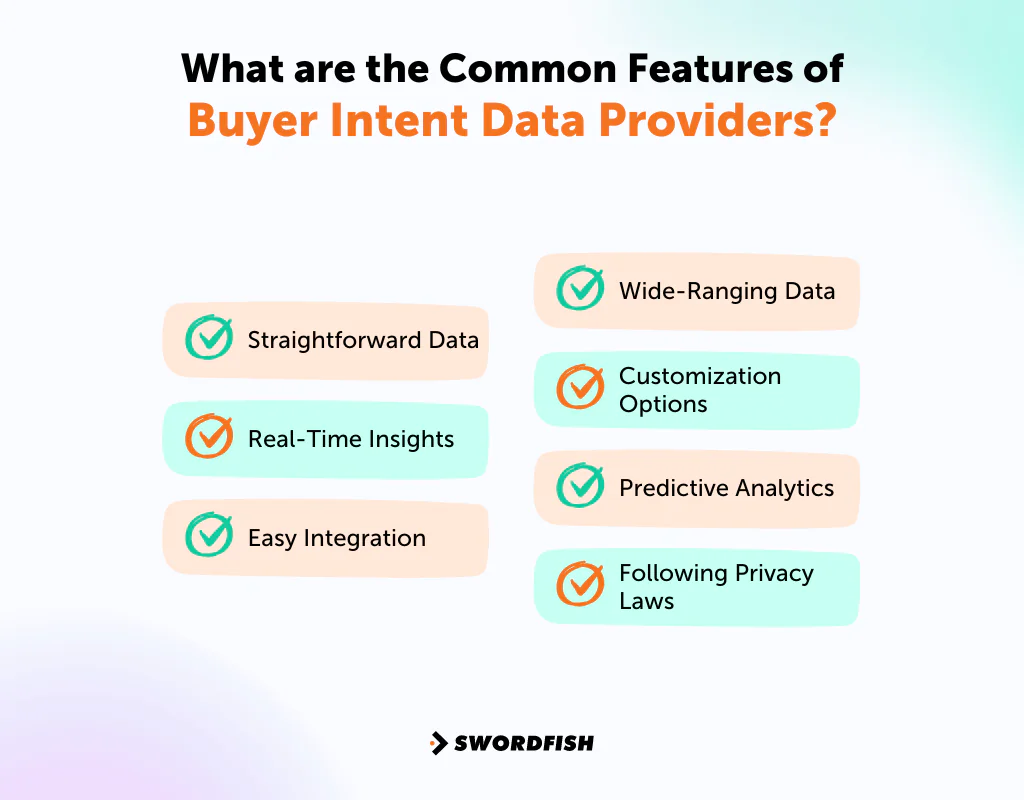
Straightforward Data
These providers offer data in a way that’s easy for everyone to understand, not just those who are experts in data. It means businesses can quickly figure out what their potential customers are looking for.
Real-Time Insights
They provide information that’s updated in real-time. In this way, businesses can stay on top of buyers’ trends and interests, thereby making relevant and timely decisions.
Easy Integration
Most of these providers make sure their data can be easily combined with other marketing and sales tools. It makes things more efficient by simplifying various business operations.
Wide-Ranging Data
They offer a wide range of data, covering different market trends and customer interests in various areas. This broad coverage helps businesses get a complete picture of the market.
Customization Options
These services often include options to customize the data according to the specific needs and goals of a business. With this customization, the data is more relevant and useful.
Predictive Analytics
Many providers use techniques to predict future market trends and customer behaviors. This foresight gives businesses an advantage in planning their strategies.
Following Privacy Laws
All of these providers are in compliance with the laws relating to data privacy. It means they make sure the data is collected and used in a way that’s legal and ethical.
Conclusion
Intent data has become a real fixture in digital marketing, and for good reason. Tapping into a buyer’s online behavior gives you a meaningfully deeper read on who’s actually in-market versus who’s just a name on a list.
The mix of first-party, second-party, and third-party sources that B2B marketers rely on shows just how central intent data has become to modern go-to-market strategy.
Given the complexity of the buyer’s digital footprint today, a solid intent data provider is less a nice-to-have and more a core part of the stack, supplying not just raw signals but the tools to actually act on them.
If you’re still weighing your options, Swordfish AI is worth a look for pairing Bombora’s intent data with direct phone and email contact discovery, backed by a free trial.
So, try Swordfish today!
Frequently Asked Questions
Where do companies get data on intent?
Businesses learn about your preferences in several ways. They gather info from their websites, apps, and customer records. They can also get details by teaming up with other businesses. For instance, they might get an email list from a partner.
Lastly, some businesses buy data from outside sources. This data doesn’t show personal details but helps companies know what customers are looking for
What’s private intent data?
It’s information that shows when someone is looking online for a product or service, based on the websites and content they check out.
What’s a double data type?
It’s a type that can hold 64-bit decimal or floating-point numbers. It can store twice as much data as the float type. ‘Double’ is a standard data type.
Who sells the best intent data?
Choosing the best intent data provider really depends on what your business needs. Companies like Swordfish AI, Bombora, Lusha, and ZoomInfo all have different strengths.
Choosing the right one depends on how accurate their data is, how well they work with your other tools, and how much you can customize their services.