
 View Products


Last updated: September 3, 2026
Picking a recruitment CRM shouldn’t feel like guesswork, but with dozens of vendors all claiming to be the best fit, it often does. This guide breaks down 18 established platforms based on their feature sets, pricing, and the type of agency each one tends to suit best, whether you’re running a two-person shop or a firm making thousands of placements a year. We included options for small agencies with just a few recruiters and large companies that make thousands of hires each year, so you can match a platform to your actual workload rather than a marketing pitch.
A CRM is not just a tool, it’s a partner to your recruiting processes and candidate experience.
What Is Recruitment CRM Software?
An applicant tracking system manages the mechanics of a job requisition, from application to offer. A recruitment CRM does something different: it manages the relationship side of hiring, tracking every conversation you’ve had with a candidate or client, whether or not they’ve applied to anything recently.
In practice, that means a CRM keeps your candidate conversations in one place, resurfaces people you spoke with months ago, automates routine follow-ups, and gives you visibility into where a relationship stands. In a market where strong candidates have multiple offers on the table, that history matters as much as the initial sourcing.
Key Benefits of Recruitment CRM Software
A well-implemented CRM changes how an agency operates day to day. Here’s where the impact tends to show up first.
Better Candidate Experience
Candidates expect fast, personal responses during a job search. AI-assisted matching and messaging help recruiters respond quickly without sending generic, obviously automated notes, which matters when top candidates are fielding outreach from several agencies at once.
Less Manual Administration
Modern CRMs automate a large share of repetitive tasks, data entry, status updates, follow-up sequences, freeing recruiters to spend more time actually talking to people rather than updating records.
Better-Informed Decisions
Platforms with built-in analytics can surface patterns in your pipeline data: where candidates drop off, which sources produce placements, and where bottlenecks are slowing time-to-fill.
Improved Team Coordination
Shared visibility into candidate records and communication history reduces the duplicate outreach and dropped handoffs that happen when recruiters work from separate notes or spreadsheets.
Essential Features to Look for in Recruitment CRM Software
Not every feature matters equally. Here’s what tends to make the biggest difference in daily use.
Core Database Management
A solid central database with reliable search, custom fields, and relationship mapping is the foundation everything else sits on. Look for platforms that don’t cap storage or bury search behind clunky filters.
AI-Powered Automation
AI has moved from a differentiator to a baseline expectation across most stages of the hiring pipeline. Look for:
- Intelligent Resume Parsing: multi-lingual support helps remote recruiters process candidate information without manual translation
- Predictive Candidate Matching: algorithms that weigh skills, experience, and fit signals
- Automated Email Sequences: triggers that send personalized follow-ups based on candidate behavior
Communication and Engagement Tools
Built-in email, SMS, and calling with templates, bulk messaging, and a logged communication history. The better platforms let recruiters tailor outreach based on a candidate’s interests and prior interactions rather than sending the same message to everyone.
Analytics and Reporting
You want visibility into placement rates, time-to-fill, source effectiveness, and individual recruiter performance, ideally through dashboards you can actually read without exporting to a spreadsheet.
Integration Capabilities
Connectivity with job boards, social platforms, email systems, and other HR tools matters more than any single feature. Social integrations in particular help recruiters reach passive candidates who aren’t actively applying anywhere.
18 Best Recruitment CRM Software Platforms
Here’s how the top platforms compare on strengths, fit, and pricing.
1. Bullhorn

Bullhorn remains the default pick for established staffing firms that need enterprise-grade features and can support the complexity that comes with them. It handles multi-step hiring workflows well and pairs that with detailed reporting.
- Best For: Big agencies and established companies that need full-featured software
- Key Strengths: Smart automation, connects with many other tools, helpful customer support
- Starting Price: Custom pricing (usually $99-199 per person each month)
2. Recruit CRM

Recruit CRM pairs an intuitive interface with AI features that don’t require heavy setup, which is why it comes up often as an easy-to-customize ATS/CRM combination.
- Best For: Mid-size agencies seeking balance of power and usability
- Key Strengths: AI-powered resume parsing, workflow automation, excellent customer support
- Starting Price: $95/user/month
3. Recruiter flow

Recruiterflow’s drag-and-drop pipeline boards and automation make it a strong fit for staffing firms that are actively growing and want less friction in day-to-day pipeline management.
- Best For: Growing agencies prioritizing user experience and automation
- Key Strengths: Intuitive interface, advanced automation, strong job board integrations
- Starting Price: $99/user/month
4. Manatal

Manatal helps agencies juggling multiple client accounts keep each engagement organized within one system, using AI-driven recommendations to speed up shortlisting.
- Best For: Agencies managing multiple clients with diverse hiring needs
- Key Strengths: AI-driven candidate recommendations, multi-client management, affordable pricing
- Starting Price: $15/user/month
5. Loxo

Loxo bundles ATS, CRM, outbound sourcing, and data tools into a single Talent Intelligence Platform, which cuts down on the number of separate tools an agency has to stitch together.
- Best For: Agencies wanting an all-in-one talent intelligence solution
- Key Strengths: Comprehensive platform, advanced sourcing, talent intelligence
- Starting Price: Custom pricing
6. Greenhouse

Greenhouse leans into collaborative hiring and candidate experience, with solid automation and a wide integration catalog. It’s priced accordingly, so it’s a better fit once budget matches the feature depth.
- Best For: Enterprise organizations with complex hiring processes
- Key Strengths: Collaborative hiring tools, extensive integrations, candidate experience focus
- Starting Price: Custom pricing (enterprise-level)
7. Zoho Recruit

If your agency already runs on Zoho apps, Zoho Recruit is an easy addition, solid core functionality at a price that’s hard to beat for smaller teams.
- Best For: Small to medium agencies seeking cost-effective solutions
- Key Strengths: Affordable pricing, Zoho ecosystem integration, scalable features
- Starting Price: $25/user/month
8. JobAdder

JobAdder is a cloud platform with strong reporting and integration options, a good match for agencies that lean on data to guide workflow decisions.
- Best For: Data-driven agencies requiring detailed analytics
- Key Strengths: Robust reporting, cloud infrastructure, integration ecosystem
- Starting Price: $99/user/month
9. Crelate

Crelate’s platform focuses on turning an agency’s existing database into an active asset, using AI enrichment to keep records current rather than letting them go stale.
- Best For: Agencies wanting to maximize their existing talent database
- Key Strengths: AI-powered database enrichment, relationship management, adaptive platform
- Starting Price: $119/user/month
10. Vincere

An end-to-end recruitment solution with advanced analytics and excellent user experience. Vincere offers strong customization to fit an agency’s specific workflows rather than forcing a one-size-fits-all process.
- Best For: Agencies requiring highly customizable workflows
- Key Strengths: Advanced analytics, customization options, user-friendly interface
- Starting Price: $99/user/month
11. TalentLyft

TalentLyft blends ATS and CRM functions with marketing automation built in, useful for agencies that want to run structured campaigns to reach passive candidates.
- Best For: Agencies focusing on talent marketing and candidate attraction
- Key Strengths: Marketing automation, candidate engagement tools, comprehensive features
- Starting Price: $79/user/month
12. Firefish

Firefish combines recruitment and marketing tools in one platform, aimed at agencies that treat employer branding and candidate engagement as part of the same job.
- Best For: Agencies prioritizing recruitment marketing and employer branding
- Key Strengths: Marketing integration, candidate engagement, modern interface
- Starting Price: Custom pricing
13. Lever

Lever puts a strong emphasis on team communication and candidate engagement, backed by solid analytics and customization options.
- Best For: Team-focused agencies prioritizing collaboration
- Key Strengths: Team collaboration tools, analytics, candidate engagement
- Starting Price: Custom pricing
14. Avature

Avature is built for large-organization complexity, but its customization also scales down reasonably well for smaller teams that expect to grow into it.
- Best For: Organizations requiring extensive customization and scalability
- Key Strengths: High customization, scalable architecture, advanced features
- Starting Price: Custom pricing
15. SmartRecruiters

SmartRecruiters is built for enterprise hiring teams that need to manage large talent communities, not just individual open roles.
- Best For: Enterprise teams focusing on talent community building
- Key Strengths: Talent community tools, enterprise features, scalability
- Starting Price: Custom pricing
16. Workable

Workable covers the whole hiring lifecycle, sourcing through onboarding, and its AI Recruiter feature ranks candidates against criteria you define upfront.
- Best For: SMBs seeking comprehensive hiring functionality
- Key Strengths: AI-powered screening, comprehensive features, user-friendly interface
- Starting Price: $299/month
17. iSmartRecruit

iSmartRecruit pairs an ATS and CRM in one modern package, geared toward recruiters, staffing firms, and internal HR teams that want to streamline processes without a steep learning curve.
- Best For: Modern agencies wanting cutting-edge technology
- Key Strengths: Modern interface, comprehensive functionality, competitive pricing
- Starting Price: $95/user/month
18. PCRecruiter

PCRecruiter offers extensive customization and dependable performance, with a design aimed at agencies of varying sizes rather than one specific tier.
- Best For: Agencies requiring extensive customization options
- Key Strengths: High customization, robust performance, comprehensive features
- Starting Price: Custom pricing
How Swordfish Supercharges Your Recruitment CRM
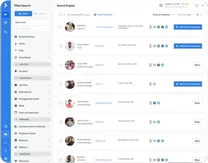
A recruitment CRM is only as useful as the contact data feeding it. Swordfish exists to solve that half of the problem, giving recruiters access to verified email addresses and phone numbers pulled from a database spanning 200+ live data sources, instead of manually chasing down contact details candidate by candidate.
Real-Time Verification
Swordfish.ai verifies email deliverability and phone connectivity in real time, so outreach is aimed at contact points that are actually live rather than stale or bounced entries.
Seamless CRM Integration
Swordfish connects directly with most major recruitment CRMs, enriching candidate profiles automatically instead of forcing recruiters to copy data between platforms manually.
Advanced Sourcing Capabilities
Whether the role is technical or executive-level, the underlying data coverage spans industries and seniority levels, which helps when a single agency is juggling very different types of searches.
Compliance and Privacy
Data practices are designed around GDPR and CCPA requirements, which matters for agencies that need to document where candidate contact data comes from.
Pricing That Scales With Your Agency
- Free Trial: 10 credits to test the platform
- Unlimited Solo: $99/month for individual recruiters
- Unlimited Teams: Starting at $299/month for teams up to 5 users
- Enterprise: Custom pricing for larger organizations
Start your free trial and see how quality contact data can transform your recruitment results.
Choosing the Right Recruitment CRM for Your Agency
For Small Agencies (1-10 Recruiters)
Focus on platforms offering solid value with essential features. Manatal and Zoho Recruit deliver strong functionality at budget-friendly prices, while Recruit CRM offers more advanced features with transparent pricing and solid support.
For Growing Agencies (11-50 Recruiters)
Prioritize scalability and automation. Recruiterflow and JobAdder both offer meaningful automation without becoming overwhelming, while Crelate stands out for agencies focused on long-term database building.
For Enterprise Agencies (50+ Recruiters)
Consider platforms with deep customization and enterprise-grade security. Bullhorn, Greenhouse, and Avature all offer the scalability and feature depth that complex recruitment operations tend to need.
2025 Recruitment CRM Trends to Watch
AI-Powered Candidate Matching
AI-driven matching analyzes large volumes of candidate data to surface stronger candidate-to-job fits, cutting down the manual screening that used to eat up a recruiter’s day.
Predictive Analytics
More CRMs now offer forward-looking analytics that attempt to forecast candidate behavior and hiring outcomes, not just report on what already happened.
Enhanced Integration Ecosystems
Social media integrations widen the reach for sourcing, especially for finding passive candidates who aren’t actively browsing job boards.
User Experience Focus
Vendors are investing more in interface design, since a CRM that requires extensive training tends to see lower actual adoption from recruiting teams, regardless of how strong the feature list looks on paper.
AI and automation are shifting from premium add-ons to baseline expectations across this category. Agencies that adopt integrated, well-supported platforms early tend to have an edge in competitive hiring markets.
Conclusion
The right recruitment CRM depends less on feature checklists and more on fit: agency size, budget, and how much customization your workflows actually need. Pairing that platform with reliable contact data, through a tool like Swordfish, helps agencies spend less time chasing information and more time building the relationships that lead to placements.
About the Author
Drew Clark is Co-Founder and CRO at Swordfish.ai and Heartbeat.ai, where he’s spearheaded sales operations since 2019. Drew works with sales, recruiting, and marketing teams to develop outbound strategies, leading to 25+ new business demonstrations per week. Based in England, Drew brings over 6 years of B2B sales leadership experience. Connect with Drew on LinkedIn.
Frequently Asked Questions
What is the difference between a recruitment CRM and an ATS?
An ATS tracks people who’ve already applied for a specific job, from resume submission through hire or rejection. A recruitment CRM tracks relationships with people who might be strong candidates in the future, whether or not they’ve applied to anything currently open, so you can stay in touch over months or years.
What are the must-have features for recruitment CRM software in 2025?
Core AI Features:
- Smart resume parsing in multiple languages
- AI candidate matching for jobs
- Automated email follow-ups
- Predictive hiring analytics
Database & Search:
- Unlimited candidate storage
- Advanced search by skills/location
- Automatic contact updates
- Communication history tracking
Essential Integrations:
- Email platforms (Gmail, Outlook)
- Job boards posting
- LinkedIn import
- Calendar sync
Automation Tools:
- No-code workflow builder
- Automatic task assignment
- Interview scheduling
- Pipeline management
Analytics:
- Real-time dashboards
- Performance tracking
- Custom reports
- ROI measurement
Mobile & Security:
- Mobile-friendly access
- GDPR compliance
- Data encryption
- Role-based permissions
Support:
- 24/7 customer help
- Easy data migration
- Simple user interface
- Fast loading speeds
The key is finding a CRM that combines these features in a package your team will actually adopt and use consistently, rather than one that looks impressive in a demo.
How can a recruitment CRM benefit my business?
By automating data entry and routine follow-ups, a CRM reduces manual administrative work and frees recruiters to spend more time on candidate and client relationships rather than paperwork. Faster fills and better-maintained client relationships tend to follow from that shift.
Better organization and matching also tends to improve placement quality, and the efficiency gains make it easier to scale without adding headcount at the same rate as your hiring volume grows.
How should I choose the right recruitment CRM for my business?
Start with your agency’s size and budget: smaller teams under 10 recruiters generally do better with affordable, low-friction options like Manatal or Zoho Recruit, while larger firms have more reason to consider enterprise platforms like Bullhorn or Greenhouse. Run a free trial before committing, so you can confirm your team can use it without a long ramp-up period.
Check that it integrates with the tools you already rely on, email, job boards, LinkedIn, and prioritize vendors that offer real support and data migration help. Switching systems later is expensive and disruptive, so it’s worth getting the choice right the first time.
How can I measure the ROI of recruiting software?
Track time-to-fill, cost-per-hire, and placement volume before and after implementation, then weigh those numbers against the software’s cost and the recruiter hours it frees up. If a CRM saves each recruiter meaningful time each week, that adds up quickly across a full team, and most agencies expect to see the impact show up in faster placements and lower administrative overhead within a few months.
Are there any industry-specific recruiting solutions?
Several recruitment software vendors build industry-specific versions of their platforms for sectors like healthcare, technology, finance, or manufacturing, with workflows, compliance tools, and integrations tailored to each field’s requirements.
Healthcare recruiting software often includes credential tracking and HIPAA-related compliance features, while tech-focused platforms tend to integrate with coding assessments and developer communities. Agencies operating in regulated industries should prioritize vendors with a documented track record in that field, since it shortens implementation and reduces the risk of missing sector-specific compliance requirements.