
 View Products


Last updated: September 3, 2026
- Core concept
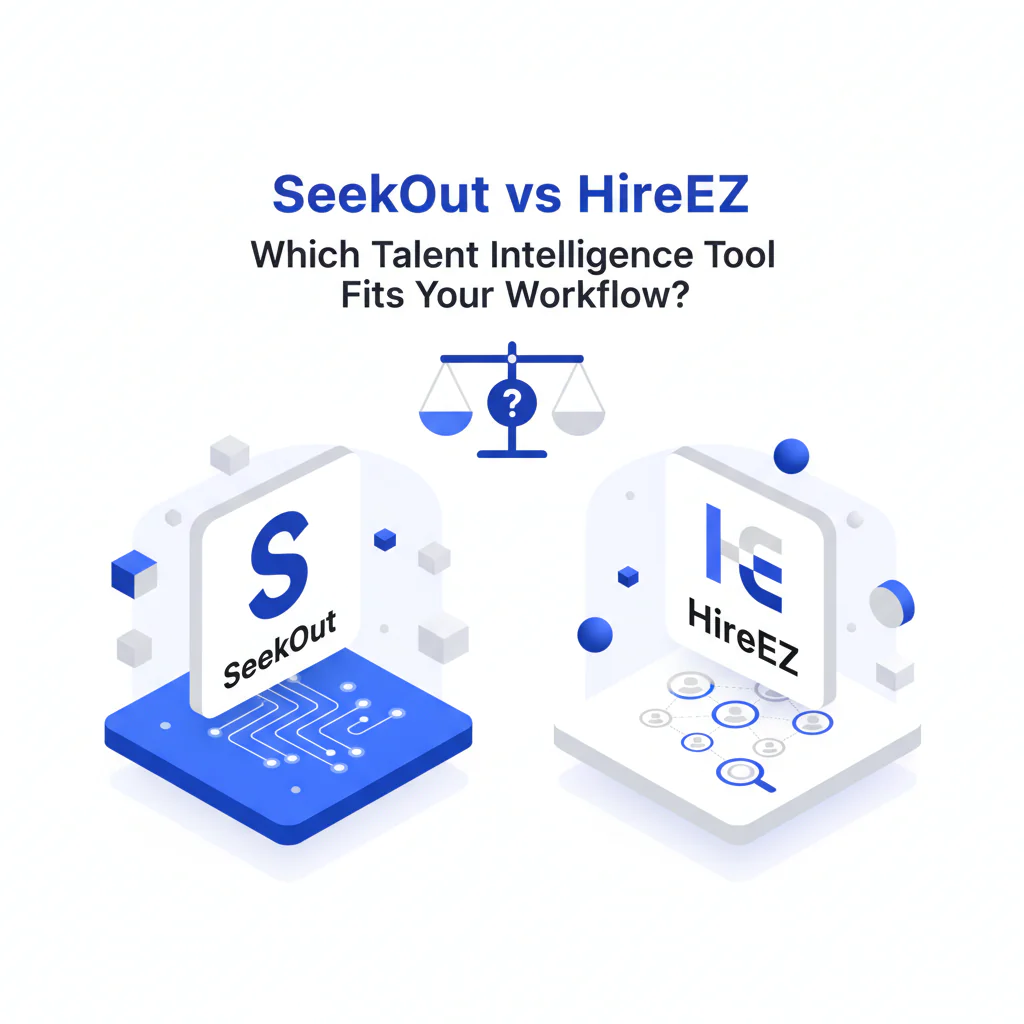
- SeekOut vs HireEZ is a discovery-tool decision. Choose based on workflow fit and team size, then validate with a pilot that measures both sourcing depth and outreach reachability.
- Key stat
- Most sourcing time is lost after “find” and before “reply.” If reachability is weak, placement speed drops even when search results look strong.
- Ideal candidate profile
- Recruiting teams choosing between SeekOut and HireEZ who want the right discovery tool—and a plan to ensure outreach reachability for passive candidates, silver medalists, and hard-to-reach roles.
Byline: Ben Argeband, Founder & CEO of Swordfish.AI
I evaluate these platforms the way a Head of Talent would: the winner is whichever tool gets qualified candidates into real conversations faster, keeps outreach consistent across a team, and survives a compliance review. This is a decision you make by workflow and team size, not by which interface looks nicer in a demo.
SeekOut and HireEZ are both discovery-first platforms. During a pilot, pay close attention to how each handles saved searches, project and list management, collaboration controls, and reporting exports — those details usually decide whether a tool sticks once the team scales past a couple of recruiters.
Who this is for
- TA leaders deciding between SeekOut and HireEZ for a team with shared pipelines and mixed roles.
- Teams hiring for hard-to-reach roles where response rate is the constraint.
- Organizations doing agency recruiting or competing with agencies and need faster outreach cycles and cleaner handoffs.
- Teams that already have an ATS/CRM and need a discovery tool that fits their operating rhythm.
What recruiters are trying to accomplish
- Placement speed: reduce time from intake to first qualified conversation by improving sourcing depth and reducing rework.
- Candidate experience: fewer duplicate touches, fewer irrelevant messages, and faster follow-up when someone engages.
- Compliance: consistent handling of contact data, opt-outs, and internal access controls across the team.
Discovery only solves half the problem. If your team can’t reliably reach the right people once they’re found, you’ll see low replies from passive candidates, stalled reqs, and follow-up gaps that quietly damage candidate experience.
SeekOut vs HireEZ: decision heuristic (choose by workflow/team size)
Framework: choose by workflow and team size. Start by matching the platform to how your team actually operates day to day, then run a short pilot focused on two metrics: qualified profiles found per hour, and replies per 100 outreaches.
At a glance:
- Choose the tool your team will actually use consistently. If recruiters and sourcers won’t follow the same project, tagging, and ownership process, you’ll end up with duplicate outreach and slower cycles no matter how good the search engine is.
- For larger teams (roughly 10+, with dedicated sourcers): prioritize collaboration controls — ownership, shared projects, tagging discipline — and reporting that cuts down on manual status updates.
- For smaller teams (1–3 recruiters doing end-to-end work): prioritize speed from search to outreach list creation and low admin overhead, since the process needs to run every single day without friction.
- If response rate is the real bottleneck: treat reachability as a separate layer, measured independently from how good the search results look.
During demos, have the team run identical tasks in both tools and record time-to-complete and error rates:
- Save a search and re-run it later without rebuilding filters.
- Add 25 prospects to a project and apply consistent tags.
- Assign ownership so recruiter vs. sourcer handoffs are unambiguous.
- Export a list with the fields needed for outreach and dedupe.
- Produce a simple weekly activity view for reporting and analytics.
Sourcing depth and workflow: what to compare in a pilot
To compare sourcing depth and workflow fit fairly, run the same intake brief in both tools and evaluate the artifacts your team will actually live with:
- Sourcing depth: how quickly you can move from must-haves to a credible prospect list, including adjacent profiles.
- Candidate discovery controls: how easy it is to iterate a search without losing prior work.
- Workflow fit: projects, collaboration, notes and tags, and how handoffs work between recruiter and sourcer.
- Reporting and analytics: whether leadership can see activity-to-outcome by role and by person without manual reconciliation.
Capture evidence as you go: screenshots of saved searches, a sample project with tags and ownership, an export file, and one reporting view. Those artifacts tell you plainly whether the tool fits your workflow or forces workarounds.
Run the pilot on two req types: one easier role to test speed, and one hard role to test sourcing depth under pressure. A tool that only performs on easy roles won’t help once the quarter tightens.
Ethical use of phone numbers
If phone outreach is part of the plan, set rules that protect candidates and your brand. Candidate experience and compliance are linked — when outreach is uncontrolled, opt-outs get missed and the same person gets contacted repeatedly by different teammates.
- Purpose limitation: contact candidates only for a specific role or a clearly defined talent community they would reasonably expect.
- Consent and opt-out: stop outreach when a candidate opts out or indicates disinterest, and record it so the whole team honors it.
- Reasonable hours: call or text during appropriate local time windows.
- Touch limits: cap attempts and avoid repeated same-day follow-ups.
- Transparency: identify yourself, the company, and why you’re reaching out in the first message.
- Auditability: log outreach so candidates don’t get re-contacted by another teammate.
Sourcing workflow
This workflow keeps discovery and reachability separate so you can diagnose where time is being lost and fix the right constraint instead of guessing.
- Intake: define must-haves, nice-to-haves, and adjacent profiles you’ll accept. Write down three disqualifiers to prevent wasted outreach.
- Discovery sprint (30–60 minutes): build an initial list in SeekOut or HireEZ; tag by persona (core, adjacent, stretch) and by constraints.
- Reachability pass (15–30 minutes): validate contactability and prioritize who to contact first. If you can’t reach the top of the list, sourcing depth never converts into screens.
- Outreach sequencing: run a short sequence (2–4 touches) with a clear follow-up SLA when someone replies.
- Recycle loops: move near-miss finalists into silver medalists and re-engage them first when a similar role opens.
- Weekly review: track replies per 100 outreaches, time-to-first-reply, and qualified screens per sourced hour by role type.
If you want a benchmark reachability layer that complements either discovery tool, use Prospector as the benchmark reachability layer (verified mobiles) and measure whether it reduces time-to-first-reply and increases replies per 100 outreaches. This matters even more in healthcare recruiting, where clinician and provider contact data changes frequently as people move between practices, hospital systems, and licensure states — a strong search result is worthless if the phone number or email on file is stale.
Checklist: Diagnostic Table
| Symptom (what you see) | Likely root cause | Fast test (24–48 hours) | Fix that improves placement speed |
|---|---|---|---|
| Low replies from passive candidates despite strong profiles | Reachability gap (stale contact data) or channel mismatch | Split-test email-only vs email+call for 30 prospects; track time-to-first-reply | Add a reachability step before sequencing; prioritize candidates with verified contact paths |
| High bounce rates or undelivered messages | Data freshness issues; exporting lists without validation | Sample 50 contacts and verify deliverability before sending the full sequence | Validate contact data at the moment of outreach, not at list creation |
| Prospects respond “wrong person” or “not me” | Identity resolution errors (name collisions, outdated employer) | Manually verify 20 records against current employer/title before outreach | Require a quick identity check for common names and high-risk titles |
| Duplicate outreach from multiple teammates | Workflow fit issue: weak collaboration controls or poor logging | Audit one req: count duplicates across recruiter vs sourcer activity | Standardize tagging/ownership rules; enforce “one owner per prospect” |
| Strong initial replies but low show rates | Candidate experience gap: slow follow-up or unclear process | Measure time from reply to scheduled screen; target < 24 hours | Set follow-up SLA; confirm role basics in the first reply |
| Hard-to-reach roles stall after week 1 | Sequencing and prioritization are weak | Re-run outreach to top 25 with a tighter message + one call attempt | Shorten the sequence, personalize the first line, and call only the top tier |
| Silver medalists don’t re-engage | Reactivation message lacks context and respect for prior process | Send a context-first reactivation note to 20 silver medalists | Reference prior stage, what changed, and offer a short call window |
Decision Tree: Weighted Checklist
This checklist keeps the evaluation honest: both SeekOut and HireEZ are discovery-first, so score search and reachability separately. The weighting reflects the usual failure points that slow placement speed — inconsistent workflow adoption, weak reporting, and low reply rates.
- Workflow fit (highest weight): Can recruiters and sourcers run the same process consistently (projects, tagging, ownership, handoffs)? If adoption is uneven, output drops even if sourcing depth is strong.
- Sourcing depth (high weight): Can the team reliably produce qualified shortlists for hard-to-reach roles, including adjacent profiles, without hours of manual iteration?
- Reporting and analytics (medium-high weight): Can TA leadership see activity-to-outcome by role and by recruiter vs sourcer without manual work?
- Data governance and compliance controls (medium weight): Are access, exports, and opt-out handling clear enough to reduce risk as team size grows?
- Reachability layer performance (separate score, don’t average into “search”): What percentage of your top 50 prospects per req are contactable through at least one working channel, and how does that affect replies per 100 outreaches?
- ATS/CRM workflow integration (medium weight): Does the tool reduce duplicate records and keep outreach history visible so candidate experience stays consistent?
How to use it: pick 2–3 live reqs, run the same sourcing brief in both tools, and score each category with evidence — saved searches, project structure, exports, and outreach outcomes. If replies per 100 outreaches don’t improve, you don’t have a placement-speed win yet.
Outreach templates
Use short sequences and stop the moment a candidate opts out. These templates are written for passive candidates, silver medalists, and hard-to-reach roles.
Troubleshooting Table: Outreach Templates
Template A (Passive candidate, email #1):
Subject: Quick question about your [domain] work
Hi [First Name] — I’m [Your Name], recruiting at [Company]. I’m reaching out because your background in [specific signal: tech/industry/project] looks aligned with a [Role Title] we’re hiring for.
Two checks before I share details:
- Are you open to a brief conversation this week?
- If not, is there someone you’d recommend I speak with?
If it’s easier, reply with “yes” and I’ll send 2–3 time options.
Template B (Hard-to-reach role, voicemail script):
Hi [First Name], this is [Your Name] with [Company]. I’m calling because we’re hiring a [Role Title] focused on [one outcome]. If you’re open to a quick chat, you can reach me at [number]. If now isn’t a fit, a quick reply with “no” is perfect and I won’t follow up. Thanks.
Template C (Silver medalist reactivation, email):
Subject: Following up from your [Company] process
Hi [First Name] — we spoke during the [Role Title] process earlier this year. You were a strong finalist, and I appreciated how you approached [specific topic from process].
We have a new opening that’s similar but with [what changed: scope/team/location]. If you’re open, I’d like to do a 15-minute reset call to confirm interest and share what’s different.
Are you available [two time windows]?
Template D (Agency recruiting coordination note to avoid duplicates):
Subject: Ownership + outreach plan for [Req/Role]
Team — for [Role Title], I’ll own outreach to [segment/persona], and [Name] will own [segment/persona]. Please log all touches in [system] before sending follow-ups so we don’t double-contact candidates.
Daily target: [X] new prospects contacted, with a 24-hour follow-up SLA on replies.
Evidence and trust notes
This comparison is meant to support an operating decision, not to declare one platform the universal winner. Outcomes depend on workflow fit, team size, and whether you measure reachability separately from discovery.
To validate your choice, run a pilot on the same reqs, with the same outreach sequence, and produce artifacts you can actually audit:
- Saved searches and project structures that show how the team really works.
- Exports with dedupe rules that reduce duplicate outreach.
- Outreach outcomes: replies per 100 outreaches and time-to-first-reply.
- Reporting and analytics views that answer leadership questions without manual tracking.
Procurement note: pricing and packaging vary by seats and modules. Ask both vendors for a seat-based quote aligned to your team size and required reporting modules, then compare time-to-adoption based on how many steps it takes to run the workflow above.
If you want product-specific context, cross-check the dedicated reviews: SeekOut review and HireEZ review.
FAQs
Is SeekOut better than HireEZ for enterprise recruiting?
It depends on workflow fit and reporting expectations. For enterprise recruiting, the deciding factor is whether the platform supports consistent collaboration across team size and whether reporting and analytics answer leadership questions without manual work.
Which is better for recruiter vs sourcer workflows?
If you have dedicated sourcers, prioritize clean handoffs: shared projects, clear ownership, and visibility into what’s already been done. If recruiters do end-to-end, prioritize speed from search to outreach list creation and low admin overhead.
How should we compare sourcing depth fairly?
Use the same intake brief and run a timed discovery sprint in each tool. Score how many qualified prospects you can find in 60 minutes, then validate quality with a quick hiring manager review of a blinded list.
What if both tools find good candidates but replies are low?
That’s a reachability and sequencing problem, not a discovery problem. Measure contactability rate and replies per 100 outreaches. If those metrics don’t improve, switching discovery tools won’t fix placement speed.
How do we define contactability rate in a pilot?
Use a consistent definition: contactability rate = the percentage of your top 50 prospects per req with at least one working channel (email or phone) at the time you send the first outreach.
Next steps
Week 1 (Setup): Pick 2–3 live reqs (include one hard-to-reach role). Define the intake brief, success metrics (qualified profiles/hour, replies per 100 outreaches, time-to-first-reply), and ownership rules to prevent duplicate outreach.
Week 2 (Pilot): Run identical discovery sprints in SeekOut and HireEZ. Build projects and lists the way your team will actually operate. Start outreach with the same sequence length and a 24-hour follow-up SLA on replies.
Week 3 (Review): Compare workflow fit (adoption friction), sourcing depth (qualified prospects/hour), and reporting and analytics (leadership visibility). Separately compare reachability outcomes: contactability rate (percentage of top 50 prospects with at least one working channel) and replies per 100 outreaches.
Week 4 (Decision + rollout): Choose the platform your team will use consistently. Document the workflow, opt-out handling, and the reachability step. Train recruiters and sourcers together so candidate experience stays consistent across the team.
About the Author
Ben Argeband is the Founder and CEO of Swordfish.ai and Heartbeat.ai. With deep expertise in data and SaaS, he has built two successful platforms trusted by over 50,000 sales and recruitment professionals. Ben’s mission is to help teams find direct contact information for hard-to-reach professionals and decision-makers, providing the shortest route to their next win. Connect with Ben on LinkedIn.