
 View Products


Last updated: September 3, 2026

Reaching out to owners of recently expired listings is one of the most reliable ways to build a real estate pipeline. Pull property details from the MLS and public records, confirm the owner’s current phone number, and you’ve got a warm-ish lead worth calling.
So how do you actually cold call in real estate?
Research the prospect first, then make sure you understand the legal rules governing telemarketing calls. Write a script that sounds like you, not a script. Figure out when your prospect is actually likely to pick up. On the call, ask real questions, listen, handle objections without getting defensive, and follow up quickly afterward.
That’s the short version. Below is a full walkthrough, along with sample scripts you can adapt.
How to Cold Call in Real Estate: Step-by-Step Procedure
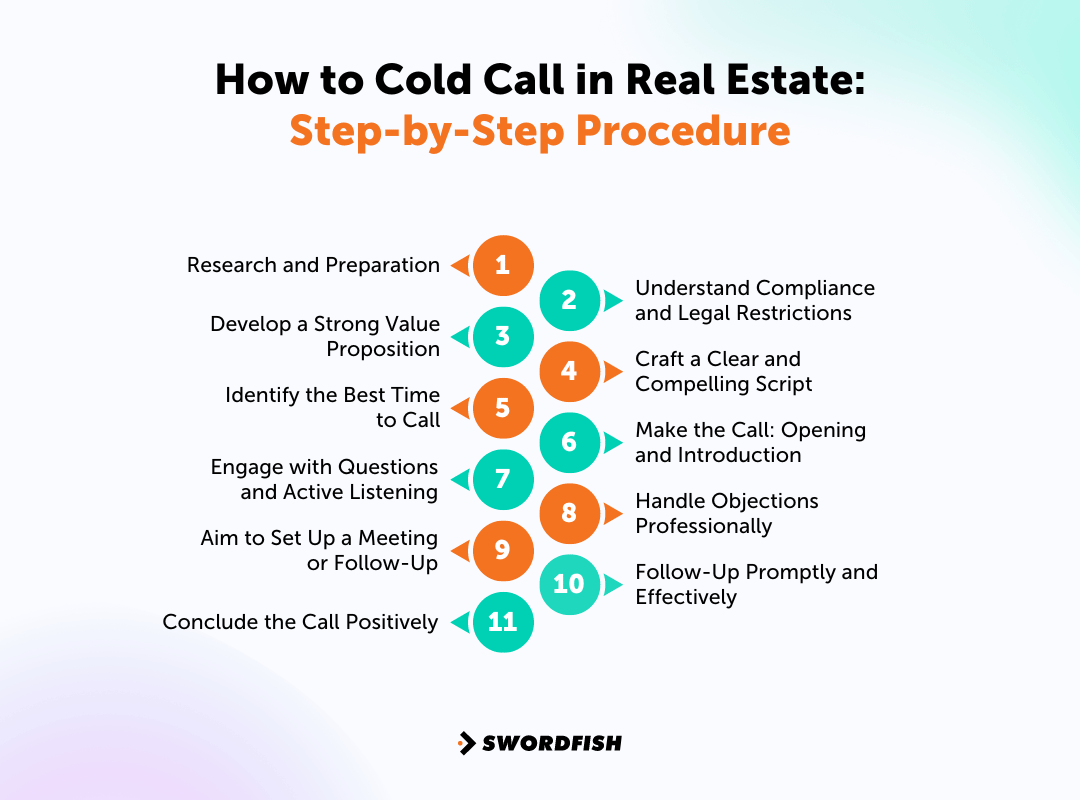
Effective real estate cold calling comes down to five things done well: research, legal compliance, a clear script, good timing, and a disciplined follow-up process. Here’s the full sequence.
- Research and Preparation
- Understand Compliance and Legal Restrictions
- Develop a Strong Value Proposition
- Craft a Clear and Compelling Script
- Identify the Best Time to Call
- Make the Call: Opening and Introduction
- Engage with Questions and Active Listening
- Handle Objections Professionally
- Aim to Set Up a Meeting or Follow-Up
- Follow-Up Promptly and Effectively
- Conclude the Call Positively
Step 1: Research and Preparation
Skipping research is the fastest way to sound like every other agent calling that day. Before you dial:
- Know the Seller’s Background: Look up the potential seller’s history. It includes their property, recent sales, and market areas. Knowing this will help you tailor your conversation.
- Understand Their Needs: Consider what the seller might need. Are they looking to upgrade, downsize, or sell an investment property? This helps you shape your approach and offer solutions that resonate with them.
- Prepare Real Estate Cold Calling Scripts for Sellers: Write down real estate scripts for sellers that align with the seller’s interests. Your script should introduce who you are, the purpose of your call, and what you offer. Keep it concise and direct.
- Practice Your Pitch: Rehearse your script until you can deliver it naturally. This makes your call sound more genuine and engaging.
- Prepare to Answer Questions: Be ready to answer questions the seller might have. This includes details about your services, pricing, and how you can meet their specific needs.
- Set Clear Goals for the Call: Decide what you want to achieve with the call. Is it to set up a meeting, gather information, or introduce your services? Having a clear goal will help guide the conversation.
Step 2: Understand Compliance and Legal Restrictions
Cold calling is legal, but it’s regulated, and the rules are worth knowing before you build a calling list.
- Familiarize Yourself with the Telephone Consumer Protection Act (TCPA): Under federal rules, telemarketing calls are generally limited to between 8 a.m. and 9 p.m. in the recipient’s local time, and calling outside that window can trigger penalties.
- Check the Do Not Call Registry: Before making any calls, make sure that the numbers you plan to dial are not listed on the Do Not Call Registry. Calling numbers on the registry without consent can carry penalties of up to roughly $1,500 per violation.
- Understand State Laws: Some states set narrower calling windows or Sunday restrictions than federal law does, so check the rules in every state where you plan to call.
- Get Consent When Required: Live agent-to-consumer calls generally don’t require prior consent, but using an autodialer, a prerecorded message, or texting a lead usually does. Know which category your outreach falls into.
- Document Your Compliance: Keep records of your adherence to these laws, including times of calls, consent obtained, and checks against the Do Not Call Registry. This documentation can be vital in case of complaints or audits, and brokerages have been held liable for their agents’ calling behavior in past disputes.
Step 3: Develop a Strong Value Proposition
A clear value proposition separates you from every other agent leaving a voicemail that week. Here’s how to build one:
- Identify Key Benefits: Focus on what sets your service or product apart. What can you offer that is unique or superior to what’s already available in the market? This could be anything from special pricing, exclusive properties, advanced technology tools, or superior market knowledge.
- Understand the Seller’s Needs: Tailor your value proposition to address specific challenges or goals that the seller might have. For instance, if they often deal with luxury properties, you might highlight your success in high-end markets.
- Be Clear and Concise: Your value proposition should be straightforward and easy to understand. Avoid industry jargon and complex language. The goal is to communicate your value quickly.
- Emphasize Results: Sellers are results-oriented. Highlight past successes, such as properties sold or clients satisfied, and be specific about how you can replicate this success for them.
- Practice Delivering Your Value Proposition: Just like with your cold calling script, practice how you’ll introduce and discuss your value proposition. Being able to speak confidently and clearly about your value is key to engaging the seller’s interest.
Step 4: Create a Clear and Compelling Script
A well-crafted script keeps you on message without sounding robotic. Here’s how to build the best real estate script for lead generation:
- Start with a Strong Opening: Begin your script with a polite introduction and a clear statement of why you are calling. This should grab their attention and make the purpose of your call clear.
- Incorporate Your Value Proposition: Quickly transition into your value proposition. Explain what you offer and why it’s beneficial to those interested in selling. This should be tailored to reflect the specific benefits your service provides to sellers.
- Ask Engaging Questions: Include questions that encourage dialogue rather than a simple yes or no answer. This can help you gauge the seller’s interest and gather useful information to tailor your pitch.
- Address Common Objections: Prepare responses to common objections you might encounter. This shows that you understand their concerns on buy or sell and have thought about how to resolve them.
- Include a Strong Call to Action: Conclude your script with a clear call to action. This could be setting up a meeting, a request to send more information, or another step that moves the conversation forward.
- Keep It Brief and to the Point: Your script should be concise. Respect the seller’s time by keeping your initial pitch short and engaging to spark their interest and lead to a deeper conversation.
Step 5: Identify the Best Time to Call
Timing has more influence on your callback rate than most agents give it credit for. Here’s how to think about it:
- Optimal Time of Day: Late morning, between 10 a.m. and 12 p.m. local time, is usually prime time for cold calls. Most people have settled into their day but haven’t started thinking about lunch yet. They’re likely at their desks and more open to taking your call.
- Second-Best Time: The early afternoon, from about 1 p.m. to 3 p.m., is another effective window for making calls. People tend to be back from lunch and not yet ready to wind down for the day.
- Best Days to Call: Here’s a cold calling fact – Wednesday is the peak day for making sales calls, with Thursday and Tuesday also being effective. These midweek days work well because people are over the Monday rush and not yet distracted by the upcoming weekend.
- Avoid Early Mornings and Late Afternoons: Early mornings before 10 a.m. and late afternoons after 4 p.m. are less ideal. Early on, people are just starting their day and might not welcome interruptions. Later, they’re likely wrapping up and less open to starting new discussions.
- Weekend Considerations: While weekends typically aren’t great for B2B calls, they can work for B2C sectors like real estate. If your target market includes consumers, trying your luck on Saturdays and Sundays might pay off — though check state law first, since some states restrict Sunday telemarketing entirely.
- Know Your Audience: Understanding the daily routines of your specific prospects can help you tailor your calling times. If you’re not sure, test different times and track the results to see what works best for your audience.
Step 6: Make the Call: Opening and Introduction
The first ten seconds decide whether the rest of the call happens. Here’s how to open strong:
- Be Clear and Direct: Start by clearly stating your name and your company. It’s important that the person on the other end knows who you are and why you’re calling right away.
- Respect Their Time: Acknowledge that you are calling unannounced and express appreciation for any time they can give you. For example, you might say, \”I know I’m calling out of the blue, but I’ll be brief.\”
- State the Purpose of Your Call: Immediately explain the purpose of your call. This should be a natural extension of your introduction and tied closely to your value proposition.
- Make a Connection: If you have a mutual contact or referral, mention this early in the call to establish trust and relevance.
If you’re looking for cold calling examples to use, here are a few:
Example for a Real Estate Investor
\”Good morning, this is [Your Name] from [Your Company]. I’m reaching out to briefly discuss some unique investment opportunities in the [specific area] market, which I believe could be of interest to you. Do you have a moment to talk?\”
Example for a Real Estate Agent Specializing in Sales
\”Hello, [Seller’s Name], I’m [Your Name] with [Your Company]. I recently came across your impressive portfolio online, and I think you might be interested in a few high-value properties that align with your specialties. Is this a good time for a quick discussion?\”
Example of General Real Estate Cold Call
\”Hi, [Seller’s Name], this is [Your Name] from [Your Company], where we specialize in [brief mention of services]. I wanted to share some insights that could help you improve your listings and close rates. Do you have a few minutes to explore this?\”
Step 7: Engage with Questions and Active Listening
Once you’re past the opening, the call succeeds or fails on how well you listen, not how well you talk.
- Ask Open-Ended Questions
These types of questions encourage a detailed response and can provide you with valuable insights into the prospect’s needs and preferences. Effective real estate cold calling scripts for sellers often include questions like, \”What are your biggest challenges in selling your property?\” or \”What kind of assistance are you looking for?\”
- Listen Actively
Show that you are listening by summarizing their points and responding thoughtfully. This not only confirms that you understand their needs but also builds rapport. For instance, when cold calling for real estate investors, you might say, \”I hear that you’re concerned about property management costs. Let’s talk about how we can address that.\”
- Respond Appropriately
Use the information gathered to steer the conversation in a way that aligns with their interests and your offerings. It’s one of the best cold calling tips to build a connection with the prospect.
- Maintain Engagement
Keep the conversation flowing by linking their responses to your services or products, demonstrating how you can address their needs or solve their problems. For example, you could say, \”It sounds like you’re looking for a quick sale. We specialize in fast transactions, and I’d love to help you achieve your goal.\”
- Offer to Set Up a Meeting
One of the best cold calling tips to get a meeting is to directly suggest a follow-up discussion. You can use cold calling examples to say, \”Would you be interested in meeting to discuss this further? I’d love to show you how we can help you sell your property quickly.\”
Step 8: Handle Objections Professionally
Objections aren’t rejections — they’re usually requests for more information. Here’s how to work through them:
- Anticipate Common Objections: Before your call, think about possible objections a potential seller might have, such as pricing, contract terms, or the necessity of your services. Prepare clear, concise responses for each.
- Stay Calm and Positive: When faced with an objection, maintain a calm demeanor and a positive tone. Reassure the potential client that you understand their concerns and are there to help.
- Listen Fully Before Responding: Make sure to listen completely to their concerns without interrupting. This shows respect and allows you to fully understand the issue before you respond.
- Address Objections Directly: Respond to each objection directly and confidently with your prepared information. Use data, testimonials, or case studies to support your responses when appropriate.
- Confirm Understanding: After addressing an objection, ask if your response has resolved their concern. This not only clarifies any lingering doubts but also demonstrates your commitment to their satisfaction.
Example of Handling Objections
Suppose a potential seller objects to the idea of working with a real estate agent because they’ve been using a different approach for years and it works fine. You can respond with:
\”However, our services offer [specific benefits] which could save you time and increase your sales. For instance, [give a specific example]. May I ask what features of your current system are most important to you?\”
Step 9: Aim to Set Up a Meeting or Follow-Up
A good call earns you a second conversation. Here’s how to close toward that:
- Summarize Key Points: Before closing the call, briefly summarize the main benefits discussed and how they align with the prospect’s needs or challenges. This reinforces the value you’re offering.
- Propose a Specific Action: Instead of a vague suggestion to connect later, propose a specific next step. This could be a meeting, a demonstration, or a follow-up call. Provide clear options and suggest concrete times.
- Seek Confirmation: Once you propose the next step, ask for confirmation. For example, \”Does Wednesday at 10 AM work for you for a quick demo, or would Thursday at 2 PM be better?\”
- Flexibility is Key: Be accommodating of the prospect’s schedule and preferences. If they are hesitant to commit to a date, offer to send a calendar invite that they can confirm at their convenience.
- Close with a Clear Plan: make sure that both parties are clear on the next steps. Confirm any details like the time and platform for a meeting or what information you will send in a follow-up email.
- Express Gratitude: Thank the prospect for their time and consideration. A simple expression of appreciation can leave a positive impression, making them more likely to engage with you in the future.
Example of Aiming to Set Up a Meeting or Follow-Up:
Imagine you’ve discussed a new real estate marketing service with a potential client, and now you want to secure a follow-up:
\”Thank you for considering the new features we discussed. I believe they could really improve your property listings and save you time. Could we schedule a brief meeting next week to go over how everything works? It would give you a clearer idea of the benefits.\”
Step 10: Conclude the Call Positively
How you end the call shapes whether the prospect answers next time. Here’s how to close well:
- Restate the Value: Briefly recap the key benefits discussed and how they align with the prospect’s needs or challenges. This reinforces your value proposition.
- Confirm the Next Step: Confirm any specific actions agreed upon, such as scheduling a meeting, sending more information, or following up at a later date.
- Express Appreciation: Thank the prospect for their time and consideration. A sincere expression of gratitude can create a positive lasting impression.
- Maintain Flexibility: Offer to adjust the follow-up based on their schedule or preferences. This shows that you are considerate and accommodating.
- End on a Positive Note: Close with a friendly and positive remark, leaving the prospect with a good feeling about the interaction.
Example of Concluding a Cold Call Positively
\”Great, I’ll send over the details shortly. Thank you again for your time today. I’m looking forward to our conversation next week. Have a great day!\”
Step 11: Follow-Up Promptly and Effectively
The call itself is only half the job. Here’s how to make sure your follow-up is timely and useful:
- Timeliness is Key: Send a follow-up email or message within 24 hours of your call. This helps keep the conversation fresh in the prospect’s mind and shows your professionalism and dedication.
- Personalize Your Follow-Up: Reference specific details from your conversation to demonstrate that you were attentive and valued the interaction. This personal touch can set you apart from others who may not take the time to customize their communications.
- Include Helpful Resources: Attach or include links to resources that were discussed during the call, such as brochures, case studies, or product demos. This not only adds value but also gives the prospect a reason to engage further with your content.
- Propose Concrete Next Steps: Reiterate any plans made during the call, such as a scheduled meeting or a demo, and confirm the details. If no specific plans were made, suggest a date and time for another call or meeting.
- Keep the Communication Open: Invite them to contact you with any questions or for more information before the next scheduled interaction. Provide your direct contact details to make it as easy as possible for them to reach out.
- Use Multiple Channels: While email is standard, don’t hesitate to use other channels where appropriate, such as LinkedIn messages or even a quick SMS to confirm a meeting time — just remember that automated texting typically requires separate consent under the TCPA. The choice of channel can depend on the preference shown by the prospect during your initial conversation.
Cold Calling Scripts for Real Estate: 10 Proven Scripts for Success
The best cold calling scripts for real estate are designed to help you connect with potential clients in the right way. They’re simple, easy to use, and tailored to suit different scenarios.
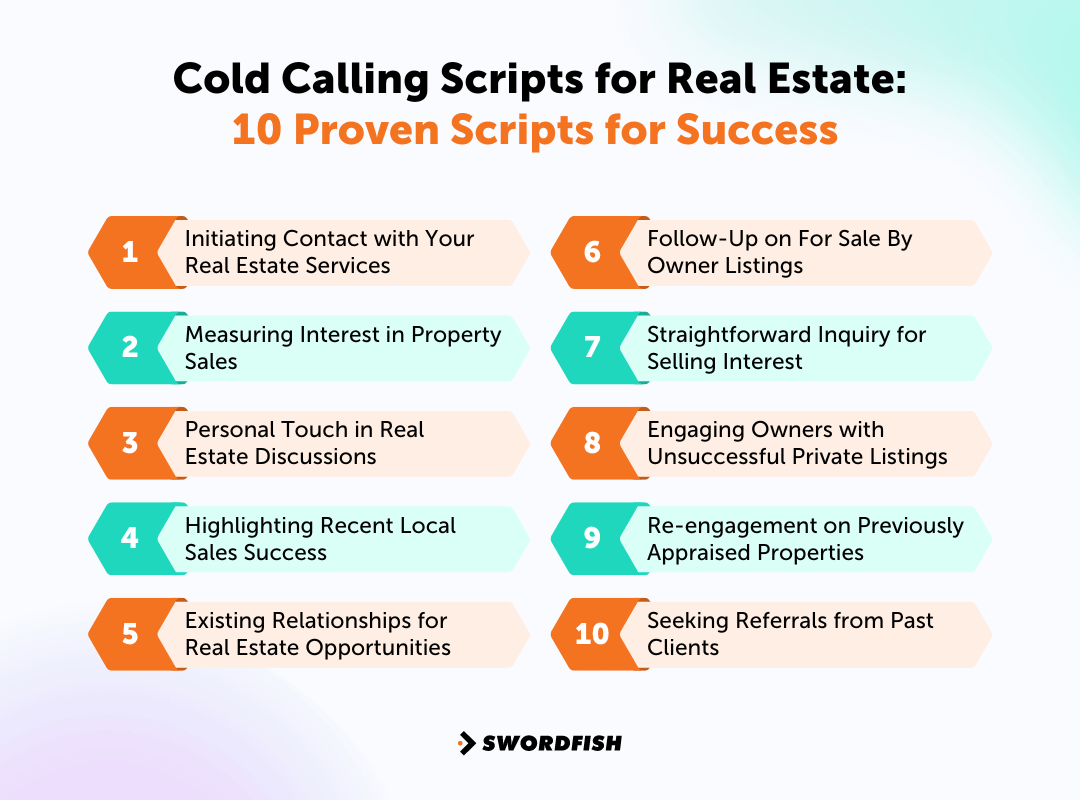
Whether you’re new to real estate cold calling or looking to sharpen your skills, these wholesale real estate scripts will guide you through the process.
- Initiating Contact with Your Real Estate Services
- Measuring Interest in Property Sales
- Personal Touch in Real Estate Discussions
- Highlighting Recent Local Sales Success
- Existing Relationships for Real Estate Opportunities
- Follow-Up on For Sale By Owner Listings
- Straightforward Inquiry for Selling Interest
- Engaging Owners with Unsuccessful Private Listings
- Re-engagement on Previously Appraised Properties
- Seeking Referrals from Past Clients
Script 1: Initiating Contact with Your Real Estate Services
\”Hello! My name is [Your Name] from [Your Company]. We’re committed to connecting buyers and sellers for a seamless property transaction experience. I’m reaching out to explore potential real estate opportunities with you. Are you available for a meeting to discuss how we can meet your property goals?\”
Script 2: Measuring Interest in Property Sales
\”Good day, I’m [Your Name]. I’m curious, have you considered selling your home? We have interested buyers ready to explore. It’s just a casual question to see if there might be a chance to work together. What do you think?\”
Script 3: Personal Touch in Real Estate Discussions
\”Hi, I’m [Your Name], and I’ve loved this neighborhood for over ten years. It’s a fantastic place, and as a local real estate specialist, I keep an eye out for standout opportunities. Have you thought about selling your property to the right buyer? I’d be thrilled to talk more if you’re open to it.\”
Script 4: Highlighting Recent Local Sales Success
\”Hello, this is [Your Name] from [Your Company]. I recently facilitated a successful property sale close to your home at [mention address]. There’s growing interest in your area. Considering this, have you thought about selling your property? Now might be a perfect time.\”
Script 5: Existing Relationships for Real Estate Opportunities
\”Hey [Prospect’s Name], it’s [Your Name]. We met before at [Event or Occasion]. How are things with you? I’m reaching out because I’m currently helping friends evaluate their real estate options. Given the market trends, have you pondered over making any property moves?\”
Script 6: Follow-Up on For Sale By Owner Listings
\”Hi, I’m [Your Name], a local realtor. I noticed your property listed for sale by the owner. With my expertise in this area, I could assist you in managing offers more effectively. How has the response been so far?\”
Script 7: Straightforward Inquiry for Selling Interest
\”Hi, this is [Your Name] from [Your Real Estate Agency]. I’m directly reaching out because we have clients interested in homes in your area. Are you considering selling your home now or maybe in the near future?\”
Script 8: Engaging Owners with Unsuccessful Private Listings
\”Hello, this is [Your Name]. I saw your property listed privately. How has the selling process been going for you? Selling independently can be quite demanding. How long has your property been on the market, and what’s the interest been like from potential buyers?\”
Script 9: Re-engagement on Previously Appraised Properties
\”Hello [Prospect’s Name], this is [Your Name] from [Real Estate Agency]. I’m following up on our last appraisal of your home back in [Month of Appraisal]. There’s been a lot of movement in your area recently. Have you reconsidered selling?\”
Script 10: Seeking Referrals from Past Clients
\”Hi [Previous Client’s Name]! This is [Your Name] from [Your Real Estate Agency]. I’m reaching out to express my gratitude for your trust in my services. I’ve been helping more families find their ideal homes and thought of our successful collaboration. Could you connect me with anyone who might need my help?\”
Cold Calling Real Estate with Swordfish AI: Connect with Property Owners
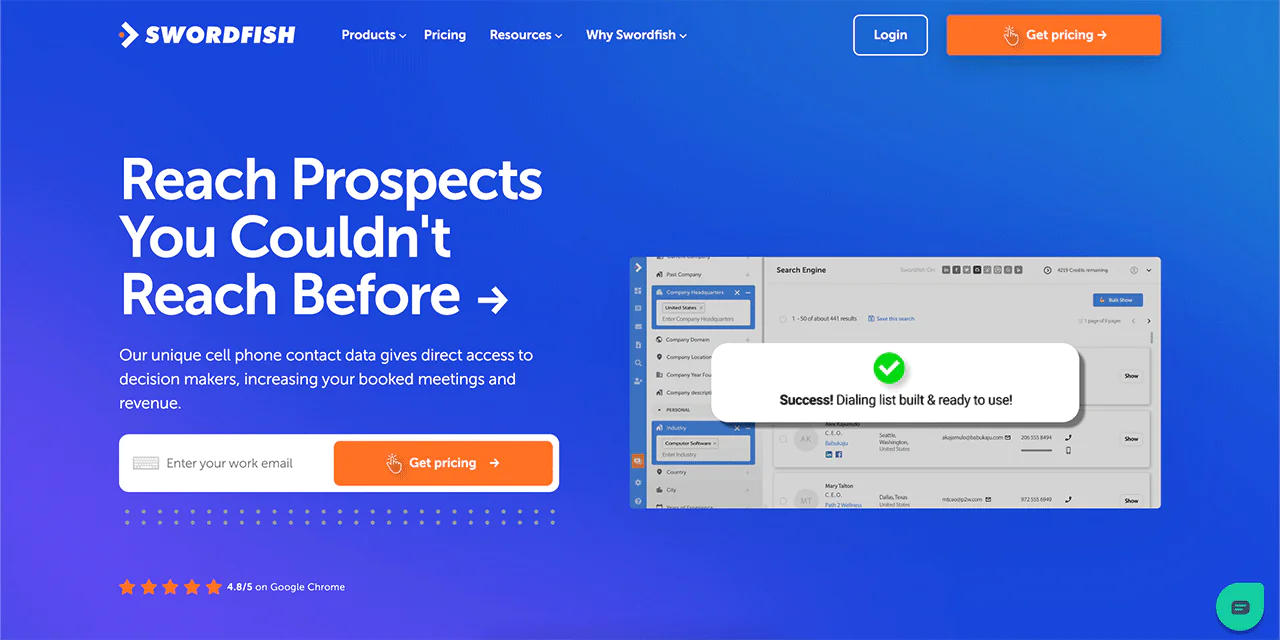
Accurate contact information is the difference between a productive calling session and an afternoon of disconnected numbers and voicemail boxes. Swordfish AI is built to close that gap, drawing on a large database of consumer and business profiles to surface current phone numbers and emails in real time.
Swordfish AI works through direct data relationships that aim to keep contact records current, rather than relying on stale, resold lists.
Bulk search lets you filter and prioritize large lead lists, while integration with common sales tools keeps that data accessible where your team already works.
Put together, these capabilities are designed to move agents from initial outreach to a closed deal with less time wasted on bad numbers.
Features of Swordfish for Cold Calling
Here are the features that support real estate cold calling specifically:
Prospector
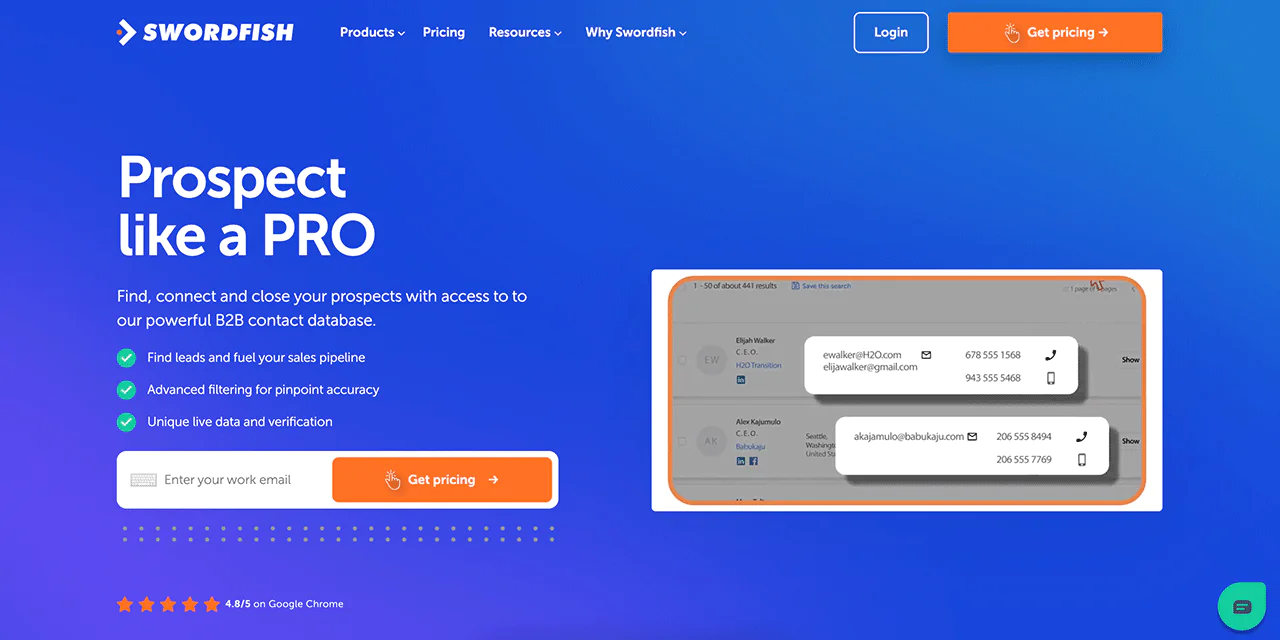
The Prospector allows you to zero in on specific geographic areas for your cold calling efforts. The feature has filters for parameters like neighborhood, property type, and estimated home value, so you can quickly identify the most relevant homeowners to target.
Reverse Search
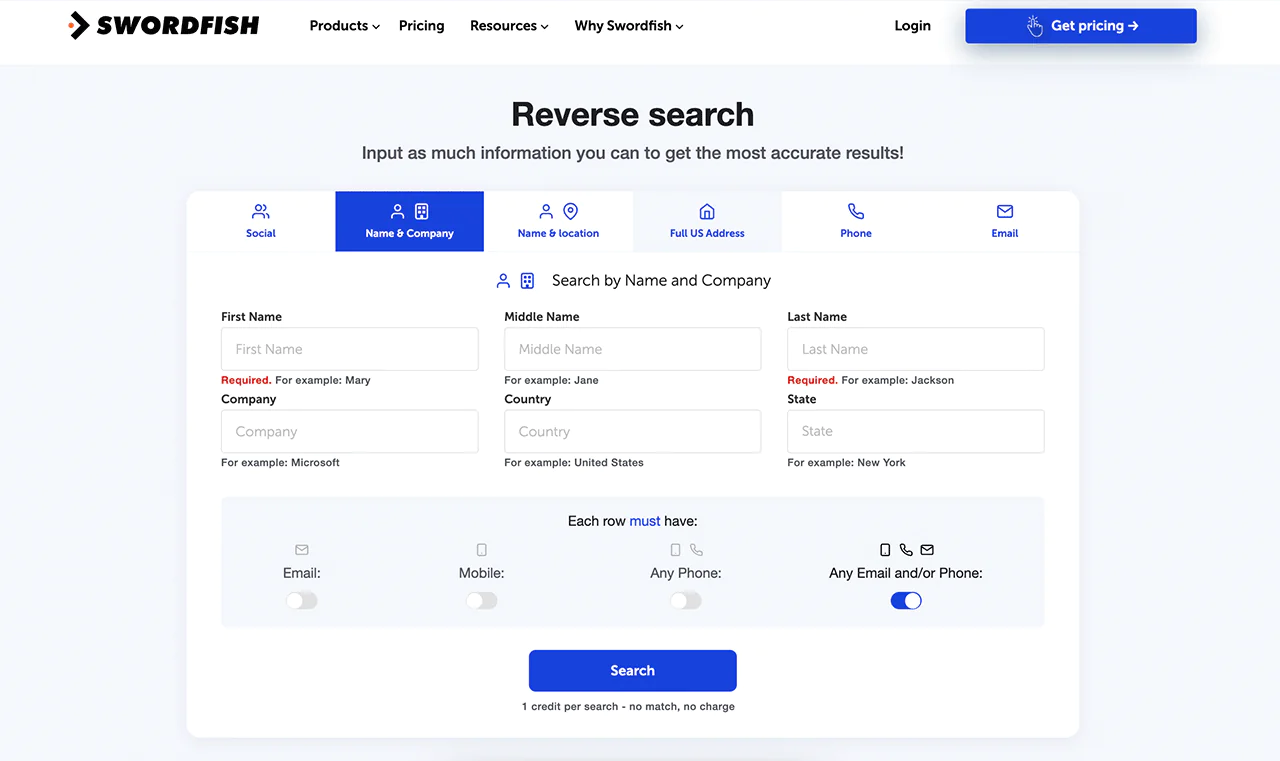
With just a property address, Reverse Search can surface details on the current homeowner, including name, phone number, and email. This is especially useful when prospecting expired listings or for-sale-by-owner (FSBO) properties.
API Access
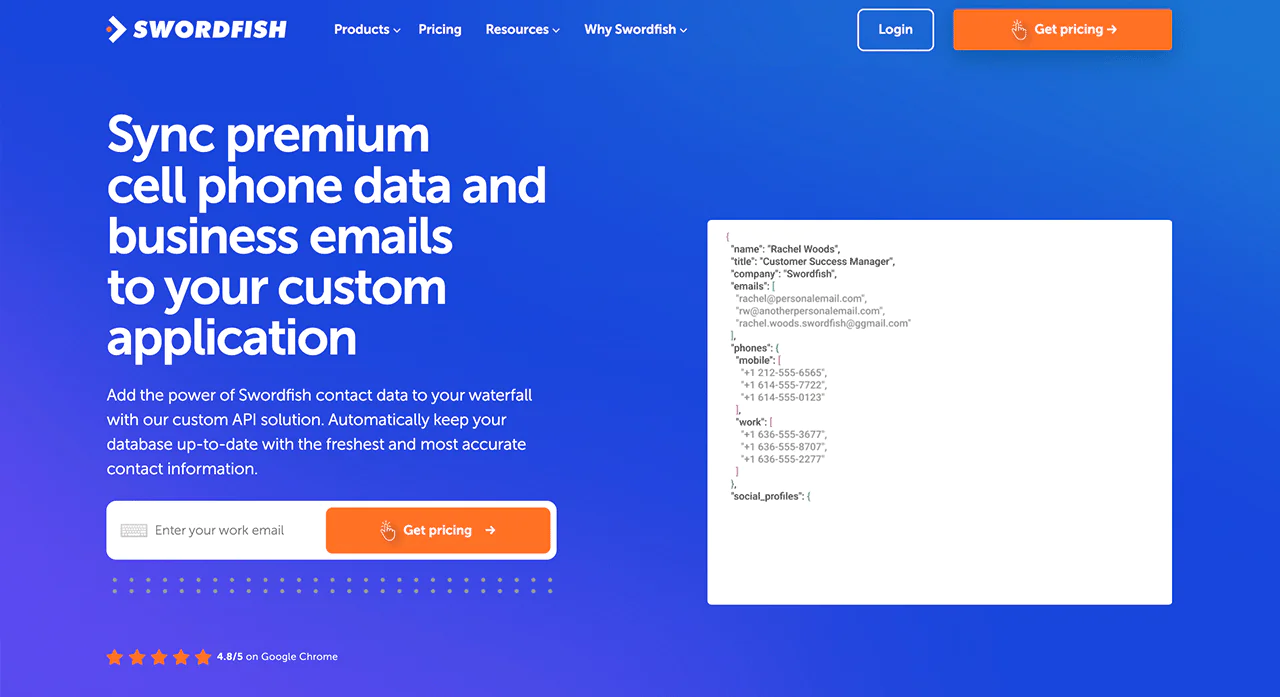
By integrating Swordfish AI’s APIs with your real estate CRM, agent and buyer data stays current without manual re-entry. Property intelligence syncs automatically, so you’re less likely to be working a stale lead.
Bombora Intent Data
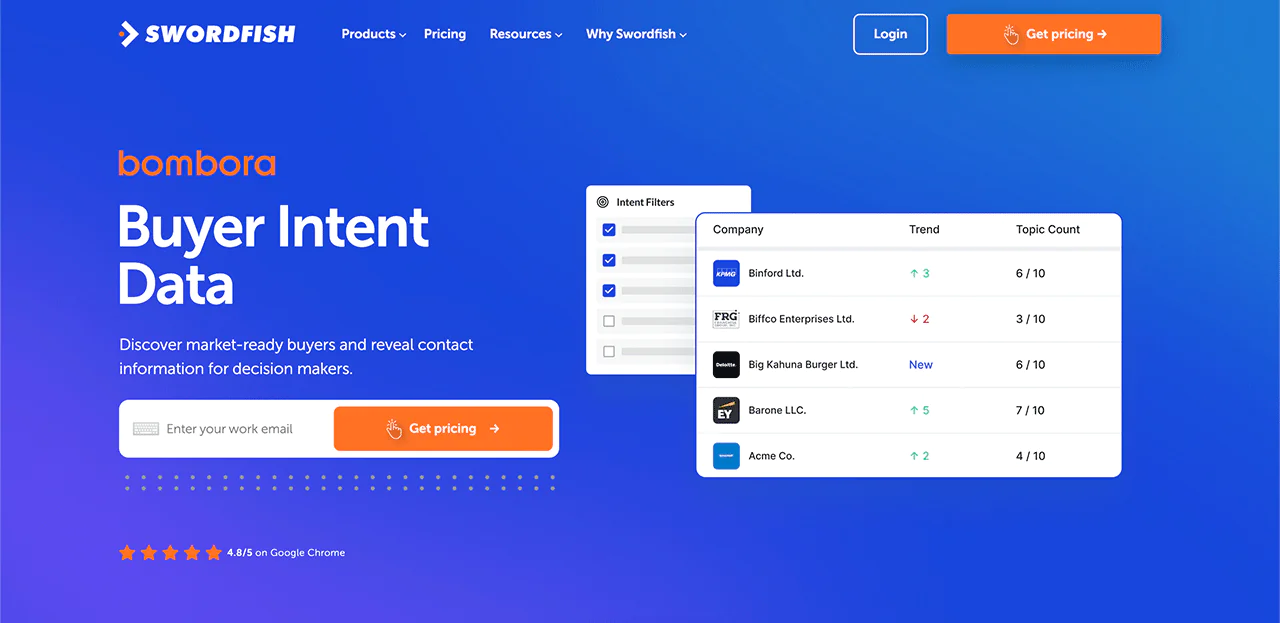
Bombora Intent Data flags potential property buyers or sellers by tracking online research related to mortgages, moving companies, and real estate listings — signals that suggest someone is closer to transacting.
Chrome Extension
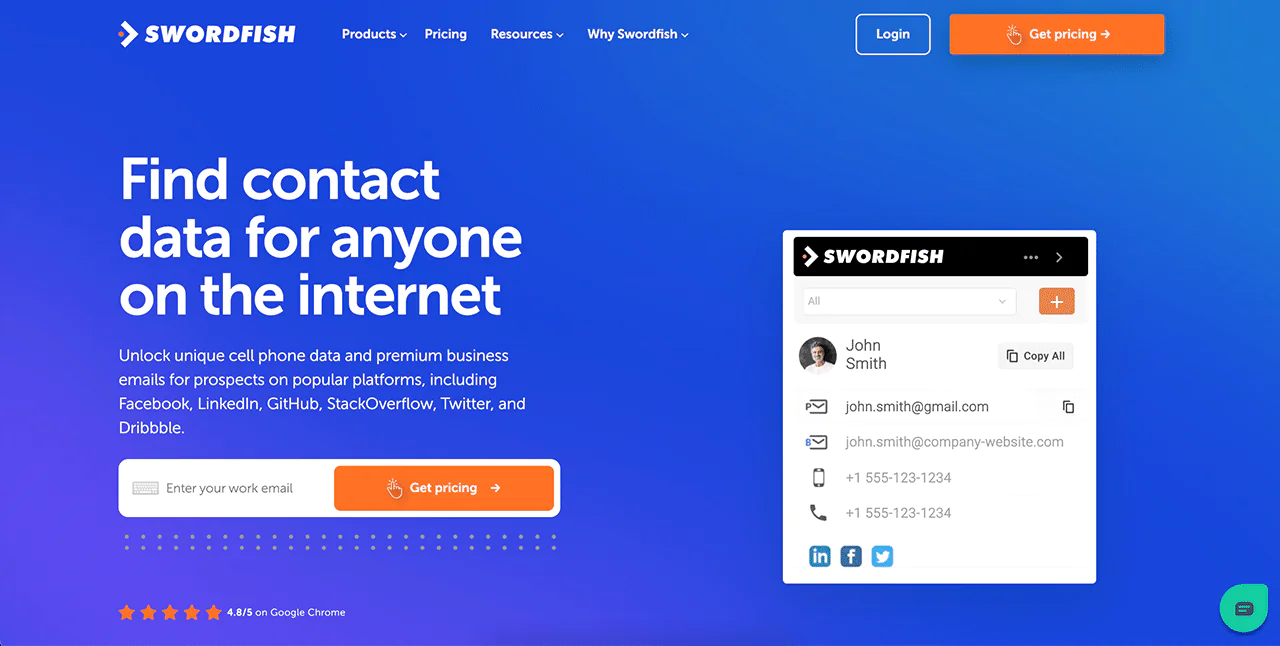
The Chrome Extension works inside your browser, surfacing mobile numbers, emails, and contact details for property owners from platforms like LinkedIn, GitHub, and Facebook. That shortens the gap between finding a prospect and reaching out.
File Upload
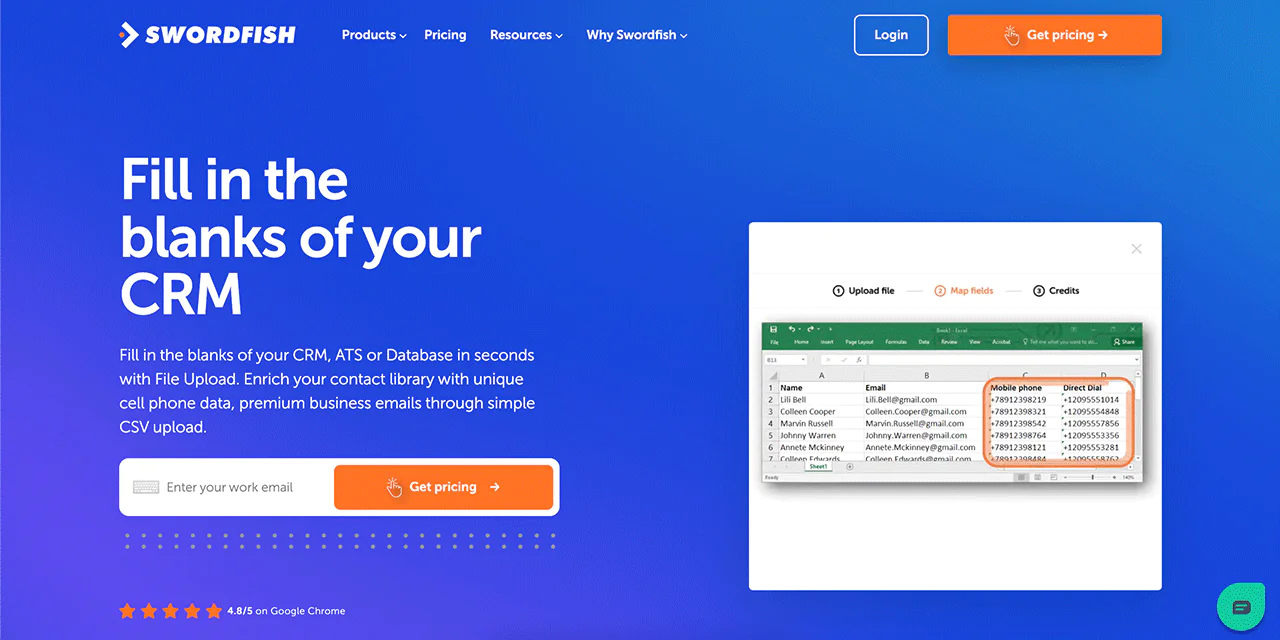
The File Upload feature is especially useful for real estate agencies and brokerages that regularly work through outdated listings, expired contracts, and FSBO properties across multiple communities.
 Try Swordfish Ai
Conclusion
Cold calling in real estate still works, but it rewards preparation, persistence, and good data over volume alone. The mistakes that sink most calling efforts are predictable: calling at bad times, skipping the follow-up, and reading a generic script that could apply to anyone.
The fix is just as predictable. Understand your prospects before you dial, build a value proposition that fits their situation, and handle objections without getting rattled.
Track your numbers, use more than one communication channel, and adjust your approach based on what the data actually shows you.
Tools like Swordfish AI help by supplying accurate contact details and signals on who’s likely ready to buy or sell. Combine that with consistent effort, and cold calls turn into a repeatable source of deals rather than a hit-or-miss activity.
FAQs
How can I measure the success of my cold calling efforts in real estate?
To measure the success of cold calling in real estate, you can use key performance indicators such as the call-to-appointment ratio, conversion rates, and the average number of calls per deal. These metrics provide valuable insights into how effective your cold calling strategy is.
What role does personal branding play in cold calling for real estate?
Personal branding improves credibility during cold calls. A strong personal brand makes potential clients more likely to trust and listen to you, enhancing the effectiveness of your calls. When clients see you as professional and reliable, they’re more open to what you have to say.
How can I use social media to complement my cold calling efforts?
Using social media can help warm up leads before you even pick up the phone. Engage with potential clients on platforms like LinkedIn or Facebook to build a rapport and establish trust. This prior interaction creates a level of familiarity, making your subsequent calls less intrusive and more welcomed.
What are some common mistakes to avoid in real estate cold calling?
Watch out for pitfalls like calling at the wrong times, not following up, and relying on generic scripts. You can enhance your success by personalizing your calls, following up diligently, and choosing the best times to reach out. These adjustments can make a significant difference in your results.