
 View Products


Last updated: September 3, 2026
LinkedIn is where most B2B professionals go to build relationships and find new business, but turning a connection into a conversation is another matter. Cold InMails often go unanswered, and LinkedIn caps how often you can message people you haven’t connected with.
That’s why many sales reps, recruiters, and marketers pair LinkedIn with a separate channel: email. A LinkedIn email finder pulls a prospect’s email address from their public profile so you can follow up outside LinkedIn’s messaging limits.
This matters even more in healthcare sales and recruiting, where decision-makers rarely check InMail but do read email. Below is a practical rundown of the top LinkedIn email finder tools and how to avoid the mistakes that sink most outreach campaigns.
What is a LinkedIn email finder?
A LinkedIn email finder is a tool that extracts email addresses tied to LinkedIn profiles, usually through a browser extension or a URL lookup. Instead of waiting on an InMail reply that may never come, you get a direct line to the prospect’s inbox.
Most of these tools work as Chrome extensions so you can pull contact details while browsing LinkedIn normally, and many include CRM syncing so leads flow straight into your existing pipeline instead of sitting in a spreadsheet.
For healthcare-focused outreach, this is especially useful when targeting providers, administrators, or procurement staff who are active on LinkedIn but slow to respond to platform messages.
Mistakes to avoid
These tools only help if you use them well. Here are the most common ways teams undermine their own outreach.
Overreliance on tools without personalization
Automating email collection is easy; automating genuine interest is not. A message that references something specific from the prospect’s profile or recent activity will always outperform a generic template, no matter how accurate the email address is.
Ignoring data privacy and compliance
Email collection and outreach are governed by rules like GDPR and CAN-SPAM, and healthcare outreach can carry additional scrutiny depending on who you’re contacting and why. Get proper consent where required, include a clear unsubscribe option, and keep records of how contact data was sourced.
Collecting emails without a strategy
A long list of addresses isn’t the same as a pipeline. Define your target audience first, build out an email sequence, and set measurable goals before you start extracting contacts in bulk.
Not verifying email addresses
Outdated or mistyped addresses hurt your sender reputation and inflate bounce rates. Most LinkedIn email finders include a verification step; use it before sending, not after a campaign underperforms.
Spamming prospects
Repeated, low-value follow-ups get flagged as spam quickly. Space out your outreach and make sure each message adds something new rather than just repeating the last one.
Avoiding these mistakes is what separates a tool that generates real conversations from one that just fills a database.
15 LinkedIn email finders
Here’s the full list of tools worth evaluating, based on their core strengths for LinkedIn-based prospecting.
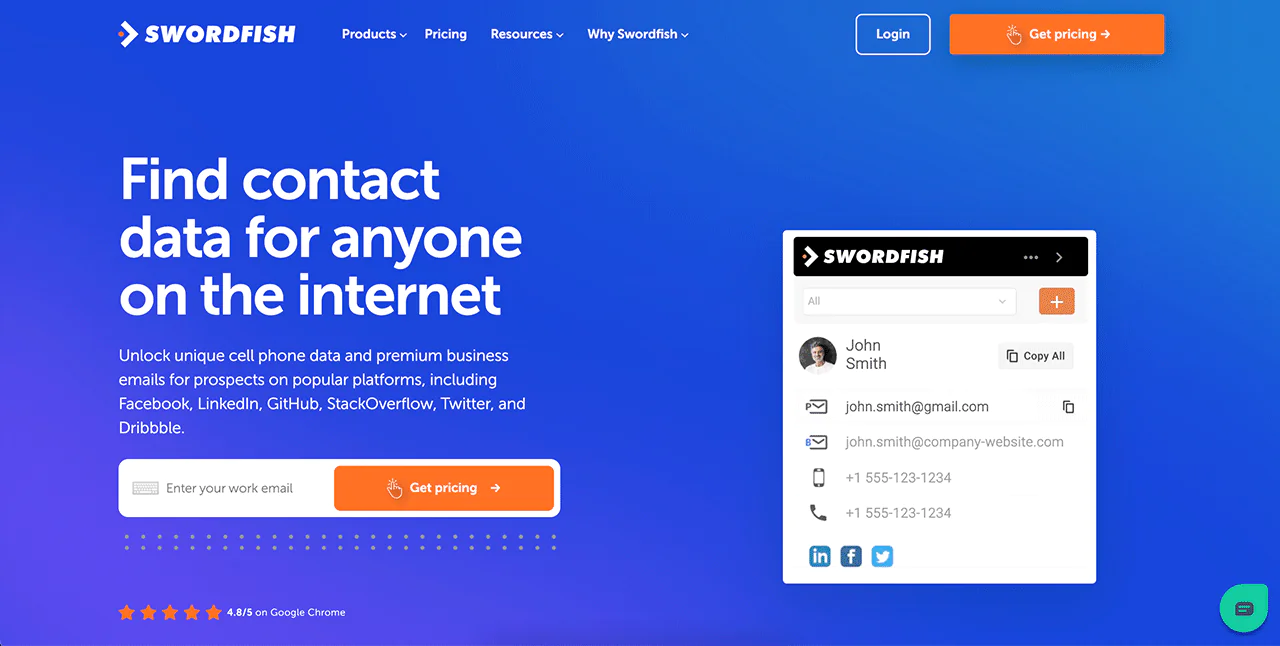
- Swordfish,ai: Find emails on LinkedIn directly from your browser with the contact-finding extension for Google Chrome, or use any LinkedIn URL to find contact data with Reverse Lookup. Swordfish.ai is built for finding both email and mobile contact data tied to LinkedIn profiles.
- Getprospect: Large database with seamless LinkedIn integration and straightforward contact management.
- Skrapp: Well suited to startups and individual users, with bulk email extraction and verification.
- Snov.io: An all-in-one outreach platform with drip campaigns and built-in email verification.
- SalesQL: Built for sales teams, with detailed lead profiles for building trustworthy contact lists.
- Prospeo: Simplifies LinkedIn prospecting with email extraction and follow-up tracking.
- Apollo.io: Strong data enrichment, suited to larger-scale prospecting needs.
- LeadLeaper: Real-time email finding for fast-moving sales environments.
- Hunter.io: One of the most widely used tools, known for precise email finding and domain search.
- ContactOut: Finds both emails and phone numbers to broaden outreach options.
- RocketReach: Large database that surfaces up-to-date professional contacts across multiple platforms.
- Lusha: High accuracy rate with integrations across many CRMs.
- Kloser: B2B focused, with detailed insights alongside email finding.
- Salesflare: CRM-centric, streamlining sales processes alongside contact retrieval.
- AeroLeads: Built for quickly assembling large email lists, with finding and verification included.
Each of these fills a slightly different niche, from bulk list-building to CRM-embedded workflows. The right pick depends on your outreach volume, budget, and whether you need phone data alongside email.
What are the benefits of LinkedIn email finders?
The most obvious benefit is reach. Once you’re not limited to InMail, you can contact prospects directly, which generally means more flexibility in timing and messaging, and more chances for a reply.
The second benefit is speed. Manually hunting for someone’s business email is slow and unreliable. A LinkedIn email finder automates that lookup so you can build contact lists in minutes instead of hours, which matters when you’re working healthcare provider lists at any real scale.
Turn LinkedIn prospects into qualified leads
The right tool makes a measurable difference in how many LinkedIn connections turn into actual conversations. Look for LinkedIn integration, solid search filters, and real-time email verification so you’re not wasting outreach on dead addresses.
Get a free trial https://swordfish.ai/