
 View Products


LinkedIn Phone Number Finder: A 5-Minute Workflow From Profile to Call List
By Ben Argeband, Founder & CEO of Swordfish.AI
Author note: Make it a tight LinkedIn workflow (profile → enrich → verify → call prep): remind that LinkedIn gives identity; enrichment provides phones; ranking picks best.
Who this is for
Recruiters and sales teams prospecting on LinkedIn who want a fast path from profile to a compliant call list. If you already have names and companies but you’re missing direct dials, this is the workflow.
Quick Answer
- Core Answer
- A linkedin phone number finder uses LinkedIn identity signals, then contact enrichment and verification to produce likely mobile numbers you can prioritize for compliant outreach. Use it to build a call list with verification status so reps don’t dial unconfirmed numbers.
- Key Insight
- LinkedIn provides identity; phone comes from enrichment + verification, and ranking matters when multiple numbers exist.
- Best For
- Outbound SDRs and recruiters building call lists from LinkedIn profiles.
Compliance & Safety
This method is for legitimate business outreach only. Always respect Do Not Call (DNC) registries and opt-out requests.
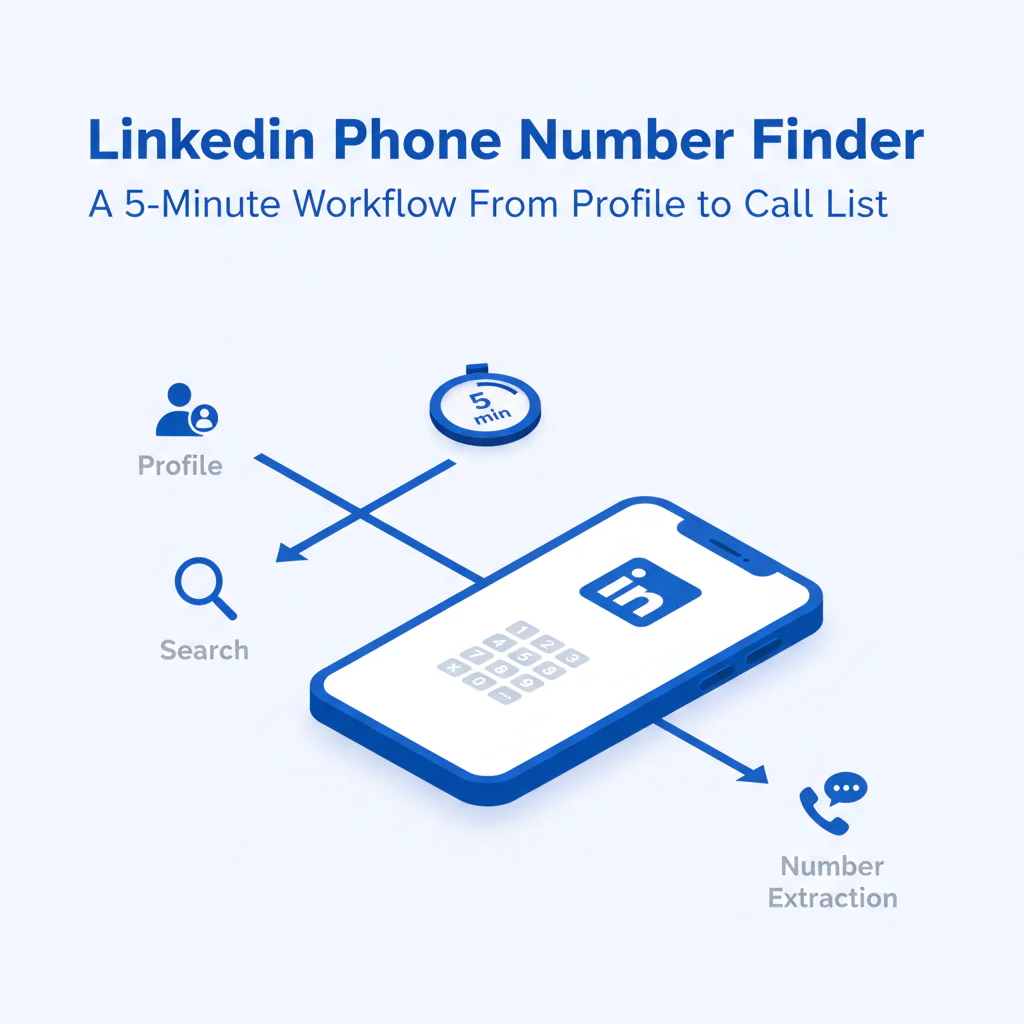
Framework: The 5-minute workflow from profile to call
LinkedIn is your identity layer, not your phonebook. A profile gives you the person, role, company, and location signals you need to avoid mismatches. Contact enrichment pulls candidate numbers from external sources; LinkedIn is the identity anchor that keeps you from calling the wrong “John Smith.”
If you’re trying to run a linkedin direct dial motion, the business outcome is fewer wasted dials because you keep identity context attached to the number you’re about to call. The trade-off is… enrichment is probabilistic, and This requires manual verification, especially when the cost of a wrong-party call is high.
Alternatives exist: email-first outreach, CRM enrichment, or form-based sourcing. The reason to stay in-profile is operational: fewer identity mismatches and faster call prep because you’re not re-keying data between tabs.
Field Note: Are you optimizing for speed or for fewer wrong-party calls?
If a profile shows a recent job change, treat any older number as high-risk. Re-check the profile and re-verify before you dial.
Step-by-step method
What you need:
- A LinkedIn profile URL (identity anchor).
- Your ICP rules (what “qualified” means for role, company, and geography).
- A way to run enrichment from the profile (to reduce copy/paste errors).
- A verification requirement (what “callable” means for your team).
- A destination for routing (CRM staging list or CSV export).
-
Start on the LinkedIn profile (identity confirmation).
- Confirm full name, current company, title, and geography.
- Check recency: current role dates and recent activity reduce mismatch risk.
- Capture the LinkedIn URL for your CRM notes and dedupe.
-
Run enrichment from the profile (phone discovery).
To find phone number from linkedin reliably, treat the profile as identity and enrichment as reachability. The Swordfish Chrome Extension works directly on LinkedIn profiles, which keeps the identity context visible while you enrich.
If you want the shortest path, install via this direct link: View numbers without leaving LinkedIn.
-
Prioritize the best candidate number (ranking).
If enrichment returns more than one possible mobile, don’t “pick one and hope.” Use the provider’s ranking and treat it as a queue: dial the top candidate first, then fall back only if needed. This is where ranked mobile numbers by answer probability reduces wasted first dials.
-
Verify before you dial.
Don’t confuse “found” with “callable.” You need to verify mobile numbers to reduce wrong-party calls and compliance risk. Use a Real-time connectivity check (Signal validation) where available, and sanity-check against the LinkedIn profile (country, region, seniority, and role). Verification indicates reachability signals, not guaranteed ownership.
-
Build a call list and prep the first 20 seconds.
- Create a call list with: name, company, title, LinkedIn URL, number, verification status, date captured, and owner.
- Make ownership explicit: one owner per LinkedIn URL prevents duplicate outreach and conflicting follow-ups.
- Write a one-line reason for calling tied to their role (not your product).
- Use an identity check opener: “Hi {Name}, it’s {You}. I’m calling because you’re leading {Function} at {Company}. Did I catch you for 20 seconds?”
- Decide your stop rule: if you can’t confirm identity quickly, end the call and follow up via email/LinkedIn.
-
Export and route to your systems.
If you’re working a batch, export linkedin contacts into a spreadsheet or CRM staging list. Use the LinkedIn URL as your primary dedupe key. For a repeatable pipeline, use export linkedin contacts to csv so your team can dedupe, assign owners, and track outcomes.
Checklist: Weighted Checklist
Purpose: prioritize what reduces wrong numbers and wasted dials. Weighting is based on standard failure points (identity mismatch, stale data, unverified numbers) and the operating reality that LinkedIn provides identity while phones come from enrichment + verification.
- Highest impact: Confirm identity on LinkedIn (name + current company + title + geography) before enrichment. If identity is wrong, every downstream step fails.
- Highest impact: Enrich from the LinkedIn profile context (reduces wrong-person errors and keeps the right record attached to the right number).
- Highest impact: Verify before dialing (Signal validation + plausibility checks). This requires manual verification, especially for executives and regulated industries.
- Medium impact: When multiple numbers exist, follow the ranking order first (don’t random-pick).
- Medium impact: Log verification status and source notes in your call list so reps don’t rework the same lead.
- Lower impact: Export to CSV/CRM only after dedupe and ownership rules are defined (prevents duplicate outreach and conflicting ownership).
Decision Tree: Conditional Decision Tree
- If the LinkedIn profile has a clear current employer/title and matches your ICP, then proceed to enrichment. If not, stop and do not enrich.
- If enrichment returns one mobile number, then run verification. If it fails verification, stop and switch to email/LinkedIn messaging.
- If enrichment returns multiple candidate numbers, then verify and dial in ranked order only. If the top candidate fails verification, test the next candidate; do not skip verification.
- If the person answers but identity cannot be confirmed in the first 20 seconds, then stop the call and mark the number as “unconfirmed/wrong party risk.”
- Stop Condition: Any opt-out request, DNC constraint, or explicit “wrong person” confirmation ends outreach to that number immediately.
Troubleshooting Table: Diagnostic Table
| Symptom | Root cause | Fix |
|---|---|---|
| High wrong-party rate | Identity mismatch (same name, job change, wrong geography) | Re-check LinkedIn identity fields before enrichment; require current company/title match in your call list. |
| Low connect rate on “found” numbers | Numbers are stale or not mobile | Verify before dialing; prefer verified mobile numbers (reachability-verified, not consent-verified); treat unverified as email-first. |
| Reps cherry-pick numbers and waste time | No ranking discipline when multiple numbers exist | Enforce dial order based on ranking; only move to the next candidate after a failed verification/dial attempt. |
| Duplicate outreach from multiple reps | No dedupe/ownership rules after CSV export | Define dedupe keys (LinkedIn URL + company) and assign owners before importing to CRM. |
| Compliance complaints or opt-outs | No suppression process and poor logging | Centralize opt-outs; suppress at the number level; document consent/legitimate interest rationale. |
Diagnostic: Why this fails
- Confusing identity with reachability. LinkedIn tells you who someone is. It does not guarantee you can call them. Phones come from enrichment + verification.
- Skipping verification. If you don’t verify mobile numbers, you increase wrong-party calls and burn your team’s time.
- No process for multiple candidates. When you get more than one possible mobile, random selection creates inconsistent outcomes and messy rep behavior.
- Bad list hygiene. Without a clean call list, you can’t learn which segments perform, and you can’t enforce opt-outs.
How to improve results
- Work in-profile to reduce errors. Using a Chrome extension on the LinkedIn profile keeps the identity context visible while you enrich, which reduces wrong-person enrichment.
- Standardize your call list fields. Minimum: LinkedIn URL, name, company, title, number, verification status, date captured, and owner.
- Enforce ranked dialing. When multiple candidates exist, enforce ranked mobile numbers by answer probability so reps don’t improvise and skew your results.
- Audit outcomes weekly. Track connect rate, wrong-party rate, and opt-outs by segment so you can adjust verification strictness and channel mix.
- Run a monthly data quality review. If you don’t review bounce/wrong-party/opt-out patterns, your list decays quietly. Use a process like data quality.
Three interpretation examples (how this changes by team)
- Recruiting sourcing workflow: If you’re calling passive candidates, prioritize identity match and verification over volume. Treat “unverified” as message-first when the profile looks stale.
- Sales prospecting linkedin: If you’re running outbound sequences, enforce a single owner per LinkedIn URL and log outcomes. This prevents duplicate touches and makes your call list usable for coaching.
- Enterprise AE expansion: If you’re calling into existing accounts, require a tighter identity check (role + org alignment) before dialing. You’ll do fewer calls, but you’ll avoid calling the wrong person inside a sensitive account.
If your motion is mobile-first, review mobile number finder for a workflow centered on mobile reachability. If you need a broader approach to cell numbers across use cases, see cell phone number lookup.
Legal and ethical use
Cold outreach can be legal and still be done poorly. Build a process that is conservative by default.
- Legitimate purpose only. Use this for legitimate business outreach, not personal or sensitive decisions.
- Consent and opt-out handling. Respect opt-outs immediately and suppress at the number level across systems. Log opt-outs with timestamp, channel, and the specific number suppressed.
- Respect DNC and local rules. Apply DNC checks and jurisdiction rules before dialing.
- Suppression across tools. Store suppression in a dedicated CRM field and sync it to your dialer and sequencing tools so an opt-out in one place stops outreach everywhere.
- Minimize data. Store only what you need to run outreach and comply with requests.
- Be direct if asked. If someone asks how you got their number, answer plainly and offer an opt-out.
This requires manual verification of whether calling is appropriate for the person, the jurisdiction, and your use case.
Evidence and trust notes
- Identity vs phone reality: LinkedIn is generally reliable for identity attributes; phone numbers typically come from external enrichment and must be treated as probabilistic.
- Verification scope: A Real-time connectivity check (Signal validation) can indicate reachability, not guaranteed ownership or consent.
- Variance by segment: Role, geography, and seniority affect number stability and wrong-party risk.
- Process variance: Teams that enforce verification and ranked dialing learn faster and waste fewer dials than teams that let reps improvise.
- Logging matters: Without outcome logging (connected, wrong party, opt-out), you can’t improve list quality or compliance.
Sources
- GDPR overview (gdpr.eu)
- FTC Telemarketing Sales Rule (FTC)
- FCC guidance on telemarketing/robocalls (FCC)
Limitations and edge cases
- Job changes: A correct number can become wrong-party after a role change. Re-check the LinkedIn profile before re-dialing older leads.
- Shared names: Common names increase mismatch risk. Use company + geography as hard constraints.
- Executive assistants and switchboards: Enrichment may return corporate lines that route through gatekeepers. Adjust your call prep accordingly.
- International dialing: Formatting and local regulations vary. Don’t assume a US-centric compliance model applies everywhere.
- “Real-time” expectations: Verification is a Real-time connectivity check (Signal validation), not a guarantee that the number belongs to the intended person at the moment you dial.
FAQs
Does LinkedIn show phone numbers?
Usually no. LinkedIn provides identity signals; the phone number typically comes from contact enrichment plus verification.
What should I do when I get multiple numbers for one person?
Follow the ranking order, verify the top candidate first, and only fall back if verification fails or the dial attempt is unsuccessful.
How do I reduce wrong-number calls?
Confirm identity on the LinkedIn profile first, then verify before dialing. Log outcomes so you can suppress bad numbers and avoid repeat mistakes.
How do I export to CSV for my team?
Use export linkedin contacts to csv so you can dedupe, assign owners, and import cleanly into your CRM.
Can I build a list for my team?
Yes. Create a call list with verification status and ownership, then export linkedin contacts into your CRM or a CSV workflow so you can dedupe and assign.
Is this compliant?
It can be, but it depends on jurisdiction, your outreach practices, and how you handle DNC and opt-outs. This requires manual verification of your compliance obligations for each region and use case.
Next steps
Day 1
- Define your minimum identity fields (name, company, title, geography) and your stop rules (opt-out, DNC, wrong person).
- Install and test the Swordfish Chrome Extension on 20 LinkedIn profiles and log verification status and outcomes.
Day 3
- Implement verification as a required step and add a “verification status” field to your call list.
- Operationalize list routing with export linkedin contacts to csv so you can dedupe and assign owners.
Day 7
- Review outcomes: connect rate, wrong-party rate, opt-outs, and time-to-first-touch by segment.
- Run a data hygiene pass using data quality and decide when to use mobile number finder vs email/LinkedIn messaging.
About the Author
Ben Argeband is the Founder and CEO of Swordfish.ai and Heartbeat.ai. With deep expertise in data and SaaS, he has built two successful platforms trusted by over 50,000 sales and recruitment professionals. Ben’s mission is to help teams find direct contact information for hard-to-reach professionals and decision-makers, providing the shortest route to their next win. Connect with Ben on LinkedIn.