
 View Products


Swordfish vs Apollo: sequencing-first vs data-quality-first (and where the hidden costs show up)
By Ben Argeband, Founder & CEO of Swordfish.AI
Author note: Myth-bust “more numbers is better”: compare mobile coverage, verification, and pricing transparency; focus on better first number.
Who this is for
This is for buyers running a real swordfish vs apollo evaluation because your outbound workflow is leaking time and money in predictable places: low connect rate, decayed contact data quality, and pricing that looks stable until credits, API usage, and seat count hit production.
It’s also for teams deciding whether an all-in-one platform (sequencing + data) is worth the lock-in, or whether a specialist data layer is the cheaper long-term answer once integration and refresh cycles are counted.
Quick verdict
- Core answer
- Pick Apollo if you’re buying sequencing as the control plane for your outbound workflow and you can live with credits vs unlimited tradeoffs. Pick Swordfish if you’re buying contact data quality (especially mobile numbers / direct dials) and you want predictable usage under a true unlimited model with fair use.
- Key stat
- There is no universal “better” result because outcomes vary by seat count, API usage, list quality, and industry. Your variance will show up as connect rate swings and credit burn, not a neat benchmark.
- Ideal user
- A team that wants sequencing to stay where it is (CRM or existing sequencer) but needs a stronger data layer to reduce bad dials, reduce rep time wasted, and avoid surprise usage costs.
- Choose Apollo when: sequencing ownership is the priority and you want one UI to run the outbound workflow.
- Choose Swordfish when: phone reachability is the constraint and you need predictable enrichment behavior as data decays.
Decision guide
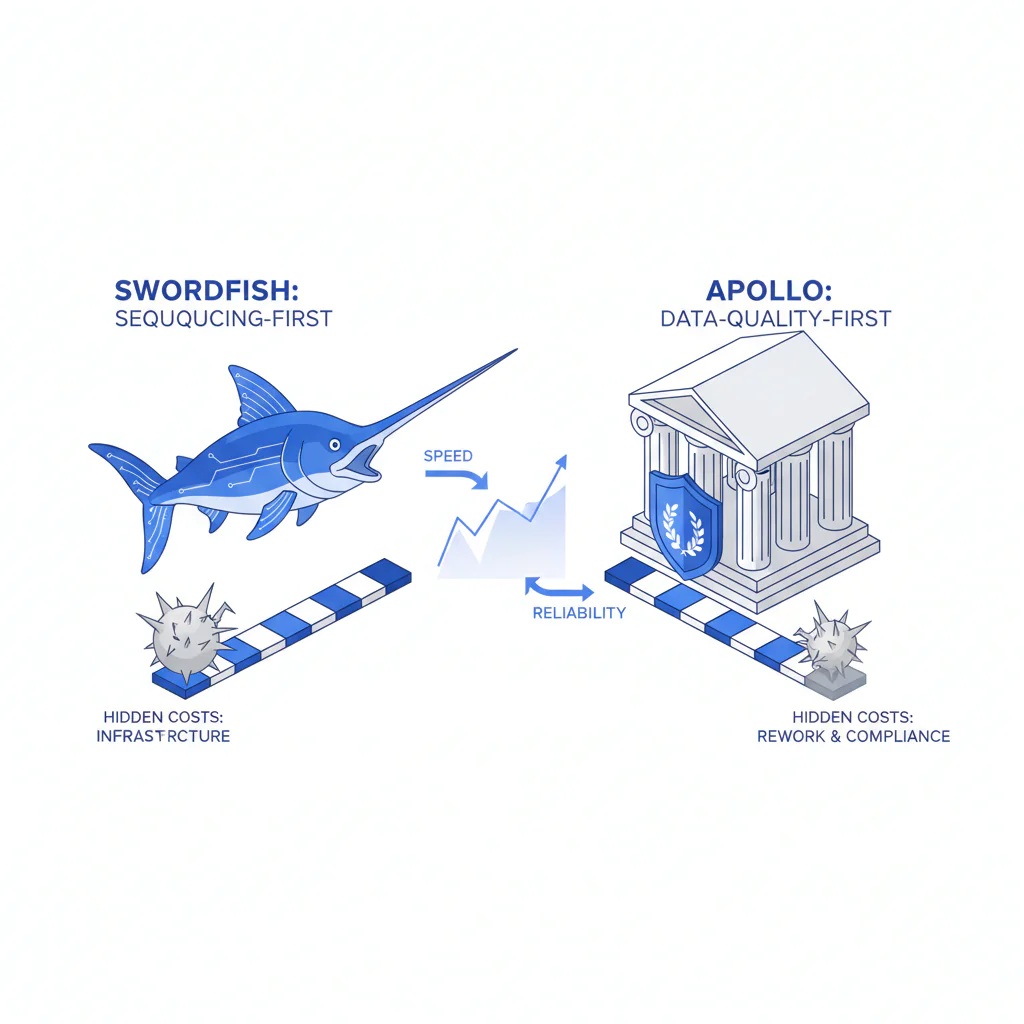
Use this framework: Choose by workflow: sequencing-first vs data-quality-first. That’s the decision that survives procurement and implementation.
Sequencing-first means you’re paying for a single place to build cadences, manage tasks, and keep reps consistent. The risk is you accept whatever contact data quality comes with the bundle, then spend later to patch it.
Data-quality-first means you treat contact data as the constraint. If phone is part of your motion, the first number matters more than having five numbers. Better first-number selection reduces wasted attempts, which is how you get time back without hiring.
If you don’t need sequencing, don’t pay the sequencing tax just to get data. That’s how stacks bloat and budgets get defended with sunk-cost logic.
This is the practical meaning of sequencing vs data quality: sequences don’t fix wrong numbers, and great numbers don’t fix a broken workflow. Decide which problem you actually have.
Checklist: Feature Gap Table
| Area | Apollo (sequencing + data) | Swordfish (data layer) | Hidden cost / integration headache to audit |
|---|---|---|---|
| Primary value | Sequencing-first outbound workflow with built-in data | Data-quality-first enrichment for mobile numbers and direct dials | If you buy sequencing but your connect rate is low, you’ll pay twice: once for sequences, again for better data. |
| Mobile numbers for outreach | Available, but quality/coverage varies by segment and plan | Ranked mobile numbers / prioritized direct dials to improve calling outcomes | “More numbers” can increase dial attempts without increasing connects. Audit whether the tool prioritizes the best first number for calling. |
| Pricing model | Commonly credit-based pricing tied to usage | True unlimited with fair use (predictable for heavy enrichment) | Credit-based pricing punishes refresh cycles. Unlimited models require you to read fair-use terms so “unlimited” doesn’t become a policy argument later. |
| Sequencing | Native sequencing (core feature) | Not the focus; integrates into your sequencer/CRM | If you need one tool for sequences + data, a specialist data layer adds a second vendor and admin overhead. |
| Outbound workflow fit | Strong if you want one UI for lists, sequences, and basic enrichment | Strong if you already run outreach elsewhere and need better contact data quality | Two-tool stacks fail when field mapping and dedupe rules aren’t enforced. Budget time for CRM hygiene or expect rep distrust. |
| API usage | API access varies by plan; usage can drive cost | Designed to act as a data layer; API usage is a normal path | API-based enrichment can multiply costs via retries and automation volume. Model usage before signing because variance is driven by API usage and seat count. |
| Data decay handling | Depends on refresh/enrichment workflow you implement | Designed for repeated lookup/enrichment as data decays | Data decay is operational. If you don’t schedule refresh, your connect rate drops while spend stays flat. |
| Exportability / writeback control | Works best when you stay inside the platform’s workflow | Designed to feed other systems as a data layer | If you can’t export enriched fields cleanly or control overwrite rules, you’ll either get lock-in or CRM contamination. Both cost more than the subscription. |
What Swordfish does differently
Swordfish is built to be the data layer, not the sequencer. Apollo’s strength is sequencing plus internal data. Swordfish is designed to feed your existing outbound workflow with better phone reachability so you don’t have to replatform just to fix contact data quality.
Ranked mobile numbers / prioritized direct dials: Swordfish focuses on getting you the best reachable number first instead of dumping every possible phone into your CRM. Expected outcome (validate in your trial): fewer wasted dials per connect, which can reduce rep time lost and raise connect rate without increasing activity volume.
True unlimited + fair use: Credit-based pricing tends to change behavior in bad ways: teams enrich less, refresh less, and accept decay because every lookup feels like a meter running. Swordfish’s unlimited model (with fair use) is designed for repeated lookups and refresh cycles. Expected outcome (validate in your trial): you can run consistent refresh to counter data decay without turning every workflow into a cost debate.
Prospector as the “Data Layer”: If you want Apollo’s sequencing but you don’t want to be stuck with Apollo’s internal data quality, Prospector is the split: keep sequencing where it is, and upgrade the contact data feeding it. Expected outcome (validate in your trial): fewer tool migrations and less rework when you change data sources.
Decision Tree: Weighted Checklist
This checklist is weighted by standard failure points in outbound audits: pricing variance, data decay, and integration overhead. The “weight” is the priority order, not invented point totals.
- Pricing variance exposure (credits vs unlimited): If your enrichment volume is uncertain or you refresh to fight decay, prioritize unlimited with clear fair-use terms. If usage is tightly capped and predictable, credits can be workable.
- Phone channel dependency (mobile numbers for outreach): If calling is a primary channel, prioritize tools that optimize the first number (ranked mobile numbers / prioritized direct dials). This reduces wasted attempts, which is how connect rate improves without brute-force volume.
- Workflow ownership (sequencing-first vs data-quality-first): If you need sequencing in the same UI to keep reps compliant, prioritize Apollo’s sequencing. If you already have a sequencer/CRM process, prioritize a data layer and avoid replatforming.
- Integration surface area (CRM writeback, overwrite rules, dedupe): If you can’t enforce field mapping and dedupe, you’ll pollute your CRM and reps will stop trusting the data. Prioritize the option that fits your governance maturity.
- Exportability / portability: If you expect to change tools later, prioritize clean export and predictable writeback. Portability reduces switching costs and prevents “we can’t leave because the data is trapped.”
- API usage reality: If you enrich via API (routing, inbound enrichment, automation), prioritize predictable API access and rate limits you can live with. If enrichment is mostly manual, this matters less.
- List quality variance: Messy lists (events, scraped, partner lists) amplify data quality differences and decay. Curated lists reduce variance and make sequencing convenience more attractive.
Troubleshooting Table: Conditional Decision Tree
- If your bottleneck is launching and managing sequences, then start with Apollo’s sequencing-first approach.
- If your bottleneck is low connect rate from wrong or stale numbers, then prioritize Swordfish’s data-quality-first approach with ranked mobile numbers / prioritized direct dials.
- If your enrichment volume is uncertain (new markets, new ICP, heavy refresh), then avoid credit-based pricing exposure and prefer true unlimited with fair use.
- If you already have a sequencer you won’t replace, then treat Apollo as optional and evaluate Swordfish as the data layer feeding your outbound workflow.
- If procurement demands one vendor and you can accept internal data variance, then Apollo’s bundle can reduce admin overhead.
- Stop condition: If you cannot get clear answers in writing on (a) how usage is billed (credits, overages, seat minimums), (b) what “fair use” means in practice, and (c) data portability (export format) plus writeback control (field mapping and overwrite rules), stop the evaluation. Ambiguity is where the hidden costs live.
Limitations and edge cases
Variance explainer: Any comparison of contact data accuracy and pricing outcomes will vary based on seat count, API usage, list quality, and industry. A small team enriching hand-picked accounts behaves nothing like a larger SDR org enriching inbound leads and refreshing on a schedule.
When Apollo wins cleanly: If you need sequencing as the control plane for rep activity and you want one UI for execution, Apollo’s sequencing-first design reduces tool sprawl. Expected outcome (validate in your trial): less training overhead and fewer handoffs.
When Swordfish wins cleanly: If calling outcomes matter and you’re losing time to wrong numbers, Swordfish’s focus on phone reachability is the direct fix. Expected outcome (validate in your trial): fewer wasted dials per connect and less rep time spent hunting for a usable number.
Integration edge case (phone field hierarchy): Decide your precedence order before you enrich anything: Mobile vs Direct vs Work, whether enrichment can overwrite existing values, and where the “best” number should live. If you don’t set this, you’ll create duplicates and conflicting phone fields, and your outbound workflow will degrade.
Refresh cadence edge case: Refresh cadence should be triggered by workflow events (territory changes, recycled leads, quarter resets), not by hope. If you don’t plan for data decay, you’ll blame reps for what is really a data problem.
Governance edge case: If your org has strict rules about storing personal numbers, validate how numbers are stored and audited in your systems. Tool choice doesn’t remove governance work; it changes where it happens.
Evidence and trust notes
I’m biased: I’m the founder of Swordfish.AI. Don’t take my word for it. Run a controlled test and force the variance drivers into the open: seat count, API usage, list quality, and industry.
If the matched-list test doesn’t improve connect outcomes or reduce wrong-number call outcomes (using your team’s disposition labels), don’t buy it. The tool isn’t the constraint in your workflow.
Who should own this internally: RevOps should own field mapping, overwrite rules, dedupe, and export format. The SDR manager should own dispositions and workflow controls so the test measures data, not rep behavior.
Use this 7-step plan to test with your own list without fooling yourself:
- Freeze the workflow: Keep the same outbound workflow (cadence, channel mix, call times) so you’re testing data, not behavior.
- Build a matched list segment: Use the same ICP slice for both tools (same industry band, seniority band, and geography). List quality is a variance driver, so don’t mix sources.
- Deduplicate before enrichment: Remove duplicates and decide whether you’re enriching Leads, Contacts, or both. Dedupe mistakes look like “bad data” but are really process failures.
- Define phone field precedence: Decide where the primary dial number goes and whether enrichment can overwrite existing values. If you skip this, you’ll contaminate your CRM and lose trust fast.
- Run enrichment the same way: If one test uses API usage and the other is manual, you’re not comparing tools; you’re comparing workflows. Keep the method consistent.
- Log outcomes consistently: Track call dispositions in a consistent way (connected vs not connected, wrong number, voicemail). Don’t change definitions mid-test.
- Review cost behavior: Model what happens when you refresh to counter data decay. Credit-based pricing often looks fine until you add refresh cycles and automation volume.
If you want background on why this matters, read data quality and how pricing models distort behavior in unlimited contact credits.
FAQs
- Is Apollo better than Swordfish?
It depends on whether you’re buying sequencing-first or data-quality-first. Apollo is strong when you want sequencing plus built-in data in one platform. Swordfish is strong when your bottleneck is reachable phone data and you want predictable usage under an unlimited model with fair use.
- How should I think about Apollo pricing credits?
Treat credits as a variable cost tied to activity and refresh. Your variance will come from API usage, seat count, list quality, and how often you re-enrich to counter data decay. If you don’t model refresh, you’re underestimating cost.
- Do more phone numbers improve results?
Not automatically. If the first number is wrong, having four more wrong numbers just increases attempts. Prioritization (ranked mobile numbers / prioritized direct dials) is what tends to reduce wasted dials and improve connect rate.
- Can I use Swordfish with Apollo?
Yes, if you want Apollo’s sequencing but you want a stronger data layer feeding it. The operational risk is CRM hygiene: field mapping, overwrite rules, and dedupe so you don’t create conflicting records.
- What’s the fastest way to test sequencing vs data quality?
Run the same outbound workflow on a matched list segment and compare connect outcomes and rep time spent on bad numbers. Don’t change ICP, cadence, or channel mix during the test.
- Where can I read more about Apollo before deciding?
Start with apollo-io-review, then check apollo-io-pricing and apollo-io-alternatives to understand the common tradeoffs.
- Where can I see how Swordfish handles cell numbers?
If your motion is phone-heavy, review cell phone number lookup to see how lookup fits into a calling workflow.
Next steps
- Day 1: Decide which problem you’re solving: sequencing-first vs data-quality-first. Write down the one outcome you’ll judge (connect outcomes or rep time wasted on bad dials).
- Day 2–3: Prepare a matched list segment and define CRM rules (phone field precedence, overwrite rules, dedupe, export format).
- Day 4–7: Run the controlled test using the same outbound workflow. Log outcomes consistently.
- Week 2: Validate integration details: CRM writeback fields, overwrite rules, dedupe, and any API usage you expect in production.
- Week 3: Model cost under real usage: seat count, refresh cycles (data decay), and automation volume. If you can’t model it, you can’t approve it.
If you want Swordfish as the data layer feeding your outbound workflow, start with Prospector and validate whether ranked mobile numbers / prioritized direct dials improve your connect outcomes on your actual lists.
About the Author
Ben Argeband is the Founder and CEO of Swordfish.ai and Heartbeat.ai. With deep expertise in data and SaaS, he has built two successful platforms trusted by over 50,000 sales and recruitment professionals. Ben’s mission is to help teams find direct contact information for hard-to-reach professionals and decision-makers, providing the shortest route to their next win. Connect with Ben on LinkedIn.