
 View Products


Last updated: September 3, 2026

By Ben Argeband, Founder & CEO of Swordfish.AI
Most “unlimited” contact data plans aren’t unlimited in the way buyers mean it. They’re a credits model wearing different packaging: soft caps, throttling, vague usage limits, and anti-abuse language that only becomes real after your team depends on it. For teams sourcing healthcare provider phone and email data, this matters more than usual, because provider lists decay fast and get re-enriched constantly. If you’re buying unlimited contact credits, you’re buying predictability, not a label.
Who this is for
This is for admins, ops, and power users who need clarity on how unlimited credits actually work before procurement signs. If you own budget, compliance, or rollout, you’re the person who gets the escalation call when “unlimited” turns into rationing and support tickets.
It’s also for recruiting and sales teams doing daily physician, nurse, and clinician outreach, where NPI-linked contact records go stale quickly and enrichment volume never really stops. If reps prospect every day, “unlimited” only matters if it stops behavior changes like skipping enrichment, hoarding lookups, or delaying outreach.
Quick verdict
- Core answer
- true unlimited is a pricing policy that removes per-record rationing for normal workflows while keeping fair use and anti-abuse rules explicit, so teams can enrich daily without surprise throttling or retroactive usage limits.
- Key reality
- “Unlimited” varies by seat count, API usage, list quality, and industry. If a plan can’t state its fair use boundaries and escalation path in writing, expect variance in access and operational continuity.
- Ideal user
- Recruiting and sales ops teams running continuous prospecting or enrichment against healthcare provider data (especially through a workflow tool) who want predictable spend and fewer adoption drop-offs caused by credit anxiety.
What Swordfish does differently
Contact data decays, and healthcare provider records decay faster than most: clinicians change practices, hospitals restructure, and direct lines get reassigned. Teams don’t enrich once; they re-enrich because yesterday’s good record becomes today’s bounce or dead line. Unlimited matters because it reduces the rationing behavior that quietly kills adoption.
Prioritized direct dials (ranked mobile numbers) instead of “a phone field.” In practice, teams don’t need “a number,” they need the best number first. Swordfish returns ranked options where available so reps spend less time cycling dead lines and less time burning paid labor on bad attempts.
true unlimited with explicit fair use. “Unlimited” without fair use is just deferred conflict. Swordfish treats unlimited as a workflow promise: you can run daily prospecting and enrichment without counting credits, while anti-abuse protections stay aimed at automation abuse, not normal business usage.
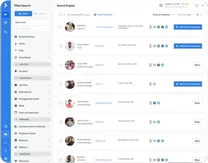
Unlimited that actually powers a workflow tool. If you’re using a prospecting workflow, the real cost isn’t the lookup, it’s the hesitation. This is the psychological tax of credits problem: people stop enriching because every click feels like spend. Unlimited reduces that tax so the team does the work instead of negotiating with a credits model. Swordfish’s unlimited plan is built to support the Prospector workflow where you enrich and move, not enrich and ration.
Variance is acknowledged instead of hidden. Contact data outcomes vary by industry, geography, and list quality, and healthcare is a particularly variable vertical given credentialing changes and multi-location practices. A vendor that pretends otherwise usually makes the variance your problem later via throttling or vague usage limits. Swordfish’s approach is to define fair use boundaries and handle edge cases with escalation rather than surprise restrictions mid-cycle.
Decision guide
Buying unlimited contact data is mostly about avoiding predictable failure modes: adoption drops because reps ration, finance gets hit with variable spend, and ops gets stuck integrating a tool that can’t support the actual volume. A credits model tends to create spend variance; unlimited reduces spend variance but increases policy risk unless fair use and throttling are explicit.
For audits, separate technical rate limits (infrastructure protection) from policy throttling (enforcement). Both can slow workflows, and both should be documented.
Before you sign, confirm what “unlimited” covers in practice: UI enrichment, API enrichment, exports, and re-enrichment. If any of those are carved out, you’re back to rationing, just with extra steps.
Require the enforcement sequence in writing (warning, review, restriction) rather than accepting the word “fair use” as a substitute for terms.
Checklist: Feature Gap Table
| What buyers ask for | What often happens in “unlimited” plans | Hidden cost / integration headache | What to require in writing (variance explainer) |
|---|---|---|---|
| true unlimited | Soft caps + throttling after “normal” usage | Reps slow down; ops builds workarounds; pipeline timing slips | Define usage limit triggers by seat count and API usage; require an escalation path before throttling |
| fair use unlimited | Fair use exists but is vague (“excessive,” “abusive”) | Procurement risk: policy changes become de facto price increases | Spell out anti-abuse examples (automation scraping, resale, bulk exporting) vs normal workflows (daily prospecting, list refresh) |
| High-volume enrichment | Unlimited UI, limited API; or API is separately metered | Integration breaks when you scale; engineering time becomes the real bill | Separate UI vs API terms; require clarity on API rate limits and whether they change with plan/seat count |
| Mobile/direct dial coverage | “Phone included” but not prioritized; quality varies by industry | Dialer time wasted; managers blame reps, not data | Require explanation of variance drivers: industry, geography, list freshness; ask how numbers are prioritized (ranked mobile numbers) |
| Data freshness | Unlimited encourages one-time bulk pulls that decay fast | Teams keep calling stale data; you pay twice (tool + labor) | Ask how re-enrichment is handled under unlimited; confirm it supports ongoing refresh without penalties |
| Compliance posture | Unlimited plans ignore governance until legal asks | Delayed rollout; blocked integrations; audit scramble | Require documented anti-abuse, acceptable use, and admin controls; confirm how violations are handled (warning vs immediate cutoff) |
Decision Tree: Weighted Checklist
Use this to score vendors when comparing credits vs unlimited. The weighting logic is based on standard failure points that create budget variance and adoption drop-offs: unclear fair use, throttling, and integration constraints. Don’t accept “it depends” without a written variance explanation.
- Highest weight: Explicit fair use + anti-abuse examples (adoption + procurement risk). If fair use is vague, your “unlimited” price is not stable. Require examples of allowed daily workflows vs disallowed automation/resale.
- Highest weight: Throttling policy and escalation path (operational continuity). If throttling exists, require when it triggers (seat count, API usage, list quality) and what happens first (notice, temporary limits, support review).
- High weight: UI vs API terms (integration reality). Many teams buy “unlimited” then discover the API is separately constrained. If you plan to enrich via CRM/ATS or internal systems, treat API terms as first-class.
- High weight: Ranked phone outputs (time-to-connect). A single phone field is not a workflow. Prioritized direct dials reduce wasted dialing and reduce the labor cost that never shows up on the invoice.
- Medium weight: Re-enrichment behavior under unlimited (data decay control). If the vendor discourages refresh, you’ll operate on stale data. Require confirmation that ongoing refresh is normal use.
- Medium weight: Admin controls and auditability (governance). Ask for admin controls and usage reporting so you can prove normal use versus abuse and avoid blanket restrictions that kill adoption.
- Lower weight: Support handling for edge cases (time cost). Unlimited plans fail when support treats normal volume as suspicious. Ask how exceptions are handled and what “review” timelines look like.
Troubleshooting Table: Conditional Decision Tree
- If your team enriches daily (recruiting/sales ops) and reps complain about “wasting credits,” then prioritize unlimited contact credits to remove rationing behavior and stabilize workflow.
- If the vendor cannot define fair use with concrete allowed/disallowed examples, then treat “unlimited” as marketing and model it as a credits plan with unknown overage risk.
- If you need CRM/ATS enrichment or internal tooling, then require API terms (rate limits, separate metering, and whether limits change with seat count).
- If the vendor’s “unlimited” includes throttling but no notice/escalation path, then assume production interruptions during peak campaigns.
- If your lists are old, scraped, or low-quality, then expect higher variance in match rates and more anti-abuse scrutiny; plan a pilot with your real data.
- Stop condition: If you cannot get written clarification on usage limits, throttling triggers, fair use boundaries, and the enforcement sequence before signing, stop the purchase. You’re buying uncertainty.
How to test with your own list (5–8 steps)
- Define “normal use” in writing. Document seat count, whether you’ll use UI, API, or both, and what “daily prospecting” means for your team.
- Bring a real list, not a curated sample. Use the same sources you actually operate on (CRM exports, ATS lists, inbound leads, or an NPI-based provider list). List quality drives variance.
- Segment the list by industry and geography. This is where phone availability and direct dial variance shows up, and it’s especially true across care settings and states. Don’t average it away.
- Run enrichment the way you’ll run it in production. If you plan to automate, test API usage. If reps will work in a tool, test the UI workflow.
- Check outputs for operational usefulness. For phones, verify whether you’re getting prioritized direct dials (ranked mobile numbers) rather than a random phone field.
- Re-enrich a subset after a short interval. You’re testing whether the plan supports ongoing refresh without penalties, because data decay is the default state, not the exception.
- Watch for throttling and policy friction. If anything slows down, require the vendor to explain whether it’s infrastructure rate limiting, policy enforcement, or list-quality-driven review.
- Get the variance explainer in writing. Seat count assumptions, API usage constraints, list quality expectations, and what triggers review should be documented before rollout.
Limitations and edge cases
Unlimited doesn’t mean infinite automation. Any provider offering true unlimited pricing still needs anti-abuse controls. The difference is whether those controls stop abusive patterns (scraping, resale, credential sharing) or quietly punish normal business usage.
Fair use should be explicit enough to audit. These examples map to normal operations versus abuse, which reduces surprise enforcement and downtime.
- Typically allowed under fair use: daily prospecting by named users, re-enrichment of active pipeline lists, routine CRM/ATS sync that matches your seat count and documented workflow.
- Typically disallowed under anti-abuse: credential sharing across teams/companies, resale or redistribution of exported data, bulk scraping automation designed to extract at unnatural volume.
List quality changes everything. If your inputs are stale, incomplete, or outside your target market, results will vary. Demand an explanation of how list quality affects outcomes and whether your workflow can re-enrich without penalties.
Industry and geography variance is real. Mobile availability and direct dial coverage differ by region and role type, and healthcare providers are a good example, since coverage can differ meaningfully between, say, a solo practice and a large hospital system. If a vendor claims uniform performance, expect the gap to show up later as throttling, fair use disputes, or support telling you your use case is “not typical.”
API usage is where unlimited plans get quietly limited. Many teams buy a contact data subscription for ops automation, then discover the API is rate-limited or separately metered. If you’re integrating, treat API constraints as a first-order cost driver because engineering time is more expensive than the data.
Evidence and trust notes
I run Swordfish, so assume bias. I’m also the person who gets pulled into the uncomfortable calls when a buyer discovers that “unlimited” meant “until we decide it doesn’t.” This page is written to reduce that outcome by making the variance drivers explicit: seat count, API usage, list quality, and industry.
We avoid publishing simplistic universal metrics because they’re not comparable across vendors without controlling for those variables. If you want a real evaluation, run a pilot using your actual workflow and data sources, and document what “normal use” looks like for your team before you scale seats.
If you want deeper policy detail, read how unlimited credits work and compare models in unlimited credits vs credit-based pricing. If you’re auditing spend, start with contact data pricing. If your concern is outcomes, review data quality. If you’re benchmarking vendors, see ZoomInfo vs Swordfish.
FAQs
What are unlimited contact credits?
They’re a plan structure where you don’t pay per lookup in the normal workflow. The operational test is whether your team can enrich daily without counting, and whether the vendor’s fair use rules are explicit enough to prevent surprise restrictions.
Is “fair use unlimited” the same as unlimited?
No. fair use is the policy layer that defines what “normal” looks like and what counts as abuse. Unlimited without clear fair use is deferred pricing risk.
What’s the difference between credits vs unlimited?
A credits model makes cost proportional to usage, which often causes rationing and adoption drop-offs. Unlimited shifts the risk to the vendor, which is why vendors add usage limits and anti-abuse language. Your job is to ensure those limits don’t block normal operations.
Does unlimited mean no throttling?
Not automatically. Some vendors throttle to protect infrastructure or enforce policy. The issue is whether throttling is predictable and documented, and whether there’s an escalation path before it impacts production work.
How do I evaluate unlimited contact data without vendor benchmarks?
Pilot with your real list quality and your real workflow. Ask for written terms on seat count assumptions, API usage constraints, and what triggers review. That’s where variance comes from.
Is unlimited best for recruiters or sales teams?
It’s best for teams with continuous prospecting where the psychological tax of credits reduces usage. If your team enriches sporadically, a credits plan can be fine, but you still need to model overage risk and admin overhead.
What should I watch for in the contract?
Ambiguous fair use, undefined usage limits, and any clause that allows unilateral throttling without notice. Also separate terms for API usage versus UI usage.
Next steps
Timeline (practical, not aspirational):
- Day 0–1: Document your expected “normal use” (seats, daily enrichment volume, UI vs API usage, and list sources).
- Day 2–4: Run a pilot using your real data. Track where variance shows up (industry/geography, list freshness) and whether any throttling appears.
- Day 5: Get written clarification on true unlimited, fair use, and escalation steps for edge cases.
- Week 2: Roll out to a controlled group and confirm adoption doesn’t drop due to rationing behavior.
If your goal is to run prospecting without credit anxiety, start with the Prospector workflow and validate that unlimited supports your actual enrichment pattern before you scale seats.
About the Author
Ben Argeband is the Founder and CEO of Swordfish.ai and Heartbeat.ai. With deep expertise in data and SaaS, he has built two successful platforms trusted by over 50,000 sales and recruitment professionals. Ben’s mission is to help teams find direct contact information for hard-to-reach professionals and decision-makers, providing the shortest route to their next win. Connect with Ben on LinkedIn.