
 View Products


Contact data quality: a buyer-grade definition (and how to audit it)
Byline: Ben Argeband, Founder & CEO of Swordfish.AI
Who this is for
This is for leaders and operators evaluating contact data tools who are tired of paying twice: once for the license, then again for the cleanup. If you own pipeline, outbound performance, RevOps, or procurement, you need a definition of contact data quality that survives data decay, integration friction, and compliance reality.
If your current vendor “looks fine” until reps start dialing dead lines and your CRM fills with duplicates, you’re in the right place.
Quick verdict
- Core answer
- Contact data quality is not one score; it’s the combined effect of accuracy, recency, verification, and connectability on your real-world connect rate and compliance exposure.
- Key stat
- Any “accuracy” claim varies by seat count, API usage, list quality, and industry; if a vendor won’t explain variance, you can’t forecast outcomes.
- Ideal user
- Teams that need measurable outreach improvement, want mobile-first reachability, and want fewer integration surprises and opt-out failures.
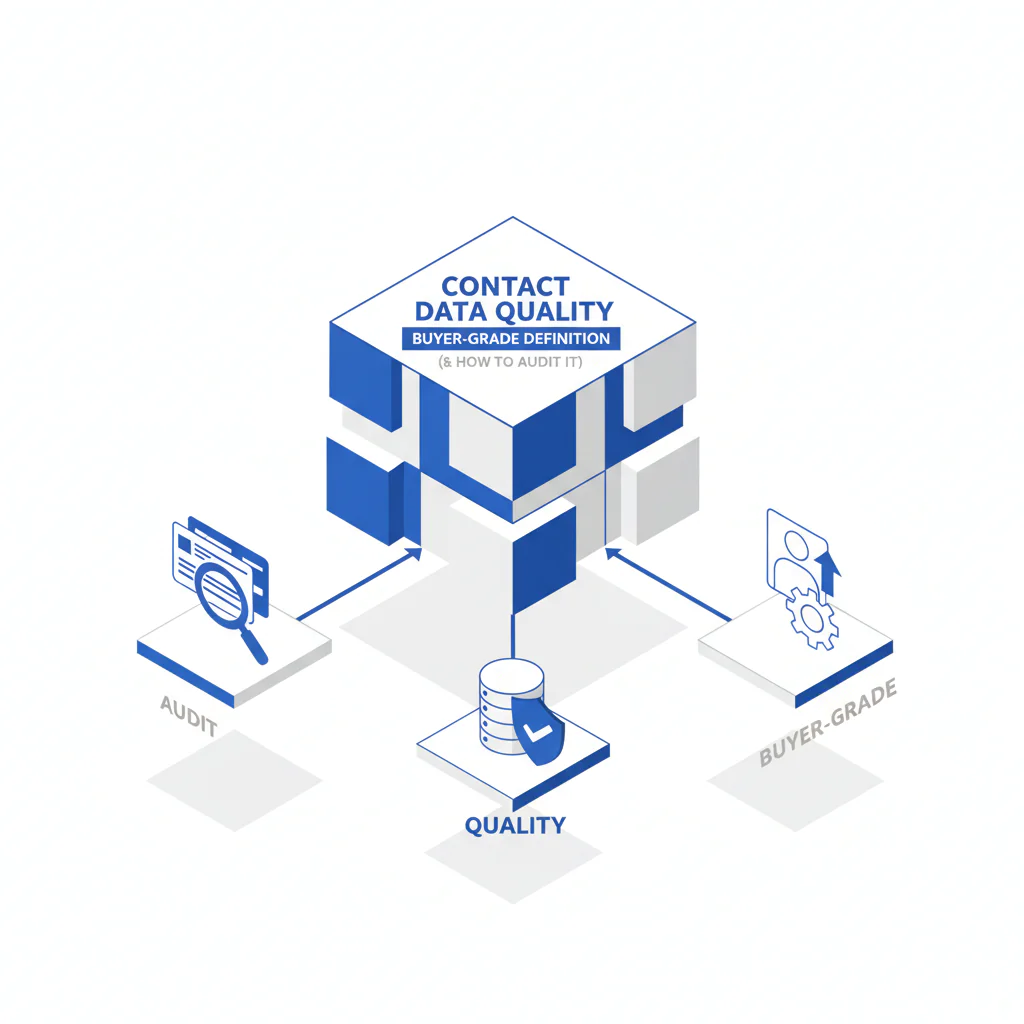
I audit contact data tools using one rule: Quality isn’t one number. It’s four dimensions that determine whether the record is usable in your workflow.
- Accuracy: Is the phone/email actually associated with the person?
- Recency: How recently was it observed or updated, and how fast does it decay in your segment?
- Verification: What checks were performed (and when) to reduce bad numbers before they hit your CRM?
- Connectability: Does it increase your ability to reach a human, measured in your systems?
Operational definition of connect rate: pick one ratio and stick to it for the pilot. Most teams use “connected conversations” divided by “dials placed” or “answered calls,” pulled from the dialer/SEP/CRM call logs. Dialer dispositions vary, so define what counts as “connected” before the pilot and keep it consistent.
Coverage is how often a vendor returns a value. Usable coverage is how often that value improves connectability in your workflow, which is what moves connect rate and reduces rep waste.
Two kinds of variance matter, and vendors tend to blur them. Data variance comes from your ICP, geography, seniority, and how quickly numbers change. Measurement variance comes from dialer rules, call dispositions, sampling windows, and rep behavior. If you don’t lock the measurement method before a pilot, you’ll argue about the result instead of learning from it.
What Swordfish does differently
Most contact data tools behave like a warehouse: you query, you get a result, and you own the fallout. Swordfish is designed to be audited on outcomes: whether the data is usable for outreach without creating downstream rework.
1) Mobile-first reachability (ranked mobile numbers and prioritized direct dials)
Mobile vs landline/VoIP changes outcomes because the channel changes reachability. A “phone number” that routes to a switchboard or a dead desk line is operationally low quality even if it’s technically accurate. Swordfish emphasizes mobile numbers and direct dials and supports ranking so reps start with the most likely-to-connect option instead of guessing, which reduces wasted dials and improves calling efficiency.
2) Verification that matches usage timing
“Verified mobile numbers” only reduce waste if verification is tied to when you use the data. A number verified months ago can be wrong today. Swordfish treats verification as part of the retrieval and usage flow so you can reduce bad-call volume and CRM contamination. See how we verify mobile numbers and phone number validation.
3) Connectability over database theater
Vendors sell coverage because it’s easy to inflate. Coverage that doesn’t improve connect rate is just more rows to pay for and clean up. Swordfish focuses on whether the data is usable in outreach, not whether it pads a record count. For how this is evaluated, see cell phone data coverage and direct dial accuracy.
4) True unlimited with fair use (so you can model cost)
Hidden cost pattern: “unlimited” that turns into throttling, overages, or vague usage definitions once you scale seats or API calls. Swordfish offers true unlimited with a fair use policy so teams can forecast usage without building a spreadsheet of exceptions. Start with unlimited contact credits.
5) Compliance and opt-out treated as usability
If your data can’t be used safely, it’s not high quality. Compliance and opt-out handling are part of quality because they determine whether the record is usable in your workflow without creating risk or rework. See contact data compliance.
If you want the Swordfish-specific accuracy discussion with context, see how accurate is Swordfish.
Decision guide
Buying contact data tools fails for predictable reasons: teams compare vendor claims instead of variance drivers, they ignore data decay until the CRM is polluted, and they underestimate integration headaches. Use the four-dimension model to force clarity on what you’re paying for.
Step 1: Define quality as outcomes
Write down what “better” means in your environment: improved connect rate, fewer wrong-person calls, fewer dead lines, fewer duplicates, and fewer compliance exceptions. If you can’t tie quality to an outcome, you’ll buy coverage and pay for cleanup.
Step 2: Separate accuracy from recency
Accuracy answers “is it correct?” Recency answers “is it still correct?” Data decay is the recurring cost you keep paying after the contract is signed. If a vendor can’t explain refresh behavior and how it varies by your industry and list quality, you’re buying a snapshot and calling it a system.
Step 3: Treat verification as a control, not a label
Verification should reduce failure before it hits reps and your CRM. Ask what is verified, when it is verified, and what happens when verification fails. If the answer is “we have a score,” assume you’ll still pay for bad dials.
Step 4: Measure connectability in your logs
Connectability is where “contact data benchmarks” usually fall apart. Benchmarks that ignore list quality and industry are noise. Instrument connect rate from your dialer/CRM and segment it by phone type (mobile vs landline/VoIP), by ICP slice, and by recency bucket so you can see whether the tool improves usable reachability instead of just returning more numbers.
- Freeze a test list from your real ICP and tag it so it can’t drift during the pilot.
- Capture baselines from your dialer/CRM logs using one connect rate definition and consistent dispositions.
- Enrich the same list using the vendor’s normal workflow (extension, CSV, or API) and record what fields are written where.
- Run outreach in a fixed window with the same reps, dialer settings, and call routing rules to reduce measurement variance.
- Analyze outcomes by segment: mobile vs landline/VoIP, recency bucket, industry, and list source quality.
- Audit failure reasons (wrong person, dead line, switchboard) and trace whether they came from stale data, phone type, or field mapping issues.
Step 5: Model total cost, including integration and cleanup
Hidden costs show up as CRM duplicates, conflicting field writes, rep-side browser extensions that bypass governance, API rate limits, and “unlimited” plans that aren’t. If reps can enrich outside governance, you’ll get inconsistent fields and duplicates that look like “bad data” but are really process failure.
Checklist: Feature Gap Table
| Quality dimension | What vendors often claim | Hidden cost / failure mode | What to ask in procurement | Business outcome it affects |
|---|---|---|---|---|
| Accuracy | “High accuracy” as one percentage | Accuracy varies by industry and list source; you pay for records that don’t match your ICP | How does accuracy vary by industry, title level, and region? What’s excluded from the claim? | Fewer wrong-person calls; less CRM contamination |
| Recency | “Fresh data” without a refresh model | Data decay creates silent rep waste; stale numbers suppress connect rate | What triggers updates? How is “last seen/updated” represented? Can we filter by recency? | Higher connect rate; fewer dead-end touches |
| Verification | “Verified” badge or proprietary score | Verification done at ingest, not at use; verified months ago still fails today | What is verified (mobile vs landline/VoIP)? When is it verified? What happens on failure? | Lower bad-call volume; fewer wasted dials |
| Connectability | “We have the number” | Having a number isn’t the same as reaching a person; desk lines and switchboards look like success in a database | Do you rank numbers (mobile/direct dial) for calling? How do you validate connectability in practice? | More conversations per hour; better rep productivity |
| Coverage | Big record counts | Paying for breadth you can’t use; low-yield segments dilute performance metrics | Coverage by ICP slice? Mobile coverage vs landline/VoIP? What’s the expected variance by industry? | Higher yield per list; less spend on low-fit records |
| Compliance & opt-out | “We’re compliant” as a checkbox | Opt-out mismatches across systems; risk shifts to you during activation | How are opt-outs handled and synced? What controls exist for suppression and audit trails? | Lower legal/brand risk; fewer blocked campaigns |
| Integration | “Integrates with X” | Field mapping conflicts, duplicates, and rate limits create manual work | What objects/fields are supported? Deduping rules? API limits? Error handling? | Lower admin overhead; faster time-to-value |
| Pricing model | “Unlimited” or “credits” | Throttling, fair use ambiguity, and overages distort ROI | What counts as usage (API calls, exports, enrich)? What is fair use in writing? | Predictable cost per meeting; fewer surprise invoices |
Decision Tree: Weighted Checklist
This weighting is based on standard failure points in contact data programs: data decay, unusable phone types, verification timing, integration friction, and compliance/opt-out handling. Use it to prioritize evaluation effort, not to pretend you can score vendors with fake precision.
- Highest weight: Connectability (connect rate impact) because it converts directly to rep productivity and pipeline outcomes.
- Highest weight: Verification (timing + method) because verification done at the wrong time still produces bad dials and CRM pollution.
- Highest weight: Recency (refresh model + visibility) because data decay is the recurring cost that quietly compounds.
- Medium weight: Accuracy (variance by segment) because accuracy claims without variance by industry and list quality are not procurement-grade.
- Medium weight: Coverage (mobile vs landline/VoIP) because mobile vs landline/VoIP changes outcomes; broad coverage with the wrong phone type is spend without reach.
- Medium weight: Compliance & opt-out because records you can’t safely use are not usable data, and suppression failures create operational risk.
- Lower weight: UI convenience because convenience doesn’t fix bad data; it just speeds up consumption.
- Lower weight: Vendor benchmarks because they rarely control for seat count, API usage, list quality, and industry.
Troubleshooting Table: Conditional Decision Tree
- If your primary channel is calling and you can’t separate mobile from landline/VoIP, then treat the tool as high risk for connectability and require phone-type labeling and mobile-first reporting before rollout.
- If the vendor can’t explain how accuracy varies by industry, region, and list source, then run a controlled pilot on your own lists and do not accept a single headline percentage.
- If “verification” is described as a score without timing and method, then assume verification won’t prevent bad calls and require workflow-level phone number validation evidence.
- If the tool increases enrichment volume but you can’t measure connect rate change in your logs, then you’re buying activity, not outcomes; instrument connect rate by segment before expanding seats.
- If opt-out handling is not auditable across systems, then treat compliance as unresolved and block activation until suppression rules are documented and tested.
- Stop condition: If “unlimited” is not defined in writing (including fair use and what counts as usage), then stop procurement until pricing is forecastable via unlimited contact credits terms.
Limitations and edge cases
List quality can swamp vendor performance. If your inputs are old exports, scraped lists, or inconsistent naming, you’ll see misses regardless of vendor. The audit question is whether the vendor can explain behavior under your conditions and help you avoid contaminating the CRM.
Some segments decay faster. High-churn roles and industries punish stale data. That’s a recency problem that changes how often you need refresh and verification.
Mobile vs landline/VoIP isn’t a preference; it’s a reachability constraint. If your motion depends on direct outreach, phone type affects connectability. A tool that can’t prioritize direct dials or mobile numbers will look fine in a spreadsheet and fail in a dialer.
API usage changes cost and rollout risk. Heavy enrichment via API can trigger rate limits, throttling, or unexpected usage definitions. That’s a budget and implementation problem, not a technical footnote.
Compliance is operational. “We’re compliant” doesn’t prevent your team from contacting someone who opted out if suppression isn’t enforced where reps work. If opt-out isn’t integrated into your CRM/SEP/dialer flow, you’re relying on luck.
Evidence and trust notes
I don’t treat vendor-wide “contact data accuracy” claims as procurement-grade without variance explanations. Outcomes depend on seat count, API usage patterns, list quality, and industry. If a vendor can’t explain variance, you can’t budget outcomes.
What I do trust is auditability: can you see what you’re getting, when it was last updated, and how it’s meant to be used. In practice, that means you can separate mobile vs landline/VoIP and segment results by recency so you can measure connectability instead of arguing about anecdotes.
During a trial, require a field-level mapping document (what gets written, where, and under what conditions) so you can reproduce results and avoid CRM drift.
- how we verify mobile numbers
- phone number validation
- direct dial accuracy
- cell phone data coverage
- contact data compliance
- how accurate is Swordfish
FAQs
What is contact data quality?
Contact data quality is the degree to which contact records are usable for outreach without creating waste or risk. In practice it’s the combined effect of accuracy, recency, verification, and connectability on outcomes like connect rate and compliance exposure.
What’s the difference between accuracy and recency?
Accuracy is whether the record is correct. Recency is whether it’s still correct today. Data decay turns accurate records into unusable ones, which is why refresh behavior matters.
How should I measure connect rate for a data vendor pilot?
Pick one definition from your dialer/CRM logs and keep it consistent across the test window. Segment it by phone type (mobile vs landline/VoIP), by ICP slice, and by recency bucket so you can see whether the tool improves connectability instead of just returning more numbers.
What does verification mean for phone data?
Verification should mean the vendor can explain what was checked, when it was checked, and what happens when it fails. If verification isn’t tied to usage timing, you’ll still pay reps to dial bad numbers.
What is usable coverage?
Coverage is how often a vendor returns a value. Usable coverage is how often that value improves connectability in your workflow.
Is compliance and opt-out part of contact data quality?
Yes. If you can’t safely use the record, it’s not usable data. Compliance and opt-out handling determine whether the record can be activated without creating risk or rework.
Where does Swordfish fit if I want to operationalize this model?
If you want a tool that implements the four dimensions natively, start with Info Prospector and validate it against your own connect rate baselines before expanding usage.
Next steps
Timeline you can run without guessing:
- Day 0–2: Define success metrics (connect rate definition, bad-call reasons, duplicate rate, opt-out exception rate) and capture baselines.
- Day 3–7: Pilot on a controlled list sample; log outcomes by phone type (mobile vs landline/VoIP) and by ICP slice.
- Week 2: Validate verification behavior and recency visibility; confirm number ranking/prioritization aligns with rep workflows.
- Week 3: Integration test (CRM/SEP/dialer), dedupe rules, field mapping, suppression/opt-out enforcement, and API usage limits.
- Week 4: Decide rollout scope and governance; lock pricing definitions (including fair use) before scaling seats or API calls.
If you want the implementation entry point, use Info Prospector.
About the Author
Ben Argeband is the Founder and CEO of Swordfish.ai and Heartbeat.ai. With deep expertise in data and SaaS, he has built two successful platforms trusted by over 50,000 sales and recruitment professionals. Ben’s mission is to help teams find direct contact information for hard-to-reach professionals and decision-makers, providing the shortest route to their next win. Connect with Ben on LinkedIn.