
 View Products


Last updated: September 3, 2026
By Ben Argeband, Founder & CEO of Swordfish.AI
Who this is for
Healthcare recruiting ops, sales ops, and revops teams who want to route provider outreach based on carrier and line-type signals, without assuming a lookup guarantees who currently owns the number.
Quick Answer
- Core Answer
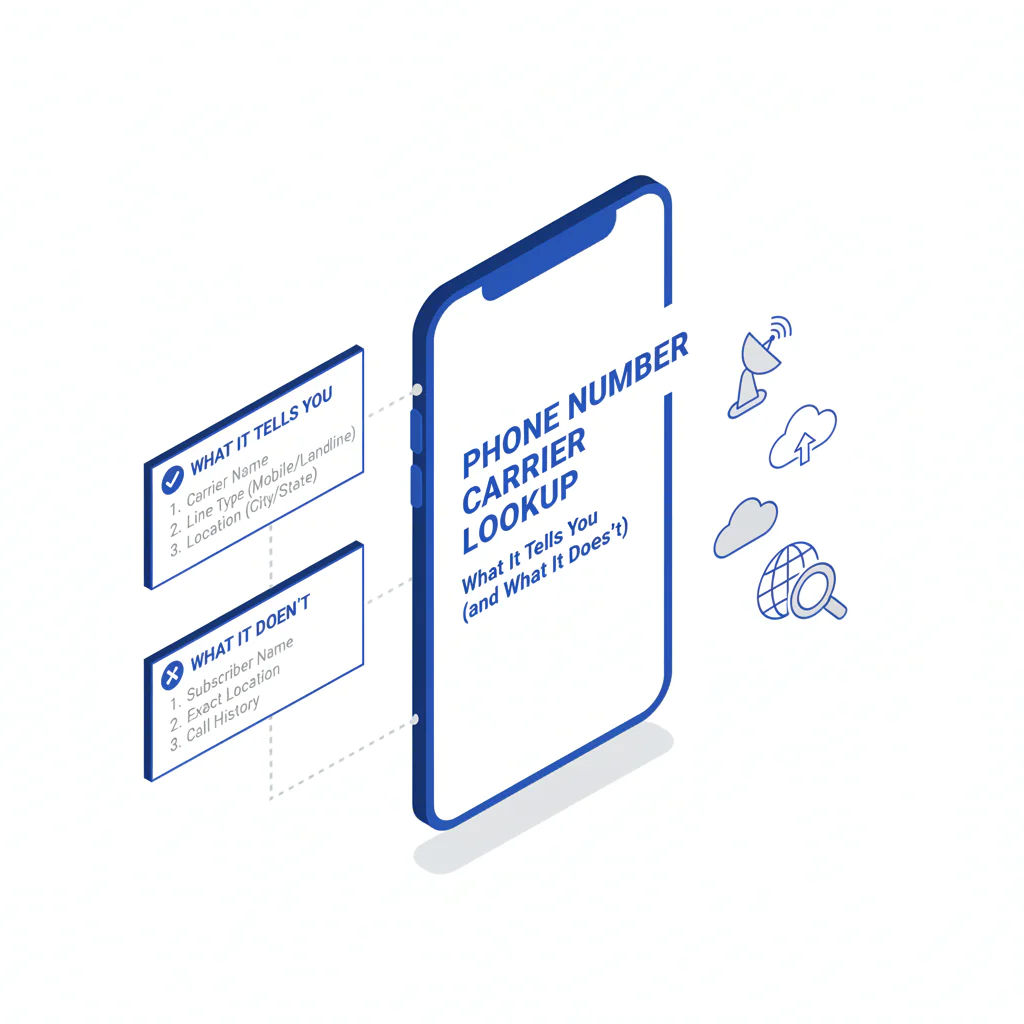
- Phone number carrier lookup returns the carrier associated with a phone number and may include line type (mobile/landline/VoIP). Use it to route outreach and QA data, but expect mismatches from number porting, number reassignment, and data refresh lag.
- Key Insight
- A phone carrier lookup is most useful when paired with line type and validation, because carrier alone won’t prevent misroutes or wasted attempts on disconnected numbers. Carrier/type also does not indicate consent.
- Best For
- RevOps leaders, SDR managers, and recruiting ops teams building routing rules and QA checks for phone outreach to providers and other hard-to-reach professionals.
Compliance & Safety
This method is for legitimate business outreach only. Always respect Do Not Call (DNC) registries and opt-out requests.
Framework: The Carrier/Type Signal Stack: Carrier → Type → Validity
Treat a carrier lookup as a signal you can audit, not as ground truth. Building routing logic on carrier name alone is a common way healthcare outreach programs end up with high misdial and complaint rates.
- Carrier: Who serves the number in the lookup source.
- Type: A line type lookup that classifies the number as mobile vs landline vs VoIP. This is what usually changes your outreach approach.
- Validity: validation and phone number verification checks to reduce attempts to disconnected numbers and obvious bad records.
A single signal is easier to automate but breaks faster once number porting or number reassignment has happened. That’s especially true for provider contact data, where NPI-linked numbers can sit unused for years before a lookup catches up. High-value contacts and sensitive roles deserve manual verification before you rely on any single field.
Quick Self Audit
When a lookup says “mobile,” do you have a documented rule for when you still stop automation and confirm identity in the first 10 seconds of the call?
Step-by-step method
-
Normalize the input before you look anything up.
Store numbers in a consistent format (ideally E.164 with country code). If you don’t have a country code, fix that before lookup. Bad formatting creates false mismatches and wastes time in downstream phone number intelligence workflows.
-
Start with the decision you’re trying to make.
- If you’re deciding “call vs text,” you need phone number type lookup (mobile/landline/VoIP) more than you need the carrier name.
- If you’re deciding “which dialer route,” carrier can matter, but only after you confirm type and validity.
-
Run a carrier by phone number check, but record it as a signal.
Expect outputs like carrier name, line type, and basic validity flags; store all three with timestamp/source. In your CRM, keep carrier, line type, validation status, timestamp, and source as separate fields so you can audit routing decisions later.
-
Run a line type lookup and prioritize it over carrier for routing.
Carrier names change; type is what changes channel eligibility and rep workflow. If your workflow depends on “mobile carrier lookup,” you’re usually trying to infer “is this mobile?”—so measure that directly.
If you need a practical starting point, reverse search can expose Line Type (Mobile vs Landline/VoIP) so you can route SMS eligibility and dialer paths.
-
Validate before you spend human time.
Use phone number verification / validation to catch malformed numbers and reduce attempts to likely disconnected numbers. Validation is not the same as identity confirmation.
For a deeper workflow, see phone number validation and how to verify a phone number.
-
Account for number reassignment and number porting in your rules.
Number porting and number reassignment are why carrier lookup accuracy degrades over time. If a record is old, treat carrier/type as stale and re-check before outreach. The FCC has estimated tens of millions of U.S. numbers get reassigned every year, which is part of why it built a dedicated database for callers to check reassignment status before dialing.
Interpretation examples (what to do with the result)
- Carrier lookup returns a major mobile carrier but line type lookup returns VoIP: route to call-first and require manual review before SMS because type drives channel eligibility.
- Line type lookup returns mobile but validation fails: quarantine the record and fix data hygiene before sequencing to avoid wasted attempts and bad rep time.
- Two sources disagree on carrier and the record is old: assume number porting or refresh lag, re-check, and stop automation for high-value contacts. This requires manual verification.
Checklist: Weighted Checklist
Use this to prioritize implementation. Weighting is based on standard failure points (porting/reassignment, disconnected numbers, misrouting by type) and the facts above (carrier is a signal; combine with type + validation).
- Highest impact: Make line type lookup mandatory for routing (mobile vs landline vs VoIP) so you don’t misroute channel and cadence.
- Highest impact: Add validation / phone number verification before sequences launch to reduce attempts to disconnected numbers and malformed records.
- High impact: Treat carrier lookup as non-authoritative; store it with timestamp + source for auditability.
- High impact: Add a staleness rule: older records get re-checked because number porting and number reassignment can invalidate prior results.
- Medium impact: Route ambiguous classifications (unknown/inconsistent) to manual review instead of forcing automation.
- Medium impact: Track outcomes by type (mobile/landline/VoIP) to see where your process is failing and where to tighten gates.
Diagnostic: Why this fails
Most failures come from treating a carrier result as current and definitive. In practice, carrier datasets can lag, and number porting can make “carrier by phone number” look stable while still being operationally wrong for your use case.
- Ported numbers: The number moved carriers, but your lookup source hasn’t caught up or is reporting lineage differently.
- VoIP ambiguity: Some providers blur the line between mobile-like behavior and VoIP endpoints. If you only store “carrier,” you lose the routing signal.
- Disconnected numbers: Carrier/type might still resolve, but the number is no longer reachable. That’s why validation gates matter.
- Reassigned numbers: Even if the number is valid, it may belong to a different person now. This requires manual verification for important outreach, particularly when contacting clinicians whose direct lines change with practice moves.
Decision Tree: Conditional Decision Tree
-
If the number fails phone number verification / validation (format/unreachable/likely disconnected), then do not sequence it and send to data hygiene cleanup.
-
Else if line type lookup returns landline, then route to call-first (no SMS) and consider alternate channels.
-
Else if line type returns VoIP, then route to call-first and require a manual check before SMS (policy-dependent).
-
Else if line type returns mobile, then allow SMS only if you have consent/appropriate basis and your compliance process supports it.
-
Then use carrier lookup as a secondary signal for dialer routing or deliverability heuristics, not as the primary decision input.
-
Stop condition: If the contact is high-value, regulated, or the record is old (porting/reassignment risk), stop automation and perform manual verification before outreach.
How to improve results
-
Use the right signal for the job. If your question is “can we text this number,” don’t proxy it with “mobile carrier lookup.” Use a direct type classification and your compliance rules.
-
Combine carrier + type + validity. Carrier lookup is a signal; pairing it with line type lookup and validation reduces misroutes and wasted attempts.
-
Measure outcomes by segment. Track connect rate, wrong-party rate, and opt-outs by mobile vs landline vs VoIP. If VoIP has high wrong-party rates, tighten your manual verification gate.
-
Implement data hygiene as a process. Add a validation gate and a staleness re-check rule so bad records don’t keep re-entering sequences. See data quality.
-
Escalate edge cases. When type is unknown or inconsistent across sources, route to manual verification. This requires manual verification, and it’s cheaper than burning brand trust, especially with clinicians who are quick to flag unwanted texts.
Troubleshooting Table: Diagnostic Table
| Symptom | Root Cause | Fix |
|---|---|---|
| High SMS failure rate | Misclassified line type (landline/VoIP treated as mobile) | Make line type lookup mandatory before SMS; route landline/VoIP to call-first |
| Carrier results inconsistent across tools | Number porting + different data refresh cycles | Store carrier as a timestamped signal; re-check stale records; don’t hardcode carrier-based rules without validation |
| Lots of “number disconnected” outcomes | Missing pre-sequence validation | Add phone number verification gate before sequences; quarantine failing numbers for cleanup |
| Wrong person answers / complaints | Number reassignment or recycled numbers | Use staleness rules + manual verification for high-value contacts; confirm identity early in the call |
| Routing rules don’t improve outcomes | Using carrier when you needed type/validity | Prioritize type + validity; use carrier secondarily for operational routing only |
Legal and ethical use
Carrier and type signals don’t change your obligations. Carrier/type also does not indicate consent; consent is separate data you must capture, store, and honor. It’s worth knowing that the FCC’s Reassigned Numbers Database gives callers a way to check reassignment status directly and can support a TCPA safe-harbor defense when queried correctly before a call, which is a more direct compliance tool than any carrier lookup.
- Respect DNC and opt-outs: Maintain suppression lists and apply them before any dial/text attempt.
- Be careful with SMS: Treat texting as higher-risk than calling in many orgs; require clearer consent and tighter controls.
- Not for sensitive decisions: Don’t use carrier/type to make decisions about eligibility, employment, housing, or credit. Use it to route outreach operations.
Evidence and trust notes
- Data freshness varies: Different providers refresh at different intervals, so carrier/type can lag after number porting.
- Classification rules differ: “Mobile vs VoIP” can be ambiguous depending on numbering blocks and provider definitions.
- Validation scope differs: Some checks focus on syntax and reachability signals; none should be treated as identity proof.
- Reassignment risk persists: A number can be valid and reachable but belong to a different person due to number reassignment. This requires manual verification.
- Signal validation wording: If a vendor offers a “live” check, interpret it as a Real-time connectivity check or Signal validation, not instant global truth.
- Auditability matters: Store timestamp + source so you can explain why a routing decision was made when a complaint comes in.
Sources
- GDPR (official portal)
- FTC Telemarketing Sales Rule (TSR)
- FCC guidance on telemarketing and robocalls (TCPA-related)
Limitations and edge cases
- Ported numbers: Carrier can be wrong even when type is right (or vice versa). Don’t build single-signal automation.
- VoIP edge cases: Some VoIP numbers behave like mobiles operationally, but compliance and deliverability rules may differ. Route conservatively.
- International variance: Carrier/type conventions differ by country; don’t assume US-centric logic applies globally.
- Reassigned numbers: Even strong validation can’t guarantee the person is the intended contact. This requires manual verification.
FAQs
What does a phone number carrier lookup actually tell me?
It tells you the carrier associated with the number in the lookup source and sometimes related metadata. It’s useful for routing, but it’s not a guarantee because of number porting and refresh lag.
Does carrier lookup tell me if it’s a cell phone?
Not reliably. Use a line type lookup (mobile vs landline vs VoIP) when your decision depends on channel eligibility.
Is carrier lookup the same as phone number type lookup?
No. A carrier name doesn’t reliably answer “mobile vs landline vs VoIP.” Use a dedicated phone number type lookup when your decision depends on type.
Why do two tools return different carriers for the same number?
Different data sources and refresh cycles, plus porting history. Treat carrier as a timestamped signal and prioritize type + validity for routing. Some numbers are served by resellers, so “brand” vs “underlying network” can differ by source.
Can I do a carrier lookup for free?
Sometimes, but coverage and refresh cycles vary. Treat any free result as a signal, then confirm with line type lookup and validation before you route outreach.
How do I reduce wasted dials to disconnected numbers?
Add phone number verification and validation before sequences launch, and quarantine failures for cleanup. Carrier/type alone won’t prevent disconnected attempts.
How should I use carrier/type signals in outreach operations?
Use type to decide channel and cadence, use validation to reduce obvious waste, and use carrier as a secondary routing signal. For related guidance, see how to find out if a number is a cell phone or landline.
Next steps
Day 1
- Define the routing decisions you’re making (call vs text, dialer route, sequence eligibility).
- Add a pre-sequence gate using phone number validation so bad records don’t enter automation.
Day 3
- Implement line type lookup as a required field for routing and reporting.
- Document your manual verification stop condition for high-value contacts and likely reassignment risk.
Day 7
- Run a 50-record audit: compare outcomes vs type and identify where misroutes happen.
- Update your enrichment + governance rules using data quality so carrier/type/validity signals stay auditable over time.
About the Author
Ben Argeband is the Founder and CEO of Swordfish.ai and Heartbeat.ai. With deep expertise in data and SaaS, he has built two successful platforms trusted by over 50,000 sales and recruitment professionals. Ben’s mission is to help teams find direct contact information for hard-to-reach professionals and decision-makers, providing the shortest route to their next win. Connect with Ben on LinkedIn.