
 View Products


Last updated: September 3, 2026
Byline: Swordfish.ai Editorial Team. Last updated: Jan 2026.
Author note: Written from a procurement and operations lens, with an emphasis on repeatable list tests and integration auditability rather than vendor marketing claims.
Who this is for
- Outbound and recruiting teams evaluating hunter alternatives who need multi-channel outreach that produces real conversations, not just activity metrics.
- RevOps teams managing contact enrichment where data decay, duplicate records, and silent field overwrites are already creating rework.
- Buyers who have watched an “unlimited” plan quietly turn into a “fair use” plan after rollout, or an integration fail without anyone noticing until reporting looked wrong.
Quick Verdict
- Core Answer
- Reach for email-first tools when deliverability is the problem: bounces, spam placement, or unverifiable addresses. Add phone-first tools when reachability is the problem: emails deliver fine but nobody picks up or replies, so multi-channel outreach needs a second path.
- Key Stat
- There’s no audited industry statistic that applies cleanly here. Treat any vendor’s accuracy or coverage claim as unproven until your own list test reproduces it.
- Ideal User
- A buyer willing to run a controlled test, log failure modes as they happen, and treat integration behavior as part of the product’s actual quality, not a footnote.
If your bottleneck is deliverability and email verification, start with an email-first tool. If your bottleneck is reachability, layer in a phone-first provider.
Framework: Channel-first choice
Channel-first choice is the framework that still holds up once the trial period ends. Figure out which channel fails first, buy the category that fixes that specific failure, then lock the workflow down so the fix survives past the pilot.
- Step 1: Identify the first failure: email delivery or live connects.
- Step 2: Buy the category that addresses it: email-first vs phone-first tools.
- Step 3: Set write rules, suppression logic, and a re-check cadence so the same problem doesn’t resurface every quarter.
Teams running multi-channel outreach typically end up using both categories: email-first tools for deliverability controls, phone-first tools for reachability.
What vendors won’t warn you about (but your ops team will live with)
- Credit rationing becomes process debt: reps skip verification to conserve credits, and bounce remediation plus list rework become recurring chores instead of one-time fixes.
- “Verified” isn’t a fixed definition: catch-all and risky domains often get pushed into outbound anyway, and the only feedback loop is a damaged sender reputation.
- Integrations fail quietly: partial writes, mismatched field mapping, and duplicate records can leave your dashboards looking clean while actual outcomes degrade underneath.
Categories of hunter alternatives (job-to-be-done)
- Email finding + verification: reduces bounces and protects sender reputation.
- Contact enrichment: fills in missing fields and slows data decay so records stay usable over time.
- Phone-first tools: returns usable direct dials and mobile numbers so calling is possible when email stalls.
- Ops-first enrichment (file/API): supports batch enrichment and integration-friendly workflows built for repeatable operations, not one-off lookups.
Practical shortlist (operational use cases)
Most “alternatives” roundups win attention by publishing invented accuracy scores. This shortlist is built instead for buyers who care about the downstream cost of a bad pick: rework, deliverability damage, and integration cleanup.
| Category | Use when… | Hidden cost to audit |
|---|---|---|
| Email-first (finder + verification) | Your first failure is bounces or inbox placement | Retries consume credits; catch-all logic pushes risk into outbound; re-check cadence is unclear |
| Phone-first tools | Your first failure is reachability and you need direct dials to make multi-channel outreach work | Coverage variance by segment; number prioritization quality; dispute and refresh workflow |
| Contact enrichment | Your CRM lacks key fields or has stale titles/companies | Overwrites “best known” data; duplicates; loss of source attribution |
| Ops-first enrichment (file/API) | You need repeatable enrichment, not browser lookups | Rate limits, throttling, idempotency gaps, and field mapping complexity |
Tool categories to consider (examples, verify before you commit)
- Email-first tools: pick these when you need discovery plus verification gates that reduce bounces before sequences go out.
- Phone-first tools: pick these when calling is part of the motion and you need direct dials or mobiles to lift reachability.
- Contact enrichment platforms: pick these when enrichment breadth and ongoing refresh matter more than one-off lookups.
- Ops-first enrichment: pick these when RevOps needs file upload and API workflows that can actually be audited.
For a vendor-by-vendor baseline inside this pillar, use the Hunter.io review.
What Swordfish does differently
- Ranked mobile numbers / prioritized dials: when multiple numbers exist for a contact, Swordfish prioritizes the dial most likely to connect, which cuts down on wasted attempts and rep time.
- True unlimited / fair use: built for sustained prospecting and enrichment without teams rationing lookups mid-campaign.
If calling is part of your motion, a missing direct dial isn’t a minor gap. It forces manual research, breaks activity attribution, and quietly inflates cost per conversation.
For a direct contrast centered on phone-first differences, see Swordfish vs Hunter.
Checklist: Feature Gap Table
| Evaluation area | What you’ll hear | What breaks in production | Evidence to request |
|---|---|---|---|
| “Unlimited” usage | “Unlimited searches” | Fair-use limits appear only after adoption; teams revert to rationing and manual work | Fair-use definition; throttling policy; what counts as a lookup; suspension triggers |
| Verification meaning | “Verified emails” | Catch-all/risky domains slip through; your sequencer becomes the test harness | Result taxonomy; catch-all policy; re-check cadence; suppression export |
| Phone-first coverage | “We have phone numbers” | Numbers exist but aren’t callable; connect outcomes don’t move | Direct dial vs main line labeling; prioritization rules; dispute workflow; refresh indicators |
| CRM integration | “Native integration” | Field overwrites, duplicate records, and partial writes corrupt reporting | Write rules; field-level mapping; dedupe strategy; audit logs; rollback approach |
| Ops workflow | “Easy extension” | Unmanaged enrichment creates inconsistent fields and messy attribution | File upload schema; API docs; rate limits; retries; idempotency guidance |
Decision Tree: Weighted Checklist
The weights below are labels, not scores. They map to the three failure points that matter most: deliverability loss, missing direct dials, and data decay.
- High impact / low effort: add verification and suppression gates before sending so bounces don’t turn into recurring deliverability incidents.
- High impact / moderate effort: add phone-first tools when you need direct dials to convert activity into actual conversations.
- High impact / moderate effort: standardize re-check and suppression rules so you stop paying to re-learn that the same segments are bad.
- Moderate impact / low effort: enforce a channel rule in CRM (email-first, call-first, or mixed) so reps stop improvising and wrecking your reporting.
- Moderate impact / moderate effort: move enrichment to file/API workflows so operations owns consistency and auditability.
Troubleshooting Table: Conditional Decision Tree
- If bounces and inbox placement are failing, start with email verification and suppression workflows.
- If deliverability is stable but conversations still aren’t happening, treat it as a reachability problem and add phone-first tools.
- If coverage is the issue (missing contacts entirely), prioritize contact enrichment breadth before buying more outbound automation.
- If reps are doing manual lookups mid-cadence, fix ops-first enrichment (file/API) before adding another browser extension.
Stop Condition: stop buying once bounce remediation stops recurring, connect outcomes are measurable and repeatable, and reps no longer do ad-hoc searches during live outreach.
Why results vary across hunter alternatives
- Domain reality: catch-all behavior, role-based inboxes, and forwarded addresses all change verification outcomes and risk profile.
- Data decay rate: title changes, company moves, and shifting email patterns can turn last quarter’s valid record into this quarter’s miss.
- Coverage boundaries: geography, industry, and seniority level all affect phone availability and the likelihood of a true direct dial.
- Refresh and dispute workflow: whether a wrong record actually gets corrected determines whether your database improves or just stays noisy.
- Integration behavior: field mapping, overwrite rules, and partial writes determine whether your CRM gets cleaner or more polluted over time.
How to test with your own list (controlled, auditable)
- Export 200–500 recent prospects with known outcomes (bounced, replied, connected, no response) and their source fields.
- Split into two groups: (a) bounced/invalid emails, (b) delivered but no conversation.
- Run email verification on group (a) and log the categories returned: valid, invalid, risky/catch-all, unknown.
- Run phone enrichment on group (b) and log dialability signals — direct dial vs main line where available — plus conflicts and coverage gaps.
- Write the enriched data into a sandbox pipeline first and validate overwrite rules, dedupe behavior, and field mapping before it touches production.
- Run a time-boxed outreach test with identical copy and cadence, and track outcomes by channel.
- Review conflicts between tools and set your “best known” rule and suppression logic accordingly.
- Only then expand to batch enrichment and automation.
Test logging checklist: match rate by segment, bounce outcomes, connect outcomes, time spent per record, duplicate creation events, and any field overwrite incidents.
Evidence and trust notes
- Freshness: Last updated Jan 2026.
- Method: categories are evaluated by failure mode — deliverability, reachability, coverage, ops friction — with phone-first options treated as a required category, not an afterthought.
- Trust posture: don’t accept accuracy claims without a reproducible list test; require written definitions of “verified” and “valid” from any vendor.
- Compliance references: GDPR overview, CCPA summary, CAN-SPAM guide.
For broader procurement criteria inside this pillar, align internally on best contact data providers before negotiating any contract.
Implementation Notes
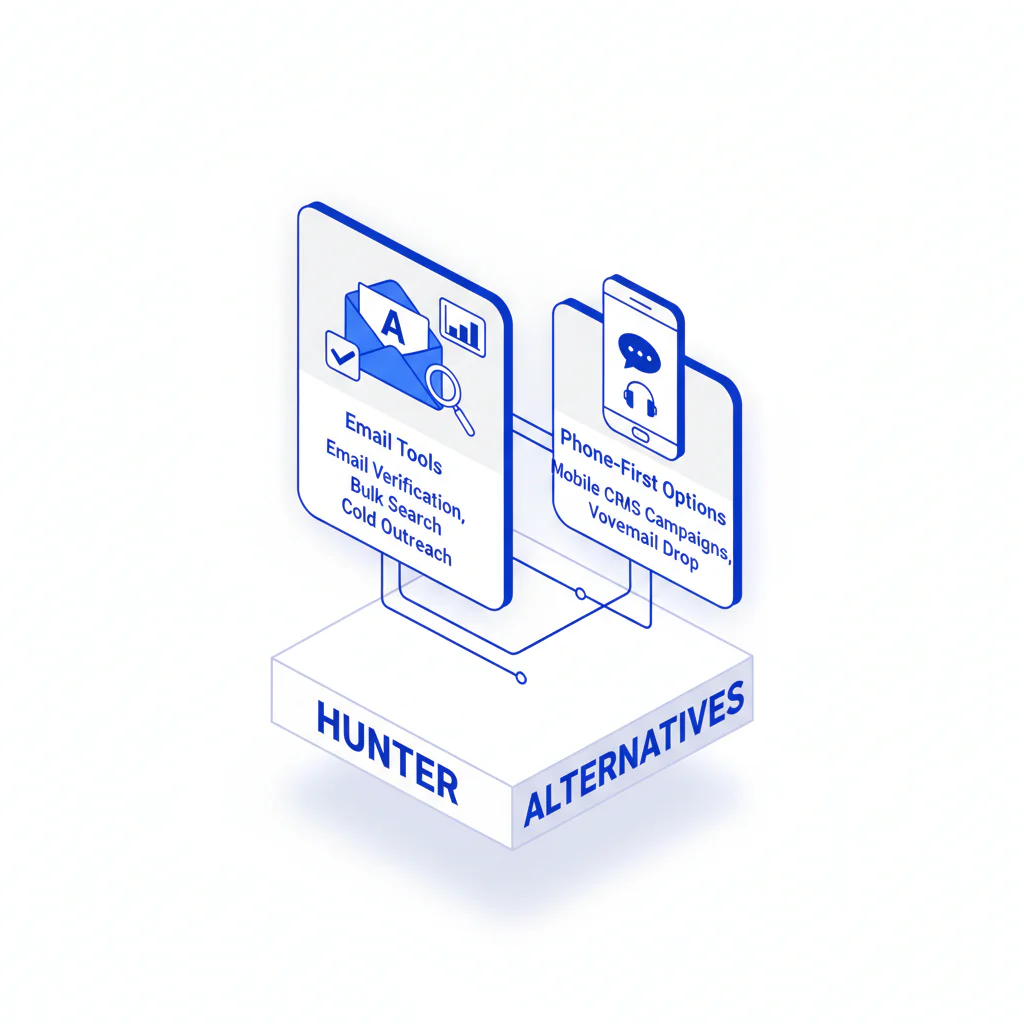
- Tables/visuals to add: Alternatives map graphic showing categories by job-to-be-done and where phone-first tools fit.
- Tables/visuals to add: Data flow diagram: enrichment → verification → CRM write rules → sequencer/dialer sync → reporting.
- Tables/visuals to add: Callout defining total cost as credits + re-verification + remediation + rep time + integration maintenance.
Common questions
What is the best Hunter alternative?
It depends on which channel fails first: email-first tools solve deliverability problems, while phone-first tools solve reachability by supplying direct dials for multi-channel outreach.
Which is cheapest?
The cheapest option is whichever one has the lowest total cost once you factor in wasted credits, re-verification, bounce remediation, and rep time spent patching missing data.
What’s best for phone numbers?
Phone-first tools are built specifically to return usable direct dials and mobile numbers, giving you a way to call when email stalls — the practical fix for a reachability problem.
Do I need both?
If you run multi-channel outreach, often yes: email-first controls protect deliverability while phone-first tools improve reachability when inboxes alone aren’t converting.
How do I choose?
Run the list test above, then pick the category that actually changes outcomes without damaging process: fewer bounces, more connects, fewer manual lookups, cleaner CRM writes.
Next steps (timeline)
- Today: apply channel-first choice and document whether deliverability or reachability fails first in your pipeline.
- This week: run the controlled list test in a sandbox and document overwrite rules and suppression logic.
- Next 2–3 weeks: standardize integrations, field mapping, and re-check cadence, then expand enrichment volume.
Secondary CTA: Download the Alternatives Map
Primary CTA: See Phone‑First Tools
Compliance note
Choose tools that support compliant outreach and opt-out.
About the Author
Ben Argeband is the Founder and CEO of Swordfish.ai and Heartbeat.ai. With deep expertise in data and SaaS, he has built two successful platforms trusted by over 50,000 sales and recruitment professionals. Ben’s mission is to help teams find direct contact information for hard-to-reach professionals and decision-makers, providing the shortest route to their next win. Connect with Ben on LinkedIn.