
 View Products


- Core answer
- Salesforce contact enrichment is a controlled workflow that fills missing reachability fields (phone/email) on Leads and Contacts, using enrichment governance (field mapping, dedupe-first controls, and staged write-back with provenance) so you increase connects without polluting Salesforce.
- Primary metric
- Time to Connect: median minutes from record assignment to first live conversation, supported by connect rate (live connects / dials) and dials per connect to quantify rep capacity and pipeline velocity.
- Ideal role
- RevOps leaders and Salesforce admins accountable for routing, data hygiene, and pipeline velocity.
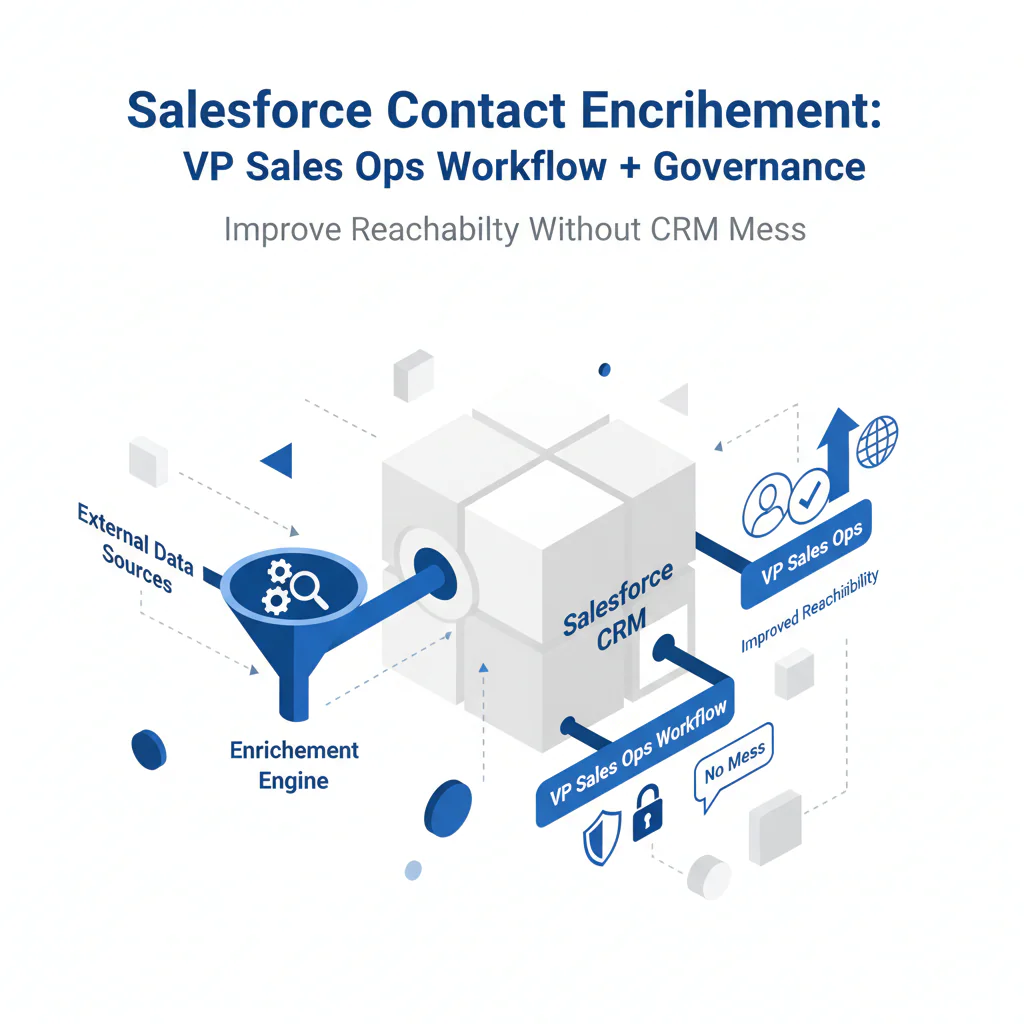
Salesforce Contact Enrichment: VP Sales Ops Workflow + Governance (Improve Reachability Without CRM Mess)
By Ben Argeband, Founder & CEO of Swordfish.AI
Operator note: I’m writing this like a VP of Sales Ops who gets measured on Time to Connect, connect rate, and pipeline created per rep-hour.
Enrichment only pays off when it reduces wasted dials and shortens Time to Connect. If enrichment creates duplicates, overwrites good rep-entered data, or breaks reporting, you slow pipeline velocity while dashboards show “more complete” records.
Framework: Enrichment governance = (1) field mapping contract, (2) dedupe-first controls, (3) staged write-back with provenance, (4) lift measurement tied to Time to Connect.
Who this is for
- RevOps and Salesforce admins implementing enrichment with clean governance and measurable lift.
- Teams that need a workflow that works even without a native integration.
- Sales leaders who want more live conversations per rep-hour, not more fields.
Playbook
-
Define the outcome in operational terms. The outcome is faster connects and more meetings per rep-hour. Prioritize reachability fields and only enrich firmographics when they change routing, segmentation, or personalization.
-
Set a write-back policy before you touch Salesforce. Default to “fill-only” for reachability fields and block overwrites unless you have a verified timestamp and a documented precedence rule. Store provenance so you can audit and roll back.
-
Implement field mapping as a contract. Treat field mapping as a contract between your enrichment source and Salesforce objects (Lead and Contact). Every mapped field needs a definition, an allowed format, and an owner.
Minimum recommended mapped set (reachability + governance): Mobile Phone, Direct Dial, Work Email, Phone Type, Phone Confidence, Enriched Source, Enriched Date. Put provenance fields on both Lead and Contact, and map them through Lead conversion so you can audit changes after conversion.
Conflict rule for conversion: during Lead conversion, define which object wins on conflicts; keep the most recently verified reachability value and preserve rep-entered notes and activity history.
-
Run dedupe before enrichment. If you enrich duplicates, you multiply touches, create ownership conflicts, and inflate activity without increasing pipeline. Use Salesforce matching rules and duplicate rules, define merge keys (commonly email + domain + name), and decide ownership precedence.
When contact dedupe salesforce is enforced, reps spend less time figuring out which record is real, which reduces Time to Connect and improves pipeline velocity.
-
Use a staging step when you don’t have a native integration. Export a targeted list, enrich outside Salesforce, validate formats, then import updates. Validate E.164 phone format, email syntax, and picklist-safe values before import to prevent automation failures and reporting drift.
Use File Upload to enrich a CSV in a controlled staging step, then import only the approved fields back into Salesforce.
-
Store multiple numbers in a way reps can use. If you have more than one callable number, store additional phone fields (or a related phone record model) with phone type and confidence so sequences and dialers can pick the right number first.
-
Prioritize dial strategy, not just “a phone number.” Store multiple numbers with type and confidence when possible, and call in the order most likely to answer. “Use ranked mobile numbers by answer probability to call the best number first.” This reduces dials per connect and increases rep capacity.
-
Prevent rationing behavior. If access is capped, reps conserve lookups and skip calls, which increases Time to Connect. “A true unlimited, fair-use model prevents reps from rationing lookups and calls.”
-
Choose CSV vs API based on control and throughput. CSV staging is best when you want human review and strict governance on what gets written back, which reduces bad writes. An API approach is best when you need programmatic enrichment at scale and can enforce write-back rules in middleware to protect Salesforce objects.
-
Run an explicit measurement plan with a holdout group. For 2–4 weeks, keep a control group with no enrichment. Compare (a) median Time to Connect, (b) connect rate, (c) dials per connect, and (d) meetings set per 100 assigned records. If lift isn’t measurable, tighten targeting, mapping, or dial order before scaling.
Checklist: Diagnostic Table
| Symptom (what you see) | Root cause (what’s actually happening) | Fix (what to change) |
|---|---|---|
| Connect rate doesn’t improve after enrichment | New fields exist, but reps still dial the wrong number first or sequences don’t reference enriched fields | Store phone type/confidence; route dial order by answer probability; update sequences to prefer enriched reachability fields |
| Time to Connect increases after rollout | Duplicates and ownership conflicts increase touches and internal back-and-forth | Run dedupe before enrichment; enforce matching/duplicate rules; define merge keys and ownership precedence |
| Rep-entered data gets overwritten | Write-back policy allows updates without precedence rules or provenance | Adopt fill-only for reachability; store source + date; block overwrites unless verified and newer |
| Reports become inconsistent across Lead vs Contact | Field mapping differs by object or values aren’t normalized | Standardize definitions and formats; align Lead/Contact mappings and conversion behavior; validate on import |
| CRM gets cluttered with fields nobody uses | Enrichment outputs everything by default without governance | Map only fields tied to routing, sequencing, or reporting; remove unused fields from write-back |
Metrics to track
- Median Time to Connect: assigned timestamp to first live conversation, segmented by source and ICP tier.
- Connect rate: live connects / dials. If this doesn’t move, enrichment isn’t improving reachability in practice.
- Dials per connect: efficiency metric that translates directly into rep capacity.
- Meetings set per 100 assigned records: whether improved reachability turns into pipeline creation.
- Duplicate rate: duplicates created per 1,000 imports/updates; a direct governance health signal.
- % of worked records with at least one callable number: ties “field fill” to actual activity, not vanity completeness.
- Data freshness: median age (days) since last enriched/verified reachability update; stale data increases wasted dials.
Diagnostic: Common mistakes
- Enriching everything. Broad enrichment increases cost and risk without improving connects. Enrich records that will be worked in the next 7–30 days or that are blocking an active deal.
- Skipping staging. Direct write-back without review is how you end up with malformed phones, polluted picklists, and overwritten fields.
- Confusing “more numbers” with “better numbers.” If you don’t rank or label numbers, reps guess, and guessing increases dials per connect.
- No provenance fields. If you can’t see source and date, you can’t debug performance or roll back bad updates.
- Ignoring data hygiene. Without normalization and validation, enrichment creates inconsistent values that break routing and reporting. This is data hygiene, and it’s cheaper than cleaning later.
Decision Tree: Weighted Checklist
- Highest weight: Reachability lift measurement (connect rate, Time to Connect) with a holdout group. If you can’t measure lift, you can’t tune targeting or justify the workflow.
- Highest weight: Write-back policy plus provenance (source + date). This prevents CRM damage and makes failures diagnosable.
- Highest weight: Dedupe-first controls (matching rules, merge keys, ownership precedence). Duplicates create wasted touches and break attribution.
- Medium weight: Field mapping contract (definitions, formats, Lead vs Contact alignment). Bad mapping creates routing errors and reporting drift.
- Medium weight: Staging workflow (export → enrich → validate → import approved updates). This reduces accidental writes when you don’t have a native integration.
- Medium weight: Normalization and validation (E.164 phones, email format checks, controlled picklists). Prevents automation failures and inconsistent reporting.
- Lower weight: Firmographic enrichment beyond what routing/segmentation uses. Only add what changes an action; otherwise it’s noise.
Tools and data checklist
- Salesforce configuration: in Salesforce Setup, configure Matching Rules and Duplicate Rules for Lead and Contact before importing enriched updates.
- Field mapping documentation: definitions, allowed formats, and which object(s) each field writes to.
- Provenance fields: source name and last enriched date for each enriched field set.
- Staging method: for bulk updates, use CSV contact enrichment so you can review changes before import.
- API option: if you need programmatic enrichment with your own rules engine, use a contact data API and enforce write-back policy outside Salesforce.
- Ongoing monitoring: run a defined data quality process to catch duplicates, invalid formats, and stale reachability fields.
Troubleshooting Table: Scoring Rubric
| Area | 0 (Not in place) | 1 (Partial) | 2 (Operational) |
|---|---|---|---|
| Outcome measurement | No baseline; success defined as “more fields” | Some reporting, no holdout/control | Holdout group; Time to Connect and connect rate tracked by segment |
| Write-back governance | Default vendor write-back | Some rules, no provenance | Fill-only where appropriate; overwrite rules documented; source + date stored |
| Dedupe readiness | No matching/duplicate rules | Rules exist but not enforced or not tuned | Dedupe-first workflow; merge keys and ownership precedence defined |
| Field mapping discipline | Ad hoc mapping; inconsistent formats | Mapping exists but Lead/Contact alignment is inconsistent | Definitions + formats; Lead/Contact alignment; validation prevents bad writes |
| Workflow safety | No staging; no rollback plan | Manual review sometimes | Staging with review; import only approved fields; rollback supported by provenance |
Evidence and trust notes
- What enrichment should improve: reachability fields that reduce dials per connect and shorten Time to Connect.
- Why governance matters: governance prevents CRM mess from duplicates, overwrites, and inconsistent values that break routing and reporting.
- How to validate impact: use a holdout group and compare Time to Connect, connect rate, dials per connect, and meetings set per 100 assigned records.
- Why provenance is non-negotiable: source and date let you audit changes and roll back when a data source degrades.
- Reporting integrity: governance also prevents reporting drift when Lead and Contact fields diverge.
Limitations and edge cases
- Regulated outreach and consent. Enrichment does not replace compliance obligations. Apply your regional rules for calling, texting, and email outreach.
- Role accounts and shared inboxes. These can inflate “email present” without improving replies. Treat them as lower priority unless your motion supports them.
- International phone behavior. Normalization helps, but answer rates vary by region and number type. Measure connect rate by geo and adjust dial strategy.
- Lead-to-Contact conversion. If you enrich Leads, ensure conversion mapping carries enriched fields and provenance to Contacts.
- Stale records. Enriching old, unworked records can look productive while not moving pipeline. Target near-term work queues.
FAQs
What is Salesforce contact enrichment in practical terms?
It’s filling missing reachability and routing fields on Leads/Contacts so reps connect faster, with governance so you don’t create duplicates or overwrite good data.
Should we enrich Leads, Contacts, or both?
Enrich the object your reps work first. If SDRs work Leads, enrich Leads and ensure conversion mapping carries enriched fields and provenance to Contacts. If reps work Contacts, enrich Contacts and enforce dedupe rules tightly.
How do we prevent enrichment from polluting Salesforce?
Use staging, enforce fill-only rules for reachability fields, store source/date, and run dedupe before enrichment. If you can’t trace a change, you can’t govern it.
What fields should we prioritize first?
Prioritize reachability fields that reduce Time to Connect: callable phone numbers with type/confidence and a usable work email, plus provenance fields so you can audit and tune.
How do we prove enrichment is worth it?
Run a holdout group for 2–4 weeks and compare Time to Connect, connect rate, dials per connect, and meetings set per 100 assigned records.
Next steps
- Week 1: Document field mapping, write-back policy, provenance fields, and dedupe rules. Define the first segment to enrich based on near-term work queues.
- Week 2: Build the staging workflow (export → enrich → validate → import approved updates). Confirm Lead/Contact mapping and conversion behavior.
- Weeks 3–4: Pilot with a holdout group. Track Time to Connect, connect rate, dials per connect, meetings per 100 assigned, and duplicate rate.
- Week 5: Scale to additional segments if lift is measurable and duplicate rate stays controlled. If not, tighten mapping, adjust dial order, or narrow targeting.
About the Author
Ben Argeband is the Founder and CEO of Swordfish.ai and Heartbeat.ai. With deep expertise in data and SaaS, he has built two successful platforms trusted by over 50,000 sales and recruitment professionals. Ben’s mission is to help teams find direct contact information for hard-to-reach professionals and decision-makers, providing the shortest route to their next win. Connect with Ben on LinkedIn.