
 View Products


- Core answer
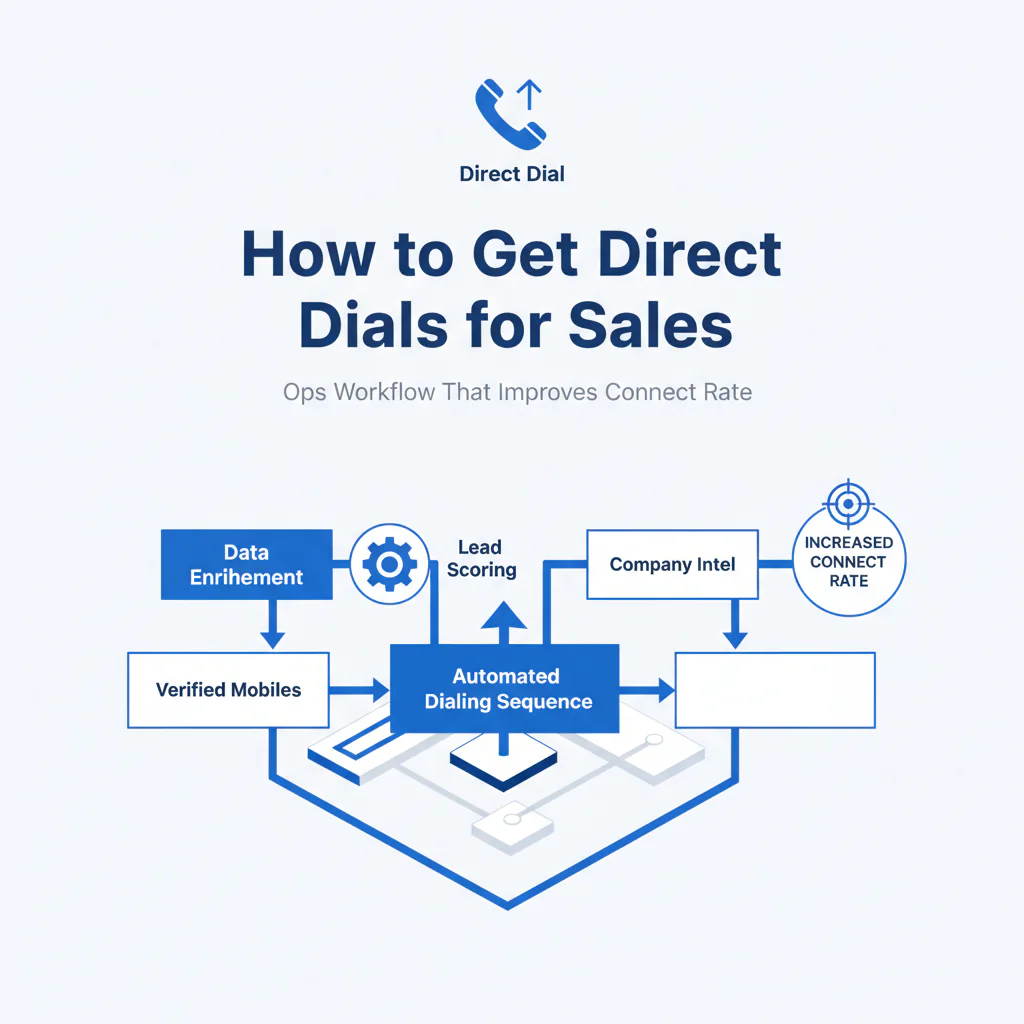
- To get direct dials (numbers that route to a specific person, not a company main line) that reps can use in production, run an ops workflow: ICP → call list → contact enrichment → verification → ranking → call order enforcement → measurement loop on connect rate.
- Primary metric
- Connect rate (live conversations ÷ dials), plus Time to Connect (minutes from list assignment to first live conversation).
- Ideal role
- Sales Ops / RevOps leaders running phone-first outbound who need higher pipeline velocity with less rep time wasted per connect.
How to Get Direct Dials for Sales (Ops Workflow That Improves Connect Rate)
Byline: Ben Argeband, Founder & CEO of Swordfish.AI
If you don’t improve connect rate and Time to Connect, you’re not solving “direct dials.” You’re just adding phone fields that reps won’t trust.
Who this is for
Sales teams prioritizing phone-first outbound who need higher reachability and more meetings. This is for Sales Ops leaders who own list quality, dialing workflow, and reporting, and who are measured on pipeline velocity.
Playbook
Workflow: ICP → list → enrich → verify → rank → call → measure connect rate. Each step exists to reduce wasted dials and increase conversations per hour.
Step 1: Define ICP and calling constraints
Define ICP tiers (A/B/C) and the minimum fields needed to call: persona, seniority, region/time zone, and target accounts. Add constraints that affect reachability: whether you prioritize mobile-first, whether you avoid HQ lines, and which countries you need coverage for. This keeps your outbound calling list aligned to how reps actually spend call blocks.
Step 2: Build the call list for dialing speed
Build a call list with one row per person and multiple phone candidates per contact (mobile, direct dial, HQ), each with a type and timestamp. Add a “call order” field so reps don’t decide on the fly. If your CRM only supports one phone field, you’ll see lower dials per hour and slower Time to Connect.
Step 3: Enrich contacts with direct dials and keep provenance
Use contact enrichment to append phone candidates, and store source plus “last seen/last verified” date. Provenance is how you diagnose a connect rate drop without guessing. If you can’t segment performance by source and freshness, you can’t manage quality.
For a workflow that supports appending direct dials at the point of work, use direct dial lookup so reps can move from list to dialing without manual searching.
Step 4: Verify numbers before they enter call blocks
Verification is a control point: it reduces wasted dials by suppressing low-confidence numbers and by classifying number type so you route it correctly. Verification outputs a status and number type used for suppression and routing. Treat verification as a gating rule for what enters a rep’s call block, not as a nice-to-have enrichment field.
Operationally, align your process to data quality basics: accuracy, freshness, and consistent field mapping across systems. When those break, reps feel it as lower connect rate.
Step 5: Rank numbers by answer probability and enforce call order
“Use ranked mobile numbers by answer probability to call the best number first.” Ranking reduces Time to Connect because the first attempt is more likely to reach a human. If you don’t rank, you’re randomizing answer probability and paying for it in rep time.
Ranking should be based on operational signals you can audit: verification status, number type, recency, and historical connect outcomes by segment. If you can’t explain the ranking logic, you can’t improve it.
Step 6: Apply the framework: Call list formula (decision heuristic)
Use this decision heuristic to keep calling focused and measurable. It’s the call list formula I use to prevent reps from spending prime hours on low-reach records.
- Priority score = (ICP tier) × (account trigger/intent signal) × (reachability rank)
- Call order = highest priority score first, then highest answer probability number first
- Stop rule = after N attempts across verified numbers, recycle only if the account remains ICP tier A
Step 7: Run a 60-minute call block example (what “good” looks like)
- Pull the top 25 contacts by Priority score for the next call block.
- For each contact, dial the ranked mobile first, then the next verified candidate if no connect.
- Standardize dispositions first: connect, voicemail, gatekeeper, wrong number.
- Log dispositions so Sales Ops can improve ranking and suppression rules.
This is how you turn a direct dial database into a repeatable dialing system that increases conversations per hour.
Step 8: Remove lookup friction so reps keep dialing
Credit caps and throttles create rationing behavior, which shows up as lower dials per hour and slower Time to Connect. “A true unlimited, fair-use model prevents reps from rationing lookups and calls.” If you want consistent activity, you need consistent access during call blocks.
If credit limits are slowing your team, evaluate unlimited contact credits models that match outbound reality: high-volume dialing with predictable cost and fewer mid-month slowdowns.
Step 9: Measurement plan (weekly loop tied to pipeline velocity)
Run a weekly measurement loop by segment (ICP tier, persona, region, source). The goal is to isolate whether you have a reachability problem (data/workflow) or a conversion problem (offer/messaging).
- Connect rate = live conversations ÷ dials (primary reachability KPI).
- Time to Connect = minutes from list assignment to first live conversation (primary speed KPI).
- First-number connect rate = connects on first attempted number ÷ contacts dialed (ranking quality KPI).
- Dials per hour during call blocks (workflow friction KPI used for capacity planning).
- Meetings per connect and pipeline per meeting (ensures you’re not optimizing connects that don’t convert).
Metrics to track
- Connect rate by persona, region, and number type.
- Time to Connect by rep and by list source.
- Verified coverage = % of contacts with at least one verified phone candidate.
- First-number connect rate to validate ranking and call order adherence.
- Dials per hour during defined call blocks.
- Meetings per connect and pipeline per meeting by segment.
Checklist: Diagnostic Table
| Symptom | Root cause | Fix |
|---|---|---|
| High dials, low connect rate | Numbers appended without verification; stale records; wrong number types stored in one field | Gate call blocks with verification; store multiple phone candidates with type + timestamp; suppress unverified numbers |
| Connect rate varies widely by rep | Reps self-select accounts or use inconsistent call order; list hygiene differs by rep | Standardize the call list formula; enforce call order via fields/filters; audit first-number connect rate by rep |
| Reps slow down mid-month | Credit caps or throttles cause lookup rationing | Move to fair-use access; monitor dials per hour before/after to confirm friction removal |
| “Direct dials” route to switchboards | Misclassified numbers; coverage gaps by region/industry | Capture dispositions (direct, voicemail, gatekeeper); feed outcomes into ranking; add a secondary provider for weak segments |
| Good connect rate, low meetings | ICP fit is off; wrong personas; offer/messaging mismatch | Re-tier ICP; adjust targeting; measure meetings per connect by persona to isolate the issue |
| Ops can’t explain a connect rate drop | No provenance: missing source, timestamp, verification status | Require source + last verified date fields; segment reporting by source and freshness |
Diagnostic: Common mistakes
- Optimizing for record count instead of connect rate. If connect rate doesn’t improve, you didn’t solve the problem.
- Storing one phone field in the CRM. Reps need multiple candidates and a call order to keep dials moving.
- Skipping verification to “move faster.” You just move the waste into the dialing block.
- No ranking. Without ranking, Time to Connect increases because reps hit low-probability numbers first.
- No segmentation. If you don’t break out connect rate by persona/region/source, you can’t fix the right failure point.
Decision Tree: Weighted Checklist
How to use: Apply weights based on standard outbound failure points. Verification gaps, lack of ranking, and rep workflow friction are the most common drivers of low connect rate and slow Time to Connect.
- Verification coverage (highest weight): Verified status is required for numbers to enter call blocks; unverified numbers are suppressed.
- Ranking by answer probability (highest weight): Reps see a clear call order and first-number connect rate is tracked to validate ranking.
- Multiple phone candidates per contact (high weight): Mobile/direct/HQ are stored separately with type and timestamp.
- Provenance and freshness controls (high weight): Source and last verified date are captured and reported so you can isolate provider and staleness issues.
- Rep workflow friction (high weight): Lookups happen in-flow during call blocks without credit rationing or manual copy/paste.
- Disposition capture (medium weight): Outcomes are logged consistently and used to improve suppression and ranking.
- Segmented reporting (medium weight): Connect rate is reviewed weekly by persona, region, and source.
- ICP alignment (medium weight): The call list formula prioritizes ICP tier A so the best dialing time goes to the best accounts.
Tools and data checklist
- Call list structure that supports multiple phone candidates, call order, and timestamps.
- Contact enrichment source that can append mobiles and direct dials at scale.
- Verification capability to classify number type and suppress low-confidence numbers.
- Ranking logic based on answer probability and operational signals (type, recency, verification, outcomes).
- Exportability and CRM field mapping so multiple phone candidates stay typed and usable across systems.
- Dialer/SEP integration so reps can dial without tab-switching and manual formatting.
- Reporting for connect rate, first-number connect rate, and dials per hour by segment.
If a tool can’t preserve phone type and timestamp into your CRM, it will degrade call order and reporting, which shows up as lower connect rate.
If you want one engine that supports enrichment, verification, and ranked dialing inputs, evaluate Prospector for getting direct dials in a workflow built for phone-first outbound.
Troubleshooting Table: Scoring Rubric
Purpose: Decide whether your current approach to find direct dials is strong enough to scale without slowing pipeline.
- Tier 1 (Scale-ready): Verified coverage is high, numbers are ranked by answer probability, call order is enforced, and connect rate is stable or improving week over week by segment.
- Tier 2 (Usable but leaky): You can find direct dials, but verification or provenance is inconsistent; connect rate swings by source or rep; Time to Connect is higher because call order isn’t enforced.
- Tier 3 (Activity trap): Lots of dials with low connect rate; reps report bad numbers; credit limits or manual steps slow dialing; reporting can’t isolate root causes.
Evidence and trust notes
- Why this works operationally: Verification reduces wasted dials; ranking improves first-number connect rate; both reduce Time to Connect.
- Governance: Sales Ops owns field definitions, suppression rules, and reporting; SDR leadership owns disposition compliance and call block adherence.
- Auditability: Document field definitions and suppression rules so changes can be tied to connect rate movement by segment.
- Data transparency: Store source and timestamps so you can audit performance by provider and freshness instead of relying on anecdotes.
Limitations and edge cases
- Regions with lower coverage: Some countries and industries have weaker direct dial availability; plan for lower verified coverage and adjust channel mix.
- Gatekeeper-heavy segments: Accurate numbers can still route through assistants; dispositions are required to tune ranking and talk tracks.
- Compliance and consent: Verification and ranking improve efficiency but do not replace compliance requirements; align dialing practices to your legal and policy constraints.
- New market entry: Expect lower connect rate until you learn local calling windows and persona fit; measure by segment to shorten the learning cycle.
FAQs
How do I get direct dials for sales without wasting rep time?
Use a workflow that includes contact enrichment, verification, and ranking, then enforce call order. If you only enrich a list once and hand it to reps, you’ll burn dials on stale or misclassified numbers and connect rate will stay low.
What’s the difference between a direct dial database and direct dial tools?
A direct dial database is the underlying dataset. Direct dial tools are what make it usable in production: enrichment in the rep workflow, verification, ranking, and reporting tied to connect rate.
How do I know if my outbound calling list is good?
Track connect rate and first-number connect rate by segment. If first-number connect rate is low, your ranking is weak or verification coverage is thin.
Should I prioritize mobile numbers or office numbers?
Prioritize the number type that produces the best connect rate for your segment, then enforce that via ranking and call order. If mobile-first improves Time to Connect in your segment, make it the default.
How many attempts should reps make per contact?
Use a stop rule tied to ICP tier and verified coverage. High-fit accounts get more attempts across verified numbers; low-fit accounts should not consume prime calling time.
Next steps
- Week 1: Baseline connect rate, Time to Connect, first-number connect rate, and verified coverage by persona/region/source.
- Week 2: Implement required fields (type, source, last verified date) and verification gating; start consistent disposition capture.
- Week 3: Implement ranking and enforce call order in the dialer/SEP; rebuild the outbound calling list using the call list formula.
- Week 4: Run the weekly measurement loop and adjust suppression, ranking, and ICP tiers based on segment performance.
If you need direct dials that are usable in call blocks, start with direct dial lookup and operationalize verification plus ranking so reps reach more people per hour.
About the Author
Ben Argeband is the Founder and CEO of Swordfish.ai and Heartbeat.ai. With deep expertise in data and SaaS, he has built two successful platforms trusted by over 50,000 sales and recruitment professionals. Ben’s mission is to help teams find direct contact information for hard-to-reach professionals and decision-makers, providing the shortest route to their next win. Connect with Ben on LinkedIn.