
 View Products


- Core concept
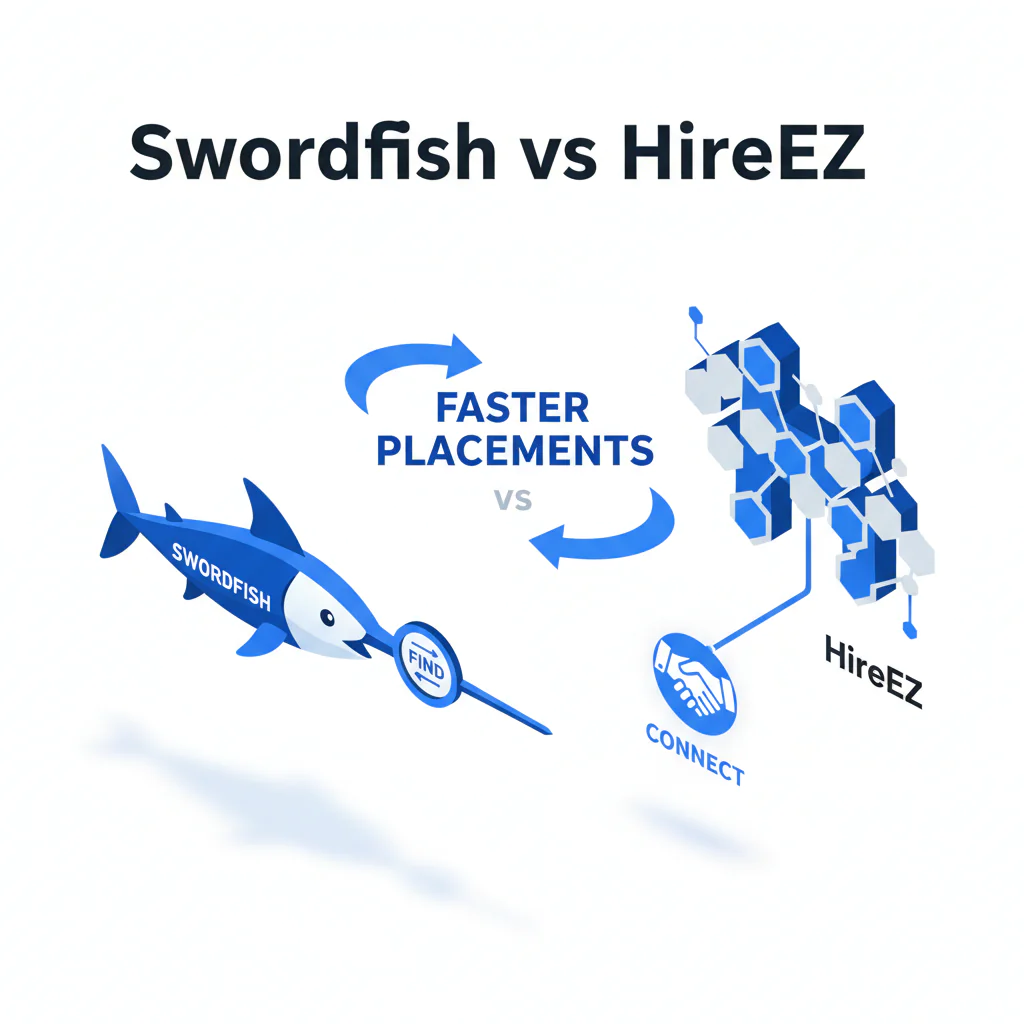
- HireEZ finds candidates (discovery and talent intel). Swordfish connects them (a reachability layer that improves contactability so sourced profiles turn into real conversations).
- Key stat to track
- Time-to-first-conversation, plus channel hygiene: reply rate, email bounce rate, and wrong-number rate for passive candidates and hard-to-reach roles.
- Ideal candidate profile
- Recruiters and sourcers using HireEZ for discovery who want better reachability and faster screens without changing their discovery tool.
Swordfish vs HireEZ: Find vs Connect for Faster Placements
By Ben Argeband, Head of Talent Acquisition (Operator Notes)
If you’re comparing swordfish vs hireez, decide what’s actually slowing hiring: not enough qualified profiles, or not enough two-way conversations. HireEZ is built for discovery. Swordfish is built to improve reachability so the people you already identified can be contacted reliably.
In practice, HireEZ + Swordfish is a common pairing: HireEZ builds the list, Swordfish improves contactability for that same list so recruiters spend fewer touches to book the first screen.
Who this is for
This is for recruiters and sourcers who use (or are trialing) HireEZ and are seeing one of these patterns:
- You can build lists, but passive candidates aren’t replying fast enough to hit screening SLAs.
- Hard-to-reach roles stall after list-building because email-only outreach doesn’t connect.
- Agency recruiting competitors are getting to candidates first because they reach them first.
- You want a workflow that protects candidate experience and supports opt-out compliance.
What recruiters are trying to accomplish
Placement speed improves when identified candidates turn into scheduled conversations with fewer attempts. Operationally, that means reducing wasted touches (bounces, wrong numbers, repeated follow-ups) and shortening time-to-first-conversation.
Reachability is measurable. If your reachability layer is working, you should see lower bounce rate, lower wrong-number rate, and faster time-to-first-conversation on the same target lists.
Framework: Find vs connect
The cleanest way to evaluate Swordfish vs HireEZ is the find vs connect split:
- Find (HireEZ): discovery, list-building, and talent intel so you know who to contact.
- Connect (Swordfish): reachability so you can contact them reliably and move them into a first conversation.
Use HireEZ only when discovery is the constraint. Use HireEZ + Swordfish when reachability is the constraint and your lists aren’t converting into conversations.
| Decision question | HireEZ (Find) | Swordfish (Connect) | What to measure |
|---|---|---|---|
| Do we need more qualified profiles per req? | Primary fit | Not the primary fit | Qualified pipeline per req |
| Do we need more replies from passive candidates? | Helps identify who to contact | Improves ability to reach them | Reply rate; time-to-first-conversation |
| Are hard-to-reach roles stalling after list-building? | Can build lists | Supports multi-channel contactability | Touches per booked screen |
| Do we need to re-engage silver medalists quickly? | Organizes prior candidates | Helps reconnect when contact info changes | Reactivation rate; days-to-offer |
| Buying lens | HireEZ | Swordfish |
|---|---|---|
| Primary job | Discovery and talent intel | Reachability layer for outreach execution |
| Best for | Building and prioritizing target lists | Turning target lists into conversations |
| Typical KPI | Qualified targets per req | Time-to-first-conversation; wrong-number and bounce rates |
| Implementation effort | Workflow setup for sourcing projects | Add to existing workflow as enrichment and outreach support |
Ethical use of phone numbers
Phone and text outreach can be respectful when it’s targeted, time-bounded, and easy to stop. It becomes a candidate experience problem when it’s high-volume, repetitive, or unclear about why you’re contacting someone.
- Identity and purpose first: say who you are, the role, and why them in the first message.
- Consent and opt-out compliance: include a clear opt-out and honor it across systems immediately.
- Reasonable contact windows: use local time zones and avoid repeated attempts in short windows.
- Data minimization: store only what you need for recruiting operations and retention policies.
These controls reduce complaints and rework, and they keep outreach aligned with how candidates expect to be treated.
Sourcing workflow
This workflow keeps HireEZ as the discovery system and adds Swordfish where teams usually lose time: connecting with the person they already identified.
- Build the target list in HireEZ. Keep the list tight enough that each outreach is defensible.
- Segment the list. Separate hard-to-reach roles and high-priority reqs so you can justify faster multi-channel outreach.
- Apply the reachability layer. Use Swordfish to improve contactability for the same list so you reduce bounce and wrong-number outcomes.
- Run a short sequence. Use one primary channel and one fallback channel, then stop if there’s no signal.
- Measure weekly by req and by source. Track time-to-first-conversation, reply rate, bounce rate, wrong-number rate, and touches per booked screen.
FIELD NOTE: The fastest placement-speed gains usually come from removing wasted touches. When recruiters stop cycling through dead inboxes and wrong numbers, they spend more time in live conversations and less time “following up.”
Checklist: Diagnostic Table
| Symptom | Most likely cause | How to confirm in 15 minutes | Fix tied to placement speed |
|---|---|---|---|
| High email volume, low replies | Low relevance for passive candidates or inbox mismatch | Check bounce rate and “opened/no reply” patterns by domain | Tighten relevance; add a second channel for priority segments to reduce time-to-first-conversation |
| Calls go to voicemail repeatedly | Wrong number or low pickup likelihood | Sample 20 dials; log wrong-number rate and pickup rate | Audit wrong-number dispositions and bounce logs by source; reduce dials that cannot connect |
| Texts get no response | Message lacks context or reads automated | Review first 160 characters; confirm it includes role + why them | Rewrite to a single question; stop after one follow-up to protect candidate experience |
| Strong profiles, still no engagement | Channel and timing mismatch for hard-to-reach roles | Compare response by time-of-day/day-of-week for the same segment | Shift outreach windows; use a two-channel sequence within 48 hours for priority reqs |
| “Remove me” replies or complaints | Opt-out compliance not handled consistently | Audit whether opt-outs propagate to ATS/CRM and sequences | Centralize suppression and stop outreach immediately on opt-out |
| Recruiters say “data is bad” but can’t prove it | No contact data quality tracking | Track bounce, wrong-number, and time-to-first-conversation by source | Replace low-performing sources and reduce wasted touches per screen |
Decision Tree: Weighted Checklist
Use this to decide whether you should add Swordfish alongside HireEZ. The weights reflect standard recruiting failure points that most directly affect time-to-fill: reachability, speed to conversation, and compliance risk. Score each item as 0 (no), 1 (partly), or 2 (yes), then multiply by the weight.
| Criterion | Why it matters | Weight | Your score (0–2) | Weighted total |
|---|---|---|---|---|
| We can find candidates, but reply rates are the bottleneck | Discovery without conversations doesn’t move reqs | High | ||
| Hard-to-reach roles regularly miss SLA for first screen | Speed to first conversation drives placement speed | High | ||
| Bounce rate or wrong-number rate is visible and non-trivial | Bad data wastes recruiter hours and harms candidate experience | High | ||
| We recruit many passive candidates who don’t check email often | Channel mix affects response rate | Medium | ||
| We need a repeatable recruiter workflow and sourcer workflow | Consistency reduces rework and improves forecasting | Medium | ||
| We must prove opt-out compliance and reduce outreach risk | Compliance failures create escalations and slow hiring | High | ||
| Agency recruiting competition is beating us to first contact | First real conversation often wins the candidate | Medium |
Interpretation: if 3 or more “High” items score 2 (yes), prioritize adding a reachability layer alongside HireEZ. If fewer than 2 score 2, fix segmentation and messaging first, then re-test before adding tools.
Outreach templates
These templates are designed to book a first conversation quickly without creating a poor candidate experience. Keep the first touch short, make the relevance obvious, and make it easy to opt out.
Troubleshooting Table: Outreach Templates
Template A (Voicemail, 20–25 seconds):
“Hi [Name], this is [Your Name] with [Company]. I’m calling because your background in [specific skill] matches a [Role] we’re hiring for. If you’re open to a quick conversation, call or text me at [Number]. If this is a bad number or you’d rather not be contacted, tell me and I’ll remove it. Thanks.”
Template B (Text, first touch):
“Hi [Name] — [Your Name] at [Company]. Are you open to a quick chat about a [Role] focused on [specific scope]? If not, reply ‘no’ and I won’t follow up.”
Template C (Email, short and specific):
Subject: [Role] — [1 specific reason you reached out]
“Hi [Name],
I’m reaching out because you’ve done [specific thing] and we’re hiring a [Role] to own [specific outcome]. If you’re open, I can share comp range and the 3 priorities for the first 90 days.
Are you open to a 10-minute call this week?
[Signature]
P.S. If you’d rather not hear from me again, reply ‘opt out’ and I’ll update my records.”
Template D (Silver medalists re-engagement):
“Hi [Name] — we spoke earlier about [previous role/process]. We have a new [Role] that’s closer to [specific preference they had]. If you’re open, I can send the scope and comp range. If not, reply ‘no’ and I’ll stop.”
Evidence and trust notes
For a fair evaluation, keep discovery constant and measure whether reachability improves outcomes on the same lists. That avoids confusing “better search” with “better conversion.”
To reduce confounding variables, keep the target list, message, and sequence constant during the test. Change only the reachability inputs, then compare outcomes.
- HireEZ success looks like: more qualified targets per req and better prioritization.
- Swordfish success looks like: fewer wasted touches and faster time-to-first-conversation on the same target lists.
Define your metrics before you test so the team logs outcomes consistently:
- Wrong-number rate: wrong-number dispositions divided by total dials.
- Bounce rate: hard bounces divided by emails sent.
- Time-to-first-conversation: time from first outreach to the first two-way reply or live call.
If you want deeper context on discovery-side evaluation, see HireEZ review. For how teams evaluate sources, see contact data quality.
FAQs
Is this an either/or decision?
No. Most teams use HireEZ for discovery and add Swordfish for reachability. That’s the find vs connect split.
When does adding Swordfish make the biggest difference?
When your bottleneck is response rate and time-to-first-conversation, especially for passive candidates, silver medalists, and hard-to-reach roles.
How should we run a fair evaluation?
Pick 2–3 reqs with similar difficulty. Keep HireEZ discovery constant. Compare outcomes with and without the reachability layer using the same target lists and the same outreach sequence.
How do we protect candidate experience when using phone or text?
Be specific about why you reached out, keep touches low, contact during reasonable local hours, and make opt-out compliance immediate and permanent across your systems.
Does this help agency recruiting teams?
Yes. Agency recruiting often comes down to speed to first contact and speed to first conversation. Better reachability reduces wasted touches and helps you book screens sooner.
Next steps
- Days 1–2: Choose two reqs (one standard, one hard-to-reach role). Define baseline metrics: reply rate, bounce rate, wrong-number rate, time-to-first-conversation.
- Days 3–7: Keep HireEZ discovery constant. Add the reachability layer for the same lists. Run a short two-channel sequence with opt-out compliance.
- Days 8–14: Review outcomes by req and by source. If time-to-first-conversation improves and wasted touches drop, standardize the workflow and document outreach rules.
About the Author
Ben Argeband is the Founder and CEO of Swordfish.ai and Heartbeat.ai. With deep expertise in data and SaaS, he has built two successful platforms trusted by over 50,000 sales and recruitment professionals. Ben’s mission is to help teams find direct contact information for hard-to-reach professionals and decision-makers, providing the shortest route to their next win. Connect with Ben on LinkedIn.