
 View Products


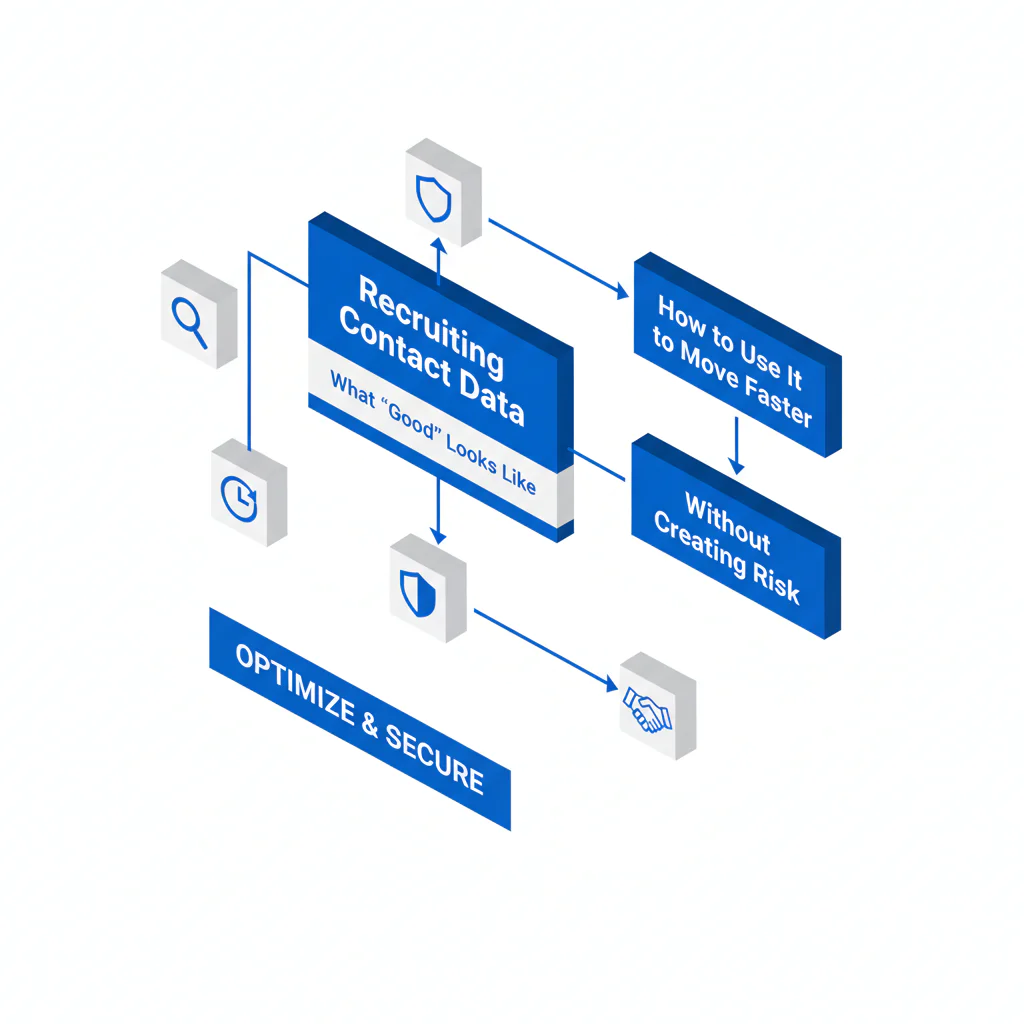
Recruiting Contact Data: What “Good” Looks Like and How to Use It to Move Faster Without Creating Risk
- Core concept
- Recruiting contact data is the set of candidate identifiers (phone, email, location, profiles) plus quality signals (verification and recency) that lets recruiters reach the right person quickly, improve response rate, and document compliant outreach.
- Key stat
- For placement speed, the highest-leverage fields are verified mobiles and recency (how recently the contact method was observed/validated), because they reduce failed attempts and wrong-party contacts.
- Ideal candidate profile
- Recruiters doing candidate phone number lookup for hard-to-reach roles who need more connects from passive candidates while keeping candidate experience and compliance tight.
Byline: Ben Argeband, Founder & CEO of Swordfish.AI (writing from a Head of Talent Acquisition operations perspective)
Framework: The best candidates aren’t checking inbox. If your team is missing screens, it’s usually because you can’t reach the right person on a current channel, not because you can’t find names.
Recruiting contact data is only “good” if it produces a faster yes/no from the right person.
Who this is for
- Recruiters doing candidate phone number lookup who want better connects with lower risk.
- Teams hiring for hard-to-reach roles where response rate is the constraint.
- Recruiters working mostly with passive candidates who won’t respond to generic email sequences.
- Teams re-engaging silver medalists who already know your brand and need a fast, clean re-approach.
- Agency recruiting desks that need consistent outreach quality across multiple recruiters and clients.
What recruiters are trying to accomplish
In TA operations, recruiting contact data is a throughput tool. It supports three outcomes:
- Placement speed: fewer dead ends means more live conversations per day and shorter time-to-fill.
- Candidate experience: fewer wrong-party contacts and fewer repeated attempts on stale numbers.
- Compliance: clear records of source, outreach history, and opt-out status.
Minimum viable recruiting contact data is: a reachable channel (mobile or email), a quality signal (verification), a freshness signal (recency), and a source/notes field so you can explain why you contacted the person and honor opt-outs.
If response rate drops, fix verification and recency before you add more touches. That change reduces wasted attempts and keeps outreach volume from turning into repeat contact.
When you can prioritize ranked mobile numbers by answer probability, you reduce wasted dials and shorten time-to-first-conversation because recruiters spend attempts on the most reachable option first.
Ethical use of phone numbers
Phone and SMS outreach can be professional when you treat it like a business channel: relevance first, clear identification, and a clean stop path.
- Relevance: contact only when the role, level, and location are plausibly aligned. Irrelevant outreach lowers response rate and increases complaints.
- Identify yourself: name and company/client context so the candidate can place the message quickly.
- Consent and opt-out: rules vary by region and policy. Operationally, include an opt-out (for SMS: “Reply STOP”), honor it immediately, and suppress future outreach across systems.
- Global opt-out: if a candidate opts out on one channel, treat it as a stop across channels.
- Suppression implementation: store opt-out status in one suppression field and apply it across email, SMS, and call tools so a candidate only has to opt out once.
- Wrong-party handling: if someone indicates you reached the wrong person, stop and suppress that number.
- Reasonable hours: use the candidate’s local time based on location data.
If your process includes ranked mobile numbers by answer probability, use that ranking to reduce attempts. Fewer attempts on higher-confidence numbers lowers the chance you contact the wrong person and reduces repeat outreach.
Sourcing workflow
This workflow is built for placement speed without sacrificing candidate experience. It works for passive candidate outreach, silver medalist reactivation, and agency recruiting where multiple recruiters may touch the same market.
- Define the outreach target: title, scope, must-have skills, location/remote rules, and comp range. This prevents low-relevance outreach that drives negative replies.
- Start with silver medalists: pull prior finalists and strong onsite candidates first. They convert faster because context already exists.
- Build the cold list: source from LinkedIn, referrals, and role-specific communities. Tag the source so you can measure response rate by channel.
- Enrich and standardize: add phone/email and capture verification and recency. If verification or recency is missing, expect more no-answers and more wasted attempts.
- Dedupe and assign ownership: remove duplicates and prevent two recruiters from contacting the same person in the same week.
- Segment and sequence: separate silver medalists, warm leads, and cold passive candidates. Use a lighter cadence for silver medalists and a tighter relevance-first opener for cold outreach.
- Log outcomes the same day: connected, no answer, wrong number, replied, opted out.
Use consistent outcome labels in your ATS/CRM so weekly response-rate reporting is clean and comparable across recruiters.
Weekly, review connect rate, reply rate, wrong-party rate, and opt-out rate by segment (passive candidates vs silver medalists) and by role type. If wrong-party or opt-out rates rise, tighten targeting and refresh stale records before increasing volume.
If you need a deeper walkthrough on phone-first sourcing, use how to find candidates phone numbers to standardize what your team does before the first dial.
When you’re selecting enrichment sources, treat verification and recency as non-negotiable quality controls. Use data quality signals to reduce wasted attempts and to document why a record was considered outreach-ready.
Checklist: Diagnostic Table
| Symptom | Most likely data cause | Candidate-experience risk | Fast fix (what to change next) | What to track |
|---|---|---|---|---|
| High “no answer” rate on calls | Number is not a mobile, or mobile is stale (low recency) | Repeated attempts feel intrusive | Prioritize verified mobiles; cap attempts; switch to SMS after 1 missed call if appropriate | Connect rate by number type + recency band |
| “Wrong person” replies | Bad match between candidate and number (poor identity resolution) | Highest risk: contacting non-candidates | Require confidence signals; dedupe across sources; suppress immediately when flagged | Wrong-party rate; suppression list growth |
| Email bounces spike | Old corporate emails; role changes not reflected | Lower, but hurts deliverability | Refresh emails based on recency; use an alternate channel rather than re-sending repeatedly | Bounce rate by domain type |
| Negative replies (“Why are you texting me?”) | Low relevance targeting; unclear identification; no opt-out | Complaint and brand damage | Tighten targeting; add identity + reason in first line; include opt-out; stop on request | Negative reply rate; opt-out rate |
| Good connects, low conversion to screens | Contact data is fine; message/role fit is off | Wastes candidate time | Rewrite opener for relevance; confirm comp/location early; segment silver medalists vs cold | Screen acceptance rate by segment |
| Strong response rate for some recruiters, weak for others | Inconsistent workflow and stop rules | Inconsistent experience | Standardize sequence, attempt caps, and logging; coach on relevance and stop rules | Response rate by recruiter + segment |
Decision Tree: Weighted Checklist
Use this checklist to decide whether a record is ready for outreach on phone/SMS without creating unnecessary attempts. The weights reflect common failure points that affect response rate and compliance: verification, recency, relevance, and documentation.
- Verified mobiles present (40%): You have a mobile number with a verification/confidence signal (not just “a number”). Without this, you’ll spend attempts on no-answers or wrong-party contacts.
- Recency documented (25%): You can see when the phone/email was last observed or validated. Older data increases failed attempts and slows placement speed.
- Role relevance confirmed (20%): The outreach target matches the candidate’s likely level, location, and skill set. Relevance is the main driver of replies from passive candidates.
- Compliance notes + source captured (10%): You can answer “where did this come from?” and you have a place to record opt-outs and preferences.
- Fallback channel available (5%): You have at least one alternate channel (email or LinkedIn) to avoid repeated attempts on a single channel.
Interpretation: Below 70% means you should fix verification or recency before increasing outreach volume. That change reduces wasted touches and protects candidate experience.
Outreach templates
These templates are designed to get a fast yes/no while staying respectful. They work for passive candidates, silver medalists, and hard-to-reach roles. Replace bracketed fields and keep the first SMS under 320 characters when possible.
Troubleshooting Table: Outreach Templates
Template A (SMS, cold passive candidate)
Hi [First Name] — I’m [Your Name], recruiting for [Company/Client]. I saw your work in [specific skill/area]. Are you open to a quick chat about a [Role Title] role in [Location/Remote]? If you’d rather not get texts from me, reply STOP.
Template B (SMS, hard-to-reach role, direct and time-boxed)
Hi [First Name], [Your Name] here. I’m hiring a [Role Title] focused on [1 key problem]. 10 minutes this week to see if it’s relevant? If you prefer no outreach from me, reply STOP.
Template C (Voicemail, after 1 missed call)
Hi [First Name], this is [Your Name]. I’m recruiting for a [Role Title] role at [Company/Client] aligned with your background in [skill]. If you’re open, call or text me at [number]. If I reached the wrong person, tell me and I’ll remove this number.
Template D (Email, silver medalist re-engagement)
Subject: Quick update on [Team/Role] at [Company]
Hi [First Name] — we spoke during the [Role/Process] search earlier this year. A new [Role Title] opened on [Team] with [1–2 specifics that map to their background]. If you’re open, I’d like to share details and confirm comp/location. If now isn’t the right time, reply and I’ll pause outreach.
Template E (Agency recruiting, transparency-forward)
Hi [First Name] — I’m [Your Name] with [Agency]. I’m working with a client hiring a [Role Title] in [Location/Remote]. Based on your [skill/industry], I think it may fit. Are you open to a quick call? If you prefer I don’t contact you again, reply STOP and I’ll update my records.
Evidence and trust notes
In TA ops, the chain is measurable: better contactability improves response rate, which increases screens per day, which reduces time-to-fill. The contact data attributes that most directly support that are verified mobiles and recency, because they reduce failed attempts and wrong-party contacts.
Candidate experience improves when you reduce retries, avoid duplicate outreach across recruiters, and stop cleanly on opt-out or wrong-party signals. Compliance improves when you capture source, outreach history, and opt-out status in the same system recruiters use daily.
FAQs
What is recruiting contact data?
Recruiting contact data is the information that lets you reach a candidate and track outcomes: phone, email, location, profile identifiers, and metadata like verification and recency. It’s only useful if it improves response rate and can be documented for compliance.
What makes contact data “high quality” for recruiters?
High quality means it’s reachable and current. Prioritize verified mobiles and recency, then dedupe and log outcomes (connected, wrong number, opt-out). This reduces wasted touches and speeds up first conversations.
How do I improve response rate with passive candidates?
Start with relevance, then use the most reachable channel, and keep the message short with a clear opt-out. Passive candidates respond to respectful relevance, and your data needs to support that by being current and verified.
Is it compliant to text candidates?
It can be, depending on jurisdiction and your policies. Operationally, identify yourself, keep messages role-relevant, include an opt-out, honor opt-outs immediately, and document source and outreach history in your ATS/CRM.
How many outreach attempts should we make per candidate?
Set a cap and stick to it. A common ops approach is 1 call + 1 SMS + 1 email over several days, then stop unless the candidate engages. If your data is verified and recent, you should need fewer attempts to get a signal.
Should we prioritize phone or email?
For hard-to-reach roles and passive candidates, phone/SMS often produces faster signals when the number is verified and recent. Email is useful as a documented channel and a fallback when phone doesn’t connect.
Next steps
Week 1: Define “outreach-ready” (verified mobiles + recency + relevance + source logging). Set attempt caps and opt-out handling rules.
Week 2: Update ATS/CRM fields for source, recency, verification/confidence, and opt-out status. Train recruiters on the sequence and same-day outcome logging.
Weeks 3–4: Review connect rate, reply rate, wrong-party rate, and opt-out rate by segment and role type. Tighten targeting and refresh stale records before increasing volume.
Ongoing: Keep refresh cycles tied to hiring volume so recruiters aren’t working from stale contact methods.
About the Author
Ben Argeband is the Founder and CEO of Swordfish.ai and Heartbeat.ai. With deep expertise in data and SaaS, he has built two successful platforms trusted by over 50,000 sales and recruitment professionals. Ben’s mission is to help teams find direct contact information for hard-to-reach professionals and decision-makers, providing the shortest route to their next win. Connect with Ben on LinkedIn.