
 View Products


- Core concept
- Fetcher alternatives usually fall into two buckets: service-led sourcing (outsourced sourcing) or in-house tooling (your team owns the workflow, data, and outreach).
- Key stat
- If you can’t reach candidates, you can’t hire them. Track connect rate, reply rate, and time-to-first-conversation as leading indicators of placement speed.
- Ideal candidate profile
- Staffing and TA teams evaluating Fetcher alternatives who need a build vs buy decision framework for sourcing and outreach across passive candidates, silver medalists, and hard-to-reach roles.
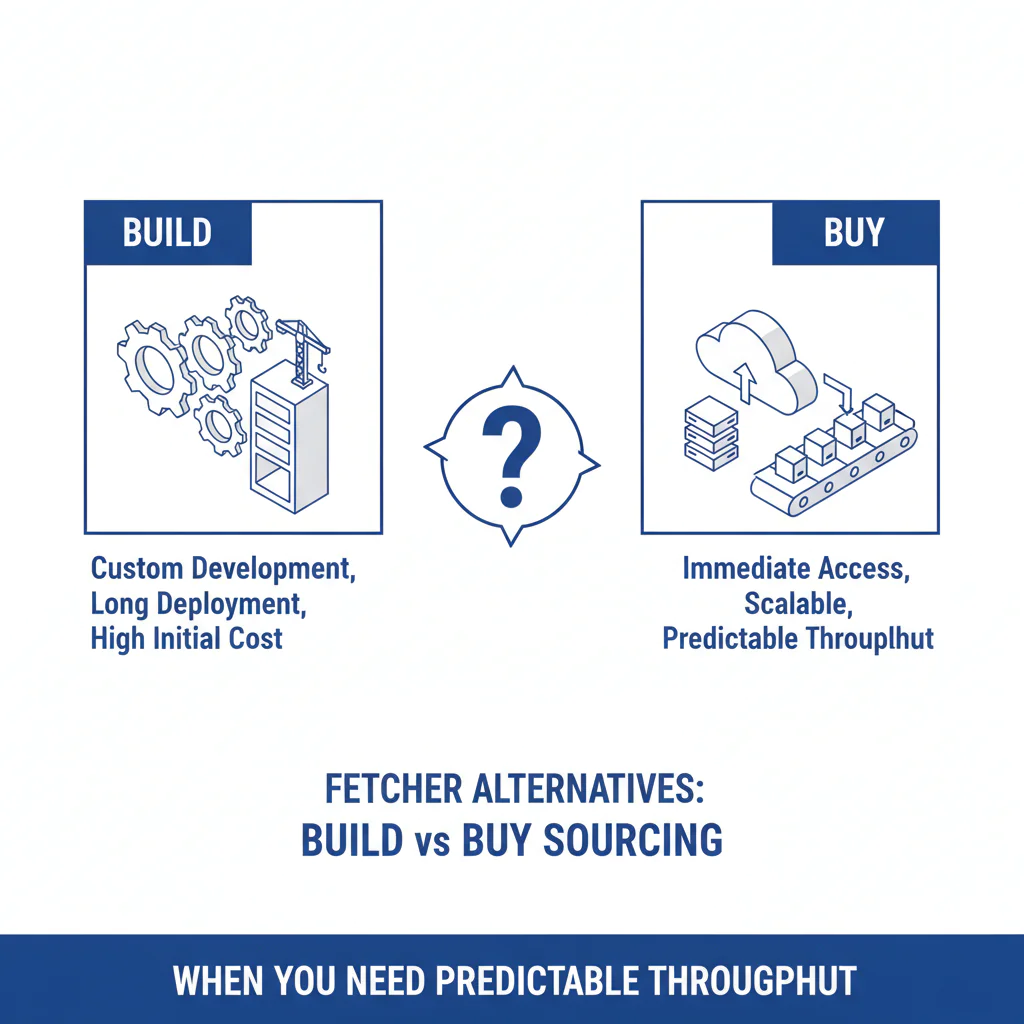
Fetcher Alternatives: Build vs Buy Sourcing When You Need Predictable Throughput
Byline: Ben Argeband, Head of Talent Acquisition
Fetcher is service-led sourcing, meaning a vendor delivers sourced profiles and may support outreach. Most alternatives are other outsourced sourcing models, internal sourcers supported by in-house tooling, or agency recruiting, and the right choice is the one that shortens time-to-first-conversation without creating duplicate outreach.
Service-led sourcing can add capacity fast. When calibration takes days instead of hours, time-to-first-conversation slips and recruiters spend more time chasing than screening.
Who this is for
- Teams evaluating Fetcher alternatives and deciding between outsourced sourcing and an owned workflow.
- Recruiters hiring for hard-to-reach roles where connect rate and follow-up speed decide who gets the first conversation.
- Leaders balancing internal sourcers with agency recruiting support while keeping one candidate experience standard.
- Teams re-engaging silver medalists without duplicate outreach or compliance drift.
What recruiters are trying to accomplish
Sourcing should produce predictable qualified conversations per week, not a larger pile of profiles.
- Placement speed: reduce time-to-first-conversation for passive candidates so you’re early to the best talent.
- Candidate experience: keep outreach relevant, brief, and respectful, with clear opt-outs.
- Operational control: maintain suppression lists and outreach history so candidates aren’t contacted twice by different teams or vendors.
Ethical use of phone numbers
Reachability helps only if it’s handled responsibly. If candidates feel surprised or pressured, reply rates drop and opt-outs rise.
- Relevance first: contact candidates only for roles that match their background and seniority.
- Identify yourself: name, company, and reason for outreach in the first line.
- Opt-out and suppression: honor “no” requests quickly and suppress across email, text, and calls.
- Single owner for suppression: assign one team owner for suppression rules so agency recruiting and internal teams follow the same standard.
- Access control: limit who can export contact data and log outreach outcomes for auditability.
Sourcing workflow
Build vs buy sourcing is a throughput decision: are you buying sourced output, or building an internal system that reliably turns target lists into conversations?
Most Fetcher alternatives fit into one of these operating models, and each ties to measurable outcomes:
- Service-led sourcing (outsourced sourcing): can start quickly, but if calibration cycles are slow, you lose days and time-to-first-conversation increases.
- Internal sourcers + in-house tooling: improves feedback loop speed; faster targeting changes reduce wasted outreach and improve reply rate.
- Agency recruiting: adds capacity, but without shared suppression and outreach logging, candidate experience degrades through duplicate contact.
- Hybrid: works when ownership is clear (who owns segments like silver medalists) and outcomes are tracked consistently.
Regardless of model, reachability is the constraint. If connect rate is low, recruiters spend time chasing instead of screening, and time-to-fill stretches.
- Define the target: must-haves, nice-to-haves, and disqualifiers.
- Segment the pool: passive candidates, silver medalists, referrals, and adjacent profiles.
- Prepare contact paths: prioritize records with higher likelihood of connection so dials and messages aren’t wasted.
- Run a short sequence: one clear outreach, one follow-up, then stop unless there’s engagement.
- Close the loop: tag outcomes (connected, replied, wrong person, not interested) and feed that back into targeting.
Checklist: Diagnostic Table
| Symptom | Likely root cause | What to check (fast) | Fix that improves placement speed |
|---|---|---|---|
| Low reply rate on email (<5%) | Message is generic or role is unclear | Does the first sentence prove relevance (team, stack, scope)? | Rewrite opener to reference one concrete match; reduce asks to one next step |
| Low connect rate on calls | Wrong numbers or poor timing | Are you calling within local hours and logging outcomes? | Improve data quality and call windows; prioritize higher-likelihood-to-connect records |
| High “who is this?” responses | Candidate surprised by outreach channel | Do you identify yourself and the reason in the first line? | Lead with identity + relevance + opt-out; keep tone direct and respectful |
| Lots of “not interested” from qualified profiles | Value prop doesn’t match candidate motivations | Are you leading with title instead of scope and constraints? | Test two value props; align to role drivers (scope, autonomy, location, stability) |
| Strong initial interest, then drop-off | Slow follow-up or scheduling friction | Time from reply to scheduled screen? | Same-day scheduling; recruiter follow-up SLA under 2 hours during business days |
| Duplicates and repeated outreach | No suppression logic across tools/vendors | Do you have a single suppression list and ownership? | Centralize suppression and outreach logs to reduce candidate complaints and opt-outs |
| Service output feels inconsistent week to week | Outsourced sourcing not aligned to req changes | How often do you recalibrate search + feedback with the service? | Set weekly calibration; if iteration is still slow, shift to internal sourcers with owned workflow |
Decision Tree: Weighted Checklist
Decision heuristic (Build vs Buy sourcing): use the weights below to choose the model that reduces time-to-fill without creating candidate experience or compliance debt. The weighting reflects standard failure points: throughput variability, slow feedback loops, and reachability constraints.
- Throughput predictability (High weight): Can you forecast qualified conversations per week per req? If output varies and you can’t correct it quickly, start dates slip.
- Feedback loop speed (High weight): Can targeting change within 24–48 hours based on recruiter and hiring manager feedback? Slow loops waste outreach and reduce reply rate.
- Reachability and contactability (High weight): Does the approach improve connect and reply rates? If reachability doesn’t improve, more profiles won’t convert into interviews.
- Workflow ownership (Medium weight): Do you own segments (passive candidates, silver medalists), suppression lists, and outreach history so candidates aren’t contacted twice?
- Compliance control (Medium weight): Can you enforce opt-outs, access controls, and audit trails across internal teams and vendors?
- Cost per qualified conversation (Medium weight): Compare service fees vs internal headcount + tooling, normalized to qualified conversations, not profiles delivered.
- Ramp time (Lower weight): How fast can you start producing conversations? Services can ramp faster; internal systems tend to win when hiring is continuous.
Outreach templates
These templates are designed to reduce time-to-first-conversation while keeping outreach respectful. Keep sequences short, stop when there’s no signal, and log outcomes to prevent duplicate contact.
Troubleshooting Table: Outreach Templates
Template 1 (Email to passive candidates):
Subject: Quick question about your work in [domain]
Hi [First Name] — I’m [Name], recruiting for [Company]. I’m reaching out because your background in [specific skill/project] matches what we need for a [Role] focused on [scope].
Are you open to a 10-minute call this week to see if it’s relevant? If not, I can send a short summary by email.
If you’d prefer I don’t contact you again, reply and I’ll update my list.
— [Name], [Title] | [Company]
Template 2 (Text after no email reply):
Hi [First Name] — this is [Name] with [Company]. I emailed about a [Role] working on [scope]. If it’s not a fit, reply “no” and I’ll close it out. If you’re open, I can send details here or by email.
Template 3 (Call voicemail for hard-to-reach roles):
Hi [First Name], this is [Name] from [Company]. I’m calling because your experience in [specific area] looks relevant to a [Role] working on [team/problem]. If you’re open to a quick chat, you can reach me at [number]. If you’d rather not be contacted, tell me and I’ll remove you from my outreach.
Template 4 (Silver medalist re-engagement):
Subject: New role that matches what we discussed
Hi [First Name] — we spoke previously about [prior role/process]. A new opening came up for [Role] with [one key difference: scope/team/location].
If you’re open, I can share the updated details and timelines. If not, reply and I’ll stop outreach.
— [Name]
Template 5 (Agency recruiting coordination note):
Subject: Alignment for [Role] outreach + candidate experience
Hi [Agency Partner Name] — for [Role], please prioritize candidates with [must-haves] and avoid outreach to [suppressed segments/silver medalists/referrals].
Use this positioning: [2–3 lines]. Log outreach outcomes daily so we don’t duplicate contact across channels.
Thanks — [Name]
Evidence and trust notes
When evaluating Fetcher alternatives, ask for evidence tied to outcomes you can audit: connect rate, reply rate, time-to-first-conversation, and qualified conversations per recruiter per week.
Define qualified conversation before you compare options. I treat it as: the candidate meets the must-haves and agrees to a recruiter screen or hiring manager conversation.
- Data provenance: where contact data originates and how it’s maintained.
- Suppression and opt-out handling: how quickly it propagates across users and exports.
- Access controls: who can view/export contact data and whether actions are logged.
- Process ownership: whether your team can iterate targeting and messaging without waiting on a service layer.
For jurisdiction-specific outreach rules, confirm requirements with your legal counsel and document your internal policy so recruiters can follow it consistently.
Related reading: recruiter sourcing tools and candidate phone number lookup.
FAQs
What are the most common Fetcher alternatives?
Most options fall into service-led sourcing (outsourced sourcing), internal sourcers supported by in-house tooling, agency recruiting, or a hybrid model. The best choice is the one that improves connect and reply rates and shortens time-to-first-conversation without creating duplicate outreach.
When does service-led sourcing make sense?
It fits when you need immediate capacity or your req load is spiky. It tends to struggle when you need consistent weekly output and fast iteration on targeting for hard-to-reach roles.
When should we build an in-house sourcing workflow?
Build (or buy tooling to run in-house) when you hire continuously in the same job families and need tight feedback loops. Ownership of suppression lists and outreach history also helps protect candidate experience across passive candidates and silver medalists.
How do we compare build vs buy sourcing costs fairly?
Compare cost per qualified conversation and time-to-first-conversation, not cost per profile. A cheaper profile stream that doesn’t connect slows hiring and increases recruiter workload.
How do we protect compliance while improving reachability?
Use relevance, clear identification, opt-outs, suppression lists, and access controls. Log outreach outcomes so candidates aren’t contacted repeatedly across tools, internal teams, and vendors.
Next steps
Week 1 (Baseline): Measure connect rate, reply rate, time-to-first-conversation, and qualified conversations per req. Use the diagnostic table to identify the failure point.
Week 2 (Pilot): Run a controlled pilot on one role family with one outreach sequence and one sourcing model. Adjust targeting within 48 hours based on outcomes.
Weeks 3–4 (Decide and operationalize): Choose the model that produces predictable qualified conversations. Document suppression rules, outreach SLAs, and ownership of silver medalists and passive candidate segments.
Ongoing (Scale): Review weekly: throughput per recruiter, opt-outs/complaints, and time-to-first-conversation. Tighten the workflow until results are stable for hard-to-reach roles.
About the Author
Ben Argeband is the Founder and CEO of Swordfish.ai and Heartbeat.ai. With deep expertise in data and SaaS, he has built two successful platforms trusted by over 50,000 sales and recruitment professionals. Ben’s mission is to help teams find direct contact information for hard-to-reach professionals and decision-makers, providing the shortest route to their next win. Connect with Ben on LinkedIn.