
 View Products


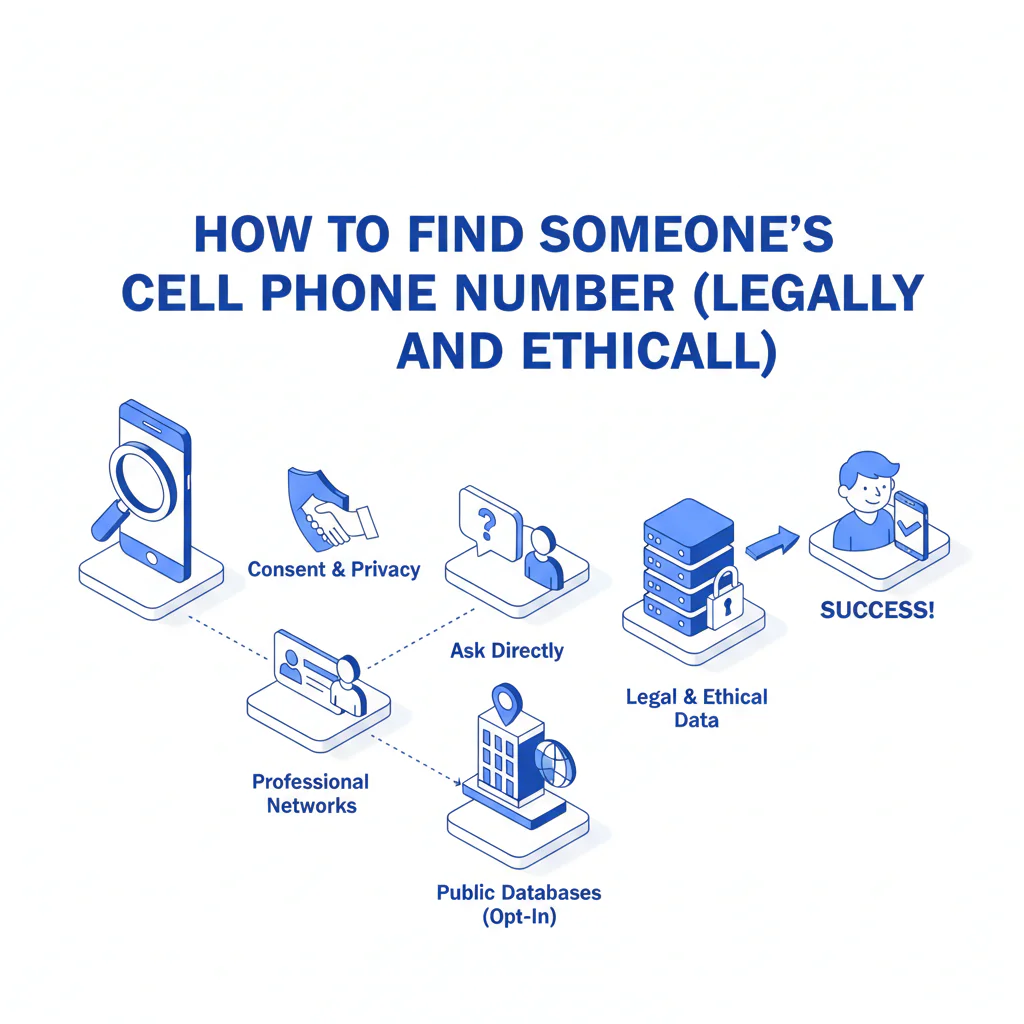
How to Find Someone’s Cell Phone Number (Legally and Ethically)
By Ben Argeband, Founder & CEO of Swordfish.AI
Who this is for
Recruiters and sales reps who need practical, ethical ways to find a person’s cell number for legitimate outreach. If you’re doing recruiting outreach or sales outreach, this is a process you can run without guessing.
Quick Answer
- Core Answer
- To find someone’s cell phone number for business outreach, confirm identity, document legitimate interest, use a reputable provider, and verify ownership signals before calling. Start with first-party/public business sources, then move to provider + verification. Log source/date, respect DNC rules, and include an opt-out so you stop immediately when asked.
- Key Stat
- Operationally: mobile vs landline changes effort and ROI; verification and context reduce wasted dials and complaints.
- Best For
- Recruiters and SDRs who need a repeatable way to find a cell phone number while protecting privacy and honoring consent and opt-out requests.
Compliance & Safety
This method is for legitimate business outreach only. Always respect Do Not Call (DNC) registries and opt-out requests.
Framework: The “3 tries” outreach plan (call/voicemail/email)
If you’re looking up a number, you’re doing it to start a conversation. The fastest way to keep this controlled is to tie the lookup to a capped outreach sequence and a hard stop.
- Try 1 (Call): One call during local business hours. If no answer, leave a short voicemail with your name, company, and reason.
- Try 2 (Email): Same day or next day, send an email that matches the voicemail context and includes an opt-out line.
- Try 3 (Call): One follow-up call 48–72 hours later. If no response, stop unless the person re-engages or you have new, relevant context.
This requires manual verification, because the cost of being wrong is not just a wasted dial; it’s contacting the wrong person or creating a complaint trail.
The trade-off is that fewer attempts can reduce total connects, but it increases response quality and reduces compliance risk.
Mini Story: Would You Want This Call If It Was Your Number?
A recruiter on my team matched a common name to the wrong mobile number and left a voicemail about a role. The recipient replied angry and asked how we got their number. We changed the workflow: identity first, context second, then reverse verification before dialing. That one change reduced wrong-person outreach and made our “how did you get this?” answers straightforward.
Step-by-step method
This is the fast path that works: correct identity → add context → reputable provider → verify.
Step 1: Confirm you have the right person (identity first)
Before you try to find someone’s phone number, lock down identity. “John Smith in Austin” is not an identity; it’s a collision risk.
- Minimum identity set: full name + current company (or recent company) + location.
- Better: LinkedIn URL, role, and a work email domain.
If you can’t disambiguate the person, don’t proceed. This requires manual verification.
- If you only have LinkedIn: confirm company + location + role, then proceed to a reputable provider and verify ownership signals before calling.
- If you only have an email: confirm the domain matches the employer, then use verification to avoid calling the wrong person.
- If you only have name + company: add location or role before you search; otherwise you’re guessing.
Step 2: Add business context (legitimate interest)
Write one sentence that explains why you’re reaching out and why it’s relevant. This is your internal check for legitimate interest and your external explanation if asked.
- Recruiting outreach example: “Reaching out about a Staff Data Engineer role that matches your recent work on streaming pipelines at X.”
- Sales outreach example: “Reaching out because you own RevOps at Y and we support contact data workflows in Salesforce.”
- Candidate outreach example: “Reaching out because your background in [skill] matches a role we’re hiring for, and I want to confirm interest before I keep contacting you.”
- Sales prospecting phone numbers example: “Reaching out because you manage [function] and we see teams like yours run into [specific problem] that we can help fix.”
If you can’t write that sentence, don’t look up the number. You’re not ready to contact them.
Step 2.5: Check first-party and public business sources before you pay in time
For many teams, the cheapest way to find a cell phone number is to avoid a lookup entirely. This reduces cycle time and reduces the chance you contact the wrong person.
- Company contact page or team page: sometimes direct lines are listed for departments or leaders.
- Company website and press pages: press releases occasionally include direct contact details.
- Email signature: if you already have an email thread, the number is often there.
- Mutual introduction: ask for the best number to reach them instead of guessing.
- Calendar invites: candidates and prospects sometimes include dial-in details or direct numbers.
Step 3: Use a reputable provider, then verify ownership
Use a provider built for business use, then verify that the number belongs to the person you intend to contact. Don’t treat “a number exists” as “this is their number.”
What I mean by a reputable provider in practice:
- Auditability: you can explain where the number came from and when you retrieved it.
- Suppression support: you can honor opt-out requests and keep them honored.
- Verification signals: you can corroborate person association instead of guessing.
Use Swordfish Reverse Search as the compliant way to verify ownership before you call. If multiple numbers are available, prioritize ranked mobile numbers by answer probability so reps start with the most likely connect.
When you see “live” or “real-time” language in tools, treat it as a Real-time connectivity check or Signal validation, not a promise that the world’s phone data updated instantly.
Reverse verification corroborates; it doesn’t prove ownership.
Step 4: Validate the number before outreach (and log it)
Validation is where you prevent wrong-party calls. At minimum:
- Phone number validation: confirm the number format and basic carrier/type signals.
- Mobile vs landline: note the type because it changes your outreach plan and expected pickup behavior.
- Ownership confidence: corroborate the person association using the signals you have (name, location, employer, and any reverse verification results).
Example of a stop-worthy conflict: the number passes formatting and carrier checks, but reverse verification associates it with a different name in the same city. Don’t call. Re-check identity and source another number.
Second stop-worthy conflict: the number type shows landline but your plan was SMS. Don’t text. Switch to email-first or call the landline if appropriate.
Log the source and date in your CRM. If someone asks “where did you get my number,” you should be able to answer without improvising.
Step 5: Run the “3 tries” plan with consent and opt-out baked in
Even with legitimate interest, you still need to behave like a professional. Include consent language where appropriate and always provide an opt-out path.
- Voicemail script (tight): “Hi [Name], this is [You] at [Company]. Calling about [specific reason]. If it’s easier, reply to my email at [email].”
- Email script (tight): “Subject: [context]. Hi [Name]—reaching out because [one sentence]. If you’d rather not hear from me, reply ‘opt out’ and I’ll stop.”
- Consent logging: if they say “yes, you can call me here,” note that consent in your CRM record.
- SMS rule: if you don’t have consent for texting, don’t text. Use email-first.
- Stop rule: if they opt out, stop across channels and document it.
Do and don’t
- Do confirm identity with multiple matching attributes before you search.
- Do document legitimate interest and keep outreach proportional.
- Do verify ownership signals before calling and log source/date for data quality.
- Do honor consent expectations and process opt-out requests immediately.
- Don’t use scraped lists or “found on the internet” numbers you can’t explain.
- Don’t call when verification signals conflict or identity is ambiguous.
- Don’t keep trying after the third attempt unless the person re-engages or you have new relevance.
- Don’t use a cell number for sensitive decisions or to pressure someone into responding.
Checklist: Weighted Checklist
Use this to prioritize what to do first when you need to find a cell number quickly without creating compliance problems. Weighting is based on standard failure points: misidentification, low context, weak verification, and poor logging.
- Highest impact: Confirm identity with at least two matching attributes (company + role, or LinkedIn + location). This prevents wrong-person outreach.
- Highest impact: Write the one-sentence legitimate-interest context before lookup. This prevents irrelevant outreach and supports legal and ethical use.
- High impact: Use a reputable provider intended for business outreach, not scraped lists. This reduces stale or misattributed numbers.
- High impact: Verify ownership via reverse search before dialing. This reduces wrong-party calls and complaint risk.
- Medium impact: Record mobile vs landline and adjust channel mix. This improves outreach efficiency.
- Medium impact: Log source + date + validation notes in CRM. This supports audits and internal data quality work.
- Lower impact (but still useful): Run the “3 tries” plan with a hard stop after attempt 3 unless new relevance appears. This reduces over-contacting.
Diagnostic: Why this fails
Most failures are process failures, not “no data exists.” Fix the workflow and your hit rate improves.
- Wrong person match: same name, same metro, different person. Result: wrong-party calls and fast opt-outs.
- No context: outreach feels random. Result: low answer rate and higher complaint risk.
- Skipping verification: dialing unverified numbers. Result: wasted dials and reputational damage.
- Ignoring mobile vs landline: treating all numbers the same. Result: poor ROI on effort.
- No suppression/opt-out handling: continuing after an opt-out. Result: compliance exposure and brand damage.
Decision Tree: Conditional Decision Tree
- If you cannot uniquely identify the person (name + at least two corroborating attributes), then do not search for a cell number; gather more identifiers first.
- If you can’t state a legitimate-interest reason in one sentence, then stop and refine targeting before outreach.
- If you have a candidate number from a reputable provider, then run reverse verification to confirm likely ownership.
- If verification signals conflict (mismatched person association), then do not call; re-check identity and source another number.
- If the number appears to be a landline and you planned SMS, then do not text; switch to email-first or call if appropriate.
- If the person opts out at any point, then suppress across channels and document it.
- Stop Condition: After the third outreach attempt in the “3 tries” plan, stop unless the person responds or you have new, relevant context.
How to improve results
Improvement comes from reducing variance: fewer wrong matches, fewer stale numbers, and tighter feedback loops into your CRM.
1) Treat phone sourcing as a data quality workflow
If you want consistent outcomes, you need consistent inputs and logging. Align your required fields and logging rules with your broader data quality process so reps aren’t inventing their own standards.
2) Use reverse verification to reduce wrong-party calls
Reverse verification catches “looks plausible but wrong” numbers before you dial. It also gives you a clean answer if a prospect asks how you got their information. This requires manual verification when the person has moved, changed jobs, or shares a common name.
3) Adjust effort based on mobile vs landline
Mobile vs landline changes ROI. Mobile can be more direct but more sensitive from a privacy standpoint, so your context and opt-out handling must be clean. Landlines can route through a business, but may reduce direct connects. The trade-off is effort versus response quality.
4) Keep the workflow connected: sourcing, verification, and compliance
- For broader sourcing approaches, see cell number lookup guide.
- For verification and ownership checks, see reverse phone lookup.
- For policy and documentation, align with contact data compliance.
Troubleshooting Table: Diagnostic Table
| Symptom | Root Cause | Fix |
|---|---|---|
| High wrong-number rate | Identity collision (same name, weak matching) | Require two corroborating identifiers (company + role, or LinkedIn + location) before lookup |
| Low answer rate on mobile | Irrelevant outreach or poor timing | Add one-sentence context; call during local business hours; keep voicemail short |
| Prospects ask “How did you get my number?” | No source logging; unclear legitimate interest | Log source/date; document legitimate-interest sentence in CRM notes |
| Complaints or negative replies | Over-contacting; missing opt-out handling | Use the “3 tries” plan; include opt-out in email; suppress immediately on request |
| Numbers don’t match the person | Skipping verification step | Run reverse verification before dialing; if signals conflict, do not call |
| Team argues about what’s allowed | No shared compliance baseline | Publish a one-page policy aligned to contact data compliance and train reps on it |
Legal and ethical use
Legal and ethical use is the operating constraint. You can do legitimate outreach without acting like a spammer, but you need rules.
- Legitimate interest: have a relevant business reason tied to the person’s role or candidacy, and keep your outreach proportional.
- Consent: don’t treat finding a number as permission. If you plan ongoing contact, get consent where appropriate and document it.
- Opt-out: provide a clear opt-out path and honor it across channels. If someone says stop, you stop.
- Privacy: limit access internally to those who need it for outreach; don’t circulate personal numbers casually.
- Not for sensitive decisions: don’t use contact data to make decisions about eligibility, employment, housing, or other sensitive outcomes.
This is not legal advice. Your counsel and internal policy may be stricter than the baseline law. This requires manual verification for your specific use case.
Operational note: keep a suppression list that carries opt-out status across your CRM and outreach tools so you don’t re-contact someone by accident.
The trade-off is that stricter rules reduce short-term volume but protect deliverability, brand, and long-term pipeline.
Evidence and trust notes
- Identity variance: common names, job changes, relocations, and shared plans increase mismatch risk.
- Number type variance: mobile vs landline affects reachability and acceptable channels, especially for SMS without consent.
- Recency variance: numbers churn; a correct number last year can be wrong today.
- Source variance: reputable providers with verification workflows generally outperform scraped or user-submitted lists.
- Validation variance: a Real-time connectivity check is Signal validation, not a guarantee of ownership.
Sources
- GDPR overview (gdpr.eu)
- FTC Telemarketing Sales Rule (ftc.gov)
- FCC guidance on telemarketing and robocalls (fcc.gov)
- National Do Not Call Registry (donotcall.gov)
Limitations and edge cases
- Common-name collisions: if you can’t disambiguate, don’t dial. Use email first or request an introduction.
- International outreach: rules and norms vary by country and channel. Validate your approach before scaling.
- SMS/texting: texting often has stricter consent expectations. If you don’t have clear consent, don’t default to SMS.
- Reverse lookup limitations: verification reduces risk but won’t eliminate it, especially with shared plans, recent number changes, or incomplete public signals.
- Role accounts and switchboards: sometimes the best outcome is a routed business line plus a relevant email, not a personal mobile.
FAQs
What’s the most reliable way to find someone’s cell phone number for business outreach?
Start with identity, then add context, then use a reputable provider, then verify ownership signals before calling. Skipping verification is the most common operational mistake.
Is it legal to look up someone’s phone number?
It depends on jurisdiction, channel, and your purpose. For business outreach, you generally need legitimate interest, you must respect DNC rules where applicable, and you must honor opt-out requests. This requires manual verification for your specific situation.
How do I verify a phone number before calling?
Use a reverse verification workflow to corroborate the number’s association to the intended person and to catch mismatches. Treat validation as a signal, not a guarantee.
Why does mobile vs landline matter?
It changes both reachability and expectations. Mobile can be more direct but more sensitive from a privacy perspective; landline may route through a business but can reduce direct connects. The trade-off is effort versus response quality.
What should I say if someone asks how I got their number?
Answer plainly: you sourced it for legitimate business outreach, you verified it before calling, and you’ll honor any opt-out request. If you logged source and date, you can be specific without guessing.
Next steps
Day 1: Set the minimum standard
- Define required identity fields (name + two corroborating attributes) and document legitimate interest.
- Publish an opt-out and suppression rule aligned to contact data compliance.
Day 3: Implement verification and logging
- Implement reverse verification using reverse phone lookup before dialing.
- Standardize CRM logging fields and align them to your data quality workflow.
Day 7: Audit outcomes and tighten
- Review wrong-number rate, opt-out rate, and complaint signals; update the workflow where it breaks.
- If your team is scaling volume, confirm your usage model supports the process controls, including unlimited contact credits.
- For additional sourcing options, review the cell number lookup guide and keep verification as the gate before outreach.
About the Author
Ben Argeband is the Founder and CEO of Swordfish.ai and Heartbeat.ai. With deep expertise in data and SaaS, he has built two successful platforms trusted by over 50,000 sales and recruitment professionals. Ben’s mission is to help teams find direct contact information for hard-to-reach professionals and decision-makers, providing the shortest route to their next win. Connect with Ben on LinkedIn.