
 View Products


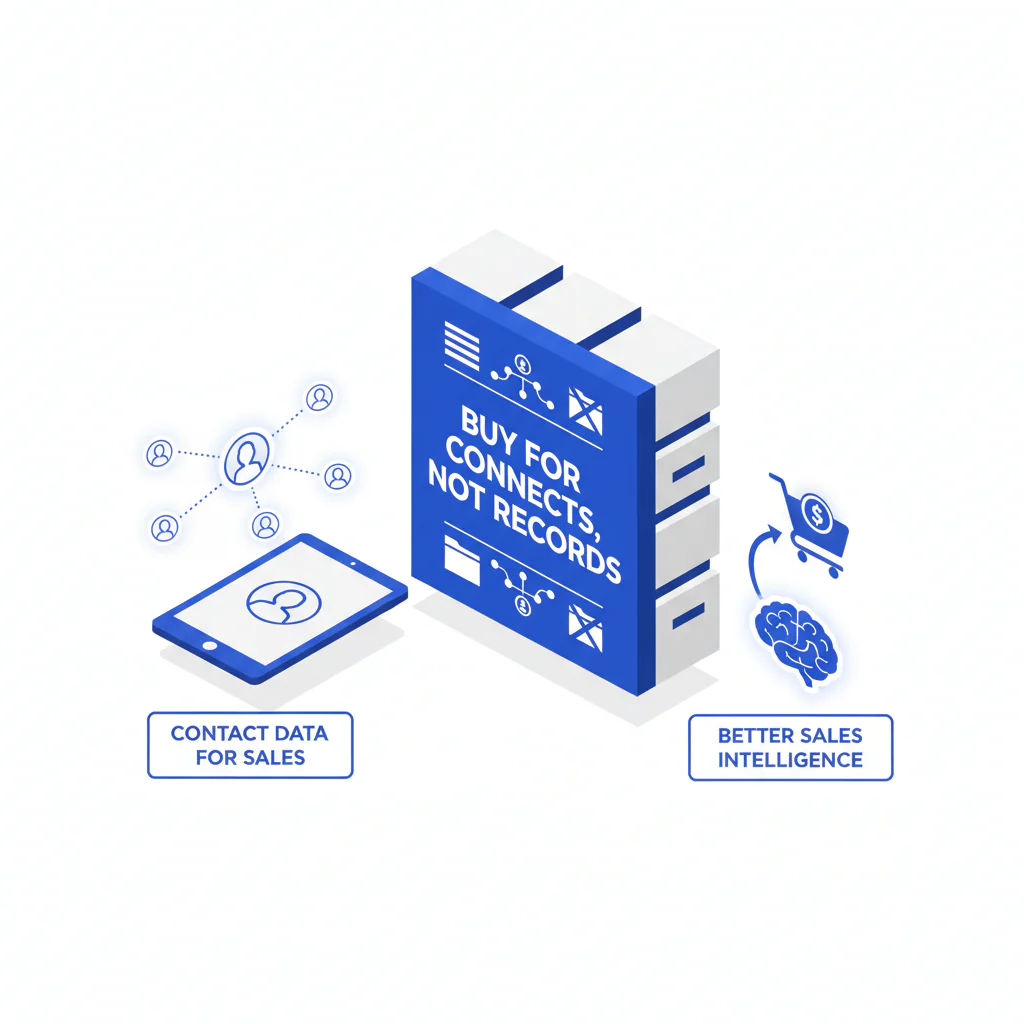
Contact data for sales: buy for connects, not records
Byline: Ben Argeband, Founder & CEO of Swordfish.AI
Most teams buy contact data for sales like they’re buying a database. Then they act surprised when pipeline doesn’t move. Sales doesn’t get paid on “records created.” Sales gets paid on connect rate, meetings, and the hidden KPI: attempt velocity (how many real attempts a rep can make per hour without getting blocked by missing numbers, bad routing, or credit rationing).
This page is written from the buyer/auditor seat: where the hidden costs show up, how data decay quietly wrecks output, and what to test so you don’t sign a contract based on a demo list.
Who this is for
This is for sourcers and outbound operators working hard-to-fill roles or niche accounts who need fast enrichment and high-velocity outreach. If reps are doing “find a number, try it, log it, repeat,” your bottleneck is attempt velocity, not lead volume.
Quick verdict on contact data for sales
- Core answer
- Contact data for sales is usable reach data (phone and email) that increases connect rate and attempt velocity. In practice, prioritize direct dials and verified mobile numbers, plus usage terms that don’t force reps to ration lookups.
- Key stat
- The KPI that quietly determines output is attempt velocity (attempts per rep-hour). Tools that add steps, throttle usage, or return low-confidence numbers reduce connects per day and meetings per week even if “coverage” looks fine in a demo.
- Ideal user
- Teams running outbound calling and multi-touch sequences where speed matters more than perfect CRM completeness, and where list quality varies by industry, seniority, and region.
Minimum useful fields: direct dials, verified mobile numbers, email, and a refresh/verification definition you can audit. If a vendor can’t explain those in plain language, you’re buying a black box.
In a phone-first motion, the highest-leverage fields are direct dials and verified mobile numbers because they reduce dead ends and improve connect rate. In an email-led motion, you still need decay and integration discipline, but your bottleneck shifts toward deliverability and sequencing rather than first-dial efficiency.
What Swordfish does differently
Most vendors sell “more data.” In production, you’re paying for fewer dead ends per hour. Swordfish is built around that reality: get you to a callable person faster, with less credit anxiety and fewer workflow detours.
1) Prioritized direct dials and verified mobile numbers (ranked for first-dial efficiency)
Sales cares about connects, not records. When a tool returns multiple numbers, the order matters. Ranking improves first-dial efficiency because reps don’t waste attempts on low-probability lines, which supports higher connect rate and more meetings from the same rep-hours.
2) True unlimited + fair use (so reps don’t ration usage)
“Unlimited” often means “unlimited until you’re successful,” then you hit throttles, caps, or policy emails. When reps think lookups are scarce, they stop experimenting: fewer niche searches, fewer iterations, fewer attempts. Unlimited prevents reps rationing usage, which keeps attempt velocity high and supports the real workflow: test a segment, adjust, and run again.
3) Built for throughput, not just enrichment
Speed + experimentation is the operator advantage. Sourcers win on throughput: more targeted attempts, faster feedback loops, and quick pivots when a segment decays. Swordfish is designed to feed that motion instead of forcing a slow “enrich everything first” batch process.
If you want the database that feeds the sales pipeline, see Prospector.
Decision guide
Two teams can buy the same “sales contact data” product and get opposite outcomes. The variance usually comes from four factors you can audit before you sign: seat count, API usage, list quality by segment, and integration friction.
1) Seat count and behavior
If you have more reps than seats, you create a queue. If you have enough seats but credits are tight, reps self-throttle. Either way, attempt velocity drops. This is why “unlimited credits” isn’t a marketing line; it’s a behavioral control.
2) API usage vs. manual usage
If you need API enrichment into a CRM, sales engagement platform, or dialer workflow, pricing and limits behave differently than a browser workflow. Some vendors price “per record enriched,” which punishes experimentation and re-enrichment as data decays. If your motion requires frequent refresh, you need terms that don’t penalize decay management.
3) List quality (and decay) by segment
Contact data quality varies by industry, seniority, and geography. A vendor can look strong on one segment and weak on another. If your ICP includes hard-to-reach roles, you need to test on your actual titles and regions, not a generic sample list.
4) Integration friction
Every extra step between “find contact” and “attempt” reduces attempts per hour. If reps have to copy/paste, switch tabs, or wait on enrichment jobs, you’re paying for software that taxes your motion.
How to test with your own list (7 steps)
- Pick a hard slice of your ICP (titles, regions, seniority) that represents where you actually struggle.
- Define outcomes you can observe without vendor math: connect rate from calls, attempts per rep-hour, and meetings created.
- Use the same rep cohort and call window for the baseline and the trial so you’re not measuring “different people, different day.”
- Standardize dispositions (connected, wrong person, main line, voicemail, dead number) and export them from your dialer/CRM so you can audit whether the tool reduces dead ends.
- Run the workflow end-to-end (lookup, log, sequence/dialer, CRM writeback) to expose integration drag.
- Re-check a subset later to see how decay shows up operationally and whether refresh is practical under your terms.
- Review fair-use and throttling triggers in writing before you roll out, because that’s where “unlimited” usually changes meaning.
Checklist: Feature Gap Table
| What buyers think they’re buying | What breaks in production | Hidden cost | What to require (audit question) |
|---|---|---|---|
| “High coverage” B2B contact data | Coverage is uneven by industry/region; your ICP underperforms | Reps waste attempts; managers blame messaging instead of data | Can you run a trial on our exact titles, regions, and seniority bands and report call outcomes? |
| “Verified mobile numbers” | Verification definition varies; some “verified” numbers still fail due to reassignment, routing, or stale sourcing | Lower connect rate; more time per attempt; more spam labeling risk | How is verification defined, and how often is it refreshed to manage decay? |
| “Direct dials for sales” | Multiple numbers returned with no prioritization; reps guess | Extra attempts per contact; lower first-dial efficiency | Do you rank numbers to improve first-dial efficiency, and can we validate it in a calling sprint? |
| “Unlimited credits” | Fair-use throttles, hidden caps, or policy enforcement when usage rises | Reps ration lookups; attempt velocity drops mid-month | What triggers throttling, and what happens operationally when we hit it? |
| “Easy integration” | API limits, field mapping issues, duplicate logic conflicts, or sync delays | Ops time, broken workflows, rep distrust of CRM data | What are the API limits, enrichment latency expectations, and recommended dedupe/field precedence rules? |
| “Data quality” claims | Quality measured as “records returned,” not connects or meetings | You optimize the wrong KPI and keep paying for noise | What reporting exists beyond match rate, and can we tie it to call outcomes? |
Decision Tree: Weighted Checklist
This weighting reflects standard outbound failure points and three facts that matter in production: sales cares about connects/meetings (not records), ranking improves first-dial efficiency, and unlimited prevents reps rationing usage. Use it to score tools during a trial using your own outcomes.
- Highest weight: Connect outcomes (because sales is paid on connects/meetings)
- Does the tool improve connect rate on your ICP during live calling?
- Do you see fewer “wrong person / main line / dead number” outcomes per rep-hour?
- Highest weight: Attempt velocity (hidden KPI)
- How many complete attempts per rep-hour after adding the tool (including lookup time and logging)?
- Does the workflow remove steps, or does it add tabs and manual copy/paste?
- High weight: Prioritized direct dials and mobile numbers (first-dial efficiency)
- When multiple numbers exist, are they prioritized to reduce wasted first attempts?
- Are direct dials and verified mobile numbers available for the roles you target?
- High weight: Usage terms that don’t change rep behavior
- Is “unlimited” operationally real under fair use, or does it introduce throttles that force rationing?
- Can you re-check contacts as data decays without getting punished on cost?
- Medium weight: Integration and governance (because broken sync kills adoption)
- Can you integrate without creating duplicates or overwriting good fields?
- Is there a clear approach to monitoring contact data quality and refresh cadence?
For how we think about quality beyond “match rate,” see contact data quality.
Troubleshooting Table: Conditional Decision Tree
- If your outbound motion is call-heavy and you measure meetings from calls, then prioritize tools that improve connect rate and first-dial efficiency via ranked numbers and direct dials.
- If reps slow down because they’re conserving lookups, then require true unlimited under fair use so attempt velocity doesn’t collapse mid-month.
- If your workflow depends on CRM/sales engagement platform automation, then evaluate API limits, enrichment latency expectations, and dedupe/field precedence rules before you evaluate “coverage.”
- If your ICP is niche (hard-to-fill roles, specific regions, seniority bands), then run a trial on that exact segment and judge by call outcomes, not record counts.
- Stop condition: If a vendor cannot explain (a) what “verified” means, (b) what triggers fair-use throttling, (c) how they handle decay/refresh, and (d) how they prevent duplicates/field overwrites, stop the evaluation.
Limitations and edge cases
Data decay is not optional. People change roles, numbers get reassigned, and routing changes. If your process assumes enrichment is “one and done,” your connect rate will drift down over time. Plan for refresh behavior and make sure your pricing doesn’t punish re-checking.
Some segments will always be harder. Certain industries, regions, and seniority levels have lower availability of verified mobile numbers and direct dials. That’s the market. The buyer mistake is assuming performance transfers from an easy segment to your hardest segment without testing.
Attribution can be messy. If your dialer reputation or spam labeling is poor, better numbers won’t fully recover connect rate. Treat data as one variable and keep your calling setup consistent during trials.
Integration can create silent failure. A tool can “work” but still lose value if fields map incorrectly, duplicates explode, or reps stop trusting the CRM. If adoption drops, your effective cost per meeting rises even if the subscription price stays flat.
Evidence and trust notes
I’m biased: I run Swordfish. I’m also the person who has to answer when a buyer asks why “unlimited” wasn’t unlimited, why connect rate didn’t move, or why the CRM is now full of duplicates.
What you should trust instead of marketing claims (and what you should export for audit):
- Trial design tied to outcomes: measure connect rate and meetings created from a controlled calling test on your ICP.
- Variance explanation: require vendors to explain expected variance by seat count, API usage, list quality (industry/region/seniority), and decay/refresh cadence.
- Operational terms: get fair-use and throttling triggers in writing, plus what happens when you hit them.
- Audit trail: export dialer dispositions and CRM activity logs for the trial window so you can re-check conclusions later.
To reduce procurement ambiguity, we will document verification definition, fair-use triggers, and refresh expectations in the order form or SOW so you’re not relying on a sales call memory.
If you’re comparing categories, start with sales intelligence tools. If your priority is phone coverage, review B2B mobile number data. If you need a focused workflow for finding numbers, see direct dial lookup. If you want to understand how unlimited should work in practice, see unlimited contact credits.
FAQs
What does “contact data for sales” actually mean?
It’s the set of usable identifiers that let a rep reach a person: phone numbers (especially direct dials and verified mobile numbers) and email. The sales definition is “does it help me connect and book meetings,” not “did it fill a CRM field.”
Why do connect rates drop even when we keep buying more data?
Because data decays and because “more records” doesn’t equal “more reachable people.” If your process doesn’t refresh and your tool doesn’t prioritize the most likely working number, reps burn attempts and your connect rate slides.
Is unlimited really important?
Yes, because it changes rep behavior. When usage feels scarce, reps ration lookups and stop iterating on niche segments. That reduces attempt velocity, which reduces meetings. “Unlimited” only helps if fair-use terms don’t throttle normal high-performing usage.
How should we compare vendors without getting fooled by demos?
Run a live test on your ICP and score by outcomes: connect rate, attempts per hour, and meetings created. Ask for variance drivers in writing: seat count, API usage, list quality by segment, and decay/refresh approach.
What’s the fastest way to see if a tool will work for our niche roles?
Pick 50–200 targets from your hardest segment (titles, regions, seniority) and run a calling sprint. If the vendor can’t support that test or won’t discuss verification and throttling, stop early.
Should we run phone-first or email-first outreach?
If your motion depends on calling, buy for direct dials and verified mobile numbers because that’s what moves connect rate. If your motion is email-led, you still need decay and integration discipline, but your bottleneck shifts toward deliverability and sequencing rather than first-dial efficiency.
Next steps
Timeline (operator-friendly):
- Day 1–2: Define your ICP test slice (hard segment), success metrics (connect rate, attempts per hour, meetings), and integration needs (manual vs API).
- Day 3–7: Run a controlled trial with real reps calling real targets. Track outcomes, not just match rates.
- Week 2: Validate operational terms (fair use, throttling triggers, refresh/decay handling) and confirm field mapping plus dedupe/field precedence rules.
- Week 3: Roll out to a wider group and monitor attempt velocity. If attempts per hour drop, the tool is adding friction or rationing behavior.
If you want Swordfish to feed your pipeline with high-throughput prospecting, start with Prospector.
About the Author
Ben Argeband is the Founder and CEO of Swordfish.ai and Heartbeat.ai. With deep expertise in data and SaaS, he has built two successful platforms trusted by over 50,000 sales and recruitment professionals. Ben’s mission is to help teams find direct contact information for hard-to-reach professionals and decision-makers, providing the shortest route to their next win. Connect with Ben on LinkedIn.