
 View Products


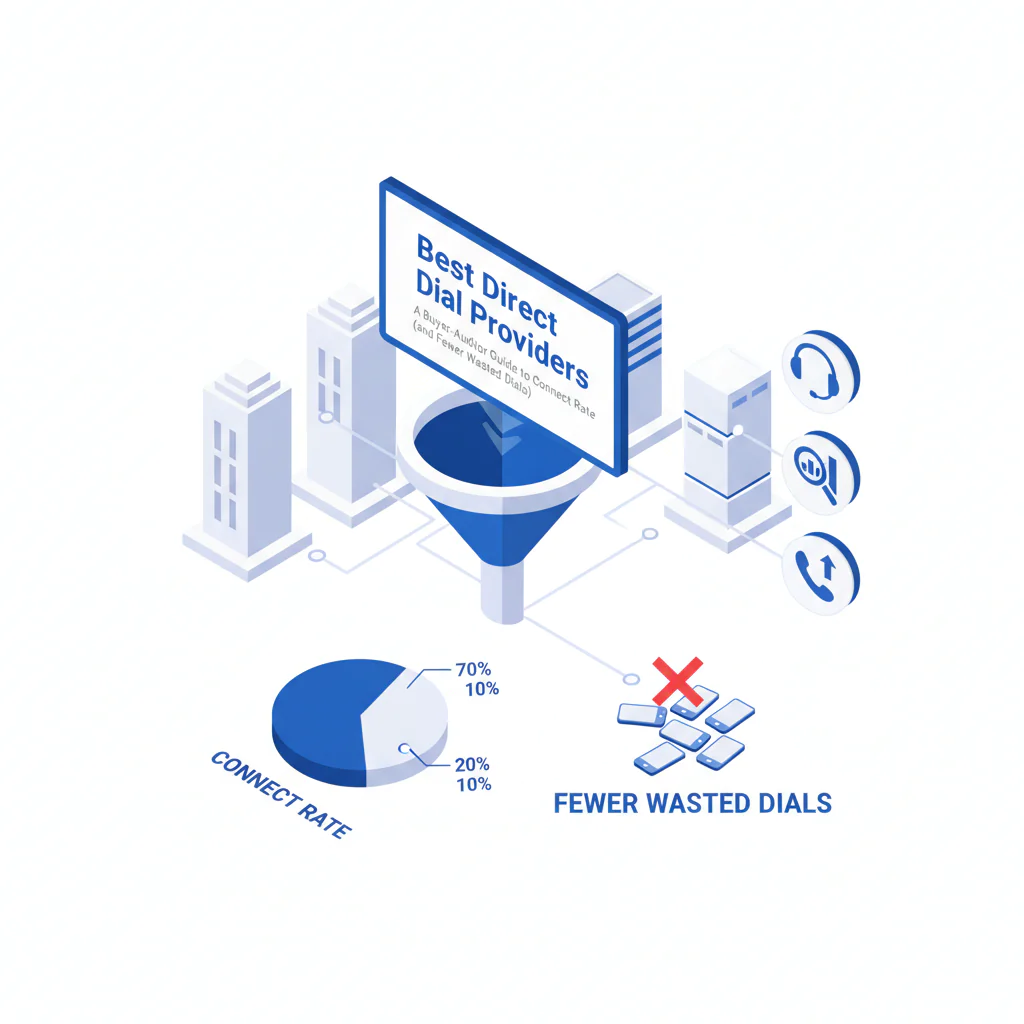
Best Direct Dial Providers: A Buyer-Auditor Guide to Connect Rate (and Fewer Wasted Dials)
Byline: Ben Argeband, Founder & CEO of Swordfish.AI
Who this is for
This is for recruiters and outbound sales teams who have to defend spend and still hit calling activity. If your reps are dialing, you care about connect rate, not “contacts found.” If your ops team is cleaning up bad fields and duplicates, you care about integration behavior, not a glossy integration logo.
Direct dial data decays. The hidden cost is the time spent retrying numbers, re-researching contacts, and arguing about which system is the source of truth.
Quick verdict
- Core answer
- The best direct dial providers improve calling outcomes by combining data freshness, verification, and ranking so reps dial the most likely number first.
- Key stat
- Don’t compare by record counts. Compare by cost per connect and how the provider handles recency, verification, and ranking. Variance comes from seat count, API usage, list quality, and industry churn.
- Ideal user
- Teams that need direct dials for real calling outcomes and want predictable usage without credit rationing.
- What to optimize: connect outcomes and attempts per connect
- What to distrust: unsourced “verified” labels without recency
- What to test: ranking, integration conflict handling, and fair-use enforcement
This page is a selection framework. Naming winners without sourced, audited metrics is unreliable, and it trains buyers to optimize for claims instead of connects.
If you came here expecting a “Top 10” list with confident winners, that’s usually where buyers get misled. If you need a shortlist, run the same proof on your own list and your shortlist will be the vendors that produce connects with fewer retries and less ops debt.
What Swordfish does differently
Direct dial success is not magic. It’s recency + verification + ranking. Miss one, and you pay for retries.
- Prioritized direct dials (ranked numbers): When multiple numbers exist, ranking reduces retries. Fewer retries reduces rep time per connect and lowers your effective cost per connect.
- Verification that’s visible in workflows: “Verified” only helps if you can see what it means operationally and use it to prioritize calling. If verification is opaque, your team can’t QA lists or tune sequences.
- High “Direct Dial Density” for calling workflows: Density changes adoption because reps stop using tools that return too many dead ends. Verify density during trial by measuring what share of your ICP records return a ranked direct dial that reps are willing to call on day one.
- True unlimited + fair use (so reps don’t ration lookups): Credit anxiety is a tax on adoption. “Unlimited” only works if fair-use boundaries are clear and enforcement is predictable. Get thresholds and enforcement mechanics in writing before you assume usage will scale.
If you want the workflow-oriented product, start with Feature Prospector, useful when you’re auditing direct dial density and calling outcomes rather than counting records.
Decision guide
Buy this like an auditor. Your results will vary, and the variance is predictable if you look in the right places.
- Seat count: More seats increases usage variability and exposes throttles, fair-use enforcement, and support limits.
- API usage: If you enrich at scale, you’ll hit rate limits, queueing, and partial failures that never show up in a browser demo.
- List quality: Clean ICP lists inflate results. Messy lists reveal whether matching and ranking hold up.
- Industry churn: High-turnover segments punish stale data. That’s where data freshness and verification discipline show up in your connect rate.
Quick self-audit (before you trial anything): If reps aren’t calling today, it’s usually because (1) they don’t trust the numbers, (2) they’re rationing credits, or (3) the CRM/dialer workflow is slow. Write down which one is true in your org, because it determines whether you should prioritize verification transparency, unlimited fair use clarity, or integration behavior.
Framework: Direct dial buyer checklist. Use this checklist to keep the evaluation tied to calling outcomes and operational cost, not vendor demos.
- Connectability: Does the provider surface recency and verification in a way that changes which number gets dialed first?
- Retry control: Does ranking reduce attempts per connect, or do reps guess?
- Workflow fit: Can you push numbers into your CRM/dialer without field conflicts and duplicate chaos?
- Usage predictability: Will reps use it freely, or will they ration lookups because of unclear limits?
- Auditability: Can you explain where numbers came from and why a number was chosen?
Checklist: Feature Gap Table
| What you’re evaluating | What vendors often claim | Hidden cost / failure mode | What to ask for (proof) | Business outcome it affects |
|---|---|---|---|---|
| Direct dial coverage | “Large direct dial database” | Coverage is inflated by stale numbers; decay forces retries and manual research | Show connect outcomes by segment and how data freshness is measured and surfaced | Higher connect rate, fewer wasted dials |
| Verification | “Verified direct dials” | “Verified” can mean anything; without method + timestamp, QA is guesswork | Define verification method, recency window, and how it appears in UI, exports, and API | Lower rework; better calling prioritization |
| Ranking / prioritization | “Multiple numbers per contact” | More numbers can increase retries if not ranked; reps burn time guessing | Explain ranking logic and whether it’s consistent across UI and API | Fewer attempts per connect; faster sequences |
| Phone number validation | “Validation included” | Validation may only check formatting/carrier, not reachability; false confidence | Clarify what validation checks and what it does not | Fewer dead-end calls; cleaner lists |
| Unlimited plans | “Unlimited credits” | Fair-use enforcement can be vague; teams self-throttle or get surprise limits | Get fair-use terms in writing: thresholds, enforcement, and overage options | Adoption stability; predictable cost per seat |
| CRM/dialer integration | “Integrates with your stack” | Field mapping, dedupe rules, and enrichment collisions create ops debt | Ask for a mapping spec and conflict handling (source-of-truth rules) | Lower admin time; fewer bad syncs |
| API reliability | “Robust API” | Rate limits, retries, and partial failures break workflows silently | Request rate limits, error codes, retry guidance, and uptime reporting | Stable enrichment; fewer pipeline stalls |
Decision Tree: Weighted Checklist
This weighting is based on standard failure points in direct dial buying (data decay, verification ambiguity, and integration overhead) and the stated reality that direct dial success depends on recency + verification + ranking. Use it to score vendors during trials.
- Highest weight: Recency + verification transparency because without it you can’t manage decay, and your cost per connect drifts upward as retries increase.
- High weight: Ranking/prioritization because ranking reduces attempts per connect. If reps guess, you pay in time and sequence noise.
- High weight: Integration behavior (CRM + dialer) because bad mapping and conflict handling create ongoing ops work and rep distrust.
- Medium weight: API constraints and observability because API usage is where rate limits and partial failures show up and break automation.
- Medium weight: Pricing model clarity (including unlimited fair use) because unclear limits change behavior. Rationing lookups lowers adoption and hides the real ceiling of your calling program.
- Lower weight (still required): Export controls and auditability because you will eventually need to explain where numbers came from and why a number was selected.
How to interpret results: if a provider “wins” on coverage but loses on verification transparency and ranking, expect higher variance across teams and months. Variance is what breaks forecasts.
Troubleshooting Table: Conditional Decision Tree
- If your KPI is connect rate for outbound calling, then require proof of recency + verification + ranking in the workflow (UI and API), not just a label.
- If the vendor can’t explain how data freshness is measured and surfaced (timestamped), then treat “verified” as marketing and assume higher decay-driven retries.
- If you enrich via API, then test rate limits, retries, and partial failure handling with your real volume before signing annual terms.
- If you’re considering an unlimited plan, then get fair-use thresholds and enforcement mechanics in writing. Otherwise reps self-throttle and you misread adoption as “tool doesn’t work.”
- If your lists are messy (duplicates, old titles, mixed regions), then run the trial on that mess. Clean lists hide matching weaknesses and inflate perceived performance.
- Stop condition: If the vendor cannot support a repeatable proof that measures outcomes as connects (not “records found”) and cannot document integration conflict handling (source-of-truth rules), stop the evaluation.
Limitations and edge cases
- “Best” varies by industry churn: High-turnover sectors punish stale numbers. A provider that looks fine in low-churn verticals can underperform where roles change frequently.
- List source quality dominates results: If your CRM is full of outdated titles and mismatched domains, any provider will look worse. Test with your real data so you see the operational cost early.
- Dialer and compliance constraints: Some dialers and compliance programs restrict how numbers are stored, displayed, or called. Integration fit can matter more than raw coverage.
- Verification is not a guarantee of reachability: Even strong validation can’t prevent reassigned numbers or internal PBX routing changes. The operational goal is fewer retries, not pretending errors go to zero.
- Operational compliance reality: Your risk is rarely the lookup itself. It’s where the number gets stored, who can export it, and whether your team has a defined DNC process. If a provider can’t support basic access controls and audit logs for exports/API usage, expect internal friction and procurement delays.
- International variance: Direct dial availability and formatting rules vary by country. If you call globally, require region-specific proof.
For deeper evaluation criteria tied to outcomes, see direct dial accuracy.
Evidence and trust notes
I run Swordfish, so treat this page as a buying framework and validate everything with your own trial data. I’m not going to invent universal percentages because they don’t survive contact with reality.
Your results will vary based on seat count, API usage, list quality, and industry churn. That’s why the only defensible evaluation is a short proof that measures connects and retries, plus the ops overhead to keep data usable.
- Connect outcomes rather than “records found”
- Attempts per connect to test ranking effectiveness
- Decay over time to see how quickly performance drops without refresh
- Ops overhead including mapping, dedupe, and conflict handling
If you need a framework for assessing list hygiene and why vendors disagree, read data quality. If you’re evaluating whether unlimited will actually be used, read unlimited contact credits.
For validating a specific person before calling, direct dial lookup is the workflow pattern to test. If reps can’t get a ranked number fast enough to place the call, the tool won’t stick.
FAQs
- Which direct dial provider is best? The one that proves higher connect outcomes on your ICP lists with fewer attempts per connect and low ops overhead. If a vendor can’t run that proof, you can’t defend the purchase later.
- What makes the best direct dial providers different from generic contact databases? They optimize for calling outcomes: recency, verification transparency, and ranking so reps dial the most likely number first. Generic databases often optimize for record count, which doesn’t map cleanly to connect outcomes.
- How should I compare direct dial providers during a trial? Use your real ICP lists and measure connects and attempts per connect. Ask how verification works and how data freshness is surfaced. If the vendor only reports “found” rates, you can’t audit ROI.
- Why do vendors disagree on the same person’s direct dial? Different sources, different refresh cycles, and different verification methods produce different candidates. Ranking and recency visibility determine whether that disagreement turns into retries or a first-call connect.
- Is “verified” the same as reachable? No. “Verified” can mean format checks, carrier checks, or other methods. Require a definition and timestamp. Reachability still changes due to reassignment and internal routing.
- Does an unlimited plan always reduce cost per connect? Only if fair-use terms are clear and reps don’t self-throttle. If enforcement is vague, behavior changes and adoption drops, which raises your effective cost per connect.
- What’s the fastest way to spot hidden integration costs? Ask how the provider handles field mapping, dedupe, and conflicts (source-of-truth). Then test one real sync path end-to-end. Integration debt shows up as bad merges and rep distrust.
Next steps
Use a short proof that measures connects and retries. Here’s a conservative 14-day timeline that surfaces decay and integration pain early. Save the trial log as an audit artifact for procurement.
- Day 1–2: Define success as connects and attempts per connect. Pick one churn-heavy segment and one stable segment so you can see variance.
- Day 3–5: Run lookups on your real lists, including messy records. Require verification definitions and recency visibility in UI and exports.
- Day 6–8: Test calling workflow: can reps get a ranked number fast enough to dial without switching tools? Track retries caused by bad ranking.
- Day 9–10: Test integration: CRM field mapping, dedupe rules, and conflict handling. Confirm source-of-truth behavior in writing.
- Day 11–12: If you use automation, test API rate limits, retries, and partial failures. Confirm how errors are reported and retried.
- Day 13: Keep a simple trial log: contact, number dialed, outcome, attempts, and any source timestamp the vendor provides. If you can’t log it, you can’t audit it.
- Day 14: Decide based on cost per connect and ops overhead, not record counts. If you can’t measure connects, don’t sign annual terms.
If your priority is maximizing direct dial density for calling workflows, evaluate Feature Prospector using the stop condition above.
About the Author
Ben Argeband is the Founder and CEO of Swordfish.ai and Heartbeat.ai. With deep expertise in data and SaaS, he has built two successful platforms trusted by over 50,000 sales and recruitment professionals. Ben’s mission is to help teams find direct contact information for hard-to-reach professionals and decision-makers, providing the shortest route to their next win. Connect with Ben on LinkedIn.