
 View Products


- Core concept
- Gem and HireEZ solve different parts of the recruiting motion: Gem is strongest when you already have candidates and need consistent outreach, sequencing, and pipeline operations; HireEZ is strongest when you need to discover net-new talent fast through deeper search and talent intelligence.
- Key stat
- Most delays show up as time-to-first-response: if you can’t reach passive candidates quickly, time-to-submit and time-to-fill slip even when sourcing volume is high.
- Ideal candidate profile
- Recruiting teams comparing Gem vs HireEZ who need the right tool for their sourcing + engagement model, especially for hard-to-reach roles where response rate and scheduling speed determine placement speed.
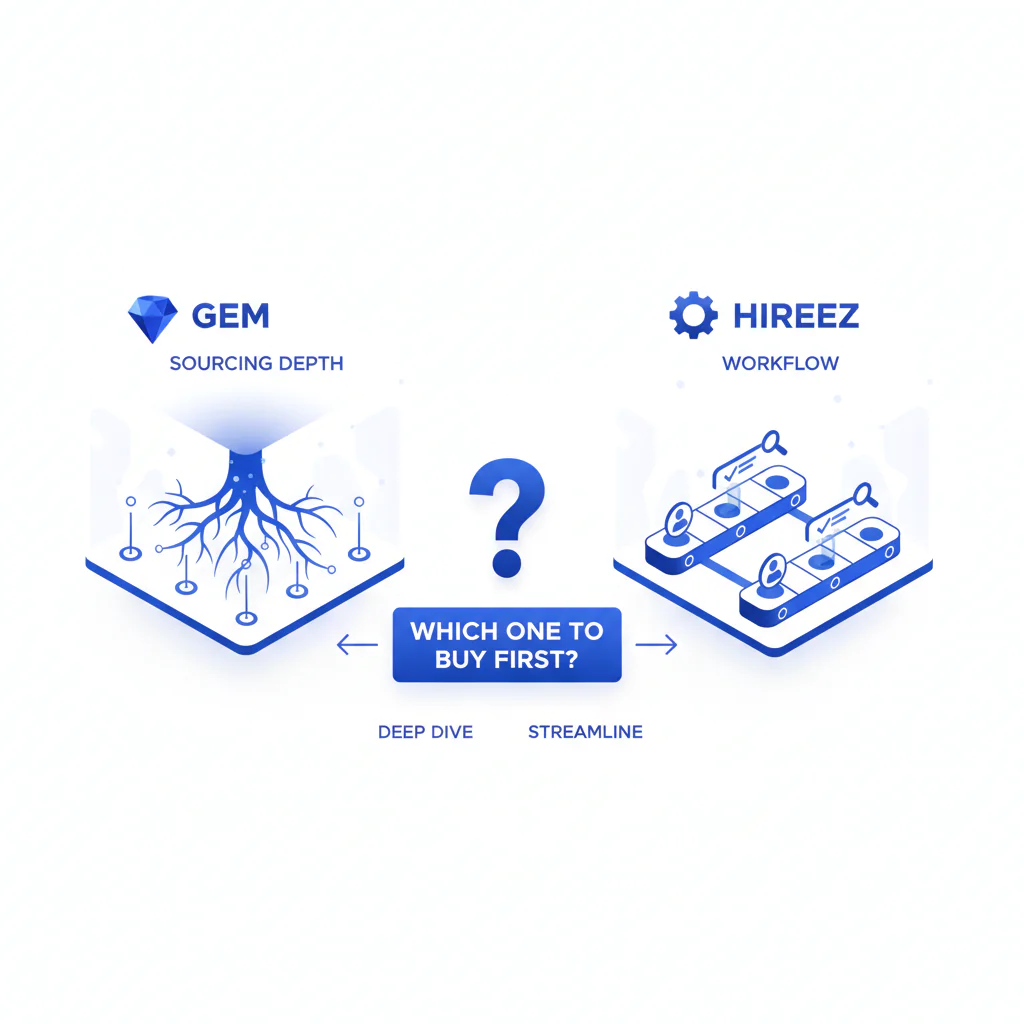
Gem vs HireEZ: Sourcing Depth vs Workflow (and which one to buy first)
By Ben Argeband, Head of Talent Acquisition
Verdict: Choose HireEZ when sourcing depth is the constraint (you can’t find enough qualified profiles). Choose Gem when workflow is the constraint (you have names, but follow-through and reporting are inconsistent).
Who this is for
This is for recruiting teams comparing Gem vs HireEZ who need the right tool for their sourcing + engagement model and better candidate reachability. It fits teams that hire for hard-to-reach roles, rely on passive candidates, and want a process that protects candidate experience while moving faster.
- You work a mix of passive candidates, inbound applicants, and silver medalists from prior loops.
- You run in-house TA, RPO, or agency recruiting motions and need consistent reporting.
- You need a clear “buy first” decision without stacking overlapping tools.
What recruiters are trying to accomplish
- Find qualified people earlier than competitors (sourcing depth).
- Reach them with fewer touches and less back-and-forth (candidate experience).
- Prove what happened in the funnel for forecasting and audits (workflow discipline).
If your bottleneck is “we can’t find enough qualified profiles,” you need more sourcing depth. If your bottleneck is “we have names but can’t move them,” you need workflow and engagement discipline.
Framework: DECISION_HEURISTIC (Sourcing depth vs workflow)
Use this framework to decide quickly and avoid a feature-by-feature debate that doesn’t change outcomes.
- If discovery is failing (thin slate, slow list-building, weak market visibility): HireEZ is usually the better first buy because it’s oriented around sourcing depth and discovery.
- If follow-through is failing (missed follow-ups, inconsistent cadence, unclear reporting): Gem is usually the better first buy because it’s oriented around engagement workflow and pipeline operations.
- If you have dedicated sourcers: HireEZ tends to fit the sourcer’s daily motion; recruiters need a consistent engagement process to prevent leads going stale.
- If recruiters do full-desk: Gem tends to reduce dropped balls because the same person is sourcing, engaging, scheduling, and closing.
Gem vs HireEZ at a glance
| Decision factor | Gem | HireEZ | What it changes in the business |
|---|---|---|---|
| Primary strength | Engagement and workflow consistency | Discovery and sourcing depth | Removes the biggest bottleneck in your funnel |
| Best for | Teams with lots of leads that go stale | Teams that can’t build qualified slates fast | Improves time-to-first-response or slate quality |
| Typical weak spot | Doesn’t solve “thin market” by itself | Doesn’t solve follow-up discipline by itself | Prevents buying the wrong fix |
| Team fit | Recruiter-led, high req load, shared process | Sourcer-led, niche searches, market mapping | Reduces handoff friction and duplicate outreach |
| Success metric to watch | Reply rate, time-to-schedule, follow-up completion | Qualified profiles/hour, slate acceptance rate | Shows whether the tool is improving placement speed |
For a pilot, keep the measurement tight. If you’re testing HireEZ, watch qualified profiles per hour and whether hiring managers accept the slate without rework. If you’re testing Gem, watch reply rate and time-to-schedule from first positive reply, because that’s where candidate drop-off usually happens.
Where each tool fits in a recruiting workflow
Most teams already have an ATS. The question is where you add leverage without creating duplicate systems.
- HireEZ fits earlier in the funnel: market mapping, list building, and identifying passive candidates who match a tight profile.
- Gem fits mid-funnel: outreach workflow, sequencing, follow-up discipline, and pipeline analytics that help recruiters prioritize.
One operating model that avoids duplicate outreach is: sourcers build and qualify the slate in HireEZ, then hand off a short list with notes and disqualifiers; recruiters run a consistent outreach cadence and own scheduling. To keep candidate experience clean, the handoff should include last-touch date, channel used, and any opt-out request so the next message doesn’t repeat or ignore preferences.
Ethical use of phone numbers
Phone outreach can reduce time-to-response for hard-to-reach roles, but only when it’s done with restraint and clear process.
- Consent and expectations: start with a relevant email or message so the candidate has context before a call.
- Identify yourself and your purpose: say who you are, why you’re calling, and offer to move to email if it’s not a good time.
- Opt-out handling: if a candidate asks not to be contacted, stop and record it where your team works so it’s honored across recruiters.
- Attempt limits: keep attempts low so you don’t create harassment patterns.
- Policy and law: follow local rules and your internal retention and suppression policies.
Sourcing workflow
- Define the search spec: must-haves, nice-to-haves, and disqualifiers. This reduces wasted outreach and improves candidate experience.
- Build the slate:
- If discovery is the bottleneck, use HireEZ to expand sourcing depth and produce a qualified list faster.
- If you already have lists (silver medalists, referrals, past applicants), work those first to reduce time-to-fill.
- Enrich for reachability: add verified contact channels so recruiters aren’t stuck with one path. Better reachability reduces total touches needed per conversation.
- Run structured outreach:
- Gem is typically stronger when you need consistent sequencing, follow-ups, and reporting across recruiters.
- If you run outreach outside Gem, standardize steps and logging so compliance and analytics don’t degrade.
- Measure what matters: time-to-first-touch, reply rate by channel, interview conversion, time-to-schedule, and time-to-submit.
Checklist: Diagnostic Table
| Symptom (what you see) | Likely cause | Fast test (24–48 hours) | Fix tied to business outcome |
|---|---|---|---|
| High open rates, low replies | Message is generic or role is unclear | A/B test a tighter subject + 2-sentence value prop to 30 passive candidates | More replies per 100 sends reduces time-to-first-response and recruiter follow-up load |
| Low opens across the board | Deliverability issues or wrong email addresses | Send to a small batch using an alternate sender and compare opens | Improved deliverability increases reachable pool without increasing sourcing hours |
| Replies say “not me / wrong fit” | Search spec too broad; weak disqualifiers | Review 20 “no” replies and identify the mismatch pattern | Better targeting improves interview conversion and reduces candidate frustration |
| Strong replies, slow scheduling | Calendar friction or unclear ownership | Track time from “yes” to scheduled for 10 candidates | Faster scheduling reduces drop-off and increases accepted offers |
| Great sourcing volume, thin pipeline | Follow-ups missed or cadence inconsistent | Audit 25 prospects: count touches, spacing, and whether a clear ask exists | Consistent sequencing increases reply rate without increasing list size |
| Phone attempts feel high, answers are low | Calling the wrong channel for the candidate | Move phone to a second touch after a relevant email and compare connect-to-conversation | Fewer attempts per conversation improves candidate experience and recruiter efficiency |
Decision Tree: Weighted Checklist
How to use: Mark each item High/Medium/Low for your team. The weights reflect common failure points that most directly affect placement speed and candidate experience.
- Weight: Highest — Your bottleneck is discovery (sourcing depth)
- Roles regularly start with “we don’t have enough qualified profiles.”
- Hiring managers reject slates due to skill/industry mismatch more than outreach volume.
- New geos/functions require market mapping before outreach can begin.
- Weight: Highest — Your bottleneck is follow-through (workflow)
- Prospects are identified but touches are inconsistent across recruiters.
- Follow-ups are missed and warm candidates go cold before scheduling.
- Leadership asks for funnel reporting and you can’t answer quickly.
- Weight: High — You rely on passive candidates for hard-to-reach roles
- Response rate is the limiting factor for time-to-fill.
- Multi-channel outreach is required to get conversations.
- Weight: High — You need to re-engage silver medalists and past leads
- Recycling prior finalists is a core strategy to reduce time-to-submit.
- You need consistent messaging and opt-out handling.
- Weight: Medium — You operate in agency recruiting or split-desk models
- Hand-offs between sourcers and recruiters must be clean to avoid duplicate outreach.
- Activity and outcomes need to be visible for coaching and forecasting.
- Weight: Medium — Compliance posture is strict
- You need auditable opt-outs, retention rules, and consistent logging.
- Candidate experience standards require controlled cadence and clear identification.
Interpretation: If the discovery items are highest, HireEZ is usually the better first buy. If the follow-through items are highest, Gem is usually the better first buy. If both are high, decide which failure is costing you the most time this quarter.
Outreach templates
These templates are written to reduce time-to-first-response while staying respectful to passive candidates. Keep the ask clear, keep the message short, and log opt-outs.
Troubleshooting Table: Outreach Templates
Template 1: Net-new passive candidate (email)
Subject: Quick question about your [domain] work
Hi [First name] — I’m hiring for a [Role] at [Company]. Your background in [specific signal: team/tech/problem] stood out.
Are you open to a 10-minute call this week to see if it’s relevant? If not, I can send a 3-bullet summary by email.
If you prefer I don’t reach out again, reply “opt out” and I’ll update my list.
Template 2: Silver medalist re-engagement (email)
Subject: New role that matches what we discussed
Hi [First name] — we spoke during the [Role] process in [month]. We now have a [new Role] that maps closely to what you wanted: [1–2 specifics].
Would you like to reconnect for 15 minutes, or should I send details by email?
If timing isn’t right, reply “later” and I’ll follow up in [timeframe]. If you’d rather not be contacted, reply “opt out.”
Template 3: Hard-to-reach role (voicemail + follow-up email)
Voicemail script (20 seconds):
Hi [First name], this is [Your name] with [Company]. I’m calling about a [Role] focused on [specific problem]. I’ll send a short email as well. If it’s not relevant, reply and I’ll close the loop. Thanks.
Follow-up email subject: Just left you a voicemail — [Role] at [Company]
Hi [First name] — I just called. The role is [1 sentence scope]. The reason I reached out: [specific signal].
Open to a quick chat, or should I send details here?
Template 4: Agency recruiting intro (email)
Subject: Candidate-first outreach for [Role]
Hi [First name] — I’m [Name] from [Agency]. I’m working with a client on a [Role] where the day-to-day is [specific].
If you’re open, I’ll share comp range and the interview steps up front. If not, reply “opt out.”
Evidence and trust notes
- Gem aligns to talent CRM-style engagement and workflow: sequencing, follow-up discipline, and pipeline reporting that helps recruiters execute consistently.
- HireEZ aligns to talent intelligence-style discovery: sourcing depth, search, and list building to find qualified profiles faster.
Specific features and integrations vary by plan and change over time; validate requirements in a live demo against your ATS and email/calendar setup.
This comparison is written from a Head of Talent operating perspective: which tool removes the current bottleneck in your funnel with the least process risk.
- ATS sync: confirm how prospects, stages, and notes are written back so reporting reflects reality.
- Permissions and auditability: confirm who can send sequences, export lists, and view candidate data.
- Duplicates and opt-outs: define the source of truth for suppression so a candidate’s “no” is honored across the team.
FAQs
Is Gem a sourcing tool or an engagement tool?
In most stacks, Gem is primarily an engagement and workflow layer: it helps recruiters run consistent outreach, follow-ups, and reporting. If your main issue is sourcing depth, you may still need a dedicated discovery tool.
Is HireEZ better than Gem for passive candidates?
HireEZ is often better for finding passive candidates quickly because it’s oriented around discovery. Gem is often better once you have a list and need consistent outreach and pipeline operations.
What does “talent CRM vs talent intelligence” mean in this decision?
Talent intelligence is about finding and understanding the market (who to contact). Talent CRM is about managing engagement and outcomes (how you contact, follow up, and report). Your fastest path depends on whether your funnel leak is discovery or workflow.
Can we use both Gem and HireEZ?
Yes, if you have enough req volume and clear ownership. A common split is: sourcers use HireEZ for discovery; recruiters use Gem for engagement and reporting. The risk is duplicate outreach unless you define handoffs and suppression rules.
What if our biggest issue is that candidates don’t reply?
Diagnose whether it’s targeting, message quality, deliverability, or reachability. Fix the highest-friction point first so you reduce touches per conversation instead of increasing volume.
Next steps
- Week 1: Pick 2–3 reqs and name the bottleneck using the sourcing depth vs workflow framework. Capture baseline metrics: time-to-first-touch, reply rate, time-to-schedule, interview conversion, and time-to-submit.
- Week 1: Run a small pilot:
- HireEZ pilot acceptance criteria: faster list-building and higher slate acceptance rate from the hiring manager.
- Gem pilot acceptance criteria: higher follow-up completion and faster time-to-schedule from first positive reply.
- Week 2: Standardize governance: opt-out source of truth, duplicate prevention, and where activity is logged.
- Week 3: Decide and document the operating model: ownership (sourcer vs recruiter), outreach cadence, and reporting fields leadership will review.
For deeper product-specific detail, see HireEZ review.
About the Author
Ben Argeband is the Founder and CEO of Swordfish.ai and Heartbeat.ai. With deep expertise in data and SaaS, he has built two successful platforms trusted by over 50,000 sales and recruitment professionals. Ben’s mission is to help teams find direct contact information for hard-to-reach professionals and decision-makers, providing the shortest route to their next win. Connect with Ben on LinkedIn.