
 View Products


- Core concept
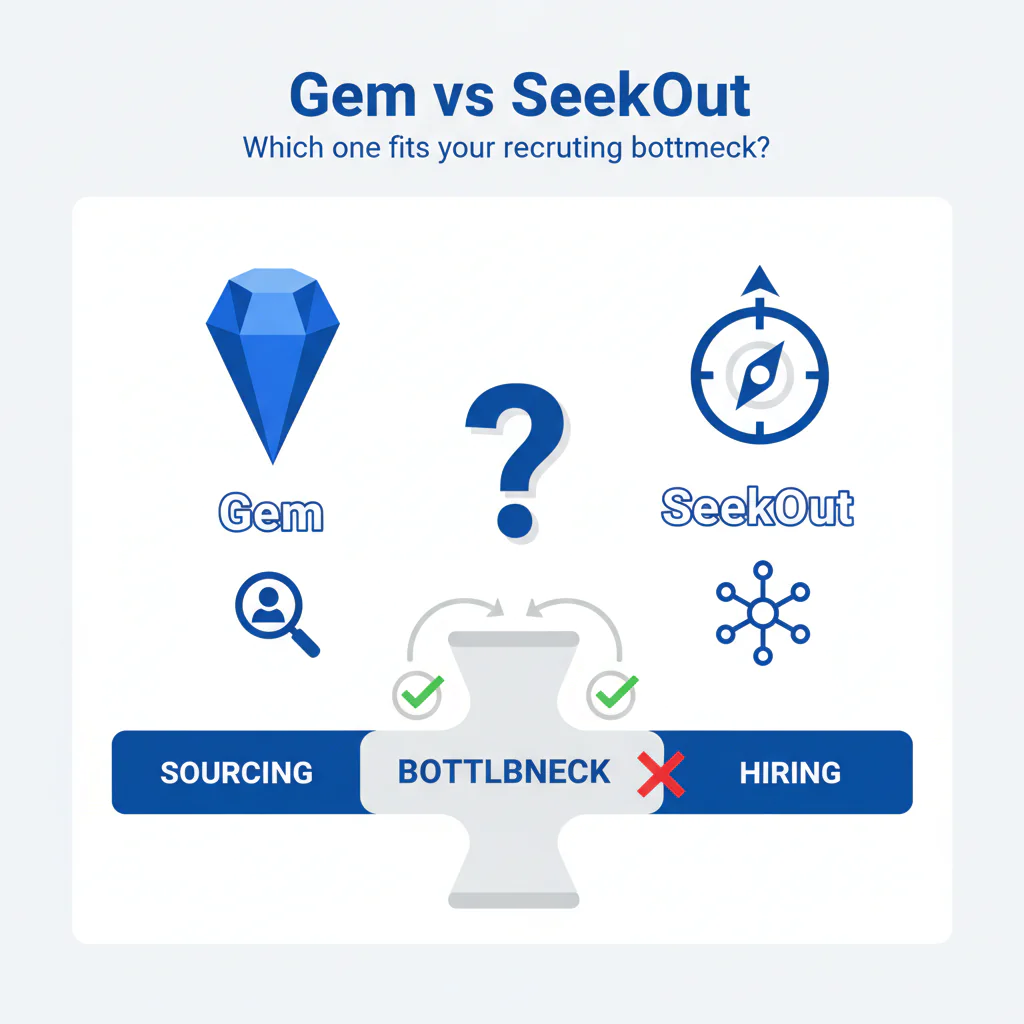
- For gem vs seekout, decide by bottleneck using the engagement vs intelligence framework: choose Gem when the constraint is engagement execution (sequencing, follow-up, reporting). Choose SeekOut when the constraint is intelligence (discovery, filtering, segmentation).
- Key stat
- Track time-to-first-conversation. If it does not improve after a pilot, you picked the wrong bottleneck or the team is not executing the workflow.
- Ideal candidate profile
- Heads of Talent and TA Ops leaders choosing between Gem and SeekOut for teams hiring from passive candidates, re-engaging silver medalists, and filling hard-to-reach roles with consistent candidate experience and opt-out compliance.
Gem vs SeekOut: which one fits your recruiting bottleneck?
Byline: Ben Argeband, Head of Talent Acquisition
Verdict: Pick Gem when your team has prospects but is not converting them into first conversations. Pick SeekOut when your team is not producing enough qualified prospects to contact. If connect rate is the limiter, plan for a separate reachability layer alongside either tool.
Who this is for
- TA leaders choosing between Gem and SeekOut based on whether the constraint is engagement workflow or sourcing discovery.
- Sourcing leaders supporting hard-to-reach roles where segmentation quality determines pipeline quality.
- Recruiters working passive candidates and re-contacting silver medalists without increasing complaints or opt-outs.
- Teams balancing in-house and agency recruiting motions that need consistent reporting and suppression handling.
What recruiters are trying to accomplish
- Placement speed: reduce days-to-first-conversation and increase qualified conversations per recruiter per week.
- Candidate experience: fewer irrelevant touches, clear context, and predictable next steps.
- Compliance: outreach that is relevant, documented, and respects opt-outs across systems.
Gem vs SeekOut: category differences (engagement vs intelligence)
Use engagement vs intelligence to keep the decision clean. Exact capabilities depend on configuration and integrations, so evaluate against your workflow and reporting needs.
Gem is typically evaluated as an engagement and workflow layer. It supports sequencing, follow-up discipline, and activity-to-outcome reporting. When engagement is the bottleneck, this improves placement speed by reducing dropped prospects and shortening time-to-first-conversation.
SeekOut is typically evaluated as an intelligence layer for sourcing discovery. It supports discovery, filtering, and segmentation. When intelligence is the bottleneck, this improves placement speed by reducing time spent searching and increasing the share of outreach going to qualified prospects.
Decision heuristic (by bottleneck)
- Discovery bottleneck: “We cannot generate enough qualified prospects per req fast enough.” Favor SeekOut. Primary KPI moved: qualified prospects per req and time-to-first-outreach.
- Engagement bottleneck: “We have prospects, but we cannot turn them into first conversations within a week.” Favor Gem. Primary KPI moved: time-to-first-conversation and reply-to-screen conversion.
- Reachability bottleneck: “We have prospects and sequences, but too many contacts are unreachable.” Add a reachability layer alongside either tool. Primary KPI moved: connect rate and wasted touches.
Where each tool tends to win
Gem tends to win when execution is the constraint.
- Standardized outreach sequences that reduce recruiter-to-recruiter variance in candidate experience.
- Follow-up tasking that reduces dropped prospects and improves time-to-first-conversation.
- Re-engagement of ATS pools and silver medalists with controlled messaging and suppression handling.
Operational example: if two recruiters work the same role family and one consistently books screens while the other does not, the gap is usually follow-up discipline and message consistency. An engagement workflow makes that gap visible and coachable.
SeekOut tends to win when discovery is the constraint.
- Faster list-building for hard-to-reach roles where the right filters matter more than volume.
- Segmentation that helps sourcers prioritize who to contact first, improving recruiter throughput.
- Discovery workflows that reduce manual searching and spreadsheet triage.
Operational example: if recruiters are waiting on slates or spending hours building lists, the fastest improvement is better discovery and segmentation so outreach starts earlier in the week.
Ethical use of phone numbers
Phone and SMS can reduce time-to-first-conversation when used with restraint. They also create compliance and candidate experience risk when used without context.
- Relevance first: contact candidates only for roles that match their background, and state the reason you reached out.
- Opt-out always: make it easy to opt out in every channel and honor opt-outs across tools.
- Channel preference: if a candidate asks for email-only, document it and follow it.
- Frequency caps: limit touches per week to avoid pressure and complaints.
- Time-of-day rules: align to candidate locale and avoid early or late outreach.
- Data minimization: store only what you need and restrict access by role.
Document lawful basis or consent and retention in your ATS or CRM record so opt-outs and audits are not handled in spreadsheets.
If a candidate would be surprised you called them, your message needs more context and your team needs tighter rules.
Sourcing workflow
- Define the bottleneck per role family: discovery vs engagement vs reachability. Done looks like a one-line diagnosis per role family and the metric you expect to move.
- Build the list (intelligence step): use SeekOut-style discovery to generate a segmented prospect set for hard-to-reach roles. Done looks like a prioritized list with a “why this person” note for each segment.
- Enrich contactability (reachability step): add validated channels so recruiters do not waste touches on unreachable contacts. Done looks like fewer wrong-number attempts and fewer repeated touches to the same person.
- Execute outreach (engagement step): use Gem-style sequencing and tasking so follow-up is consistent and opt-outs are enforced. Done looks like every prospect either converts to a conversation or is dispositioned with a reason.
- Close the loop: tag outcomes (connected, interested, not now, wrong fit, no response) and feed that back into segmentation and messaging. Done looks like weekly adjustments based on outcomes, not opinions.
Measure the workflow with time-to-first-conversation and qualified conversations per recruiter per week. If those do not move, stop adding tools and re-check the bottleneck.
Checklist: Diagnostic Table
| Symptom (what you see) | Likely root cause | Fast test (24–48 hours) | Fix that improves placement speed |
|---|---|---|---|
| High email volume, low replies | Message relevance is weak for passive candidates | Send 20 messages with one role-specific proof point (skill plus why them) | Tighten segmentation and require a “why you” line tied to the candidate’s background |
| Good replies, low show rate | Scheduling friction or unclear next step | Add one-click scheduling and confirm role basics in the first reply | Standardize a 2-step conversion: confirm fit, then schedule immediately |
| Wrong numbers or no pickups | Stale contact data | Sample 30 prospects and verify deliverability before calling | Add a reachability layer and reduce wasted touches and recruiter time |
| Replies say “stop contacting me” | Frequency too high or opt-outs not honored across tools | Audit suppression list sync between ATS/CRM and outreach tool | Centralize opt-outs and cap touches per week per candidate |
| Strong pipeline, weak offer acceptance | Misaligned expectations set during outreach | Compare outreach claims vs actual comp, level, and location constraints | Align messaging to real constraints to reduce late-stage fallout |
| Silver medalists don’t re-engage | Outreach does not reference prior process or a new reason to talk | Test a “what changed since last time” message to 25 silver medalists | Use prior context plus a specific new hook (scope, team, location, comp band) |
Decision Tree: Weighted Checklist
Score each factor as 0 (not true), 1 (somewhat true), or 2 (very true). Multiply by the weight. The weights reflect standard failure points that directly affect placement speed and candidate experience.
| Factor (score 0–2) | Weight | Why it’s weighted this way | If high, lean toward |
|---|---|---|---|
| We can’t generate enough qualified prospects per req fast enough (discovery bottleneck) | 3 | Without qualified volume, recruiters can’t create enough first conversations | SeekOut |
| We have lists, but follow-up is inconsistent across recruiters (execution bottleneck) | 3 | Inconsistent follow-up is a primary driver of lost replies and slower fills | Gem |
| Hard-to-reach roles require tight segmentation to avoid wasted outreach | 2 | Better targeting reduces irrelevant touches and improves response quality | SeekOut |
| We need standardized outreach to protect candidate experience and brand | 2 | Standardization reduces spammy behavior and improves conversion consistency | Gem |
| We struggle to re-engage silver medalists and past applicants at scale | 2 | Re-engagement is a fast path to placements when messaging and tracking are tight | Gem |
| Contact data is often stale; we waste touches on unreachable people (reachability bottleneck) | 3 | Unreachable contacts directly waste recruiter hours and slow time-to-first-conversation | Add reachability layer alongside either |
| We need clearer reporting on outreach activity to outcomes for coaching | 2 | Coaching to behaviors improves throughput when the process is measurable | Gem |
Interpretation: If your highest-weight items cluster on discovery, SeekOut is the better primary bet. If they cluster on execution and re-engagement, Gem is the better primary bet. If reachability scores high, plan for enrichment alongside either tool.
Outreach templates
These templates keep context upfront, reduce irrelevant touches, and make opt-out easy. Use them in sequences or as manual outreach after discovery.
Troubleshooting Table: Outreach Templates
Template 1: Passive candidate (email)
Subject: Quick question about your [skill/domain] work
Hi [First Name] — I’m reaching out because your background in [specific signal] matches a role I’m hiring for: [Role Title] on [Team/Company].
Two specifics so you can decide fast:
- Scope: [1 sentence on what they’d own]
- Constraints: [location/remote], [level], [comp band if you share]
If it’s not relevant, reply “no” and I’ll close the loop. If you’re open, are you available for a 10–15 minute call? [Give two time windows]
Template 2: Hard-to-reach role (SMS after one email)
Hi [First Name] — [Your Name] here. I emailed about a [Role Title] that matches your [specific signal]. If you’re open to a quick 10-minute chat, reply “yes” and I’ll send times. If not, reply “no” and I’ll stop.
Template 3: Silver medalist re-engagement (email)
Subject: Following up — what changed since we last spoke
Hi [First Name] — we spoke previously about [prior role/team] at [Company]. I’m reaching out because we have a new opening where the scope is different in a way that may fit you better: [1 sentence on what changed].
If you’re open, I can share details and confirm basics (level, location, comp range) in 10 minutes. If now isn’t the right time, reply “not now” and I’ll pause outreach.
Template 4: Agency recruiting candidate submission follow-up (email)
Subject: Next step for [Role Title] — quick confirmation
Hi [First Name] — I submitted your profile for [Role Title] at [Client/Company]. Before they review, I want to confirm two items to avoid delays:
- [Must-have requirement]
- [Availability, location, or comp expectation]
Reply with short answers and I’ll keep the process moving. If you’d rather do a 5-minute call, share a time window.
Evidence and trust notes
- Decide by bottleneck: the wrong choice shows up as either low-quality pipeline (discovery failure) or low conversion (engagement failure).
- Reachability is separate: even strong workflows underperform when contact data is stale, which wastes recruiter time and increases repeated touches.
- Compliance varies by jurisdiction: set internal policy for consent or legitimate interest, opt-outs, and retention, and have counsel review it for your regions.
Implementation notes:
- Integrations: confirm how each tool connects to your ATS/CRM so dispositions and opt-outs are not trapped in one system.
- Suppression ownership: assign one system as the source of truth for opt-outs and ensure every outreach channel respects it.
- Pilot instrumentation: require consistent outcome tags so you can compare discovery quality and engagement conversion without guesswork.
For tool-specific detail, use the dedicated reviews: Gem review and SeekOut review.
FAQs
Is Gem a talent CRM or a sourcing tool?
Gem is typically used as an engagement and workflow layer. It helps recruiters run consistent outreach and track outcomes. If your bottleneck is discovery, you still need an intelligence workflow to build segmented lists.
Is SeekOut better for sourcers than recruiters?
SeekOut is often strongest for sourcers because it supports discovery and segmentation. Recruiters benefit when the output is a prioritized list with a clear “why this person” note that translates into relevant outreach.
Can we use both Gem and SeekOut?
Yes. Use SeekOut for discovery and Gem for engagement. The operational risk is duplicate outreach and inconsistent opt-outs, so you need one suppression source of truth and clear ownership of sequences.
What if our main issue is that candidates don’t pick up?
That is a reachability problem more than an engagement vs intelligence problem. Add validated contact channels and tighten calling and SMS rules so you reduce wrong-number attempts and repeated touches.
How do we keep compliance tight when adding phone and SMS?
Keep outreach relevant, document your policy, make opt-out easy, and enforce suppression across systems. Audit suppression syncing monthly, especially if you run both discovery and engagement tools.
Next steps
- Days 1–2: Name the bottleneck by role family. Pull baselines: time-to-first-conversation, reply rate, connect rate, and qualified conversations per recruiter per week.
- Days 3–7: Pilot on 3–5 reqs. If testing Gem, measure follow-up completion and conversion to scheduled screens. If testing SeekOut, measure time to produce segmented lists and the qualified response rate from those lists.
- Days 8–14: If connect rate is limiting, add a reachability layer and re-run the pilot with the same reqs to isolate impact.
- Days 15–21: Standardize the workflow, define ownership (sourcing vs recruiting), and coach weekly using the two leading indicators: time-to-first-conversation and qualified conversations per recruiter per week.
About the Author
Ben Argeband is the Founder and CEO of Swordfish.ai and Heartbeat.ai. With deep expertise in data and SaaS, he has built two successful platforms trusted by over 50,000 sales and recruitment professionals. Ben’s mission is to help teams find direct contact information for hard-to-reach professionals and decision-makers, providing the shortest route to their next win. Connect with Ben on LinkedIn.