
 View Products


- Core concept
- To find candidates phone numbers without slowing hiring or creating compliance risk, run a repeatable sourcing workflow: identity → enrich → verify → rank → outreach, with opt-out handling and minimal retention.
- Operational benchmark
- If response is low, the leak is usually measurable: wrong-number rate, connect rate, and reply-to-meeting conversion. Fix identity and verification before increasing outreach volume.
- Ideal candidate profile
- Recruiters and sourcers working hard-to-reach roles, engaging passive candidates, reactivating silver medalists, or supporting agency recruiting where speed-to-contact and candidate experience drive placements.
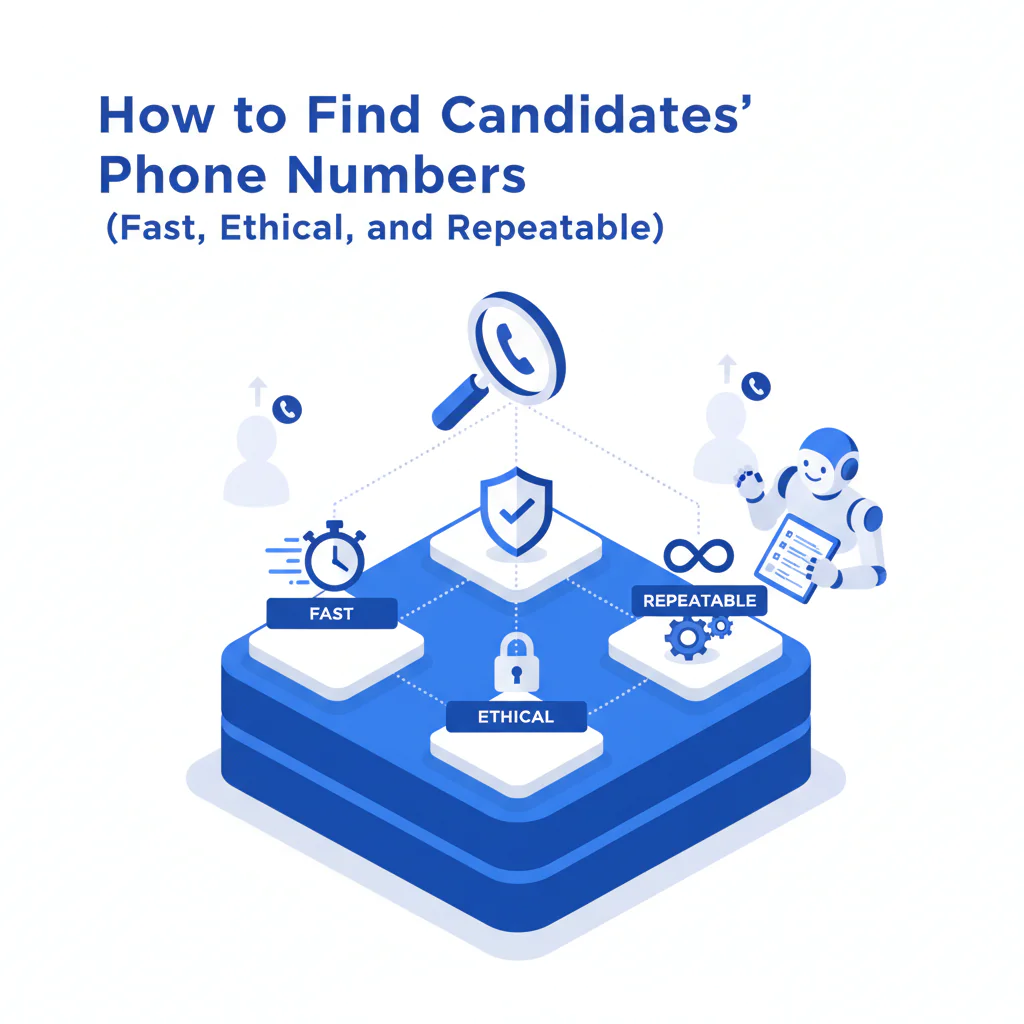
How to Find Candidates’ Phone Numbers (Fast, Ethical, and Repeatable)
Byline: Ben Argeband, Founder & CEO of Swordfish.AI
When I’m accountable for time-to-fill and candidate experience across a team, phone is a precision channel. It only helps if we can prove we’re contacting the right person, keep messages respectful, and stop immediately on opt-out.
If you’re asking how to find candidate phone number reliably, the repeatable part is identity resolution before enrichment. That prevents wrong-person outreach, reduces complaints, and improves reply rates without adding more volume.
Who this is for
This is for recruiters and sourcers who need a practical playbook for finding candidate phone numbers and reaching out responsibly. It fits teams that:
- Recruit for hard-to-reach roles where email-only outreach slows shortlists.
- Need a consistent way to reach passive candidates who don’t respond to InMail.
- Want to re-engage silver medalists with better timing and clearer context.
- Operate in agency recruiting where speed-to-first-conversation affects fill rate.
What recruiters are trying to accomplish
Finding phone numbers is not the outcome. The outcome is faster, higher-quality conversations with the right people while protecting candidate trust. In practice, teams are trying to:
- Reduce time-to-contact for qualified prospects when email is outdated.
- Increase reply rate by using a channel candidates actually see.
- Improve candidate experience with clear context and an easy exit.
- Stay compliant by collecting only what’s needed and honoring opt-out across systems.
Ethical use of phone numbers
Treat phone as permission-based even when the data is legally sourced: lead with identity, purpose, and an exit.
- Use-case fit: Use phone when the role is time-sensitive, the profile is scarce, or prior channels failed.
- Data minimization: Store only what you need for recruiting, and delete when it’s no longer needed.
- Source transparency: Be prepared to explain how you found the number in plain language.
- Opt-out: Include opt-out language in every SMS and honor it across ATS/CRM and sequencing tools.
- Timing: Contact during reasonable local hours and avoid repeated calling.
If someone asks how you got their number, answer once in plain language, then offer opt-out again and stop if requested.
Rules vary by region and channel. Follow your internal policy and local requirements for calling/texting, and stop immediately on opt-out.
Sourcing workflow
Use this sourcing workflow to find candidates phone numbers with fewer wrong numbers and faster first conversations: identity → enrich → verify → rank → outreach. Each step exists to protect candidate experience while improving placement speed.
1) Identity (resolve the right person)
Input: name, current company, title, location, and a stable profile URL. Output: one confirmed person record you can defend if challenged.
Many teams anchor identity on LinkedIn sourcing because employer and role signals are consistent. Using LinkedIn sourcing as the identity anchor reduces false matches, which reduces wrong-number texts and protects candidate experience.
2) Enrich (append contact channels)
Input: a confirmed identity record. Output: phone and email attached to that identity.
Write the number back to your ATS/CRM with source URL, date captured, and suppression status so the team doesn’t re-contact opted-out candidates.
3) Verify (reduce wrong numbers and wasted touches)
Input: enriched phone data. Output: a number you’re comfortable using for SMS/call outreach.
Minimum standard: confirm country/area alignment, mobile classification where available, and at least one corroborating identity signal before outreach. If you need a deeper walkthrough of enrichment and validation approaches, see candidate phone number lookup.
4) Rank (prioritize who to call/text first)
Input: verified contact data plus role fit. Output: a prioritized list that matches effort to expected return.
Some teams use ranked mobile numbers by answer probability to decide who gets a call versus SMS-first. Use SMS-first when you need consent-forward outreach and the candidate is likely in meetings; use call after you’ve sent context and you need a same-week conversation. The business outcome is more conversations per hour of sourcing, which improves time-to-submit on scarce profiles.
5) Outreach (3-touch candidate reach plan)
Input: a prioritized list and a clear reason for outreach. Output: a scheduled conversation or a clean “no,” without repeated pings.
Use the 3-touch candidate reach plan over 3–5 business days: (1) SMS with opt-out, (2) email with role context, (3) one call or voicemail referencing the prior messages. This reduces surprise calls and increases replies from passive candidates who need a clear reason to engage.
FIELD NOTE: SMS-first with opt-out typically produces cleaner engagement than call-first because the candidate can respond on their schedule and you’ve established intent before a live conversation.
Checklist: Diagnostic Table
| Symptom | Likely root cause | What to change (next 24 hours) | Metric to watch |
|---|---|---|---|
| SMS delivered, no replies | Message lacks context or reads like bulk outreach | Add 1 line proving relevance (specific skill + why now) and include opt-out | Reply rate per 50 sends |
| High “wrong number” rate | Weak identity resolution before enrichment | Require company + title match before saving a number; re-check location | Wrong-number rate |
| Calls go to voicemail repeatedly | Calling at low-answer times or using non-mobile numbers | Shift to SMS-first; call only after SMS/email context | Connect rate |
| Candidate replies: “How did you get my number?” | No transparency or consent framing | Use a short explanation and offer opt-out immediately | Negative reply rate |
| Candidate opts out, then gets contacted again | Opt-out not synced across ATS/CRM and sequences | Create a single suppression field and enforce it in every tool | Repeat-contact incidents |
| Strong candidates respond but don’t schedule | Too much back-and-forth, unclear next step | Offer two time windows and confirm interview format in the first reply | Reply-to-meeting conversion |
| Low response on hard-to-reach roles | Value prop not specific to the constraint | Lead with the one constraint that matters (comp band, location flexibility, tech stack) | Qualified reply rate |
Decision Tree: Weighted Checklist
Use this weighted checklist to decide whether a candidate should enter phone/SMS outreach today. The weights reflect common failure points that slow placement speed: poor identity match, unverified contact data, and weak relevance. Total possible weight: 100.
- Identity confidence (40): Name + current company + role align across your source and your record. If identity is uncertain, you risk wrong-person contact and complaints.
- Role relevance (30): You can state, in one sentence, why this person fits the role (skill, scope, industry, or location). If relevance is weak, reply rates drop and opt-outs rise.
- Contact quality (20): Number appears to be a current mobile and meets your minimum verification standard. If quality is low, connect rates drop and time is wasted.
- Compliance readiness (10): You can provide a clear opt-out path and you have a place to record suppression so the candidate is not contacted again. If this is missing, risk increases.
Operating rule: If you score below 70/100, fix identity, relevance, or verification before you send SMS or place a call.
Outreach templates
Use the templates below as written, then personalize the one line that proves relevance. Recommended spacing for the 3-touch plan: Day 1 SMS, Day 2 email, Day 4 call/voicemail.
These recruiting outreach templates reduce back-and-forth and improve reply-to-meeting conversion because the next step is explicit.
When they respond, confirm the best channel and ask if texting is okay going forward. If they reply STOP, confirm suppression and do not re-add later.
Troubleshooting Table: Outreach Templates
Template 1: SMS (first touch, passive candidate)
Hi {FirstName} — I’m {YourName}, a recruiter with {Company}. I’m reaching out because your background in {SpecificSkill/Domain} looks aligned with a {RoleTitle} role I’m hiring for. Open to a quick 10-min chat this week? Reply YES and I’ll send times. If you’d rather not get texts from me, reply STOP.
Template 2: Email (second touch, adds detail)
Subject: {RoleTitle} — quick question
Hi {FirstName},
I’m {YourName} with {Company}. I’m hiring for a {RoleTitle} and reached out because of your work in {SpecificSignal: tech stack / domain / scope}.
If you’re open to it, I’d like to ask two questions: (1) are you open to a change in the next {Timeframe}? (2) what range would you need to consider it?
If now isn’t a fit, reply “not interested” and I’ll close the loop.
Template 3: Voicemail (third touch, references prior messages)
Hi {FirstName}, this is {YourName} with {Company}. I sent a quick text and email about a {RoleTitle} role because of your experience in {SpecificSkill}. If you’re open to a brief chat, you can call me back at {CallbackNumber}. If you’d prefer I stop reaching out, just reply STOP to my text and I’ll update my records. Thanks.
Template 4: SMS (silver medalist re-engagement)
Hi {FirstName} — {YourName} here. We spoke earlier about {OldRole/Team}. I’m hiring again for {NewRoleTitle} with {KeyConstraint: comp/location/stack}. Want me to send details? Reply YES and I’ll share a 3-bullet summary. Reply STOP to opt out.
Template 5: Agency recruiting (candidate-first framing)
Hi {FirstName} — I’m {YourName}. I support a few teams hiring for {RoleFamily}. Based on your {SpecificSkill}, I may have a role that matches your priorities (comp/location/remote). If you tell me your top 2 must-haves, I’ll only send roles that match. Reply STOP to opt out.
Evidence and trust notes
Why this workflow works operationally: identity resolution reduces wrong-person outreach; enrichment increases reachable candidates; verification reduces wasted dials; ranking focuses effort on the best-fit prospects; structured outreach improves reply-to-meeting conversion. Those are the levers that affect placement speed.
What to log for auditability: source profile URL, date/time of enrichment, verification notes (at a high level), and opt-out status. This keeps your team consistent and prevents repeat-contact incidents.
Suppression discipline: If a candidate opts out in SMS, suppress them from calls and emails as well.
Quality expectations: If connect rates are low, don’t assume candidates don’t answer. Assume your identity and verification steps are leaking. Teams that use ranked mobile numbers by answer probability typically waste fewer touches because they prioritize the most reachable prospects first.
FAQs
How do I find a candidate phone number if I only have a LinkedIn profile?
Confirm identity signals (name, company, title, location). Then enrich from that identity and verify the number before outreach. This reduces wrong-person contact and improves reply-to-meeting conversion.
Is it acceptable to text passive candidates?
It can be if you provide context, keep it brief, and include opt-out language. SMS-first often improves candidate experience because it’s asynchronous.
What’s the safest order: call, text, or email?
For most roles: SMS (with opt-out) → email (details) → one call/voicemail referencing the prior messages.
How many times should I try before I stop?
Use a defined 3-touch plan over 3–5 business days, then stop unless the candidate re-engages.
How do I avoid contacting the wrong person?
Make identity resolution a gate before saving a number: company + title + location consistency. If you can’t confirm, don’t outreach by phone.
How do I manage opt-outs across tools?
Create one suppression field in your ATS/CRM and enforce it in every sequence tool so SMS opt-outs suppress calls and emails too.
Next steps
Day 1: Standardize the workflow (identity → enrich → verify → rank → outreach) and add a suppression field that every recruiter can see.
Days 2–3: Implement the 3-touch candidate reach plan and require the Weighted Checklist score before SMS/call outreach.
Week 2: Review wrong-number rate, connect rate, and reply-to-meeting conversion. Fix the step that’s leaking before increasing volume.
Week 3–4: Document your minimum verification standard and opt-out handling so agency recruiting partners and internal teams follow the same rules.
If you need a compliance baseline for contact data collection and outreach, use contact data compliance.
About the Author
Ben Argeband is the Founder and CEO of Swordfish.ai and Heartbeat.ai. With deep expertise in data and SaaS, he has built two successful platforms trusted by over 50,000 sales and recruitment professionals. Ben’s mission is to help teams find direct contact information for hard-to-reach professionals and decision-makers, providing the shortest route to their next win. Connect with Ben on LinkedIn.