
 View Products


Contact data accuracy test: a buyer-grade protocol (same list, same window)
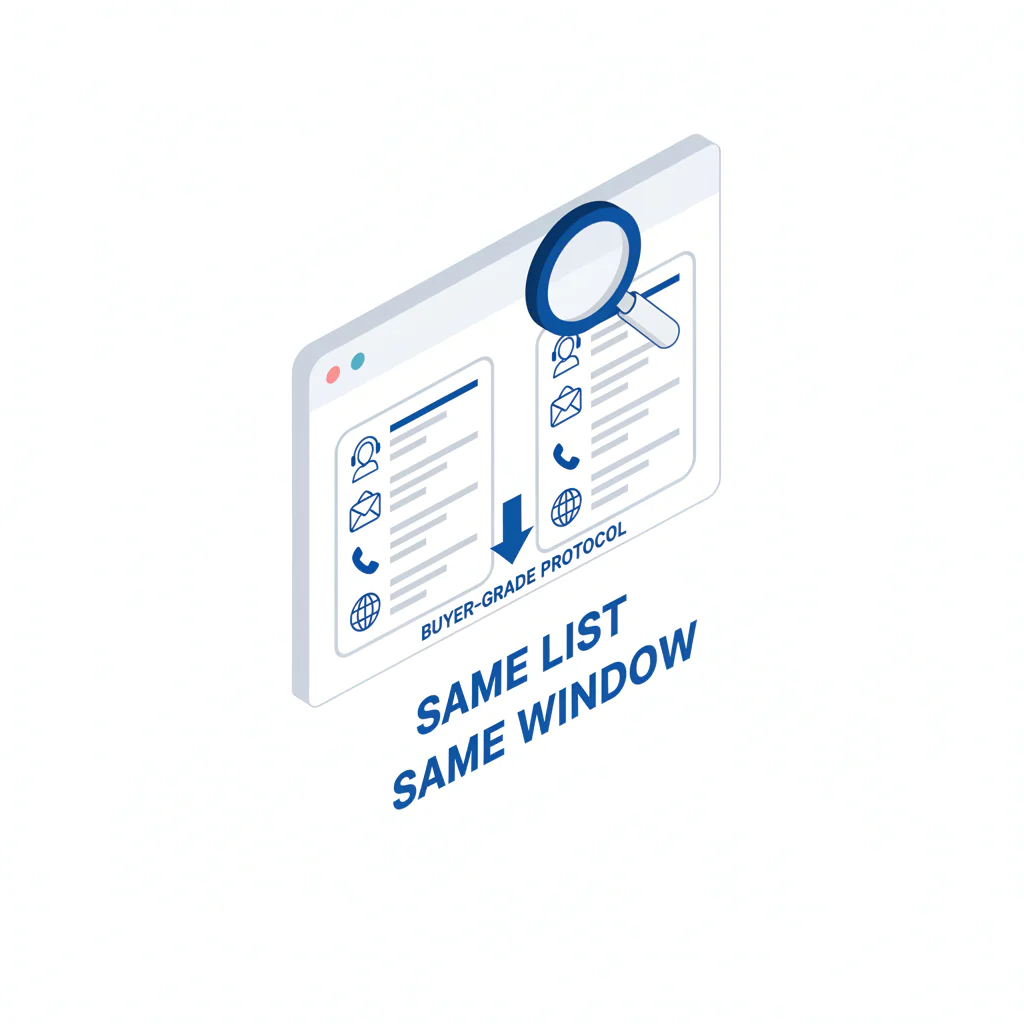
A contact data accuracy test is an A/B test that measures connect rate on the same list same window, with vendor limits documented so the result survives procurement and QBR scrutiny.
Byline: Ben Argeband, Founder & CEO of Swordfish.AI
Most “accuracy” claims are accounting tricks: record-level matches, unverifiable “coverage,” and tests run on different lists across different weeks. If you’re paying for contact data, you’re buying connects per hour. Everything else is a proxy that breaks the moment data decay shows up and reps start dialing dead lines.
Who this is for
This is for sales teams searching Apollo alternatives because pricing, data quality, or workflow fit stopped making sense. It also fits RevOps and procurement reviewers who have to defend a vendor choice after the first quarter when stale numbers and CRM collisions turn into rep time waste and cleanup work.
Human element (decision heuristic): group alternatives by job-to-be-done (sequencing, enrichment, phone-first calling), then test the workflow gap that costs you money.
Quick verdict
- Core answer
- Run an A/B test using the same list same window, measure connect rate (not “records returned”), and document vendor limits (seats, API usage, exports). Use File Upload to enforce identical inputs across tools.
- Key stat
- Record-level “match” rates routinely overstate calling outcomes because they ignore wrong lines, stale routing, and mislabeled phone fields; connect rate is the outcome that maps to pipeline activity.
- Ideal user
- Operators who need a defensible methodology for benchmarking contact data providers and want a protocol they can rerun quarterly as data freshness drifts.
What Swordfish does differently
Most tools make evaluation expensive: you burn credits to discover the data doesn’t connect, then you get throttled when you try to validate at scale. That’s not a product feature; it’s a billing strategy. Swordfish is structured to reduce the risk that your evaluation gets capped before you can measure connect rate.
- Prioritized direct dials: If your team is phone-first, a “phone field exists” is not a win. You need a number that reaches the person. Swordfish prioritizes direct dials so a connect rate test reflects calling reality.
- True unlimited with fair use: “Unlimited” often means caps, throttles, or feature gating. Swordfish’s unlimited with fair use reduces the risk that your evaluation gets throttled or capped before you can measure connect rate.
- File-based testing that matches how audits work: Upload the exact same CSV to Swordfish and a competitor, then compare outputs on identical inputs. Use File Upload as the mechanism to run the test so the “same list” constraint is enforceable.
Variance still happens. It’s usually driven by seat count (who can access what), API usage (rate limits and endpoints), list quality (ICP fit, geography, seniority), and industry (switchboard-heavy orgs and regulated sectors). If you don’t document those variables, you can’t explain why results differ, and you can’t predict what happens after rollout.
Decision guide
This decision guide is the accuracy test protocol you can attach to an evaluation memo. It’s designed to test contact database outputs in a way that doesn’t collapse when someone asks, “What did you actually measure?”
Framework (accuracy test protocol): lock inputs, lock the window, lock outputs, measure connects, log limits, then explain variance by seat count, API usage, list quality, and industry. If any one of those is missing, you’re not benchmarking; you’re collecting anecdotes.
- Sequencing-first teams: you care about deliverability and replies; phone accuracy matters less unless you call. If you still buy phone data, measure connect rate anyway so you don’t pay for dead fields.
- Enrichment-first teams: you care about stable identifiers, API behavior, and merge logic; “accuracy” includes dedupe and overwrite rules because integration mistakes create downstream rework.
- Phone-first calling teams: you care about direct dials and connect rate; record coverage is noise if it doesn’t ring the right person.
To compare contact data providers without getting trapped by vendor-defined metrics, you’ll run an A/B test with identical inputs and a connect-rate outcome, then write a variance explainer using the variables above.
Checklist: Feature Gap Table
| Area | What vendors claim | Hidden cost / failure mode | What to demand in your test protocol | Business outcome you can measure |
|---|---|---|---|---|
| “Accuracy” | High accuracy % based on record matches | Matches can be stale, wrong line type, or routed; reps waste dials | Define accuracy as connect rate on attempted calls; log dispositions | Higher connects per hour; less rep time wasted on dead lines |
| Coverage | “We have more contacts” | More records can mean more duplicates and more wrong numbers | Measure unique people with at least one callable direct dial | Lower cost per connect; fewer duplicate touches |
| Freshness | “Continuously updated” | Data decay shows up after purchase; refresh cadence is unclear | Run the same list same window; rerun quarterly on a holdout list | More stable connect rate over time; fewer dead-end sequences |
| Limits | “Unlimited” or “fair use” | Throttles, feature gating, or endpoint restrictions break workflows | Document seat count, API limits, export caps, and enrichment rules | Predictable operating cost; fewer mid-quarter surprises |
| Integrations | “Works with your CRM” | Field mapping, overwrite logic, and dedupe create rework | Test in a sandbox; define merge rules before production | Lower RevOps cleanup time; fewer CRM data regressions |
| Phone fields | “Mobile” and “direct” available | Line type labels vary; “mobile” can be VoIP or HQ | Validate by call outcomes; track wrong person vs non-working | Higher connect rate; fewer brand and compliance issues |
| Auditability | “Trust us” dashboards | No exports means no audit trail; you can’t reproduce results later | Require timestamped exports of outputs and limits encountered | Defensible vendor selection; faster re-tests when performance drops |
Decision Tree: Weighted Checklist
Use this weighted checklist to score vendors. The weights are based on standard failure points that create real cost: data decay, credit burn during evaluation, and integration rework. Change weights only if your workflow changes.
| Criterion (what fails in real deployments) | Weight (High/Medium/Low) | How to verify (audit step) | Variance explainer (why results differ) |
|---|---|---|---|
| Connect rate definition and measurement (connects, not records) | High | Write the definition in the test doc; run call attempts and log dispositions | Industry routing and list quality change connect outcomes |
| Same list same window execution (A/B test integrity) | High | Freeze a CSV; run both vendors within the same timeframe; keep timestamps | Data freshness shifts weekly; timing bias inflates results |
| Limits disclosure (seats, API usage, exports, throttles) | High | Document seat count, API limits, export caps, and any throttling encountered | Seat count and API usage change what you can actually test |
| Direct dial prioritization for phone-first workflows | High | Confirm outputs include direct dials and how they’re prioritized vs HQ/switchboard | Seniority and industry affect availability of direct lines |
| Data freshness test (repeatability over time) | Medium | Rerun a holdout list after 30–90 days; compare connect-rate drift | Data decay varies by role churn and company size |
| CRM overwrite and dedupe behavior (integration headaches) | Medium | Test in sandbox; confirm merge rules and field precedence before production | Existing hygiene and CRM configuration change collision rates |
| Operational transparency (what happens when data is wrong) | Medium | Ask how feedback/corrections propagate; confirm whether fixes are global or local | Vendor processes differ; some corrections don’t improve future pulls |
| Cost predictability under real usage (not demo usage) | High | Model usage by reps/week; include testing burn and re-enrichment cycles | API usage and list volume drive cost variance |
| Exportability and audit trail (defensible procurement) | Low | Confirm you can export results and retain a timestamped snapshot | Some tools restrict exports by plan or role |
Troubleshooting Table: Conditional Decision Tree
- If you can’t define “accuracy” as connect rate with a written methodology, then stop calling it an accuracy test and treat it as a coverage demo. Stop condition: vendor refuses connect-rate measurement, refuses exports needed to audit, or won’t disclose limits that affect the test.
- If the vendor won’t run same list same window (or won’t let you), then assume timing bias and don’t compare results across weeks.
- If the vendor won’t allow exporting enriched outputs, then stop. No export means no audit trail, and you can’t reproduce results when someone challenges the decision.
- If your workflow is phone-first and the vendor can’t explain how it prioritizes direct dials vs HQ/switchboard, then expect lower connects per hour even if “coverage” looks high.
- If your test requires API usage and the vendor rate-limits or gates endpoints, then model the operating cost as higher than the quote because you’ll need workarounds or extra seats.
- If your CRM has strict hygiene rules and the vendor can’t specify overwrite/dedupe behavior, then run sandbox-only until you can prove it won’t regress existing data.
Test protocol (how to test with your own list)
This test protocol is the minimum viable contact data validation test that stays fair: same list same window, measure connects not records, and document limits. A connect rate test reduces wasted dials by exposing stale routing and wrong lines before you roll a tool out to the whole team.
What you need: one frozen CSV, one calling workflow with consistent dispositions, and a place to store timestamped exports.
- Freeze the list (no vendor-supplied list). Build one CSV of prospects (name, company, title, domain, LinkedIn URL if you have it). Do not accept a vendor-built list. Do not let vendors “clean” inputs differently per tool.
- Define the window (same window). Run both vendors within the same timeframe (ideally 24–72 hours). Document timestamps and who ran each export.
- Lock the output requirements. Decide what fields count for your workflow (direct dial, mobile if available, email if relevant). If one vendor requires extra identifiers to return the same fields, record that as workflow overhead.
- Run enrichment the same way (enforce same list). Use the same CSV and the same enrichment path for each vendor. Use File Upload to run the identical list through Swordfish and your competitor so input parity is enforceable.
- Export outputs and keep an audit snapshot. Save the returned numbers and any metadata you’re allowed to export. At minimum, retain: vendor name, timestamp, input row ID, returned number, line-type label (if provided), and call disposition. If exports are restricted, document it as a test limitation because you can’t reproduce results later.
- Sample calls without bias. Randomly sample a subset for calling. If your list spans segments (industry/geo/seniority), stratify the sample so one segment doesn’t dominate results.
- Call and log dispositions (you control the calling). Log outcomes: connected to right person (including gatekeeper transfer that reaches the person), connected wrong person, non-working, voicemail, gatekeeper/IVR (no transfer), no answer. Don’t let vendors run the calling or “interpret” outcomes for you.
- Compute connect rate and report “no answer” separately. Connect rate = connects to the right person / attempted calls. Treat “no answer” as an outreach outcome (neither accurate nor inaccurate) and report it separately so vendors can’t argue definitions.
- Document limits and write the variance explainer. Record seat count, API usage constraints, export caps, and any throttling. Explain variance using seat count, API usage, list quality, and industry. If you average everything into one number, you’ll miss the segment where the tool fails in production.
Limitations and edge cases
- Switchboards and shared lines distort connect rate. Some industries route calls through reception or IVR. That reduces connects even when the number is “working.” Segment results by industry if your ICP is mixed.
- International dialing changes outcomes. Line types, formatting, and carrier behavior vary. If you sell globally, segment the test by region instead of averaging everything.
- CRM collisions are a hidden tax. Common failure modes include overwriting a previously verified direct dial with a stale number, creating duplicate contacts because matching keys differ, and breaking attribution when enrichment updates the wrong record.
- Integration edge cases that cost real time: lead vs contact object mismatches, field precedence that overwrites “verified” fields, and dedupe rules that merge two people at the same company into one record. If you can’t describe your merge rules in one paragraph, you’re not ready to automate enrichment.
- Rollback is part of the integration plan. Before production, decide how you’ll revert bad updates (restore from backup export, disable overwrite, or restrict to empty fields). If you skip this, your “integration” becomes a cleanup project.
- API vs UI results can differ. Some vendors expose different fields or limits via API usage. If your workflow depends on API enrichment, test the API path, not the UI export.
Evidence and trust notes
This page avoids vendor-supplied accuracy percentages because they’re rarely comparable across tools. A fair benchmark requires: same list same window, a connect-rate definition, and documented limits. Without those, you’re not benchmarking; you’re watching a controlled demo.
You’ll notice there’s no public leaderboard here. Publishing a “winner” without your list, your industry mix, your seat count, and your API usage constraints would be fake precision. If a vendor claims a benchmark, require the raw methodology and rerun it on your list; don’t accept screenshots.
For related reading on how data quality breaks in production and how to think about ongoing hygiene, see data quality. If you’re evaluating Swordfish against a common incumbent, see ZoomInfo vs Swordfish. If you want Swordfish’s own accuracy positioning and how to interpret it, see Swordfish data accuracy. If your procurement process is stuck on credit models and caps, see unlimited contact credits.
FAQs
What is a contact data accuracy test?
A contact data accuracy test is an A/B test where two providers enrich the same list in the same window, and you measure outcomes that matter operationally, typically connect rate for phone-first teams. If you only compare “records returned,” you’re measuring coverage, not accuracy.
How do I run a connect rate test without bias?
Freeze the list, run both vendors within 24–72 hours, and use the same calling process and disposition codes. Bias usually comes from timing (freshness drift), list differences (ICP mismatch), or inconsistent definitions.
Why do vendors show different results on the same list?
Variance usually comes from list quality (your ICP vs their strengths), industry routing (switchboards), and operational constraints like seat count and API usage limits. If a vendor’s plan restricts exports or endpoints, you may not be testing the same product you’d deploy.
What should I do if a vendor refuses exports or won’t disclose limits?
Treat it as a stop condition for a defensible benchmark. If you can’t retain outputs and document constraints, you can’t audit results later, and you can’t explain variance when connect rates drop.
How often should I rerun a data freshness test?
Quarterly is a practical cadence for most teams because role changes and routing updates accumulate. Keep a holdout list and rerun the same protocol so you can see drift instead of arguing about anecdotes.
Next steps
- Day 0–1: Build and freeze your CSV list; write the connect-rate definition and dispositions; choose your same window.
- Day 1–2: Run enrichment in both tools using identical inputs; export and snapshot outputs; document limits encountered. Use File Upload to enforce “same list.”
- Day 2–5: Call the sample; log outcomes; compute connect rate; report “no answer” separately.
- Day 5–7: Write the variance explainer (seat count, API usage, list quality, industry) and decide by job-to-be-done (sequencing, enrichment, phone-first calling).
- Day 30–90: Rerun the holdout list as a data freshness test to see drift before it shows up in pipeline.
About the Author
Ben Argeband is the Founder and CEO of Swordfish.ai and Heartbeat.ai. With deep expertise in data and SaaS, he has built two successful platforms trusted by over 50,000 sales and recruitment professionals. Ben’s mission is to help teams find direct contact information for hard-to-reach professionals and decision-makers, providing the shortest route to their next win. Connect with Ben on LinkedIn.