
 View Products


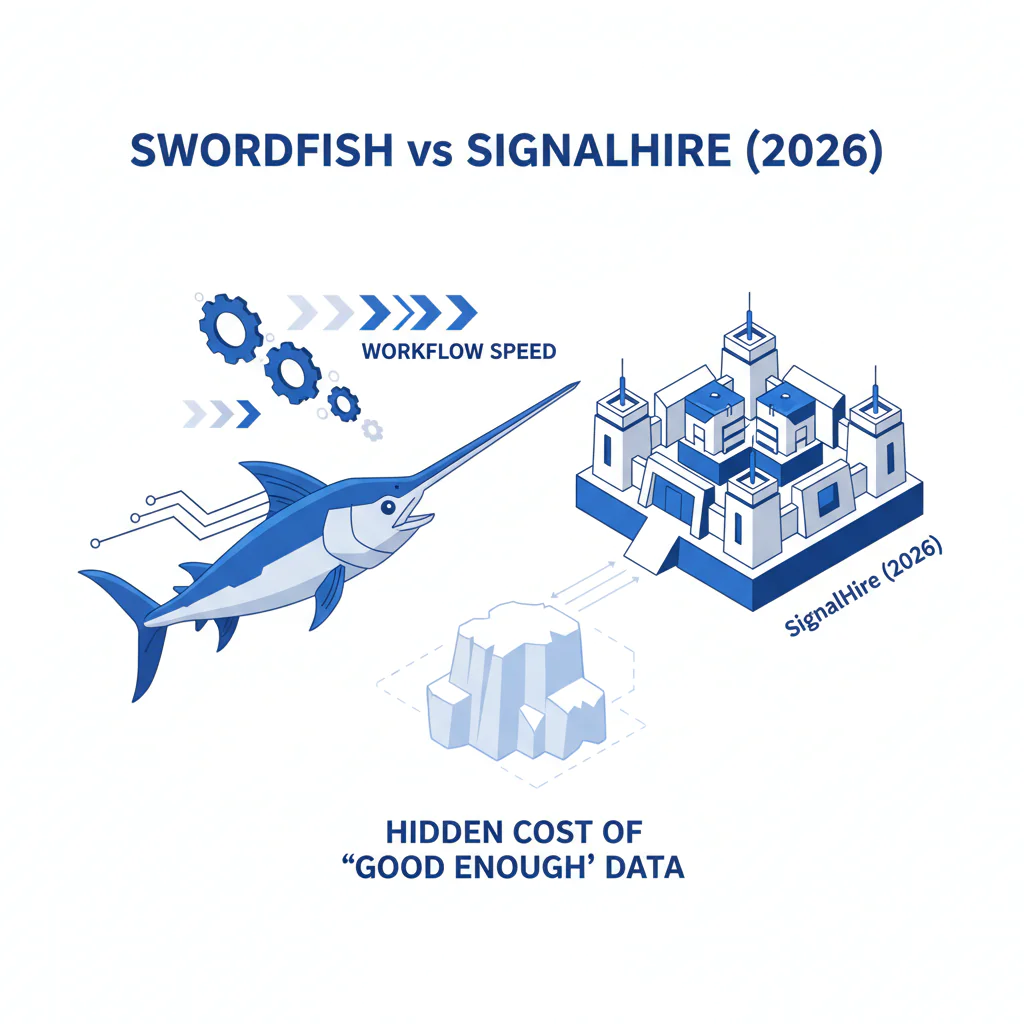
Swordfish vs SignalHire (2026): reachability, workflow speed, and the hidden cost of “good enough” data
Byline: Ben Argeband, Founder & CEO of Swordfish.AI
Who this is for
RevOps and growth teams deciding between firmographic enrichment and phone-first reachability. If your motion includes calling, “reachability” means the number actually gets you to the intended person, not that a phone field exists in the CRM.
Quick verdict
- Core answer
- If your KPI is reachability (more conversations per hour), bias toward Swordfish. If your KPI is company enrichment and calling is not a primary channel, SignalHire can fit, but you should price in the workflow tax and refresh behavior.
- Key stat
- No universal “accuracy %” is portable across vendors because results vary by seat count, API usage, list quality, and industry. Treat single-number claims as non-auditable until you run your own list.
- Ideal user
- Teams that want predictable usage (true unlimited with fair use) and faster sourcing-to-outreach without stitching extra workflow tools together.
If you don’t call, measure enrichment completeness only on the fields your routing and reporting actually use, plus workflow time. “More fields” that don’t map cleanly still create rework.
What Swordfish does differently
Demos hide the costs that show up in production: data decay, integration edge cases, and reps wasting time on contacts that aren’t reachable. Swordfish is built around person-level reachability and a tighter workflow so data doesn’t rot in exports.
Prioritized direct dials: Swordfish prioritizes phone numbers that are usable for outreach (direct dials where available). A main line or switchboard number behaves like missing data and increases dials per connect.
True unlimited + fair use: Predictability matters because caps and throttles change behavior. When teams ration lookups, they stop refreshing records, and data decay becomes your problem instead of the vendor’s.
Tool sprawl vs tight workflow: Tool sprawl is a cost model. Every extra export/import step creates duplicates, stale fields, and attribution gaps that you’ll end up debugging in the CRM.
FIELD_NOTE: In audits, the subscription is rarely the expensive part. The expensive part is the quiet shift where reps stop trusting the tool, start “verifying” manually, and your CRM becomes a warehouse of half-wrong contact enrichment.
Decision guide
Use this framework: tool sprawl vs tight workflow. If a tool forces extra steps to get from a sourcing tool to outreach, you pay twice: once in licenses and again in rep time and integration upkeep.
Variance is why two teams can buy the same product and report opposite outcomes.
- Seat count and role mix: A few power users can make anything look efficient. Roll it out to SDRs and the friction becomes visible.
- API usage vs manual usage: If you need automation, the real cost is field mapping, monitoring, and rework when update rules don’t match your CRM.
- List quality: Clean inbound leads behave differently than scraped lists. Bad inputs make every vendor look worse.
- Industry and geo: Reachability differs by region and job function. If your ICP is narrow, you need a pilot on your own data.
Before you sign anything, get pricing mechanics in writing. These questions decide whether your team will ration usage and let records decay.
- Does refresh consume the same usage as net-new? If refresh is penalized, your CRM will age out.
- How is API usage counted vs manual? If API calls are treated differently, your automation plan may be dead on arrival.
- What triggers a fair use review? If the boundary is vague, your “predictable” plan becomes a negotiation mid-quarter.
How to test with your own list (5–8 steps)
- Freeze a list snapshot: Export a fixed ICP list (same titles, geos, seniority) so both tools see identical inputs.
- Define “usable” up front: For phone, define usable as “reaches the intended person” versus “main line/switchboard/unknown.” For email, define usable as “deliverable enough to run outreach without immediate bounces.”
- Run both tools on the same list: Capture what each returns without manual cleanup so you measure the tool, not your team.
- Measure workflow time with the same operator: Use the same rep and the same workflow path for both tools, including any exports/imports and dedupe steps.
- Measure reachability outcomes: Log outcomes during recruiting outreach: connected, wrong person, voicemail, disconnected, bounced email. Don’t collapse this into a single “accuracy” number.
- Test refresh behavior on a randomized subset: Re-run a subset and confirm what changes, what overwrites, and what costs usage.
- Test integration rules: Validate field mapping (direct vs main), update precedence, and dedupe behavior in the CRM.
- Review pricing mechanics under your real volume: Confirm how seat count and API usage affect limits, and whether the pricing model stays predictable when volume spikes.
Checklist: Feature Gap Table
| Audit area | Swordfish (what to verify) | SignalHire (what to verify) | Hidden cost if you get it wrong |
|---|---|---|---|
| Reachability focus (person-level) | Confirm prioritized direct dials and how often you get an outreach-usable phone on your ICP sample. | Confirm whether results skew toward emails/enrichment and how often phone results are outreach-usable for your roles/regions. | More dials per connect; reps compensate with manual research. |
| Workflow speed | Time a rep from profile to CRM record with phone + email; count clicks and context switches. | Time the same flow; note any export/import steps or extra workflow tools needed. | Lost rep hours; tool sprawl becomes the default operating model. |
| Pricing model predictability | Validate “true unlimited + fair use” terms: what triggers review and whether refresh changes usage behavior. | Validate credit/limit mechanics: what counts as usage, what happens at caps, and whether teams start rationing. | Quarterly surprises; under-enrichment; stale CRM records. |
| Data decay handling | Check how often you can refresh contact data and how updates propagate into your workflow. | Check refresh costs/limits and whether stale records accumulate due to rationing. | CRM rot; duplicate outreach; wasted sequences. |
| CRM overwrite and precedence rules on refresh | Confirm which fields overwrite, which are appended, and how “source of truth” is handled when a record already exists. | Confirm the same, including whether refresh creates field thrash or duplicates when data differs. | Field thrash, duplicates, broken reporting, and reps calling the wrong number because the “latest” value won. |
| Integration and field mapping | Confirm CRM mapping for phone types (direct vs main), dedupe behavior, and update rules. | Confirm the same, plus whether you need middleware or custom scripts for your workflow. | Engineering time; broken automations; inconsistent reporting. |
| Operational reporting | Verify you can audit usage and outcomes (connect outcomes by source, refresh frequency) without manual spreadsheets. | Verify the same; check if reporting is split across tools due to workflow sprawl. | Can’t prove ROI; renewals become opinion-based. |
Decision Tree: Weighted Checklist
- Reachability on your ICP (highest weight): If calling is part of your motion, prioritize the tool that returns more outreach-usable phone numbers on your pilot list. This reduces wasted dials and increases connects per hour.
- Pricing model predictability (highest weight): If caps or unclear fair use triggers cause rationing, refresh stops and data decay accelerates. Predictable unlimited credits (with clear fair use) keeps behavior stable.
- Workflow speed (high weight): Fewer steps from sourcing tool to outreach reduces rep time and reduces the chance data gets stranded in exports.
- Refresh economics (high weight): Data decays. If refresh is penalized, you will keep stale records and pay for it in wasted recruiting outreach.
- Integration overhead (medium weight): If you need API-based contact enrichment, weight vendors by how much field mapping and monitoring you will own after go-live.
- Coverage fit by industry/geo (medium weight): Run a pilot on your real list because vendor-wide claims don’t survive niche ICPs.
- Governance and auditability (medium weight): If you can’t trace where data came from and when it was refreshed, you can’t debug performance or defend spend.
Troubleshooting Table: Conditional Decision Tree
- If your success metric is “more conversations,” then choose the tool that produces more outreach-usable phone numbers on a pilot list from your ICP, not the tool with more enrichment fields.
- If calling is not a channel and your KPI is enrichment completeness, then choose the tool that fills the fields you actually route and report on, with the fewest workflow steps.
- If you expect volume spikes (hiring pushes, territory expansions), then prefer a pricing model that stays predictable under load so reps don’t ration lookups.
- If your workflow requires multiple exports/imports to get data into your CRM and sequences, then assume tool sprawl will become permanent and budget rep hours accordingly.
- If you need API-based automation, then run an integration proof focused on field mapping, dedupe rules, and refresh updates before you commit.
- Stop condition: If neither tool improves reachability or enrichment completeness on your ICP sample without adding workflow steps, stop the purchase and fix inputs (list quality) or re-scope the channel.
Limitations and edge cases
- When SignalHire can be the better fit: If calling is not part of your motion and your team mainly needs company enrichment, SignalHire can be a reasonable choice. In your pilot, measure enrichment completeness on the fields you route and report on, and measure workflow time, because “more fields” that don’t map cleanly still create rework.
- Niche geos/roles: Coverage variance is real. A vendor can look strong in one region and weak in another. Pilot on your actual target titles and locations.
- “Unlimited” misunderstandings: Unlimited plans still have fair use boundaries. Confirm what triggers review and whether your usage pattern (seat count, automation, refresh frequency) stays inside the boundary.
- Data decay is not optional: If your process doesn’t include refresh, results degrade regardless of vendor. Build refresh into the workflow or accept that your CRM will age out.
Evidence and trust notes
Disclosure: I’m the CEO of Swordfish.AI. This comparison is written as an audit checklist so you can reproduce the outcome with your own list instead of trusting vendor claims.
This page avoids hard accuracy percentages because they aren’t portable across teams. Outcomes vary with seat count, API usage, list quality, and industry. If you want a defensible evaluation, run a controlled pilot and log outcomes instead of relying on “records enriched.”
To keep the test honest, define “usable phone” as “reaches the intended person” and log outcomes (connected, wrong person, voicemail, disconnected) alongside workflow time. That gives you an operational view of reachability instead of a marketing number.
For deeper context on SignalHire, see SignalHire review and SignalHire pricing. For how to evaluate decay and verification, see data quality. If you’re trying to avoid rationing behavior, read unlimited contact credits.
FAQs
Is Swordfish better than SignalHire for recruiting outreach?
If your recruiting outreach includes calling, Swordfish tends to fit better because it’s optimized for person-level reachability and workflow speed. If your process is mostly enrichment and email-based, SignalHire can fit, but validate the workflow overhead on your stack.
Why do results vary so much between teams?
Because contact coverage and usability depend on your ICP, region, list source quality, and whether you’re using API automation. Seat count also changes behavior: caps and unclear limits create rationing, which reduces refresh and accelerates data decay.
What should I test in a pilot?
Test reachability outcomes (connected vs not), time-to-outreach-ready, refresh behavior, and pricing mechanics under your expected volume. Don’t accept “records enriched” as a proxy for pipeline.
Does “unlimited” mean no limits?
No. It usually means unlimited within fair use. Confirm what triggers review and whether your usage pattern (seats, automation, refresh) stays inside the boundary.
How do I reduce tool sprawl?
Pick the tool that gets you from sourcing tool to outreach with the fewest handoffs, and ensure the data lands in your CRM with clear update rules. Every export/import step is a place where stale data and duplicates accumulate.
Next steps
Week 1 (setup): Freeze an ICP list snapshot, define “usable phone,” and document your workflow path (source → CRM → outreach).
Week 2 (pilot): Run both tools on the same list. Track workflow time and reachability outcomes. Note where pricing mechanics change behavior (caps, refresh costs, fair use ambiguity).
Week 3 (integration proof): If you need automation, validate API usage counting, field mapping, dedupe rules, and refresh overwrite behavior in your CRM.
Week 4 (decision): Choose the tool that improves reachability or enrichment completeness with the least workflow overhead. If your goal is to reduce tool sprawl, evaluate Prospector using the same pilot metrics above.
About the Author
Ben Argeband is the Founder and CEO of Swordfish.ai and Heartbeat.ai. With deep expertise in data and SaaS, he has built two successful platforms trusted by over 50,000 sales and recruitment professionals. Ben’s mission is to help teams find direct contact information for hard-to-reach professionals and decision-makers, providing the shortest route to their next win. Connect with Ben on LinkedIn.