
 View Products


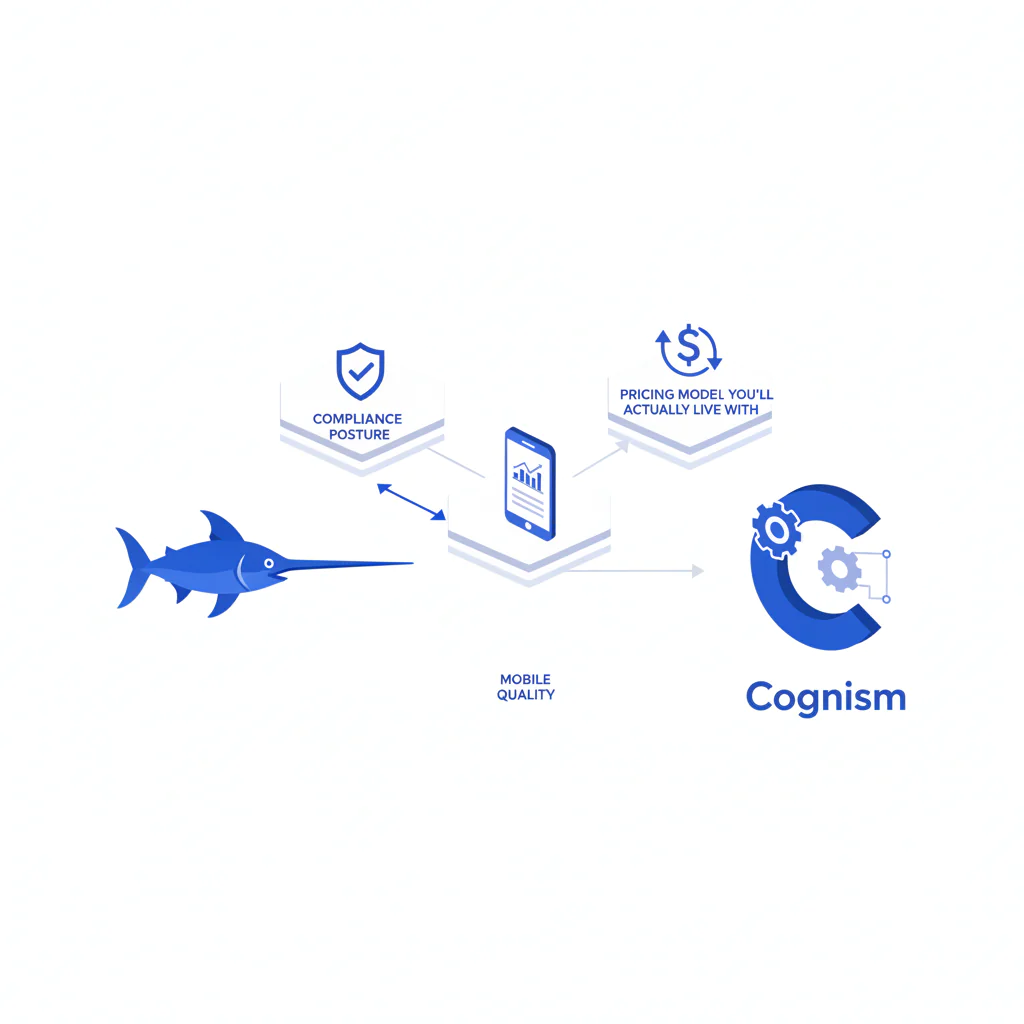
Swordfish vs Cognism: compliance posture, mobile quality, and the pricing model you’ll actually live with
Byline: Ben Argeband, Founder & CEO of Swordfish.AI
Author note: Don’t evaluate contact data tools by record counts. Evaluate by connect rate and time-to-first-meeting. “Verified” should mean “recently reachable for your specific ICP and channel,” not “exists somewhere in a database.” Run a small, controlled test: same ICP, same messaging, same cadence, and measure connect rate, bounce rate, and opt-out handling.
Who this is for
Teams comparing vendors and trying to choose based on real outreach outcomes. If you’re the person who gets blamed when the CRM fills with stale numbers, compliance questions show up in procurement, or the “unlimited” plan turns into a usage audit, this is for you.
Quick verdict
- Core answer
- If you’re deciding on swordfish vs cognism, treat it as a trade between compliance posture, reachability (mobile/direct dials), and pricing model risk.
- Key stat
- No universal stat is honest here. Your variance will come from seat count, API usage, list quality (ICP fit), industry, and region mix (EU/UK vs US). Measure connect rate and opt-out handling on your own sample.
- Ideal user
- Operators who want compliant data controls, predictable spend, and a test plan that exposes data decay before it hits pipeline.
Fit in one line: Pick Swordfish if your constraint is predictable usage economics and compliance-aware workflows; pick Cognism if your constraint is internal standardization on an existing stack and you can validate reachability on your own ICP. If you can’t run a pilot, you’re guessing.
What Swordfish does differently
Most “vs” pages pretend the only difference is who has more records. That’s not what breaks your program. What breaks it is data decay, compliance ambiguity, and integration friction that turns “we bought a tool” into “we hired a part-time data janitor.”
Prioritized direct dials and mobile numbers: You care about whether the number reaches the right person, not whether a vendor can claim a bigger database. Swordfish is designed around reachability outcomes, with emphasis on mobile numbers and direct dials for outbound. Expect variance by industry and region; EU-heavy lists and regulated industries tend to surface gaps faster.
Unlimited claims that survive automation: Verify what “fair use” means for exports, enrichment, and API calls, because that’s where “unlimited” usually gets redefined after you integrate. If you can’t get a straight answer in writing, assume you’ll be renegotiating mid-year.
Compliance filters tied to operational outcomes: Compliance isn’t a checkbox; it’s a constraint that changes your reachable market and your operational risk. Swordfish is built to support compliance-aware workflows (including opt-out handling and filtering) so your team spends less time in procurement loops and less time patching suppression lists after the fact.
Prospector context: If you want to see how this behaves in a real workflow, Prospector’s compliance filters are meant to reduce downstream risk (complaints, opt-outs, internal policy violations) while keeping list building usable for outbound. Validate this in your own CRM sync, because that’s where “compliant” often falls apart.
A B2B contact database that doesn’t improve connect rate just shifts cost into rep time and CRM cleanup.
Decision guide
Use this framework to avoid buying the wrong thing for the wrong reason: Compliance-first vs cost-first vs quality-first. Pick your primary constraint, then test the failure mode that will waste the most time.
Compliance-first: Choose this if you sell into EU/UK, regulated industries, or you’ve already had complaints escalate. Your success metric is fewer compliance escalations and fewer manual suppression workflows. If you’re evaluating Cognism GDPR readiness, ask for written documentation on sourcing, opt-out handling, and how suppression propagates across exports and integrations, because that reduces procurement back-and-forth.
Quality-first: Choose this if your reps are already doing enough activity and the bottleneck is “wrong numbers / wrong people.” Your success metric is connect rate and wrong-party rate. The trade is that quality varies by segment; you need a segmented pilot (industry + region + seniority) to avoid buying a tool that only performs on easy lists.
Cost-first: Choose this if budget is fixed and you need predictable spend. Your success metric is total cost per meeting, including ops time. The trade is that “cheap” data becomes expensive when you factor in rep time, enrichment rework, and CRM cleanup.
Procurement questions that prevent surprises:
- Fair use: What triggers plan changes?
- Automation: How is API/enrichment usage measured and throttled?
- Opt-out compliance: How does opt-out suppression propagate across exports and CRM sync?
Variance explanation: if your team has high seat count, heavy API usage, or aggressive enrichment cadence, pricing and fair use terms matter more than the sticker price. If your list quality is poor (bad ICP, outdated accounts), every vendor looks worse and you’ll misattribute the failure to the tool.
How to test with your own list (7 steps)
- Freeze the ICP: pick one segment (industry + region + seniority) and don’t change it mid-test.
- Build a holdout list: use the same accounts/people across vendors so you’re comparing data, not targeting.
- Define “verified” for your team: reachable within the last X days for your channel, with a clear wrong-party definition.
- Run the same outreach: same messaging, same cadence, same rep mix, same time window.
- Track outcomes that cost money: connect rate, wrong-party rate, bounce rate (email), opt-out rate, and time-to-first-meeting.
- Test integration friction: map fields, set dedupe rules, and verify suppression/opt-out enforcement across CRM sync and exports.
- Model real usage: seats + exports + enrichment volume + API calls, then confirm what triggers plan changes or throttling.
Document results by segment (region, industry, seniority) so you can explain variance to procurement and leadership without hand-waving.
Checklist: Feature Gap Table
| Area | What buyers assume | Where hidden costs show up | How to test it (connect-rate focused) |
|---|---|---|---|
| Compliance posture (GDPR compliance, opt-out compliance) | “Both are compliant.” | Procurement asks for documentation, opt-out workflows, and data sourcing clarity; sales ops builds manual suppression processes when exports and CRM sync don’t match. | Request written compliance documentation, opt-out handling process, and suppression propagation across exports and integrations; run a pilot with EU/UK-heavy accounts and track complaint/opt-out rates by source. |
| Suppression propagation & audit trail | “Opt-outs are handled automatically.” | Suppression breaks across exports, sequences, and CRM sync; you end up with inconsistent do-not-contact enforcement and internal blame-shifting. | Submit opt-out requests during the pilot and verify suppression in every workflow you use: export, CRM sync, and rep access; confirm what gets logged and who can audit it. |
| Mobile number accuracy | “Mobile is mobile.” | Reps burn time dialing wrong numbers; connect rate drops; managers blame messaging instead of data. | Take a fixed ICP list, sample across regions, and measure: connect rate, wrong-party rate, and time-to-first-connect per rep. |
| Direct dial data coverage | “Direct dials are included.” | Coverage varies by industry and seniority; you pay for seats but still route through switchboards. | Test by persona level (IC, manager, VP) and industry; measure “reached target person” rate, not “call answered.” |
| Pricing model comparison | “Unlimited means predictable.” | Fair use thresholds, API limits, enrichment volume caps, or add-ons appear after integration. | Model your real usage: seats, searches, exports, enrichment, and API calls; ask what triggers plan changes and how overages are handled. |
| Integration & workflow | “It connects to our CRM.” | Field mapping, dedupe rules, and refresh cadence become ongoing work; bad merges create suppression gaps and attribution disputes. | Run a sandbox integration: map fields, define dedupe logic, verify suppression enforcement, and test refresh; measure time spent per 1,000 records to keep CRM clean. |
| “Verified” definition | “Verified means accurate.” | Verification can mean “seen before,” not “reachable now,” which inflates confidence and depresses pipeline. | Define “verified” as “reachable within last X days for this channel”; require the vendor to explain what their verification label means operationally. |
Decision Tree: Weighted Checklist
- Compliance posture (highest weight if EU/UK or regulated): You need documented GDPR compliance expectations, opt-out handling, and suppression that survives exports and CRM sync. This reduces procurement delays and lowers complaint-driven interruptions.
- Reachability quality (highest weight if outbound is the main channel): Prioritize mobile number accuracy and direct dials by persona and region. This reduces rep time wasted per connect and improves meetings per 1,000 records.
- Pricing model risk (highest weight if you automate): Stress-test the pricing model against seats, exports, enrichment, and API calls. This reduces renewal surprises and mid-year plan changes.
- Integration overhead (highest weight if CRM hygiene is fragile): Confirm field mapping, dedupe rules, refresh cadence, and suppression enforcement. This reduces data decay inside your CRM and prevents duplicates that break reporting and compliance workflows.
- Operational controls (highest weight if multiple teams touch data): Role-based access, logging, and consistent opt-out enforcement reduce internal policy violations and “who changed this record” disputes.
Troubleshooting Table: Conditional Decision Tree
- If your outreach includes EU/UK contacts, then start with compliance posture and opt-out workflow documentation before you compare coverage. Stop condition: if the vendor cannot clearly explain compliant data sourcing and opt-out enforcement, stop the evaluation.
- If your reps complain about wrong numbers or switchboards, then run a segmented pilot focused on mobile/direct dials by persona level. Stop condition: if connect rate does not improve on your ICP sample, stop and re-check list quality before blaming the vendor.
- If you plan to enrich via CRM or API, then model usage (seats + API calls + refresh cadence) against the pricing model. Stop condition: if “unlimited” becomes conditional under normal automation, stop and renegotiate terms before rollout.
- If your CRM already has duplicates or inconsistent suppression, then treat integration as a first-class test. Stop condition: if you cannot enforce dedupe and opt-out suppression across sync and exports, stop rollout until the workflow is fixed.
- If procurement is sensitive to risk, then require a written variance explanation: what changes by region, industry, and seniority. Stop condition: if the vendor only offers generic claims and won’t define “verified,” stop.
Limitations and edge cases
No vendor wins every segment: Mobile and direct dial coverage can vary sharply by industry, seniority, and geography. A tool that looks strong in US tech can look weaker in EU manufacturing.
Compliant data still requires process: Even with compliant data controls, your internal workflow matters. If your CRM allows uncontrolled imports, you can reintroduce risk through other sources and then blame the vendor.
Data decay is not optional: If you don’t refresh, your CRM becomes stale. If you refresh too aggressively without dedupe rules, you create duplicates and suppression gaps. Either way, the cost shows up as rep time and compliance noise.
API usage changes the economics: Many teams buy a tool for reps and later add enrichment. That’s where “predictable pricing” often breaks. Decide upfront whether this is a rep tool, a data pipeline, or both.
Evidence and trust notes
Disclosure: I run Swordfish. This page is written from an operator/auditor perspective because that’s how these tools get bought: someone has to defend the spend, the compliance posture, and the operational impact. The evaluation method above is designed to be vendor-agnostic so you can reproduce it with any provider.
I will not invent metrics. Your outcomes will vary based on seat count, API usage, list quality, industry, and region mix. If you want a defensible evaluation, run a pilot that measures connect rate, wrong-party rate, bounce rate (for email), opt-out handling, and time spent cleaning CRM records.
Related reading for deeper due diligence:
FAQs
-
Is Cognism GDPR compliant?
“Cognism GDPR” is a common procurement question, but the practical issue is whether the vendor can document sourcing, lawful basis approach, and opt-out enforcement in a way your legal team accepts. Ask for documentation and test opt-out handling in a pilot, especially for EU/UK lists.
-
What does compliant data mean in practice?
It means you can explain where the data came from, how opt-outs are handled, and how suppression is enforced across exports, CRM sync, and rep workflows. If suppression breaks in one workflow, your risk returns.
-
How should I compare mobile number accuracy and direct dial data?
Don’t compare claims. Compare outcomes: connect rate, wrong-party rate, and “reached target person” rate on a segmented ICP sample (region + industry + seniority). That’s the only comparison that survives scrutiny.
-
Is unlimited credits actually unlimited?
Sometimes it’s unlimited under fair use, sometimes it’s unlimited for one workflow but constrained for API/enrichment. The cost risk shows up when you automate. Ask what triggers plan changes and how usage is measured.
-
Why not just buy the biggest B2B contact database?
Because record count doesn’t predict reachability for your ICP. A smaller set of reachable, compliant contacts can produce more meetings than a larger set of stale records that burn rep time and create opt-out mess.
Next steps
Timeline:
- Day 1–2: Define ICP segments (industry, region, seniority) and success metrics (connect rate, wrong-party rate, opt-out handling, time-to-first-meeting).
- Day 3–5: Run a controlled pilot with the same list and the same outreach process. Track outcomes by segment.
- Week 2: Review integration overhead (field mapping, dedupe, suppression enforcement, refresh cadence) and model pricing against seats + API usage + enrichment volume.
- Week 3: Make the call using meetings per 1,000 records and operational risk, not database size.
If you want to evaluate Swordfish in the workflow that usually exposes problems (list building + compliance filters + repeatable enrichment), start with Prospector’s compliance filters and run the pilot above.
About the Author
Ben Argeband is the Founder and CEO of Swordfish.ai and Heartbeat.ai. With deep expertise in data and SaaS, he has built two successful platforms trusted by over 50,000 sales and recruitment professionals. Ben’s mission is to help teams find direct contact information for hard-to-reach professionals and decision-makers, providing the shortest route to their next win. Connect with Ben on LinkedIn.