
 View Products


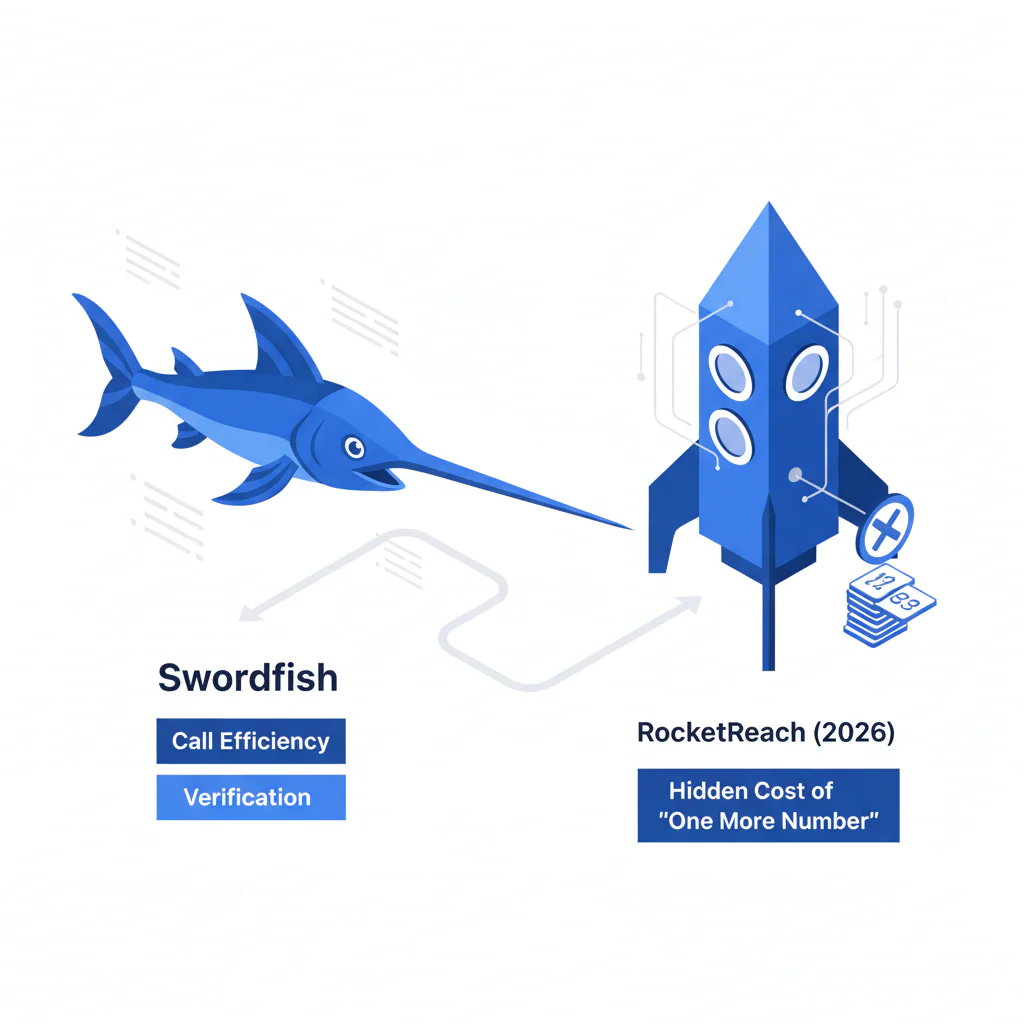
Swordfish vs RocketReach (2026): Call efficiency, verification, and the hidden cost of “one more number”
Byline: Ben Argeband, Founder & CEO of Swordfish.AI
Author note: This category gets mislabeled. Some tools behave like workflow capture layers; others behave like contact data tools. If you don’t separate those, you pay twice: once for the UI, and again for the missing verification, ranking, and pricing model that actually determines connect rate.
Who this is for
Sales teams evaluating LeadIQ-style workflows vs deeper phone reachability needs. If your reps live in a dialer and you measure outcomes in connects and meetings (not “contacts exported”), this comparison is about the part that quietly burns budget: data decay, retries, and integrations that strip context.
Quick verdict
- Core answer
- swordfish vs rocketreach is a choice between a workflow designed to reduce retries (ranked mobile numbers and prioritized direct dials, plus verification signals) versus a more traditional contact database approach where you may spend more rep-hours and budget chasing a working line.
- Key stat
- Call efficiency = connects per 100 dials (and the rep-hours required to get them). Expect variance by seat count, API usage, list quality, and industry.
- Ideal user
- Swordfish fits teams that call a lot and need predictable spend when the first number fails. RocketReach fits teams that want broad coverage and can tolerate more manual cleanup and retry overhead.
Choose Swordfish if your reps routinely hit the “second number” time sink (time spent sourcing an alternate number after the first fails) and you want the tool to tell them what to dial first. Choose RocketReach if calling is secondary and you mainly need a contact database for general coverage. Don’t buy either if neither improves connects per 100 dials on your own list in a controlled test.
What Swordfish does differently
Most buyers compare “how many contacts” and ignore the operational tax: what happens after the first number fails. That’s where budgets leak and reps start doing detective work instead of selling.
1) Ranked phone outputs to reduce wasted attempts. Swordfish focuses on prioritized direct dials and ranked mobile numbers so reps don’t guess which line is most reachable. Using ranked numbers improves call efficiency because reps start with the most likely-to-answer option, which reduces retries and lowers cost per connect.
2) Verification that changes dialing behavior. “Contact verification” only matters if it changes what the rep does next. Swordfish is designed to surface higher-confidence numbers first so the rep spends less time on the “second number” time sink.
3) True unlimited + fair use (pricing model that matches calling reality). Calling is iterative. If your team needs multiple attempts per prospect, a pricing model that punishes retries turns normal selling into spend variance. Swordfish’s unlimited contact credits approach is built around fair use so responsible retry behavior doesn’t become a procurement problem.
4) When you need a database alternative, not another layer. If your current stack captures leads but your bottleneck is reachability, Prospector is the option to test when you need fewer retries and less rep time spent hunting numbers.
Where RocketReach can still fit. If your motion is mostly email, calling is occasional, and you can accept more manual retries when numbers fail, RocketReach can be sufficient as a contact database. The cost shows up later as rep-hours and inconsistent connect rate, not as a missing feature on a comparison chart.
Checklist: Feature Gap Table
| Buying criterion (what breaks in production) | Swordfish (what to verify in a trial) | RocketReach (what to verify in a trial) | Hidden cost if you ignore it |
|---|---|---|---|
| Call efficiency (connects per 100 dials) | Test whether ranked mobile/direct dials reduce “dial-and-fail” sequences on your ICP list | Test how often reps need alternates after the first number fails | Rep-hours lost to retries; meeting volume drops even if “contacts found” looks high |
| Contact verification behavior | Confirm verification signals are visible at dial time and influence which number reps try first | Confirm what “verified” means operationally and how often it still fails in your segment | False confidence increases dials with low answer rate; managers misdiagnose rep performance |
| Pricing model sensitivity to retries | Validate “true unlimited + fair use” boundaries for your seat count and usage pattern | Validate how limits behave when reps need multiple attempts per prospect | Budget variance spikes when list quality drops or when you expand into harder industries |
| Mobile reachability vs generic phone coverage | Confirm mobile numbers are present and prioritized where mobile is the real path to answers | Confirm mobile availability and whether it’s consistent across titles/industries | Teams “have numbers” but can’t reach decision-makers; pipeline math becomes fiction |
| Integration integrity (CRM + dialer) | Confirm CRM writeback preserves number type (mobile/direct), rank, and verification recency | Confirm the same, plus whether field overwrite and dedupe rules create collisions | Data decay accelerates when reps work around the system; admins spend cycles deduping |
| Re-checking stale records (data decay) | Confirm how quickly you can re-check a stale record without turning it into a budget event | Confirm whether re-checking consumes limited resources or creates throttling | Stale numbers inflate dial volume; answer rate drops; leadership blames messaging instead of data |
Decision guide
Decide on variance, not screenshots. The question is what happens to cost per connect when list quality drops, when you add seats, or when you expand into an industry with lower answer rate.
Framework to use: the “second number” time sink. The moment a rep says “that number’s dead” and starts searching is where tools get expensive. You pay in rep-hours, and you pay again when your pricing model penalizes retries.
How to test with your own list (5–8 steps)
- Pick one ICP slice. Use a single segment (same industry, seniority band, and geography) so you’re not mixing variance sources.
- Pull a fixed list sample. Use the same prospects for both tools. Don’t let either vendor “help” by swapping in a cleaner list.
- Define outcomes before you start. Track connects per 100 dials, answer rate, and time-to-first-connect per rep-hour.
- Log the “second number” events. For each prospect, record whether the rep needed an alternate number and how long it took to find it.
- Run the same dialer workflow. Same caller ID setup, same call windows, same cadence. Otherwise you’re testing process, not data.
- Classify failures. Track “wrong number” vs “disconnected” vs “no answer” so you don’t confuse bad data with bad timing.
- Audit CRM writeback. Check whether number type (mobile/direct), rank, and verification context survive the sync, and whether duplicates were created.
- Stress the pricing model. Re-check a subset of stale records and observe whether the model discourages normal retry behavior as seats and usage increase.
Decision Tree: Weighted Checklist
- Highest weight: Pricing model variance under retries. Calling requires retries. If the model penalizes re-checks and second attempts, cost per connect rises when list quality declines or when you add seats.
- Highest weight: Mobile reachability and prioritized direct dials. If your decision-makers answer mobile more than desk lines, ranked mobile numbers reduce wasted attempts and improve call efficiency.
- High weight: Contact verification that changes workflow. Verification must be visible at dial time and tied to which number is attempted first, or it’s just a label.
- Medium weight: Data decay handling. Numbers rot. If refresh/re-check is slow, limited, or expensive, your database degrades and answer rate falls over time.
- Medium weight: Integration integrity (CRM + dialer). If enrichment overwrites fields, drops rank/verification context, or creates duplicates, reps stop trusting the system and go off-book.
- Lower weight (unless you’re ops-heavy): Governance and admin controls. Important at scale, but it won’t rescue a low connect rate caused by stale or unranked numbers.
Troubleshooting Table: Conditional Decision Tree
- If reps frequently say “the first number is wrong” and spend time hunting alternates, then prioritize Swordfish for ranked mobile numbers, prioritized direct dials, and verification-driven dialing to improve call efficiency.
- If your budget swings because retries and re-checks consume limited resources, then prioritize a pricing model designed for iterative calling (true unlimited + fair use) and validate boundaries based on seat count and API usage.
- If calling is occasional and you mainly need broad contact coverage, then RocketReach may be sufficient if your team accepts more manual cleanup when numbers fail.
- If your CRM ends up with duplicated contacts or overwritten phone fields after enrichment, then pause rollout until you can preserve number type, rank, and verification context end-to-end.
- Stop condition: If neither tool improves connects per 100 dials on the same list in the same dialer workflow, stop the purchase and fix upstream list quality and segmentation first.
Limitations and edge cases
Industry variance is real. Phone number accuracy and answer rate vary by industry, seniority, and geography. A tool can look worse simply because your segment is harder to reach. Compare on your own list.
Seat count changes the economics. More seats means more retries and more re-check pressure. Validate how the pricing model behaves as usage scales, not just how it looks for one pilot pod.
API usage can create surprise work. If you plan to enrich via API, confirm rate limits, field mapping, and whether rank/verification context is returned. Integration headaches usually show up as engineering time, not vendor line items.
Workflow layer vs data layer mismatch. If you buy a workflow layer when you needed reachability, you’ll stack vendors. That can be fine, but it’s a cost decision you should make on purpose.
Evidence and trust notes
I build Swordfish, so treat this like a vendor-authored audit memo. The only honest way to evaluate is to force both tools through the same constraints and measure outcomes.
What to demand in a trial: export a CSV of the same prospects from each tool, run them through the same dialer workflow, log outcomes (connect rate and answer rate), and audit your CRM for duplicates and overwritten fields after writeback.
Verification in exports (what to look for): ask each vendor to show number type (mobile/direct), rank or priority, and a verification recency field (for example, a timestamp or “last verified” indicator). Also ask them to define what triggers “verified” in their system, because vendors use the same word for different checks.
Falsification rule: if ranking and verification don’t reduce “second number” events on your list, treat the feature as non-functional and stop the purchase.
Why you’ll see variance: seat count, API usage, list quality, and industry. If a vendor claims a universal accuracy number without those qualifiers, it’s not procurement-grade evidence.
For background on why this fails in production, see data quality and the broader category overview of contact data tools.
FAQs
Is this just “swordfish vs rocketreach” on features?
No. Features don’t pay for themselves. Decide on call efficiency and how the pricing model behaves when reps need retries.
How do I evaluate phone number accuracy without vendor metrics?
Run a controlled trial and measure connect rate and answer rate on your own list. If accuracy doesn’t translate into answers, it doesn’t help pipeline.
What should I ask about the RocketReach pricing model?
Ask what happens when a rep needs multiple attempts per prospect, how re-checking stale records works, and how costs behave as seat count and API usage increase.
What’s the practical difference between direct dials and mobile numbers?
In many segments, mobile reachability drives answers. If the tool doesn’t prioritize the most reachable line, reps waste attempts and cost per connect rises.
Where can I read more about RocketReach before deciding?
Read RocketReach review for operational pros/cons and RocketReach pricing for procurement questions that affect spend variance.
Next steps
Timeline (7–10 business days):
- Day 1–2: Define success metrics: connects per 100 dials, answer rate, and time lost to the “second number” time sink.
- Day 3–5: Run the controlled test on the same ICP list with the same dialer workflow. Log retries and classify failures.
- Day 6–7: Review pricing model variance: seat count assumptions, API usage plans, re-check behavior, and fair use boundaries.
- Day 8–10: Implement a pilot: finalize CRM field mapping so number type, rank, and verification context survive, then roll out to one pod before scaling.
If your priority is higher call efficiency through ranked mobile numbers, verification-driven dialing, and predictable spend under retries, run Prospector through the same test plan above and keep the winner.
About the Author
Ben Argeband is the Founder and CEO of Swordfish.ai and Heartbeat.ai. With deep expertise in data and SaaS, he has built two successful platforms trusted by over 50,000 sales and recruitment professionals. Ben’s mission is to help teams find direct contact information for hard-to-reach professionals and decision-makers, providing the shortest route to their next win. Connect with Ben on LinkedIn.