
 View Products


- Core concept
- When evaluating avature alternatives, treat the ATS as the compliance and workflow backbone, then design separate layers for sourcing and candidate reachability so placement speed doesn’t depend on ATS configuration alone.
- Key metric to track
- Track median time-to-first-response and the percent of prospects reached on the first attempt; these two metrics usually explain outreach performance more than ATS features.
- Ideal candidate profile
- Enterprise TA leaders and TA Ops teams evaluating an enterprise ATS replacement who need strong configurability, clean compliance controls, and a practical plan for hard-to-reach roles, passive candidates, and silver medalists.
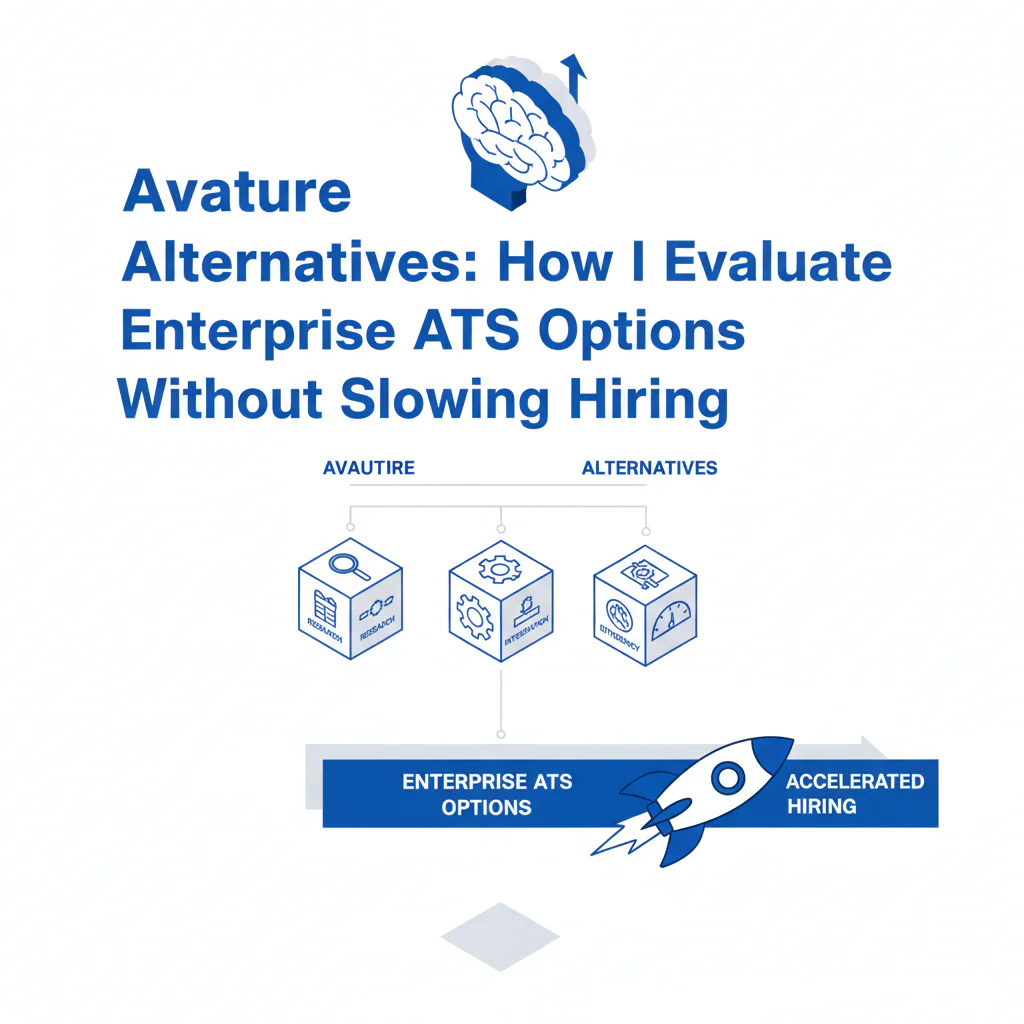
Avature Alternatives: How I Evaluate Enterprise ATS Options Without Slowing Hiring
Byline: Ben Argeband, Founder & CEO of Swordfish.AI
Author note: Written with enterprise TA leadership operators; focused on placement speed, candidate experience, and compliance.
Avature is commonly selected when teams need a highly configurable system to match complex enterprise workflows. The tradeoff is that heavy configuration can increase change-management overhead, which shows up as slower process updates and recruiter workarounds.
If you’re comparing Avature alternatives, separate two decisions: your enterprise ATS choice (workflow, compliance, reporting) and your sourcing/reachability stack (pipeline creation and speed to contact). This prevents teams from switching ATS expecting reply rates to improve, then finding the bottleneck was reachability and follow-up speed.
Who this is for
This is for enterprise TA leaders evaluating Avature alternatives who want the right ATS backbone and a clear plan for sourcing + reachability. It also applies when you manage agency recruiting and need consistent process controls across internal and external recruiters.
What recruiters are trying to accomplish
At enterprise scale, the ATS is where you prove compliance and run repeatable workflow. The outcomes I hold teams to are placement speed, candidate experience, and audit readiness.
- Placement speed: reduce time from “prospect identified” to “first conversation,” then reduce time from “qualified” to “scheduled.”
- Candidate experience: fewer duplicate outreaches, clear expectations on comp/location, and fast follow-up after replies.
- Compliance: consistent consent/opt-out handling, retention rules, and role-based access that stands up to audits.
Most enterprise ATS platforms can support these outcomes if configured well. The difference is how quickly you can adapt workflows without breaking reporting or creating shadow processes.
Enterprise ATS choice (Decision Heuristic)
My decision heuristic for enterprise ATS choice is simple: pick the ATS that best supports your required workflow and compliance controls, then integrate the rest of the recruiting tech stack around it. This keeps the ATS stable while you improve sourcing throughput and response rates through tools designed for that job.
Run demos with TA Ops, HRIS, and InfoSec in the room so you don’t select a platform that later stalls in security review or integration scoping.
Examples of commonly evaluated platforms alongside Avature are below. This is not a ranking; validate fit against your workflow and integration requirements.
| Platform | Often considered when you need |
|---|---|
| Workday Recruiting | HRIS-aligned governance and standardized enterprise reporting |
| SAP SuccessFactors Recruiting | Global enterprise controls and HR suite alignment |
| Oracle Recruiting (HCM) | HCM suite integration and centralized process management |
| iCIMS | Enterprise ATS with broad ecosystem integrations |
| Greenhouse | Structured hiring workflows and recruiter usability focus |
| SmartRecruiters | Enterprise hiring manager experience and marketplace integrations |
| Lever | ATS + CRM-style workflows for teams that want one interface |
Ethical use of phone numbers
Phone outreach can improve candidate experience when it’s used to reduce back-and-forth and speed up scheduling. It becomes a risk when it’s used as a volume tactic without consent and controls.
- Consent and opt-out: capture channel preferences where you track candidates and honor opt-outs immediately across all tools.
- Use-case boundaries: prioritize phone for time-sensitive scheduling, re-engaging silver medalists, and roles where email response is consistently slow.
- Data minimization: collect only what you need to recruit and apply retention rules aligned to your policy and legal requirements.
- Access controls: restrict exports, log access, and review who can see contact data.
If your legal or privacy team requires it, document the outreach policy and train recruiters on what “stop” looks like in practice: one clear opt-out path, immediate suppression, and no re-importing lists outside governance.
Sourcing workflow
When comparing enterprise ATS alternatives, map the workflow end-to-end and decide which system owns each step. This reduces cycle time because recruiters stop switching between tools to do basic work, and TA Ops can enforce consistent stages and reporting.
A configurable ATS reduces recruiter workarounds, which reduces time from reply to scheduled because recruiters can move candidates and trigger scheduling steps without side processes.
Operating model (what belongs where):
- ATS (system of record): requisitions, stages, compliance fields, interview plans, offers, reporting.
- Recruiting CRM enterprise layer (optional): talent pools, nurture, event leads, rediscovery of silver medalists.
- Sourcing tools: search, list building, and pipeline creation for passive candidates.
- Contact data layer: verified email/phone to reduce time-to-contact and reduce wasted outreach attempts.
Operationally, I run a 48-hour pipeline loop: source, enrich, outreach, and schedule. The business outcome is fewer stalled reqs because recruiters spend less time chasing unreachable profiles and more time booking screens.
If you’re standardizing your stack, start with recruiter sourcing tools to align on what sourcing should do versus what the ATS should do.
Checklist: Diagnostic Table
| Symptom | Likely root cause | What to check (fast) | Fix that improves placement speed |
|---|---|---|---|
| Low reply rates from passive candidates | Reachability gaps (wrong/old contact data) | Sample 25 prospects: % bounced emails, % wrong numbers, median time-to-first-contact | Add/upgrade contact data layer; enforce “verify before outreach” step |
| High opens, low replies | Message relevance is weak | Audit 10 messages: role fit, location/remote, comp band/level, clear ask | Standardize role-specific templates; require one clear CTA |
| Recruiters blame the ATS for slow outreach | Too many required fields early or over-configured steps | Time “new prospect to first outreach”; count clicks and mandatory fields | Move non-essential fields later; automate field population via integrations |
| Duplicate outreach to the same person | No identity resolution across ATS/CRM/sourcing tools | Review match rules; check duplicates created in last 30 days | Implement dedupe rules; enforce one owner per prospect |
| Slow scheduling after a positive reply | Handoff friction and calendar latency | Median time from “reply” to “scheduled” by recruiter/team | Use scheduling links + defined SLA; route hot replies to coordinators |
| Compliance concerns block outreach | Unclear policy on phone/email usage and retention | Do you have documented consent/opt-out handling and retention rules? | Publish usage policy; centralize opt-outs; restrict exports and log access |
Decision Tree: Weighted Checklist
How to use this: treat “High” as must-pass, “Medium” as tradeoffs you can manage, and “Low” as nice-to-have. The weights reflect standard enterprise failure points: audit risk, change-management overhead, and integration brittleness.
| Criterion (what to validate) | Weight | Why it’s weighted this way | How to test in a demo/pilot |
|---|---|---|---|
| Configurability of workflows (stages, approvals, global variance) | High | Workflow misfit creates workarounds that slow hiring and break reporting | Run 3 real req types end-to-end; measure clicks and exceptions |
| Compliance controls (permissions, retention, audit logs) | High | Audit gaps create risk and force process freezes during reviews | Review role-based access, export logging, and retention settings |
| Integration depth (HRIS, background checks, scheduling, BI) | High | Brittle integrations create manual work that increases time-to-fill | Confirm native connectors vs custom work; validate data sync frequency |
| Reporting and data model clarity | High | If definitions vary by team/region, leadership metrics become untrusted | Recreate your exec dashboard; validate source-of-truth fields |
| Recruiter usability for core actions (submit, move stage, schedule) | Medium | Usability affects throughput, but can be improved with training and automation | Time common tasks with real recruiters; compare median completion time |
| CRM/talent pooling capabilities | Medium | Helps with nurture and silver medalists, but can be handled by a separate CRM | Test rediscovery and campaign workflows; validate dedupe behavior |
| Vendor implementation and change-management support | Medium | Slow implementations delay adoption and create inconsistent process use | Ask for a phased plan, resourcing model, and reference calls |
| Built-in sourcing/reachability features | Low | ATS is not where most teams win on response rates; integrate specialized tools | Validate integrations and governance instead of relying on native features |
Outreach templates
These templates are designed to reduce time-to-first-response while protecting candidate experience. They work best when you log outcomes back to your ATS/CRM so teams don’t duplicate outreach and candidates don’t get mixed messages.
Troubleshooting Table: Outreach Templates
Template 1: Passive candidate (email)
Subject: Quick question about your [skill] work
Hi [First Name] — I’m hiring for a [Role Title] on [Team] at [Company]. Your background in [specific skill/project] looks aligned.
Two details upfront: [location/remote policy] and [comp range or level].
Are you open to a 10-minute call this week to see if it’s worth a full conversation? If not, reply “no” and I won’t follow up again.
— [Name], Talent Acquisition
Template 2: Hard-to-reach role (SMS)
Hi [First Name] — [Name] from [Company]. Hiring a [Role Title] ([location/remote]). If I send 3 bullets + comp range, will you tell me if it’s worth a quick call? Reply Y/N. Reply STOP to opt out.
Template 3: Silver medalist re-engagement (email)
Subject: New role aligned to what you wanted
Hi [First Name] — we spoke previously about [prior role/process]. A new [Role Title] opened on [Team]. It matches what you said you wanted: [1–2 specifics].
If you’re open, I can fast-track a conversation this week. If not, reply “pass” and I’ll close the loop.
— [Name]
Template 4: Agency recruiting coordination (email to candidate)
Subject: Confirming your point of contact at [Company]
Hi [First Name] — I’m [Name] at [Company]. I see you may be speaking with [Agency/Recruiter Name]. To avoid duplicate outreach and protect your experience, can you confirm if you want to continue through them or directly with our internal team?
Reply “agency” or “direct” and I’ll route you accordingly.
— [Name]
Evidence and trust notes
ATS vs contact data: An ATS is designed to manage workflow, compliance, and reporting. It is separate from a contact data layer. If your evaluation assumes the ATS will materially improve outreach response rates, you’ll still miss response-time targets for hard-to-reach roles.
Why this affects candidate experience: When recruiters can’t reach candidates, they compensate by increasing volume, which increases duplicate outreach and inconsistent follow-up. Verified reachability reduces wasted attempts and shortens time-to-first-conversation.
What to validate in your contact data layer: accuracy, suppression/opt-out handling, export controls, and whether it supports your reporting needs. If you’re standardizing definitions, start with recruiting contact data so stakeholders agree on what “reachable” means.
Where Swordfish.AI fits: If you keep Avature or choose an alternative, Swordfish.AI Prospector is designed to be the sourcing/reachability layer that feeds your ATS with verified contact data. See Prospector for how teams operationalize enrichment without expecting the ATS to do outreach work.
FAQs
What should I prioritize when comparing Avature alternatives?
Prioritize your enterprise ATS choice around configurability, compliance controls, reporting integrity, and integration depth. Those are expensive to fix later and directly affect audit readiness and throughput.
Will switching ATS improve reply rates from passive candidates?
Not by itself. Reply rates are usually driven by reachability, message relevance, and speed of follow-up. An ATS change can reduce internal friction, but it won’t fix bad contact data or slow response handling.
Is a recruiting CRM enterprise platform required?
Not always. If you run nurture campaigns, events, or frequent rediscovery of silver medalists, a CRM helps. If not, you can run lean with an ATS plus sourcing tools and a contact data layer.
How do I reduce duplicate outreach across teams and agencies?
Use identity resolution (dedupe rules), define ownership, and require logging of outreach outcomes. This protects candidate experience and reduces compliance exposure from uncontrolled exports.
Next steps
Week 1 (requirements): Document 3–5 req archetypes, compliance requirements, and your integration list. Identify where cycle time is lost today (prospect-to-first-outreach, reply-to-schedule).
Week 2 (vendor validation): Demo Avature alternatives using your req archetypes. Score vendors using the weighted checklist, focusing on configurability, compliance, reporting, and integrations.
Week 3 (stack design): Decide what sits outside the ATS: sourcing tools, CRM (if needed), and contact data layer. Define dedupe rules, ownership, and opt-out handling.
Week 4 (pilot): Pilot on two teams: one standard role and one hard-to-reach role. Track median time-to-first-response, percent reached on first attempt, and median time from reply to scheduled. Set a reply-handling SLA and measure adherence by recruiter/team.
Week 5+ (migration and rollout): Plan data migration and a short parallel run for reporting continuity. Roll out in phases by region or business unit, with HRIS, InfoSec, and Legal sign-off on permissions, exports, and retention.
About the Author
Ben Argeband is the Founder and CEO of Swordfish.ai and Heartbeat.ai. With deep expertise in data and SaaS, he has built two successful platforms trusted by over 50,000 sales and recruitment professionals. Ben’s mission is to help teams find direct contact information for hard-to-reach professionals and decision-makers, providing the shortest route to their next win. Connect with Ben on LinkedIn.