
 View Products


Last updated: September 3, 2026
Byline: Reviewed by Swordfish.ai Ops Editorial (Senior Buyer / Data Auditor) • Last updated Jan 2026
Who this is for
- SMB sales and recruiting teams buying contact tools who are tired of paying twice: subscription now, cleanup later.
- Revenue ops leaders who have to defend the price to quality tradeoff with evidence that survives budget review, including teams sourcing healthcare provider contacts where a wrong mobile number or bounced email costs more than the credit itself.
- Anyone integrating a contact tool into a CRM and trying to stop enrichment rules from overwriting correct data with stale data.
Quick Verdict
- Core Answer
- Lusha vs UpLead is less about feature checkboxes and more about whether your workflow controls verification, mobile reachability, and data decay well enough to keep cost per connect from drifting upward.
- Key Insight
- Cheaper records aren’t cheaper if they don’t connect; measure reachability and verification signals instead of optimizing for exported record count.
- Ideal User
- If bounces and deliverability are hurting you, enforce strict verification gates. If wrong numbers and no-connect dials are hurting you, audit mobile quality before scaling either vendor.
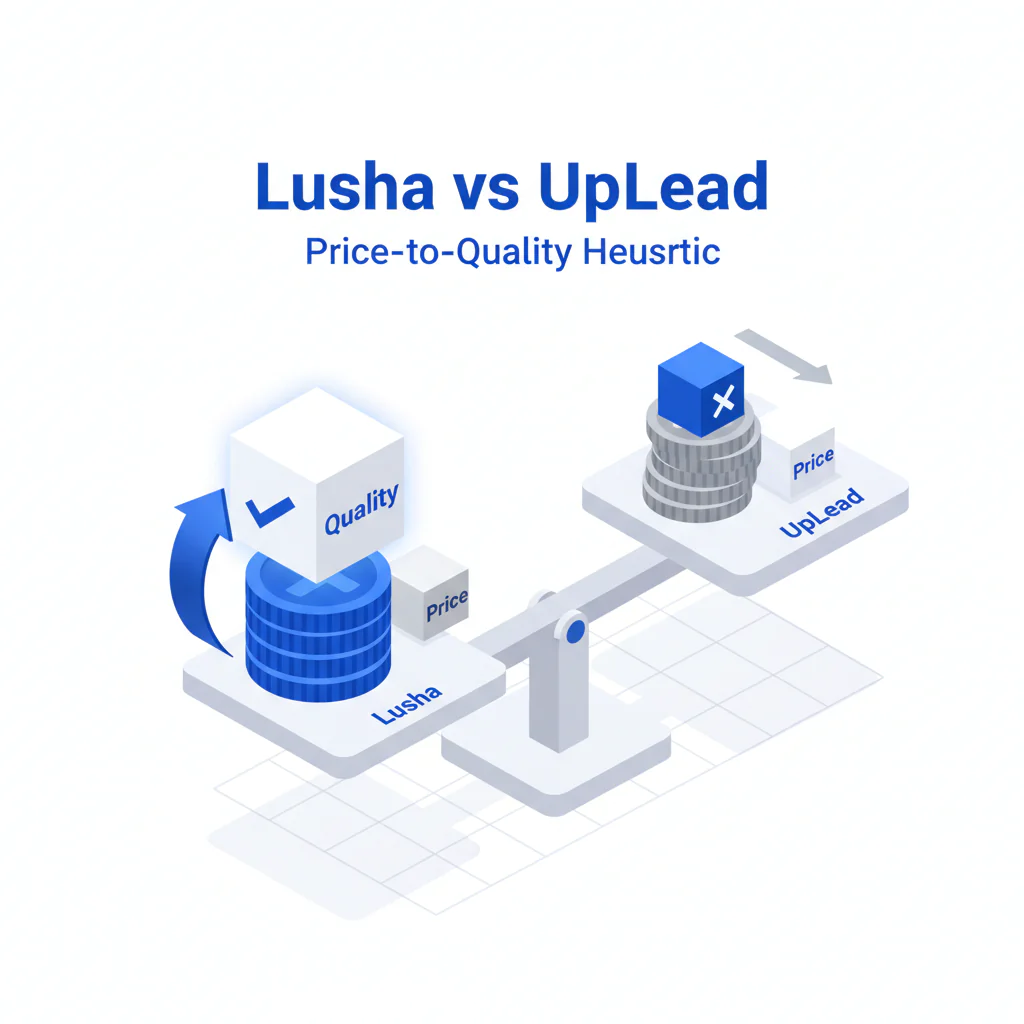
Price‑to‑quality heuristic (framework)
This page uses the Price-to-quality heuristic because contact data spend rarely fails at the invoice. It fails at the rep level: credits get consumed on partial records, reps burn time on dead ends, and CRM data gets dirtier after “automation.” That pattern is amplified in healthcare outreach, where provider mobility, credential changes, and practice mergers make records decay faster than in most B2B verticals.
- Cost per record is what procurement sees.
- Cost per connect is what the business pays after retries, wrong targets, and time spent validating bad inputs.
- Verification (email deliverability signals) and mobile quality (direct dials that reach the correct person) must be tested separately.
What breaks after you sign (hidden costs)
- Data decay: job changes, reassigned numbers, and alias emails create rework and stale pipeline — a known problem in healthcare rosters where clinicians rotate between practices and health systems.
- Integration headaches: bad field mapping and enrichment conflicts can overwrite higher-confidence CRM fields.
- Process drift: when quotas hit, teams skip verification steps and then blame “data quality.”
Checklist: Feature Gap Table
This table is an audit list: the places where “contact data” turns into hidden labor. Treat both tools as untrusted inputs until your own list test says otherwise.
| Audit question (hidden cost) | Lusha (what to verify) | UpLead (what to verify) |
|---|---|---|
| When do credits get consumed? | Confirm what triggers credit usage and what counts as a “successful” pull in your workflow. | Confirm what triggers credit usage and whether verification steps occur before export. |
| What does “verification” actually cover? | Document whether verification signals are email-only and treat phone reachability as a separate test. | Common positioning emphasizes email verification; treat that as deliverability evidence, not direct-dial proof. |
| Is phone data usable for direct outreach? | Measure mobile quality by call outcomes: correct person reached vs wrong person vs dead line vs routed line. | Measure mobile quality the same way; “a phone field exists” is not a connect. |
| Will enrichment overwrite good CRM data? | Test conflict rules before enabling automated enrichment. | Test conflict rules before enabling automated enrichment. |
| How are disputes handled? | Decide how wrong-number and “left company” reports get suppressed so reps don’t recycle bad records. | Decide how wrong-number and “left company” reports get suppressed so reps don’t recycle bad records. |
Decision Tree: Weighted Checklist
Weights are directional (High/Medium/Low) and based on standard failure points in contact data procurement: bounces, wrong numbers, and CRM contamination. Use your own test results to score vendors; don’t invent certainty.
- High impact / Low effort: Require an email verification gate before export and enforce suppression for known bouncers.
- High impact / Medium effort: Audit mobile quality with call outcomes and log “wrong person” and “dead line” as separate failure buckets.
- High impact / Medium effort: Track cost per connect by vendor: credits consumed plus rep minutes per connect. This is the operational price to quality tradeoff.
- Medium impact / Low effort: Lock CRM field mapping and prevent overwrites unless a rule explicitly allows it.
- Medium impact / Medium effort: Run an exception queue (wrong number, left company, bounced) and feed it back into vendor evaluation.
These controls align with data quality practices: protect existing good records and prove incremental value before scaling volume.
How to test with your own list (5–8 steps)
- Build a benchmark list of contacts your team will actually pursue in the next 30 days.
- Define pass/fail outcomes before you pull data: verified email (deliverability), mobile direct dial (reachability), correct person reached.
- Run the same list through Lusha and UpLead and export results with timestamps.
- Send a controlled email batch and record bounces; keep volume low until you see failure rates stabilize.
- Call-test a fixed subset and log outcomes: direct-to-person, wrong person, dead line, routed line, voicemail.
- Compute cost per connect using credits consumed plus rep minutes. Compare vendors on this metric, not on exports.
- Retest a slice in 30 days to measure decay and decide refresh cadence.
Troubleshooting Table: Conditional Decision Tree
This includes a Stop Condition because the most expensive contract is the one you renew after ignoring your own test results.
- If email outcomes are acceptable but call outcomes are weak, then stop using “verified email” as a proxy for phone reachability and re-score vendors by mobile quality.
- If you can’t find enough contacts fast enough, then choose the faster capture workflow but keep verification and reachability audits before outreach.
- If bounces are harming deliverability, then stop scaling sends until verification and suppression controls are enforced.
- If neither tool clears your minimum connect-rate threshold in your niche, then Stop Condition: do not sign an annual commitment; run a third benchmark focused on prioritized dials.
What Swordfish does differently
- Ranked mobile numbers / prioritized dials: Swordfish prioritizes the numbers most likely to connect, so reps don’t waste cycles guessing which number is real.
- True unlimited / fair use: Swordfish is designed to reduce rationing behavior that shows up when teams fear burning credits on low-quality records.
For reachability-first benchmarks in this cluster, use Swordfish vs Lusha and Swordfish vs UpLead.
Evidence and trust notes
- Method: Procurement-style review using price-to-quality, verification, and reachability outcomes rather than marketing summaries.
- Variance explainer: Results change by industry, geography, title mix, and how strictly your team follows verification and suppression controls.
- Limits: Vendor databases change; this page avoids hard numeric claims unless you validate them in your own test.
- Freshness: Last updated Jan 2026.
Policy reference points: FTC CAN-SPAM compliance guide, UK ICO GDPR guidance, California AG CCPA overview.
FAQs
Which is cheaper?
The cheaper option on paper is the plan with a lower cost per credited record; the cheaper option in operations is the tool that produces more connects per hour after you account for bounces, wrong numbers, and rep time.
Which verifies better?
Verification depends on what you measure. Treat email verification as a deliverability signal; measure phone reachability separately using call outcomes.
Which is better for phone data?
Evaluate phone performance by mobile quality: whether numbers connect to the correct person with minimal wrong-number and dead-line outcomes.
How do I test?
Run both tools on the same benchmark list, define pass/fail criteria, record bounce outcomes for email, and call-test a controlled subset of mobiles to measure connect rate and cost per connect.
What’s an alternative?
If your priority is direct-dial reachability, benchmark a third option focused on prioritized dials and compare using the same cost-per-connect method.
Next steps (timeline)
- Today: Build the benchmark list and define pass/fail outcomes (verification, reachability, correct person reached).
- This week: Run the controlled email and call tests; compute cost per connect and log failure buckets.
- In 30 days: Retest a slice for decay and decide whether any annual commitment is justified.
When your main risk is paying for exports that don’t become conversations, start from the pillar workflow inside Compare to Swordfish.
About the Author
Ben Argeband is the Founder and CEO of Swordfish.ai and Heartbeat.ai. With deep expertise in data and SaaS, he has built two successful platforms trusted by over 50,000 sales and recruitment professionals. Ben’s mission is to help teams find direct contact information for hard-to-reach professionals and decision-makers, providing the shortest route to their next win. Connect with Ben on LinkedIn.