
 View Products


Lusha vs Kaspr (Geography Fit + GDPR Context)
Byline: Swordfish.ai Editorial Team • Senior operator review (software buyer/auditor) • Last updated Jan 2026
Who this is for
- Teams choosing between Lusha vs Kaspr where geography fit (EU vs US, then country-by-country) determines whether outreach works.
- RevOps operators who end up paying for bad enrichment twice: once in credits and again in cleanup.
- Outbound teams operating under GDPR who need a documented process for permissible use, opt-out, and suppression.
Quick Verdict
- Core Answer
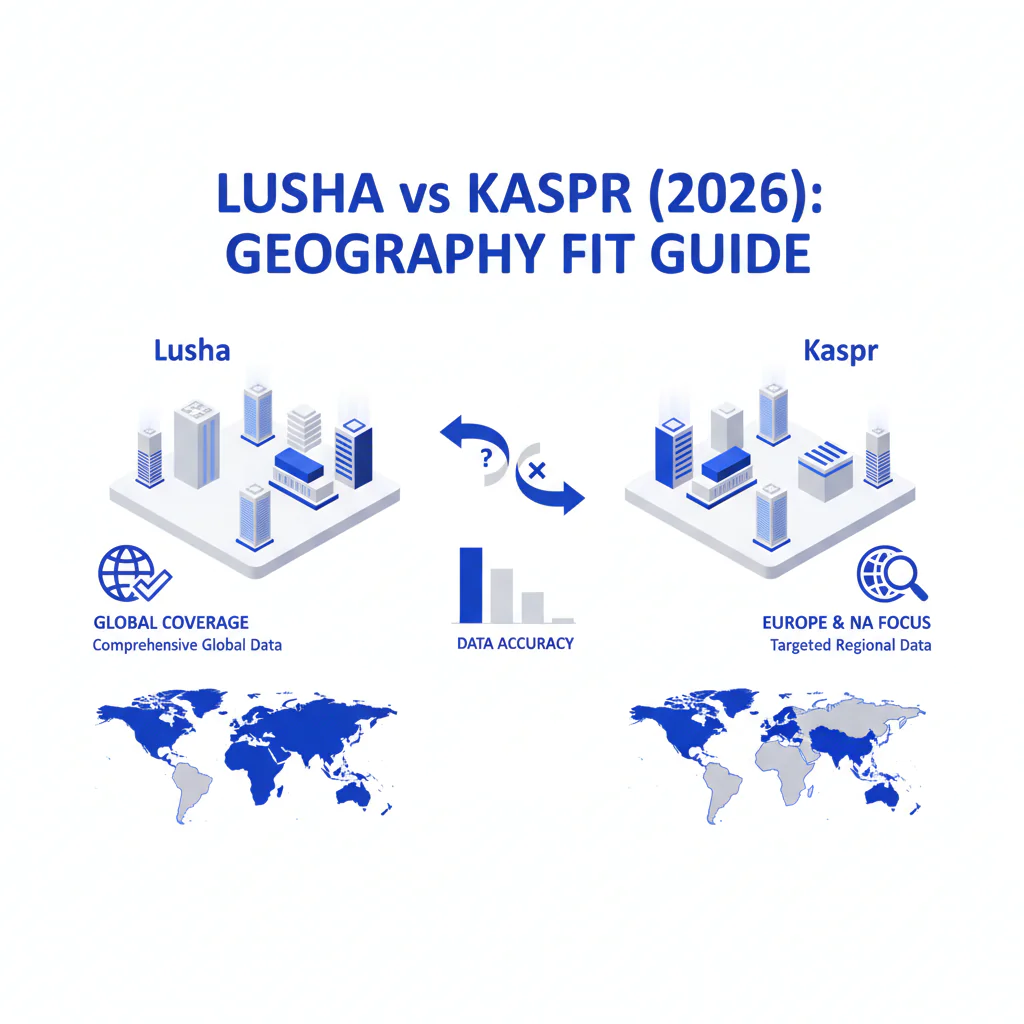
- If your EU prospecting is LinkedIn-first, validate Kaspr first; if you need broader enrichment outside LinkedIn across multiple regions, validate Lusha first. Do not treat either as “proven” until a sample test shows verified emails and reachable numbers in your target countries.
- Key Insight
- Geography fit matters: coverage varies by country, and the cost shows up as data decay, re-verification work, and CRM cleanup.
- Ideal User
- A team that runs a controlled evaluation, saves evidence, and refuses to scale a tool that creates recurring rework.
- Best for EU LinkedIn-first workflows (subject to test): Kaspr.
- Best for broader enrichment across regions (subject to test): Lusha.
Geography fit matters: evaluate coverage and compliance posture in your target regions, and test reachability with a small sample.
What is Lusha?
Lusha is a contact data tool typically evaluated for enrichment and prospecting workflows that extend beyond a single site. As a buyer, assume output quality varies by country, industry, and seniority until you test it on your own targets.
What is Kaspr?
Kaspr is commonly evaluated for LinkedIn-centric workflows where teams want to pull contact data within that prospecting motion. As a buyer, treat “works on LinkedIn” as a workflow claim, not a reachability guarantee, until you test.
Geography-fit framework: EU vs US without wishful thinking
Framework: geography-fit. Treat coverage as three outputs you can audit on your list: retrieval rate by country, reachability on first attempt, and rework burden when records are wrong. Results also vary by industry, seniority, and channel, so keep your sample representative.
- EU contact data: evaluate by country, not “Europe.” A tool can look fine in one EU market and fail in another, which turns into manual sourcing and inconsistent outreach rules.
- US contact data: a common failure mode is wasted dials and repeated re-checks as data decays.
For GDPR references, use the GDPR text and practical summaries and the European Data Protection Board (EDPB) guidance when you define lawful basis, notice language, and opt-out handling.
Integration audit notes (where pilots die)
- Duplicates: confirm whether enrichment creates new records instead of updating existing ones.
- Overwrite rules: decide which system is source-of-truth per field before you sync anything.
- Audit trail: ensure you can explain what changed, when, and why, especially for disputed outreach.
- Rollback plan: test with a small batch and prove you can revert unwanted updates.
Where buyers get burned (hidden costs)
- Credit leakage: if your workflow includes exports, retries, and re-checks, the unit economics shift. Map vendor charging rules to your weekly process.
- Data decay: stale emails bounce and stale numbers waste dials. If re-verification is painful, your CRM becomes fiction.
- Workflow mismatch: a tool optimized for a LinkedIn motion can underperform when you need list enrichment, and vice versa.
What Swordfish does differently
- Ranked mobile numbers / prioritized dials: when phone outreach is part of your motion, starting with higher-probability dials reduces wasted attempts and bad dispositions.
- True unlimited / fair use: teams that re-verify routinely can run hygiene without rationing checks, which reduces long-term CRM rot.
How to test with your own list (5–8 steps)
- Define the geography split (EU vs US, then key countries) and the job functions that drive pipeline.
- Pull a representative sample from your ICP: include hard-to-find roles and multiple seniority levels.
- Use the same workflow your reps will use (extension, web app, or API). Mixing workflows hides failure modes.
- Record retrieval outputs per record (email found, phone found, notes/flags).
- Verify emails using your standard verification approach and record pass/fail.
- Test phone reachability in a controlled window and record dial disposition (connected, wrong person, invalid, blocked, voicemail-only).
- Measure rework: which records require a second pass and whether the tool’s model makes re-checking expensive or slow.
- Save the evidence as a CSV for procurement: country, email_found, phone_found, email_verified, dial_disposition, recheck_needed, notes.
Checklist: Feature Gap Table
This table is a buyer’s ledger. It converts “features” into failure modes that create cost later.
| Audit area | Hidden cost | What to capture during your test |
|---|---|---|
| Geography fit (EU vs US) | Country-level under-coverage forces manual sourcing and extra tools. | Retrieval rate by country; highlight where your pipeline countries fail. |
| Reachability (email + phone) | Non-usable data wastes send volume and dials; it also creates complaint risk. | Email verification outcome and dial dispositions by country and role. |
| Credit model and re-check loops | Re-verification becomes a tax if your process requires repeated checks. | List actions that consume credits; map them to your weekly workflow steps. |
| CRM integration hygiene | Duplicates and overwrites turn “enrichment” into a cleanup project. | Sync a small batch; inspect duplicates, overwrites, and whether changes are auditable. |
| GDPR operational handling | Process gaps create regulatory and brand risk, regardless of vendor claims. | Document lawful basis, notice approach, opt-out mechanism, suppression list ownership. |
Decision Tree: Weighted Checklist
Weights are ranked, not scored. The ordering reflects standard buying failure points and the core fact: geography fit matters.
- Highest weight: geography fit by country — Wrong-country coverage is a structural failure that no onboarding fixes.
- High weight: reachability outcomes — “Found” is not “usable.” Measure verification and dial dispositions.
- High weight: re-verification friction — Data decays; if re-checks are painful, your CRM becomes fiction.
- Medium weight: integration hygiene — Duplicates, overwrites, and missing audit trails create downstream operational cost.
- Medium weight: GDPR operational fit — You need a documented process: lawful basis, notice, opt-out, suppression, retention policy.
- Lower weight: UI preference — Operators adapt; bad data and cleanup do not.
Troubleshooting Table: Conditional Decision Tree
This tree is meant to stop evaluation when you hit a predictable failure mode.
- If EU targets drive pipeline and one tool fails your key countries in the sample, then stop and reject it for poor geography fit.
- If dial dispositions show frequent wrong or invalid numbers, then stop and prioritize a provider that improves phone reachability in your target regions.
- If your workflow requires re-checking and the model makes re-checks expensive or throttled, then stop and re-evaluate total cost based on re-verification cadence.
- If you cannot document GDPR handling (lawful basis, opt-out, suppression), then stop and fix process before scaling any vendor.
Stop Condition: When any condition above triggers, pause purchase and remediate the failing condition. Otherwise you are buying rework.
Evidence and trust notes
- Freshness: Last updated Jan 2026.
- Evidence posture: This page avoids vendor performance claims because outcomes vary by list, region, workflow, industry, and seniority. The test plan is the control.
- Primary sources for GDPR: links point to GDPR.eu and the EDPB for baseline interpretation, not vendor marketing pages.
- What to keep for auditability: your test CSV, verification outcomes, dial dispositions, and a short internal note covering lawful basis, notice approach, opt-out mechanism, suppression list owner, and retention policy.
Internal references for deeper evaluation
- Use data quality criteria as acceptance gates so comparisons remain consistent.
- When standardizing vendors, align outcomes with Swordfish vs Lusha and Swordfish vs Kaspr.
FAQs
Which is better in Europe?
The better tool in Europe is the one that wins your country-level geography fit test with usable outcomes. Treat “EU coverage” as unproven until it holds for your target countries and job functions.
Is Kaspr GDPR compliant?
GDPR compliance is mainly your process: lawful basis, transparency, opt-out handling, and suppression lists. Validate the vendor’s documentation, then enforce your internal rules during outreach.
Is Lusha good for EU data?
It may be, but you should treat it as unknown until your EU sample produces verified emails and reachable numbers under your GDPR process.
How do I test coverage?
Split a representative list by country, run identical lookups, verify emails, test reachability, and record rework. Keep the CSV so the decision is repeatable.
What is permissible use?
Permissible use depends on lawful basis and outreach method under GDPR and local rules. Document purpose, honor opt-out, maintain suppression lists, and avoid secondary uses outside your stated scope.
Next steps (timeline)
- Today: select a sample list and define pass/fail gates using the geography-fit framework.
- Next 48 hours: run lookups in both tools using the same workflow and capture retrieval outputs.
- Next week: verify emails, run a controlled dial test, and summarize rework causes.
- Before purchase: review your GDPR process note (lawful basis, opt-out, suppression, retention) with the internal owner.
Primary CTA: Read Compliance Guide
Secondary CTA: Download the Geography Checklist
Compliance note
We are not a law firm. Follow GDPR/CCPA and local telecom/outreach rules; honor opt-out.
About the Author
Ben Argeband is the Founder and CEO of Swordfish.ai and Heartbeat.ai. With deep expertise in data and SaaS, he has built two successful platforms trusted by over 50,000 sales and recruitment professionals. Ben’s mission is to help teams find direct contact information for hard-to-reach professionals and decision-makers, providing the shortest route to their next win. Connect with Ben on LinkedIn.